Software
Houzz Logo Print
bardstownky

Clay soil help with plan

10 years ago
last modified: 10 years ago

I'm in Kentucky and just purchased a house and started in flower beds that are obviously clay. I tried the mason jar test and I can see some sand settle first then it all looks like light brown clay and I can't see layers at all when it completely settles. The beds have a few plants, rose bushes that seem to be doing ok even though my house faces north and doesn't get enough sun.

anyways, I'm rambling. I started by removing the old mulch to get the weed block fabric and Iaid new mulch before worrying about the clay soil. I'm sure I can plant and things would do ok but id like to have them do better then ok.

is there a way I can make my beds better without tilling or raising them too much? could I plant them and mulch them with compost/manure and grass clippings leaves then more manure and wood chips next spring? If this is a feasible option id prefer this over tilling.

I can buy a small tiller. If I did that I was thinking I could till In some manure now and dump grass clipping on them all summer and till again before fall then dump mulched leaves and till again in the spring and plant.

i know that was long but any help would be great. I have some bags of manure and can buy more. I also have good topsoil in bags and potting soil of they could be helpful.

since it is part sun, mostly shade I'll have lots of hostas, bleeding hearts and some boxwood a that are already planted in the back of the beds.

Thanks in advance

Comments (13)

  • 10 years ago

    If there are no distinct layers after all the settling is done you do not have a mixture of mineral in that soil. Keep in mind that sand, the largest and heaviest mineral particle, will be on the bottom, Silt, the next largest and heaviest will be above that, and clay the smallest and lightest mineral particle will be above those. If there is no sand or silt you will not see them.

    Above the mineral particles will be any organic matter, and that is what you are really interested in. If 4 inches of soil was put into the jar the math becomes fairly easy and to get about 6 to 8 percent organic matter in the soil this test should show 1/4 inch of organic matter at the top.

    To start you really need to get some organic matte into that soil and tilling is the best method. Once the soil has been well amended then the gardener can consider no till. While tilling does disrupt the Soil Food Web it does not destroy them and if the soil you have now has little to no organic matter they will not be there anyway. Work whatever organic matter, compost, shredded leaves, grass clippings, and any other vegetative waste you can.

    Clay soils tend not to drain well because the soil particles fit very close together and do not allow water to flow very well. Organic matter will separate those particles and open up the soil to both air and water much better than anything else.

    Before adding something like lime have a good reliable soil test done to see what, and if, any really needs to be added since excess amounts of Calcium can have adverse affects on plants as can excess amounts of any nutrient. In addition these simple soil tests may be of some help.

    1) Soil test for organic
    material. From that soil sample put enough of the rest to make a 4 inch level in
    a clear 1 quart jar, with a tight fitting lid. Fill that jar with water and
    replace the lid, tightly. Shake the jar vigorously and then let it stand for 24
    hours. Your soil will settle out according to soil particle size and weight.
    For example, a good loam will have about 1-3/4 inch (about 45%) of sand on the
    bottom. about 1 inch (about 25%) of silt next, about 1 inch (25%) of clay above
    that, and about 1/4 inch (about 5%) of organic matter on the top.

    2) Drainage. Dig a hole
    1 foot square and 1 foot deep and fill that with water. After that water drains
    away refill the hole with more water and time how long it takes that to drain
    away. Anything less than 2 hours and your soil drains’ too quickly and needs
    more organic matter to slow that drainage down. Anything over 6 hours and the
    soil drains too slowly and needs lots of organic matter to speed it up.

    3) Tilth. Take a handful
    of your slightly damp soil and squeeze it tightly. When the pressure is
    released the soil should hold together in that clump, but when poked with a
    finger that clump should fall apart.

    4) Smell. What does your
    soil smell like? A pleasant, rich earthy odor? Putrid, offensive, repugnant
    odor? The more organic matter in your soil the more active the soil bacteria
    will be and the nicer your soil will smell, to a point. Too much organic matter
    can be bad as well.

    5) Life. How many
    earthworms per shovel full were there? 5 or more indicates a pretty healthy soil. Fewer than 5,
    according to the Natural Resources Conservation Service, indicates a soil that
    is not healthy.

    kimmq is kimmsr

  • 10 years ago

    Thanks thanks for the answer, I had very little organic matter floating after the soul test. It was actually surprisingly clear with almost nothing floating. I'll do another test and take pictures and post them later so I can get better opinions.


    When I first done the mason jar test I could see black and white sand looking particles settle first but it all turned dark peanut butter colored after 24 hours and I couldn't see layers anymore.

  • 10 years ago

    The only thing outside of the advice given, is curiosity concerning your experience using grass clippings as mulch. I too have clay soils, and yes, layering on top of the soil can work, but as the others have said, turning OM into the soil is quicker. That said, be careful with the grass clippings. If you don't mix them with something - leaves, wood chips etc... - even a 2" - 3" layer will 'mat' and can become temporarily detrimental, especially with water not being able to easily flow through the mulch.. There can be a similar problem with whole leaves.


    If you have enough leaves, shred them up a bit (you can use a lawnmower, or if they are dry, just your hands) and mix them together with the grass clippings. If you do toss on just grass clippings, try to not add any more than an 1/2" to 1" at a time. If you have more, start a compost pile for next year's use.


  • 10 years ago

    Right now there's only a few rose bushes and small boxwood in the bed. The majority of the beds are unplanted. I plan to keep them that way until next spring to make tilling easier.


    The plan unless suggested otherwise is

    Remove newspaper and woodchips

    spread a couple inches of compost/manure over the beds and til as soon as the ground dries out some (heavy rains recently)

    then lay grass clippings over the beds and till towards the middle/end of summer. Maybe twice.

    In the fall I would mulch and bag the leaves and spread over the beds til spring next year when I would add newspaper and woodchips back on the beds after planting.

    If this sounds good and no one has anything to change that's the plan as of now.

    I might add gypsum but I haven't found it locally at lowes or the one nursery near me.

  • 10 years ago
    last modified: 10 years ago

    "Remove newspaper and woodchips..."


    I wouldn't be afraid of wood chips. You should rake them back, add your mulch, till, and return them to the top of the soil. When you toss your grass clippings on (in between your tillings,) use your rake to mix the clippings into the wood chips. Wood chips, especially around perennial beds, make an excellent mulch product. Insects and worms love the protection and aeration they provide... as well as the food and a host for beneficial fungi. A caveat might be that some people say they will attract termites. That is partially true. They don't 'attract' termites. but if they are kept moist, and termites happen to find them, they can make a home. So, especially if it stays moist a lot from shade, keep them away from any wood that might be on your house (that includes sheathing.)

  • 10 years ago

    I plan to keep the wood chips, I removed the old because it was easier that way to get a majority of weeds and the fabric. I have more chips on now and plan to put them back on next spring. I just would rather til the grass and leaves directly into the soils and not have to take my woodchips back every time. Thanks again for the help, keep it coming.

  • 10 years ago

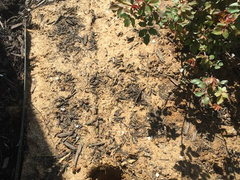
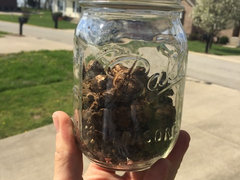
    Just a couple pictures incase it helps. Some of the ground and the dirt in the jar for the sample. I did try to break it up more but it was difficult so I had to shake it a while. I'll post more when you can see some heavier stuff settle then another after its all settled.


  • 10 years ago

    If it were me - and I did exactly this a few years ago starting about May - I would avoid/remove any landscape fabric and pile on whatever ground up leaves, grass clippings(I'd compost them some first), and other organic cover material I can find. The mulch should do most of the work, but keep any sprouting weeds from going to seed(get them out of there). In the fall, after the soil has had a chance to mellow with all the organic material on top, and as all the new leaves start falling, dig everything that's there into the soil, stirred in as deeply as you are able. If you want to use mechanical equipment, that's fine, but I tend to just use a mattock and do it in little bits at a time. All the new fall leaves can then be ground up and put on top of the soil again as mulch. In an established landscaping bed, doing this once may be enough, just reapplying leaf mulch each fall and winter. In my vegetable garden areas, I stirred the ground leaves in both the fall and spring the first couple of years. Yes, it required some extra fertilizer, particularly nitrogen, to compensate for the active breakdown of organic matter the first couple of years, but now at year three I can work my hand down into the soil as much as a foot (was like concrete), and all I need to do is push aside the fall applied mulch to plant this spring. Very nice.

  • 10 years ago

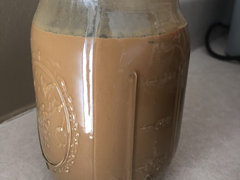
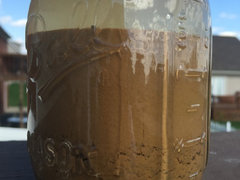
    Couple more picture, this is after only an hour or so but it's clearly settled because the clearing water on top. This sample however you can see some different layers atleast.

  • 10 years ago

    If you search this forum for 'clay soil' you'll find a lot of folks who have dealt with exactly this problem: tight heavy clay with low organic matter, poor drainage, etc.

    IMO the best approach is to till in a heavy load of compost immediately and if it's a perennial bed (not a veggie garden) obviously you can't do that every year after you plant. So mulching thickly with compost and/or degradable stuff as mentioned above - leaves, grass clippings, shredded yard waste - every year will allow the soil food web to incorporate more organic matter and lighten up the soil structure passively. But it takes time, hence the big load of compost at the beginning.

    Don't walk on it if you can help it.

  • 10 years ago

    Ok I have mixed in a good deal of compost/manure and I'm ready to start with my plan of grass clippings on top. My problem is my grass has weeds, dandelions, crabgrass, clover. Alittle of everything. Wouldn't bagging that and spreading in my flowerbeds just promote weed growth?


    What at if I put the clippings in a black trash bag in the sun for a while, would that kill the weed seeds? I don't have a compost pile yet and would like to use the clippings as mulch til I lay woodchips after the fall.

  • 10 years ago
    last modified: 10 years ago

    "Weeds" in lawns are not a problem unless they have seeds. Before they can have seeds they need to have flowers, blossoms. No blossoms, no seeds.

    Putting the lawn clippings in a black plastic bag might, after several weeks, kill any "weed" seeds there are but will also kill the organic material. I did put quack grass, roots and all, in some black plastic bags because I was told it would kill that grass.
    It did not and the grass grew and punched holes in the plastic bags. Just put the lawn clippings on the garden and deal with any "weeds" as they appear.

    kimmq is kimmsr.