Software
Houzz Logo Print
mattp321

DC-area camellia

10 years ago

Posted this in the camellia forum the other day but i know this forum is more active.

anyone growing "camellia x high fragrance" successfully around here? The tag on it says "zone 7" but when I google it some sites are listing it as zones 8-9. If it's just going to die id rather return it now.

i purchased it about 50 miles to the south of here so I'm not sure.

thanks!!


Comments (15)

  • 10 years ago
    last modified: 10 years ago

    Most of the camellia collection at the National Arboretum was killed off by a sequence of hard winters awhile back - so the climate there can sometimes be murder on camellias. If you are disinclined to gamble on repeat performances of punitive weather events during the life of your planting you may wish to seek out known extra hardy kinds.

    http://www.usna.usda.gov/Newintro/camelli1.html

  • 10 years ago
    last modified: 10 years ago

    Cheers for that - the oleifera hybrids won me over to camellias - they seem to possess a sort of innate grace that the Japonicas and Williamsii types just don't have. I have never grown them myself, living in chalklands but fondly recall my Lancashire upbringing (along with rhodies)...still crave an anomalous little variety - Cornish Snow.


  • 10 years ago

    Camellia x 'High Fragrance' would probably be a challenge some years. Siting would be key. Winter shade and protection from strong winter winds. Then you might have a chance.

    But there are many hardier varieties out there.

  • 10 years ago

    playing the zone pushing game.. can be very expensive .. sooner or later.. ma nature insists on winning ...


    and it appears.. that you dont want to play that game.. so return it ...


    ken

  • 10 years ago

    Dave,

    do you have any suggestions for hardy varieties that are fragrant? Looking for one fall and one spring bush. 5-6' wide and up to 10' tall is fine.

    fragrance is a dealbreaker for my wife, which I think is crazy but you know...

    I know they exist especially in the fall because we walked through the arboretum and there were some great ones, including one that smelled like a freshly baked cake.

    but you know how it goes, you forget to make notes of the exact names as you're going around, and/or then you can't find anywhere to buy them later!

    thanks for any tips!

    site gets morning sun then shade the rest of the day - north side of house.


  • 10 years ago

    Ken,

    maybe I can bury some of those electric heating cables all around my yard and plant a grove of coconut trees or something! Now that would be epic.

  • 10 years ago
    last modified: 10 years ago

    Well, go for it, but morning sun is very hard on camellias...even the 'hardy' ones. Fragrant camellias are hard to find for zone 7a. Keep in mind the Arboretum is about 3 degrees milder than the rest of the DC burbs. Makes a difference. Just sayin...

    For fragrance I'd consider other plants -- if you are partial to broadleaf evergreens, then Eleagnus pungens, Osmanthus x fortunei, Osmanthus heterophyllus, Osmanthus x burkwoodii are especially noteworthy.

    Of course in deciduous shrubs, many of the Viburnums are fragrant.

  • 10 years ago
    last modified: 10 years ago

    Morning sun sounds like an eastern exposure, which is not favorable as you don't want sun hitting the flowers in particular while the tissues are still frozen. This is a factor with many broad leaved evergreens and not just camellias. For instance during a sharp winter here the Viburnum davidii foundation planting on one side of the store at a local garden center turned brown - and as soon as you went around the corner, to a different exposure the plants remained intact. There was actually a burned up plant and a ~pristine one a few feet (or less!) apart from one another, at the building corner.

    Asian montane species from monsoonal climates may typically spend cold periods insulated by huge snow dumps, not be adapted to Arctic conditions - where the tops are frozen and directly exposed to frigid winds, rapidly thawing sun rays. Even for use in USDA 8 Sino-Himalayan plants often have to come from above 10,000 ft. or so before reliable hardiness starts to become a possibility.

  • 10 years ago

    It's a north-northeastern exposure we could say, so depending on the time of year the sun/shade patterns differ a bit due to the latitude.

    i was planning on throwing a large oak leaf hydrangea to the eastern side of the camellia location, which would give it even more morning shade at least in the summer.

    i assumed the sun was actually more dangerous to the camella in the summer when it's stronger... Very interesting that it's actually the winter morning sun which is problematic... Maybe I need an evergreen shrub instead of the hydrangea... Hmm... Mountain laurel maybe?

    dave- this would be near the brick house, so that might help with the temp.

  • 10 years ago
    last modified: 10 years ago

    Morning sun is a problem for camellias in zones 7a and colder, because the when ground is frozen (often quite deep), and the sun hits the leaves, it causes the leaves to warm and lose moisture. The plant is unable to draw up any moisture due to frozen roots, so the leaves dry up (burn). It's not uncommon to see a plant burned only on the East or South side, while the north side is pristine.

    Camellias planted on the West side of a house do much better. By the time the sun hits them, usually the soil has thawed a bit.

    In the South in zones 8 and warmer, afternoon sun will be too hot for them, so they will recommend shade in afternoon and morning sun. But here in the East/Mid-Atlantic, the opposite is better.

    If you could plant something that will shade it in winter in the mornings, it would benefit. But it would have to be quite high and outgrow the camellia.

    Or, you could wrap it with a semipermable (breathable) frost cloth in winter -- tho that's not a very attractive option.

  • 10 years ago
    last modified: 10 years ago

    Anywhere there are frosts at flowering time camellia flowers warmed quickly by morning sunshine will go brown - even when the leaves of the same kind will not be affected. Multi-hour full sun exposure at any time of the day may perhaps also damage the flowers of early blooming cloud-land trees and shrubs even without hard frosts having occurred - as is often the case at this time of the year here toasted looking (partly light brown) camellia and magnolia flowers are everywhere right now, during the current period of summer like afternoons we are having.

  • 10 years ago

    hi mattp321, Green Spring Gardens has their plant sale May 14. The camellia society usually has a booth there with many knowledgeable people.


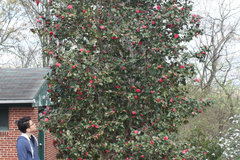
    Here is the 'Variety Z' that I mentioned in another thread. I took this pic today at the Nat'l Arboretum. It has never been known to suffer winter damage. Sorry, no fragrance.

  • 10 years ago

    Sam I'll be at that plant sale - 5 mins from my house... It's my wife pushing for the camellia... Gonna be next to impossible in my sunny yard I guess... Going to just plant these and when they die replace them with a oakleaf hydrangea or something. Or maybe one of these Carolina cherry laurel seedlings I have going.

  • 10 years ago
    last modified: 10 years ago

    Sam, will you be there again? I live about 10 minutes away. Hope to be there too! Maybe we should set a time and chat? Got any extra Variety Zs or Anacostias?