

Containers and fertilizer- help??
Hi! This is the first year I've ever tried to grow anything. I planted seedlings in the little jiffy pods and plan on moving them into pots with drain holes down the road. Herbs, spinach, broccoli, and carrots.
Here's the problem. I did some basic reading/YouTube surfing and initially learned that growing veggies in 5 gallon buckets just required potting mix. Maybe some soil mixed with compost.
WRONG? Well, I've been reading some more tonight and let me tell you, my head is spinning! There are SO MANY suggestions/opinions/methods out there that I'm completely lost. Everything from adding fungus and worm castings to seaweed and various teas and "Al's mix" and I am completely lost. People keep saying you can't use organic fertilizers in pots unless you infuse microbes and then others say you can.
I had no idea it was so complicated. After much reading I now understand why plants need certain nutrients and why they can't digest certain things without microbes but still, everyone uses different things and I'm an overthinking/never-doer so the simpler, the better.
Please- someone tell me exactly what I need to put in my buckets and pots to see my plants bear fruit. If it comes in a pre-packaged mix, that helps a lot. Just give me a nice little list- 1)... 2)... 3)...
Comments (21)
Cassie Blue
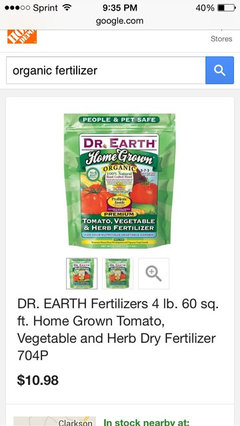
Original Author10 years agoCan I just use organic potting mix and throw some of this in there and leave it be for the season? It says it has microbes so then I should be able to use some organic liquid fertilizer every couple weeks right?
 10 years ago
Cassie, yes that is a good choice. My experience with Dr. Earth products has been very positive. I understand your confusion. These sites try to make everything complicated when gardening is really common sense simple. There is a difference if growing in pots vs in-ground. Pots need a well draining mix and not soil and require fertilizing and water management. They dry out quicker and don't have the ground to search for food. Just don't use any kind of soil in a container. Use something specific to containers which will be labelled on the bag. Use the search function for container gardening will give you some good advise. Good luck Cassie!
Related Professionals
Bainbridge Landscape Architects & Landscape Designers · Lexington Landscape Architects & Landscape Designers · Harrisonburg Landscape Architects & Landscape Designers · Waterbury Landscape Architects & Landscape Designers · Brainerd Landscape Architects & Landscape Designers · Middletown Landscape Architects & Landscape Designers · Logan Landscape Architects & Landscape Designers · Charleston Landscape Contractors · Brooklyn Landscape Contractors · Colorado Springs Landscape Contractors · Hilo Landscape Contractors · Frisco Architects & Building Designers · Roanoke Architects & Building Designers · Kenosha Architects & Building Designers · Tacoma Architects & Building Designers 10 years ago
The problem with the above advice is that Ma Nature does not grow in containers with a soil-less mix :-) In theory, that all should work but in reality it does not. Growing in a container is completely distinct and carries vastly different requirements than growing inground and you cannot superimpose one practice on the other and expect to have similar results.
To be honest - and I've got some 30 years of container growing under my belt to back this up - it is pretty hard to over-fertilize a container unless you do not follow label directions. The frequency of watering all containers require provides for significant nutrient leaching, so frequent fertilizer applications are advised. Generally the recommendation is "weekly, weakly" or a liquid fert mixed at half strength applied once a week.
By all means stay organic if you prefer but with the understanding that you may not be maximizing your growing and fruiting potential with this philosophy. At least with container growing :-)
- 10 years ago
I won't argue with you - we can just agree to disagree :-) btw, there is a whole lot more than than just 30 years of doing this behind my advice. I am a degreed horticulturist and a consultant plus I teach classes on a wide range of gardening topics, including container gardening. The lack of efficiency in using organics in a container environment is very well documented despite all manner of opinions to the contrary. I'm not at all sure why one would want to minimize the differences between inground gardening and container gardening unless it was just an issue of not needing to make any extra effort. If that's the case, then why bother with containers at all??
There can be as many as a billion microbes in 1 gram of garden soil. You will never get close to those population levels in a soil-less potting medium. So exactly how well will your dry organics be metabolized and converted to plant accessible forms if the required microorganisms are just not present or present in far less than ideal populations? Adding organic matter to your containers is NOT the answer as it will only serve to interfere with drainage and porosity, two absolutely essential elements to successful container gardening.
It is simply a matter of having your cake and not being able to eat it too - you can't have it be the same.
 10 years agolast modified: 10 years ago
If you want to stay organic in your containers, then I personally would follow gardengal's advice about mediums and look into organic soluble fertilizers. Whether you agree with the politics or not, cannabis growers have really pioneered innovation, and there are a lot more products now available than in the past. The problem is that while not exorbitant in most cases, they are not nearly as inexpensive as the synthetics.
I'm not saying that other people are incorrect in their advice - there are many ways to garden, and if it works for you... keep going - just keep an open mind.
BTW... adding mycorrhizal fungi to containers is pretty much a waste of time. Most products contain just 3 or 4 types, and each plant species is host to its own fungi. Besides which, they are delicate, and might be dead in the packaging if not handled, shipped, or stored correctly.
 10 years ago
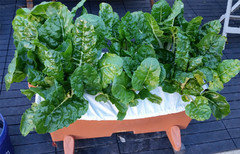
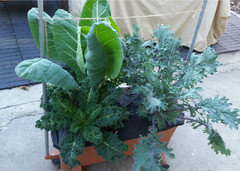
@Cassie Blue, I grow a lot of organic veg year round in EarthBoxes, which are self irrigating planters (SIP). They are basically self watering, sealed containers. The Dr Earth Tomato & Veg is what I use as fertilizer in my EBs. I grow toms, cukes, zucchini, greens, melons, you name it --in them.
So while others want to talk about their theories and foregone conclusions, I can tell you that organic fertilizers such as Dr Earth's, with water insoluble nitrogen work very well in pots (in my case SIPs). I do not add any liquid fertilizers to my EBs.
EB organic Swiss Chard:
EB organic kale:
EB organic toms:

I could post more, but I think you get the idea. :)
- 10 years ago
I grow blueberries organically in regular pots using Dr Earth Acid Lovers formula fertilizer. You can read about them here: http://forums.gardenweb.com/discussions/3783754/blueberries-2016?n=8
It's interesting that some people allow their theories and foregone conclusions to overshadow the fact that there are other ways of doing things. At the end of the day plants could care less about our accolades (real or perceived). They will thrive if their needs are met, regardless of the method.
- 10 years ago
"It's interesting that some people allow their theories and foregone
conclusions to overshadow the fact that there are other ways of doing
things."That has very little to do with the issue. It is a matter of science and has nothing to do with theories or foregone conclusions. But I am not going to argue with those that insist that doing it their way will work. Yes, it CAN work but it is matter of degree. If one opts to follow a preconceived growing philosophy despite whatever science and soil biology may indicate is a more efficient path, then so be it. Yes, they will thrive if their needs are met but science has dictated that in a container setting, their nutrient needs are more completely and efficiently met by using a water soluble fertilizer. And that eliminates 99% of the organics.
- 10 years ago
It's really just a theory when you have no direct experience growing anything organically in a container. Have you even tried it? This is an organic forum and we can help you learn how to do it. I do it every day of the year, and I harvest fresh veg every day of the year. It works really well.
Please post a picture of some veg that you've grown in a container using whatever science you feel is appropriate.
 10 years agolast modified: 10 years ago
Thank you MrClint, You have more patience than I do. I removed my posts, tired of dealing with their Pseudo Science, Lack of Knowledge, Resistance to Using New Techniques,and Non Empirical guessing. Many make reference to research, with no links. A picture is worth a thousand words. I was going to leave the Forms, but seeing some quality posts gives me hope. Coming from a Science and Physics Background, I see many errors in quote" Based on Science" Statements. Thanks Again, the human mind can have great inertia to change.
- 10 years ago
"This is an organic forum and we can help you learn how to do it."
What an incredibly patronizing response!! Do you think I am a beginning gardener that needs guided instruction and hand holding? In addition to being a garden educator - I teach container gardening classes - and horticultural consultant, I have gardened professionally (for other people/paying clients) for years. I am exclusively organic in my inground gardening but have determined that I am not maximizing the potential of my plants if I attempt organic methods in a container setting.
The science is simple. Dry or granular organics are not water soluble and require the activities of soil organisms to break them down and convert them into plant accessible forms. High quality potting soils do not have sufficient quantities of these organisms to accomplish this thoroughly and efficiently and lack the organic matter necessary to support them long term. Even infusing limited populations into the mix via inoculated soil mixes and/or fertilizers still does not achieve the vast populations necessary to accomplish this transition. It doesn't even begin to come close!
So you have a choice. Adhere to organic principles and fail to deliver to your plants a full range of nutrients in the quantity and with the frequency/availability they demand to maximize growth and production. Or recognize the deficiencies inherent in this type of approach and use a water soluble fert with a full range of trace elements and maximize the plants' potential.
- 10 years agolast modified: 10 years ago
" Pseudo Science, Lack of Knowledge, Resistance to Using New Techniques,and Non Empirical guessing."
LOL!! Pseudo science - that's great! Exactly what is pseudo-science about how organic fertilizers are activated and assimilated in the soil? The science is indisputable. And then make the logical (and scientific) transition of the use of organic ferts in that of a closed environment - not exposed to natural soil and with restricted drainage - and the soil-less media and the lack of decomposing organic matter in a container setting. It is NOT the same.
You know, there is a lot of less than subtle sarcasm and finger poking going on here with the "it must work because I do it" explanation but with little demonstration of the science behind that mindset. I have explained why it doesn't work well - please enlighten me on how and why YOU think it does. Scientifically....not just photos of plants you have grown. Have you compared the production of the same plants grown in containers using both methods? Have you evaluated their nutritional content? Are they the same? Prove it to me.
FWIW, anything can be grown successfully in a container for a single season, in virtually any kind of medium and with any kind of fertilization. Or even without any fertilization at all. Plants are tough and can survive and reproduce with very little human input or with outright bad input. But try it long term or for more than a single growing season and you will clearly see the difference.
- 10 years agolast modified: 10 years ago
This was a general overall observation on all the Forums, not directed to individuals. All members have experience and knowledge also. Many have results that contradict the statements against Organic Container Culture and other posted topics. There are disagreements among the researchers themselves on this topics. These have observations, test results , and empirical measurements. Agree lack of Patience with people who don't understand the meaning of info or don't even bother to read post accurately is a personal limitation, As I stated no links, detailed controlled tests results given by those making claims against Organics. I just like quality and open info, not everything that fits other's beliefs. Not listen to me I am an expert, plus throw out a few technical buzz words or jargon. Forget egos everyone makes errors learns, and improves from the them. Even the PHD's vary in quality, and honesty. We used to call PHD "Piled Higher and Deeper". The soil scientists are learning new things constantly, that have changed previous thought. The whole interest in Mycorrizhae and BioChar is fairly recent. Debating is a waste of time without the exchange of Data, Test Parameters, and Measurements.
Sidenote Addition: Someone showed 2 plants one organic dry fertilizer and one fertigation. Stated liquid plant larger than other. But failed to mention the plant received 1 1/2 to 2 times more Nitrogen than the other in the application. Parameters are important. In addition a portion of dry fertilizers are water soluble, and listed on the labels.
Addition 2: Science is not only a collection of Knowledge.
It is also a methodology for collecting data and experimenting as new
information becomes available. It is not defending Dogma or current Paradigms A
serious investigator will adjust, and look into new information or Phenomena . Not dismiss things immediately . This is what
I mean, some call it Scientism. Just
overall disappointed with the Forums, with a few exceptions. I see people attacked and ridiculed because
they do things different. The term I am doing it means it is currently in practice and is empirical , Theory is just an idea or thought without implementation. As far as Fertilizers, one can use both Dry Fertilizers as the base maintenance amount, supplemented with Fish emulsion or Other soluble Organic. Doesn't have be to either or. This is common practice in Non Organic Methods with a CRF Base amount, with supplemental ferigation. Organics usually start a little slower , but catch up after a short period, just have to keep it sustained afterward. This can be done with small frequent amounts of Dry Fertilizers also. Some Organics can act quickly, and can burn plants if too much is used (ie Bloodmeal, Sulphate of Potash). The solubility of Rock minerals is increased by acids, either natural or manufactured( ex. Superphoshate, Rock Phosphate treated with Sulfuric Acid). A person can share information, personal results, and techniques. But an Individual must prove things to themselves, it is difficult to impossible to be done externally.It is found that soil life can vary greatly with locations, and climates. All this food for microbes from OM is interesting since most soils contain 2% to 5% OM at best. Plus limited to the topsoil. Soilless mixes range from 50 to 75% OM, microbes multiple quickly when conditions are good so numbers are no problem.
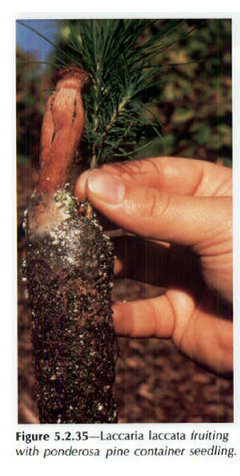
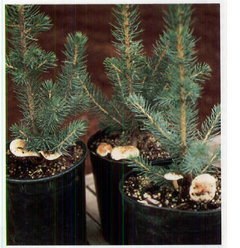
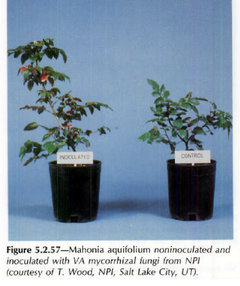
A Few photos of the Mycorrizhae Flourishing in Containers: Some with Mushrooms or Puffballs, fruiting bodies of the Ecto Mycorrizhae ( Pines, Oaks, plus others). Spores are wind or water spread. But Endo or VAM ( not visible )used by majority of plants,must be added via spores in some cases on disturbed areas or sterile media. VAM fungi is seen to spread from undisturbed areas about 3 to 6 feet a year. VAM fungi is also spread by animals( gophers and other burrowing animals). Containers were inoculated via water during irrigation. The fungi live in and on the plant roots aiding the plant in getting water and nutrients form soil and mulch surface layer. They will will go dormant to survive stress. Photos and Data from Container Tree Nursery Manual, Communication, and Data received from Tom Landis USFS Nursery Specialist. No problem with temps affecting the fungi, just try not to disturb the hyphae as little as possible. Many Growers culture their own with host plants, then let media slowly dry. The media and roots are chopped and used as inoculate. The collection of soil from native habits or burying rice in mesh bags or stockings in the ground for several months has been used also for fungi and microbe starter cultures. Pulverized mushrooms in solution is used for Ecto type also. Alliums like onions are heavy VAM users, and often used as culture plant in combination with grasses, and Legumes. Some Plants species don't have root hairs, and depend on Mycorrizhae.
 Pro Mix Video Links on Mycorrizhae in soiless medium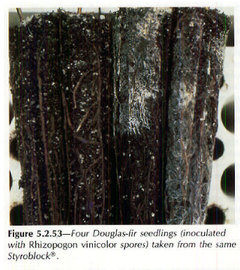
https://www.youtube.com/watch?v=kIecCXp4XUs
https://www.youtube.com/watch?v=4V1OEMoNELY
https://www.youtube.com/watch?v=s22yZ_qPR3U&nohtml5=False
https://www.youtube.com/watch?v=gq59LM99QNU&nohtml5=False
Groasis Water Box Vegetable No fertilizer Mycorrizhae trials in ground.
https://www.youtube.com/watch?v=WXycR9zmPFY
https://www.youtube.com/watch?v=eVuxEZ9BH0o&nohtml5=False
- 10 years agolast modified: 10 years ago
Plants don't care if we're the Queen of England or Bill Nye the Science guy. They simply have needs that must be met in order to fruit, produce leafy greens, roots or whatever it is that we want from them. The last thing on my mind is to try and talk anyone into or out of anything. Organic container grown fruits, veg, herbs, and flowers work very well for me. I've grown conventionally and prefer organic by a mile. This morning my wife and I had organically container grown blueberries and strawberries on our french toast.
dale92539 SoCal Zone10b(9), this forum can be whatever we want it to be. :)
- 10 years agolast modified: 10 years ago
Just some misc Information That came to mind, that might be helpful. Any Good books on Organic Gardening with general theory, and what materials supply which nutrients is helpful. As far as fertilizer amounts, the original Bio Intensive Method called for 0.5lb-0.6lb-0.5lb of N-P-K per 100sqft on poor soil per crop( about 4 to 6 mo). This equals approx 100ppm N. This is a good starting point for monthly applications in a container, because of leaching of nutrients. This is about 1 to 2 TBS per Gallon Soil Mix of any organic fertilizer of 4 to 6% N. As one gains more experience single nutrient sources are used, creating your own fertilizers. For background reference only ,I have been a Organic Gardener for about 43 years started with the work of John Jeavons and Alan Chadwick in mid 1970's. They were the founders of the Bio Intensive Method. The Dr Earth Products have shown good results, and have high quality ingredients. Read and Learn about the inoculation of Legumes with Nitrogen Fixing Bacterial. It is also a good idea to let you water sit about 24hr for chlorine to dissipate, before using. Especially if you are making Nutrient teas from it. I know this scattered info, but I hope it is helpful. I have not helped beginners that much, so I don't know what they want to know. or what previous horticultural knowledge or experience is acquired. Just getting to old to dig any or garden any more :-)
Addition: Fertilizers are applied based on weight. The dry fertilizers can range form Sp 0.6 to 1.2. So volume based applications such as tsp,TBS, or Cup. Should be adjusted according. Based on Sp=1 the density of water a tsp is about 1/6 oz or 5grams, and a TBS is 1/2oz or 15grams. Most dry Organics are about 0.67, so increase the volume amount by 1.5 times.
Irrigation methods vary from subirrigation( from the bottom or capillary), or from the top( drip, watering can etc) . I use the top irrigation with scheduling from both gravimetric or weight based target points and plant appearance. This is based on the amount of water lost from the container. Some use time intervals, derived form weight data ,experience or plant appearance. Drought stress can cause more problems with Vegetables than other plants. Causing them damage, or switching to flowering and setting seed prematurely.
Addition 2: about 20 years ago became intrigued when a couple volunteer tomato plants came up away from the garden. The plants did as well without all the extra care recieved in the garden. So currently interested in no till,natural based food forest systems and permaculture. A No Gardening Self Sustaining Food System. Just walk around and pick a few fruit and vegetables as needed. It seems the less you disturb the soil, the better the results.
Misc Information
The Groasis Water Box and similar hold great promise in Wild Land Restoration, Reforestation,and growing in extreme climates. I included the Groasis, because variations or other wick irrigation devices can be applied to containers. Some Videos
https://www.youtube.com/watch?v=vJCCXaIz3xc&nohtml5=False
Uses wick Irrigation, hold a years supply of water, 50ml per day (10tsps/day). Collects Rain water and Condensation to refill. Condensation Collection surface based on the Lotus Leaf.
Groasis Technology explanation of capillary water transport
system in the soil https://www.youtube.com/watch?v=afuN4P_VFtE&nohtml5=FalseAnother system is Larry Hall's Rain gutter system, which uses capillary irrigation,5 gal buckets, or Grow Bags. He was placing 6 months of fertilizer at one time on the soil surface. The nutrients are gradually being transferred to the roots without fertilizer burn. This may be capillary migration or Mycorizzhae or both. His system and variations are becoming very popular. Many discoveries come from creative people that don't know you cant do something. I have respect for the many pioneers and creative spirits. They are the future. A few Misc Videos.
More food with less water, use mycorrhizae (fungi), grow
with Groasis Waterboxx Trials 1-15https://www.youtube.com/user/GroasisVegetables
Quick Summary
https://www.youtube.com/watch?v=U5qzmqyBx48&nohtml5=False
Dr Earth Videos
https://www.youtube.com/watch?v=GOZp89kXOlg
Make Fertilizer Teas
https://www.youtube.com/watch?v=9mFHTxHkKZY
Dr Earth Q and A
https://www.youtube.com/watch?v=7dGXFs5wLzc
https://www.youtube.com/watch?v=fEd188SLllM
Misc Conversions:
oz per cuft is equivalent to grams per Liter, 1 Quart is 0.95 liter
100sqft is 50cuft for 6in Depth
1 in water is 0.623 Gallon per sqft
Nutrient applications for N for 100sqft(50cuft) High 0.5lb, Med 0.25lb, low 0.1lb
@Sp=1 1tsp 5grams 1TBS 15grams, 1 cup 48tsp or 16 TBS
lbs per acre/2= ppm
- 10 years agolast modified: 10 years ago
Sidenote MrClint, There was a post in the Container Gardening Forum looking for help with Blueberries in Containers. He wanted to know about fertilizing. Since you are raising Blueberries.
- 10 years agolast modified: 10 years ago
Basic Test to see the Fertilization methods you like.
People can make a test for themselves to compare which they
like better. Also if it gives enough difference to worry about which Organics
they use. Start with (3) 16oz
plastic cups. Make 4 or more drainage holes in the bottoms of the cups with a
sharp object nail or awl. Use a 6 pack of the plants of your choice marigolds,
vegetables, or other. You can use whats on sale. Use the Potting soil of your choice to plant
each of the cups with 1 plant. One cup is the control, with no fertilizer at
all. The other 2 cups , one is fertilized with liquid organic, the other with
dry organic try Dr Earth for this. Water each at the same time as needed. But
for the watering of liquid organic cup use the nutrient solution for that
watering at the intervals you will be
using. You must be accurate that the dry
Organic cup gets the same about of nutrients applied that the fertigation cup
will receive or the test will not be valid. For a start let each cup receive 100ppm
N per month or 0.1mg N per liter per month.
Observe the plants for 2 to 3 months for results. After you transplant
them in the garden if you wish.Nutrients per volume
of 16floz (473ml )cups for 100ppmN and Water Holding Capacity of approx. 65% avg for Potting Mixes( used for Liquid Fertigation amount reference).Calculation Error: Fertigation Amount is once a week at 65%WHC of 12oz or a total
of 4*0.65*473ml= 1230ml solution per month . For 100ppm N per month the
solution must be 100e-6*1230ml= 0.12grams N/1.23Liter or 1.23 quart of water once a week. For a 5% fertilizer 0.12grams/.05= 2.5grams/1.23liter or 1.23 quart of
water. At 5grams per tsp this is 2.5grams/5grams or 1/2tsp/1.23 liter or 1.23 quart of
water for the solution. Roundoff to 1 1/4 liter or quart.Dry Fertilizer Application for 100ppm N for a 16oz cup at Sp=1 is
473grams*100e-6= 0.047 gramsN per cup. For the 4%N Dr Earth this is
.047grams/.04= 1.2 grams N per month.
1.2grams/5grams= 0.24tsp approx. ¼ tsp. Adjusting for density about a
heaping ¼ tsp per month.Do this actually and verify the results , and you can choose
your favorite. If you notice any math errors let me know. It has been observed that Dry Organic Fertilizer or Organics in general start a little slower but soon catch up to Nonorganics
using equal amounts of nutrients overall. This will give you personal results not based on speculation or opinions of others. Each individual is responsible for their own advancement and growth.Addition: Correction -Needed to reevaluate the Fertigation amount. The target is to apply the same amount Nitrogen per month as the Dry Organic. If the WHC of the mix is known more accurately it is better. The Fertigation Cup must receive 0.047grams N per month also in the estimated 1230ml(monthly) of applied solution. Dr Earth Homegrown Liquid Fertilizer is 4-6-2. The Fertigation Solution would be 0.047grams N/0.04=1.2grams of Dr Earth Homegrown Liquid Fertilizer per 1230ml (approx 42floz) water. Listed as Sp=1.28. This would be 1.2grams/5grams per tsp or 0.24tsp or 1/4tsp of Dr Earth Homegrown Liquid Fertilizer per 42oz of water. This would be the weekly nutrient solution.
- 10 years agolast modified: 10 years ago
Sidenote: Foxfarm offers a liquid "Microbe Brew" That can be evaluated.
http://foxfarmfertilizer.com/index.php/item/bush-doctor-microbe-brew.html
Another supplement source of minerals is using Apple Cider Vinegar instead of Distilled White Vinegar when doing pH adjustments to irrigation water.
- 10 years agolast modified: 10 years ago
Fertilizer Appllication Notes:
John Yoshio Naka recommends in his book " Bonsai Techniques 1" Dry Organic Fertilizers at 4 to 6% Nitrogen at 1 Heaping TBS per Gallon of Container Capacity. Fertilizer is placed in a pile in the corner of the pot away from the base of the Plant. This is done monthly during the growing season. Also recommends the use of Bonemeal mixed into the growing medium for flowering species like Wisteria etc. Plus a Supplementing with Fish Emulsion if necessary for extra Nitrogen.







gardengal48 (PNW Z8/9)