I upgraded an entire 1200 foot game room to test if LED bulbs can have the same warm color temperature as incandescent bulbs.
LED bulb prices have come way down and will continue to do so over the next few years. But there are a few things you may want to know before upgrading your space to LED bulbs. Maybe you have purchased 1 or 2 LED bulbs to test them out. The comments that I usually hear are about the look of LED bulbs, they are too blue or super bright white light.
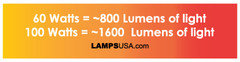
The lighting color temperature of all bulbs including LEDs are measured on the Kelvin scale and brightness is measured in Lumens. Now that Watts are so low on LEDs you need to pay attention to the Lumens more than Watts. Read this post on the Scale of Light Brightness to help you visualize how Kelvin, Lumens and Watts are all related.
First you need to purchase the right type and color of LED bulb for the application. LEDs that are too blue or bright white are mainly for exterior applications like security lighting, parking lot lighting or street lights. Selecting the right interior color temperature for a room is now easier because LEDs are available in more colors. It may be a new skill, but as I will demonstrate it is possible to match existing color temperature and brightness when swapping out your old incandescent bulbs for LEDs.
Second you need to know that LEDs are measured in Lumens not Watts. The manufacturers usually include the “60W Equivalent” on the 10 Watt LED bulb package as a reference point. But you need to start thinking in terms of Lumens or brightness when selecting LEDs. Here are a few more details on LED bulb benefits to enlighten you.
Finally I wanted to keep the same warm color temperature of 2,700 Kelvin used in the halogen lights when upgrading to LED bulbs while taking advantage of the total cost of ownership TOC that LEDs offer. At 5 hours a day this upgrade could save up to a $600 a year based on local utility rates. Not to mention that the new LEDs have an bulb life of up to 50K hours.
As I mentioned my LED upgrade and lighting design was a test to demonstrate that by choosing the correct color temperature for LED bulbs I could actually match the equivalent warm look of halogen bulbs when swapping out all of the lighting in a common area. For this upgrade I chose Philips LED bulbs to upgrade a game room. I used an online lighting calculator to help me determine how much lighting I would need for a room of this size. To calculate how many Lumens the room needed I calculated the room Width x Length x 1.5 to find the total number of Lumens.
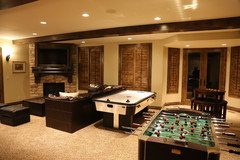
The game room was approximately 30 x 40 ft. with a ceiling height of 8 feet. The game room was burning twenty-four 120 volt 50 Watt halogen bulbs (1,200 Watts) at 2,700 Kelvin in recessed can lights. Eight Soft White 40 Watt A-shape bulbs (A19) were also used as accent lighting in pendants and wall sconces. I estimated I would need the halogen equivalent of 2,280 Watts to produce around 26,800 Lumens for an overall brightness between a medium and high intensity for this space.
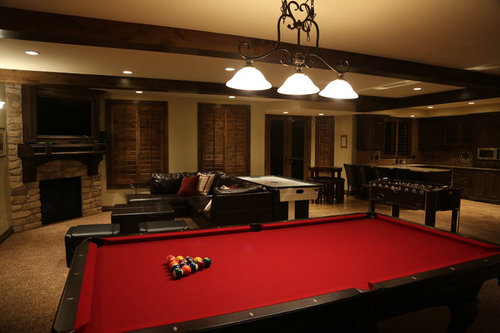
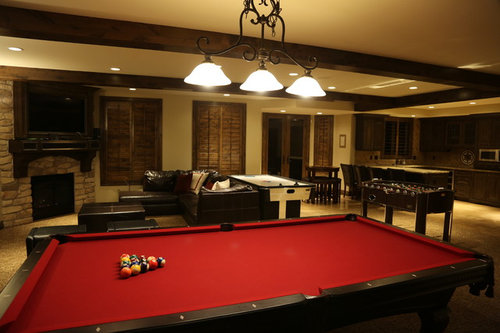
After the LED bulbs were swapped out the room actually had the same warm feeling as the halogen bulb but with a brighter sharper look because while the LEDs floods only use 12 Watts of energy they produce the equivalent of 75 Watts with 850 Lumens each. The hot spots on some of the after affect photos are due to the narrow flood pattern of the LEDs I selected. The total wattage of the room was actually reduced to 288 Watts, a savings of over 1,150 Watts while the overall room Lumens increased slightly as you can see in the before and after photos.
Part of this test upgrade was to surprise the property owner. My challenge was validated when I asked the owner if anything looked different in the room after the upgrade, without revealing that the bulbs had actually been changed to LEDs. The owner could not tell what exactly was different in the game room but only commented that things looked brighter. I considered this upgrade a success because the owner could not tell that LEDs were being used.
before
after


 10 years ago
 PRO9 years ago
 PRO9 years ago
 PRO9 years ago



tooky58