Software
Houzz Logo Print
jmorris271

Do you spray for bugs

10 years ago
last modified: 10 years ago

I have a problem with using insecticides in my garden to control the bad bugs. Where is the happy medium between killing bad bugs and having blooms? There seems to be more bad guys than good ones.

Comments (25)

  • 10 years ago
    last modified: 10 years ago

    Every time I think NOW I'm going to spray, that's it! - I see a Ladybird and then decide against it....

    There are excellent methods to control bad bugs... I had a Japanese beetle legion here a while ago and read that by putting them in pots with water and dish washing liquid (in all the areas they love to frequent), the smell of their dead bodies deter others entering your garden. It worked....like a dream...

    I keep aphids for Ladybird larvea, and tiny birds that also enjoy eating aphids..

    There are so many spiders, mantids and assassin bugs to kill the rest. For thrips, I learned from Straw to only water during the hottest part of the day because they can only hatch when the soil is moist, and to add clay on top because that becomes too hard for them to be happy and thrive. Also when a rose bush has thrips, I cut of all the blooms and dispose of them in the garbage can.

    Those tiny green worms also gets eaten by tiny birds. If you don't have tiny birds eating them, use corn flour - sprinkle it all over the rose and the next day wash it of with strong water from hose pipe. Corn flour also helps for Black Spot.

    Larvae of Ladybirds looks scary but are great friends for the rose garden.

    It teaches us patience, and observation :-)


    Jasmine wrote: But the roses can survive without us. The blooms don't have to be perfect if you aren't competing in a rose show. I think it's important to have balance in the garden. -

    I agree 100% :-)

    Samuel that sounds like a great movie and I think I should order that....

  • 10 years ago

    Please don't pile it on, folks, when I state the following. I have a few very thrips susceptible roses like Frederic Mistral. In the spring before the buds pop, I put on granular systemic insecticide (Hi Yield, not a spray) around the base of those few susceptible roses, and scratch it in. Usually one treatment is enough. I certainly don't have a lack of beneficial insects in my garden. Diane

  • 10 years ago

    My garden doesn't have midge or chili thrips so I don't need to spray insecticides. I can treat aphids and spidermites with the garden hose. Rose slugs get picked off when I do my daily garden walk. I use a trap for JBs, others may have different opinions on the use of JB traps. Your climate & insect pressure isn't the same as mine so your mileage will vary - and your roses should be making you happy. Peace.

  • 10 years ago

    I never use any poisons and never will, even if I have to give up roses, but nature usually balances things out and there are things you can do, such as jess's suggestions. I can't take the chance of killing any of the wildlife in my garden (except for grasshoppers!) and the roses usually muddle through, with the help of natural predators and my squishing aphids when I see them or murdering grasshoppers. I caught one yesterday that was three inches long and I was sadistically happy about its demise via my secateurs. When I had a legion of snails and slugs I was out there at night and easily disposed of many of them that way. Nowadays I let them live when I see them because with the drought their numbers have decreased, and the roadrunners love to eat them.

  • 10 years ago

    Plain and simple, insecticides do not work. You can not and never will kill them all and those you miss shall become immune to what you are spraying. What you are doing successfully is making Bayer and friends very rich and happy.

    I realize chili trips are a whole different ball game. But there again most folks will fail to properly rotate their chemicals or spray on time. Soon nothing will kill them.

    Nature knew how too handle insect problems until we intervened. Plant for beneficials and they will come. The garden won't be perfect ever. But you can smile with pride that you have done what you can to help make our world a better place. Even thou it is a small contribution. Every little bit helps.

    I'm very sorry if I offended anyone. I don't mean too but jmorris was kind enough to ask for opinions.

  • 10 years ago

    Patty wrote: "What you are doing successfully is making Bayer and friends very rich and happy."

    ...ditto! :-)


    Ingrid wrote: "I never use any poisons and never will, even if I have to give up roses"


    another ditto!


    :-)))

  • 10 years ago

    I do use insecticide for thrips. Only on the buds and only on closed buds. If I see thrips in an open blooms I take it off and throw into a sealable bag and put in the trash. The thrip probably just became overwhelming (even with not using any insecticide and all year long) that I gave in. But I try to be as careful as I can be with it.


  • 10 years ago

    Only bugs I ever sprayed for were whiteflies last year when they were bad. Thrips and aphids and such just get the hose. It isn't any real aversion to pesticides, they have their use, but most of the time Nature takes care of itself. I do on occassion spray when black spots gets really rampant when I lived on the gulf coast, but not often.

  • 10 years ago
    last modified: 10 years ago

    It helps to plant a variety of plants. As per per the following article, a general rule of thumb is to designate between 5 and 10 percent of your garden space to plants that bring in beneficial insects: plants-to-attract-beneficial-insects. Hope this helps.

  • 10 years ago

    I agree - poisons kill the good bugs, which keep the bad ones under control (btw - systemic insecticides kill bees).

    Jackie

  • 10 years ago

    No I do not spray or use any type of insecticide on insects... I strive to have balance through planting companion plantings that attract good insects etc....

  • 10 years ago

    I usually have dunked JB in Ivory or Mr. Clean but the MIDGE, I am at a loss with.

  • 10 years ago

    Maintaining a bird feeder can bring insect eating birds into one's yard. Sometimes I scatter birdseed in the garden beds a an exchange for free fertilizer.

    A way to not have the kinds of beetles which hatch from lawn grubs, such as JBs and rose chafer beetles, is to not have a lawn!

    JBs were all over my basil plants one year and ignored the roses.

  • 10 years ago

    Has anyone tried homemade spray from hot hot peppers and garlic? I have heard that some gardeners are growing Bhut Jolokia to make insect spray from. Use gloves and goggles when compounding your homemade BugDeath. I expect it would also kill beneficials but at least you would not be releasing chemicals into your yard.

  • 10 years ago

    Midge is a terrible pest I agree. Midge has been in my garden for 17 years. For 2 years after learning what they were I admit to using insecticides. I did the worlds greatest attack with everything by the book. Even removed 2 full inches of soil around and under every rose. At the end of those two years midge was still here. That ended the old way of doing things. I started reading instead.

    I must admit that all I had where roses in the yard. So for the next few I forgot about the roses and diversified the garden. To make a long story short. My best years follow drought. The worst are wet years. After acquiring too many daylilies, my roses never had spider mites any more but rose midge came back. How does all of this fit in I don't know yet. All I know right now is the garden is healthy, I'm happy and rose midge is much better than it use to be. Something is taking care of it just don't know what that is yet.

  • 10 years ago

    I have rose midge problem pretty bad, so I use Bayer's product for that. Just did 1st treatment last weekend for the lawn, this weekend will be the treatment for the roses.

  • 10 years ago

    I don't use any chemicals either. I try to be as organic as I can. Luckily I don't have major insect problems beside Japanese beetles, which is a world of its own. I believe that as humans we pollute the planet too much with man made chemicals which is the cause of a lot of health problems for all living things on earth including us. Realistically we can not avoid chemicals but we can lessen its impact.

  • 10 years ago

    I agree with Patty: insecticides do not work, plain and simple. I used to use them, and every year, I had more bugs than the year before and my roses looked worse. I stopped because of a health problem, coupled with the advice of Paul Zimmerman and the people at Bierkreek (sure miss that forum...). It worked. Even the first year after I stopped, it was a little better. I still have bugs, of course,but not nearly as many.

    My worst problem was the Oxythyrea funesta beetle,and his ilk (these do damage similar to that done by JB's). I think spraying probably actually did just fortify this loathsome pest! Every year it was worse! I finally got the problem under control by using pherormone traps placed well away from the rose garden. Once I learned their "flyways",I began planting fast-growing trees, etc to block the aerial "paths" (made screens out of netting while the trees were still small, but those Leylandiis do grow fast! they might not be the best looking trees around, but I am grateful to mine for services rendered!) The first few years I also did have to do a lot of hand-picking/ dropping them into soapy water,which was a lot of work; even doing the rounds twice per afternoon (they are only active in the hottest hours of the day). But these last few years it's gotten significantly better. Again, I agree with Patty's approach: I think it's best to experiment and try to figure out sort of the "larger picture"; i.e., how does your enemy pest think? what conditions does it like?,etc. Integrated Pest Management is the way to go, IMO.

  • 10 years ago

    Excessive spraying of insecticides can be damaging, but limited targeted spraying for certain problems does work. It's called Integrated Pest Management.

  • 10 years ago

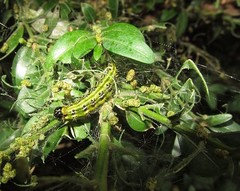
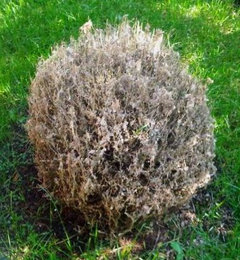
    Buford, I agree. There are some pest with no natural enemies which have to be controlled. eg. we have Cydalima perspectalis (box tree moth)

    These little guys can be devastating if you don't do anything


    Your boxwood can look like this in no time

    Of coarse, there are often two options, chemical or natural (bio) insecticides.

    Sharlene

  • 10 years ago

    So where would systemic methods come into play here or should it?

  • 10 years ago
    last modified: 10 years ago

    Morris sorry to hear about the Midge problem. we don't have them over here....

    https://uk.answers.yahoo.com/question/index?qid=20070413143046AAi2NaC

    http://www.getridoffliesguide.com/how-to-get-rid-of-gnats-inside-house-kitchen-outside/

    good luck with that!


    ps - maybe the sand on top of the soil will help, if the area is not too large?

  • 10 years ago

    I don't spray and have no insect problems other than aphids which I don't consider a problem worth spraying for. [knocking wood] There are many lizards in the garden, so I believe there is a healthy ecosystem going. I might sing a different song if I had something like JB's.

  • 10 years ago
    last modified: 10 years ago

    I have a garden with 65 rose bushes. And i use Bayer Advanced 3 In 1 Insect & Disease Control every 2 weeks on them without mercy. My roses were literally getting killed by Japanese bettle, spider mite, caterpillars... Before I started using the Bayer product, I tried to use all natural stuff following several advices from this site, but I never had success. I just had enough of it. It is exhaustive handpicking insects, and all that water and soap it just a quicly band-aid.. Its like trying to dry ice. I guess if I had just couple of roses it probably would work out well.... Anyway, since I started using Bayer Advanced 3 In 1 Insect & Disease Control I take a lot of pride of my yard and my roses are thriving strong every day. I love it and I will neve look back