Software
Houzz Logo Print
bjb817

Cedar Sage Sun Tolerance

10 years ago

So I bought a slew of Cedar Sage in 4" containers to go along an east facing fence in a tight area sandwiched between the house and fence. I thought it was almost full shade in this area. Here I was working out there the other day and it finally hit me how much sun in gets in this area during the early to mid afternoon. I'd say there's probably 3-4 hours of full sun. Can Cedar Sage handle that much mid day sun? If not, I have a spot under a live Oak I can use them.

Thoughts or suggestions for small perennials that would work in this scenario would be much appreciated.


Comments (11)

  • 10 years ago

    Ours that get full sun through about 1:00pm actually like it and grow noticeably faster than ones in heavier shade (which also do well, just slower/smaller). They're under deciduous trees that are just leafing out, so later direct afternoon sun is not a problem for the rosette over winter through this time of year. Have not tried, so don't know how badly they would suffer if still in full mid-afternoon sun by August's triple digits. They seem to transplant well, so might give them a shot and move if they begin to burn up.

    Texas betony (Stachys coccinea) does well in sun and partial shade.... where it does well, anyway. Others here have commented that it can be fickle in some locations. Longer and more frequent blooming than Cedar sage.

    bjb817 thanked bostedo: 8a tx-bp-dfw
  • 10 years ago

    Thanks for the responses! I think I'll play it safe and save them for under the oaks. The spot I had in mind is pretty much full sun from about 12-4. It sounds like that might be enough to turn them into crispy critters.

    Dwarf Ruellia would be perfect, the only problem is I already have a ton of it and would like to try something else. That's one of my favorite plants. Tough and versatile!

    Would 4 hours of sun be enough for Four Nerve Daisies? I know they prefer full sun, but supposedly part shade is ok too? I was also thinking maybe pincushion flowers, but my past experience with them hasn't been great. It's a pretty tight area. I'd ideally like something that gets no more than 1.5' h by 1.5' w.

    I'm thinking TX Betony might spread too wide for this spot, otherwise I'd totally try that! It sounds like S. Coccinea is more of an annual. I'm more of a plant it once kind of guy.


  • 10 years ago

    Our potted Four Nerve Daisy is currently blooming away in 3 to 4 hours of direct sun, so seems it should work in your spot.


    Pincushion could also be nice. Our 'Butterfly Blue' does well with sun from ~11-4.


    Some Heuchera cultivars (Dolce series?) should also be able to handle that much sun.

    bjb817 thanked bostedo: 8a tx-bp-dfw
  • 10 years ago

    The Ladybird Johnson Wildflower Center site lists SALVIA ROEMERIANA (Cedar Sage) as requiring Part Shade. Part Shade and Part Sun would seem to be two terms for the same thing; however, the use of shade/sun implies a preference. When you see Part Shade the preference is for less sun, and especially less afternoon sun. Sunscald symptoms will appear as yellow or white lesions on foliage. If you don't see this, then there is no problem.

    The LJWC site also notes that this plant has a hard time perpetuating itself under deciduous
    hardwoods, as the large leaves on the ground will block the
    emergence of seedlings and of the new years growth. It really
    is adapted to live under junipers/cedars. Live Oaks lose all their leaves in the spring just when S. roemeriana is beginning growth, so you will have to keep the leaves raked off the area.

    bjb817 thanked mindshift
  • 10 years ago

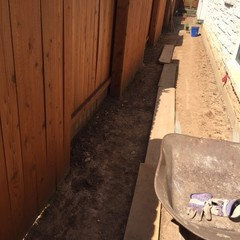
    Just for reference, here's the area in question.

    I took this pic around 4 or so this afternoon. The sun had swung around enough that it was actually mostly shaded by 3. I was paying pretty close attention today. I realize the sun angle will get a little higher yet the next few months, but it looks like this area sees about 3 hours of early afternoon sun max and even then it's not direct sunlight. The plants will go where the indented sections of fence are so it's not so blah. The rest will be a stone pathway and hardwood mulch. The space is only 5' wide, so there's only so much that can be done here.

    I may roll the dice after all and give the cedar sage a shot here. If they don't work out, I'm out just over $30 and I'll try again with something else.

  • 10 years ago

    Wow. Picture worth a thousand words. You will have reflected heat off the wall in addition to sun. Keep an eye out for sunscald as the season progresses, and best of luck with the project.

    bjb817 thanked mindshift
  • 10 years ago

    I'm hoping that's not the case. What helps is that the fence faces east and our house is two story, effectively blocking out most of the direct sunlight from that direction. The only sunlight comes in at an angle. We'll see. I'll have to update this summer. :^)

  • 10 years ago
    last modified: 10 years ago

    My guess is they'll make it there. Ours has spread out to the edge of the small tree canopy it was planted under where it gets a half day of reflected light/heat off the pool deck it's grown against.

    We get just a few volunteers each year on clay, may see more on your soil... and certainly with your larger number of plants. Biggest challenge for me has been distinguishing the small seedlings from the Lamium weedlings; I've potted quite a bit of henbit. :-(

    PS: They took a couple years to really get established. Don't know if that is typical, just suggesting not to judge performance too harshly at least until the second year.

    PPS: Like the light veneer on the house. Is that cut stone, brick, or something else?

    bjb817 thanked bostedo: 8a tx-bp-dfw
  • 10 years ago

    It sounds like if they're making it in your situation, they should do ok in mine too, Bostedo.

    Our "soil" in this part if the yard is the standard issue "red death" the builders use around here. Basically it's the clayey scrapings from the bottom of gravel pits. Needless to say, I need to add a good bit of compost whenever I plant something.

    I'm a plant small and wait kind of guy. Unless something appears dead, I'll hang with it for one season at least, typically. :^)

    Our stone is chopped limestone. It needs a good powerwashing though. It should all be light like it is a few feet up.

  • 10 years ago

    This experiment came to an abrupt end. Out of 15, only 4 were left after several weeks in the ground. I believe they drowned. While I amended the planting holes, this is a part of the yard that tends to stay wet. Couple that with all the rain we've had that's probably not the best recipe for success with a plant that needs good drainage. Oh well. At least they were only 4" pots, so I wasn't out a ton of $.

    The Sinaloa Sage I planted to replace them seems to be faring much better so far.

Sponsored