Software
Houzz Logo Print
jamiesm126

Identify and suggestions please!

10 years ago
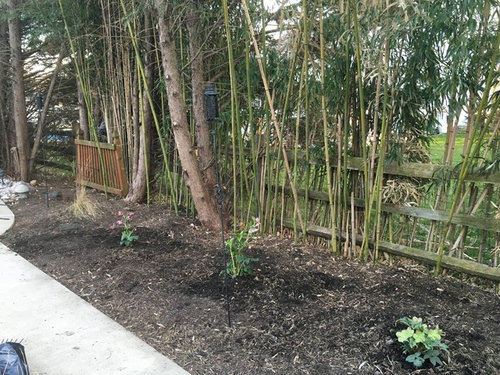
My husband and I just bought a house and thought nothing of the bamboo. It sits directly on our property line and is killing the fence. #1 can anyone identify it? The roots go all the way down the side of the concrete and its sprouting everywhere... and dying at he same time. A lot of it is already dead and the previous owners have it tied together with string to keep the privacy. We are considering getting rid of it but I've heard and read crazy threads on removal. A landscaper said he could get rid of it by chopping it down to 4' tall and pouring chemicals down the center which would need to be repeated multiple times. Full extraction wont work either since it goes down the side of the concrete so it therefore goes down the side of my neighbors house!

any suggestions at all or ideas on how much it could potentially be to remove this?

I really appreciate any help/guidance I can get.

Comments (5)

  • 10 years ago
    last modified: 10 years ago

    Hard to tell what kind it is but it looks like a Phyllostachys, probably P. aurea aka Golden Fishpole Bamboo. You could advertise it for sale or for free if they dig it up. Removing it would consist of cutting ALL culms or any other growth down to the ground and keep cutting any new growth as it appears until it stops emerging which might take a month or two or three, this would keep from using harmful chemicals for future plantings in that area, or you could use straight undiluted Roundup on the culms immediately after cutting them down to speed up the process.

    Personally, I would leave it and just tie the culms up to straighten those that are leaning, and cut down any new growth in the areas where you do not want it growing.

    A close up picture of the culms would be more helpful in identifying the species.

  • 10 years ago
    last modified: 10 years ago

    Whatever you do, don't use the contractor who wants to dump a bunch of chemicals on your property. He doesn't know what he is doing and will mess up the ground for planting something else. Chemicals are not useful for getting rid of bamboo.

    I also don't believe the bamboo is dying. It looks like you have a lot of healthy bamboo culms. Bamboo culms last about 6-7 years, so, while you may have some dead culms, this is natural, and you can just prune them out.

    I don't know what you mean about the bamboo "killing your fence": the fence looks pretty old and may be dying all by itself. Bamboo is not going to attack a fence.

    The bamboo cums are all in a straight line and provide a nice privacy fence. It does not look out of control at all so I am not sure why you would want to get rid of it. If it is a running bamboo, it could spread, but you can deal with that by trenching and putting in a line of bamboo barrier, or by severing the rhizomes annually with a pickaxe or sharp shovel.

    In short, it sounds like you are fearful about bamboo based on urban horror stories, while in fact I don't see much cause for concern.

  • 10 years ago
    last modified: 10 years ago

    That is Phyllostachy aureosulcata "Yellow Groove" which is a large and vigorous grove forming bamboo by nature. By the sound of it, there's a network of root mass (rhizomes) under that whole area and the prior owners were essentially keeping it pruned to the fence. The deadened canes are just old and dried out, the bamboo itself looks healthy.

    Agreed with the above statements, avoid the poison route. It's time consuming, ineffective, unnecessary, misinformed, irresponsible etc.. to try and kill an established bamboo with toxic chemicals. If you have time on your side, attrition is probably the best strategy. It's tangled in the tree roots and under the concrete, but get as much mass as possible dug out of that main area and around the fence. It shouldn't take someone with landscaping skills all that long to excavate a sizable amount of it. Whatever is left in the ground will keep trying to send up new shoots which you'll cut back on a regular basis until the roots are starved off.

    I can almost guarantee there's someone in your area that specializes in bamboo that can further guide you and offer practical advice. It's worth seeking that person out, I think you'll find that your situation is relatively easy to remedy.

  • 10 years ago

    I'm not sure I'd care to get that specific on identification :-) It is pretty darn hard to tell exactly at that distance and magnification. I'd risk going as far as saying it was a species of Phyllostachys, as that is a very commonly planted genus of tall running bamboo and fits both the visual and written description but there are multiple species and cultivars within that genus that could fit. If I were guessing - which is about all one can do with this resolution - I'd go with Phyllostachys aurea. It's the most commonly planted (and escaped from cultivation) bamboo in the US.

    I agree that removal is quite possible without a need to resort to chemicals. It just requires some effort, elbow grease and determination.

  • 10 years ago

    If you zoom in, you can see the yellow stripe and that's the node and leaf structure of aureosulcata. Aurea is generally low branching and tends to form a tighter grove.

Sponsored