Software
Houzz Logo Print
jamie_buehler

Need help with Bermuda and Soil Test

10 years ago
last modified: 10 years ago
Hi all,
First year in this house with a Bermuda Tifway II lawn, which is primarily on the west (front) and east (back side of house). My goal is, of course, to have a thick green yard.

Right now, here in west Tennessee, the grass is about 40% greened up.
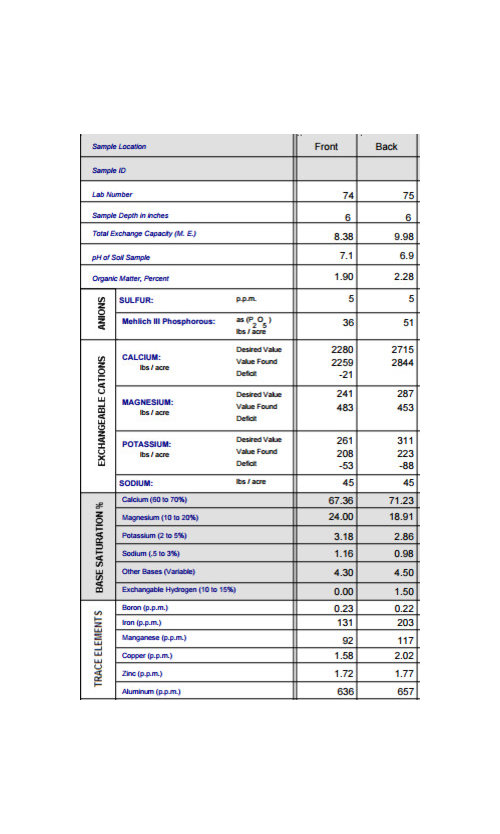
I got the soil test below done right BEFORE I levelled the lawn with builders sand. It wasn't terribly bumpy, but I just purchased a manual reel mower and I want to be able to mow lower than I could with rotary.

There are a few patches that were low that I effectively had to bury the 100% dormant grass. Hope that doesn't end up killing the grass in those spots.

I've read through several soil-test evaluations on this site and here is my interpretation of the results (based on others' tests). I could be totally off. I would LOVE if someone could help me out here!

very low:

--organic material

--sulfur

--phosphorous - 300 is
ideal?

low?

--boron

very high:

--magnesium

--copper

little low:

--potassium (treat
with sulfate of potash)

--iron

little high:

--manganese

--pH

I have these products at home. But i'm willing to get whatever I need to get this yard in tip-top shape!

--Lesco 16-4-8

--Dyna-gro "Foliage Pro" 9-3-6

--Nitrogen Urea 46-0-0

--Bag of Earthworm Castings

--Compost Tea

--Bonide Liquid Iron

--Liquid Soil "Aerator"

Comments (7)

  • 10 years ago

    Sounds like a nice lawn! Compost tea & castings will certainly help those deeper spots fill in faster.

  • 10 years ago

    Your soil is in pretty good shape overall! There are a few things to twiddle with, but nothing extreme.

    Exchange Capacity 8-10: That's a normal variance, and leans toward a sandy silt. It's a nice place to be, and indicates that your soil holds resources reasonably well.

    pH 7.1, 6.9: Hovering near neutral, which is no barrier to a fantastic lawn. I talk about some of the implications under Calcium, Magnesium, and Potassium below.

    OM 1.9, 2.2: In the poor to fair range. I'd always mulch mow, mow in all your fall leaves, consider importing leaves, and otherwise not allow a usable organic to leave the lawn.

    Sulfur 5: Low, but fine.

    Phosphorus 36, 51: Low to very low. The target here would be around 200, and 220 wouldn't be a bad idea with your pH. We use starter fertilizer (just get the cheapest, they're all pretty much the same) to fix this. Recommendations below.

    Calcium 67, 71%: While technically a touch high, it's not enough to matter and absolutely doesn't cause any problems. It does raise your pH a bit, so I might avoid any calcium source and let this drift down for a year or two.

    Magnesium 24, 19%: Very high and high respectively. Again, this raises your pH and will tend to make the soil tight and impenetrable. Avoid any magnesium sources (including lime, which you're avoiding anyway due to the calcium) for the foreseeable future.

    Potassium 3.2, 2.8%: While technically a hair low, I'm content to ignore this for a year or three. It's not that far off.

    Minor Elements: Boron and Iron are mentioned below; the others are fine.

    Iron: Not a problem, but kind of low to produce good color at your pH. Whenever you like, you can feed with Milorganite to very slowly raise this.

    Boron 0,23, 0.22: Essentially a photo finish, and both very low. This one should be fixed! We use Milorganite as a carrier and 20 Mule Team Borax as the boron source. You can purchase 20 Mules at the grocery store in the laundry section. In a wheelbarrow or the like, dump the Milo. Spraying very, very lightly with water (I use a spray bottle like the kind people use to damp their clothes when they iron) will help the boron stick. Add the recommended amount of 20 Mule Team Borax and stir, spraying occasionally to get the stuff to stick to the Milo. Then apply over the recommended area. So if going for bag rate Milorganite (1 bag per 2,500 square feet), you'd add 10 tablespoons of 20 Mule Team Borax.

    Recommendations (for Bermuda):

    May 1: Feed at bag rate with starter fertilizer.

    May 15: Apply 4 tablespoons (not a misprint) of 20 Mule Team Borax per thousand square feet.

    June 1: Feed at bag rate with starter fertilizer.

    July 1: Feed normally with a high nitrogen fertilizer (16-4-8 is fine if that's what you want to use).

    August 1: Feed normally with a high nitrogen fertilizer

    September 1: Feed at bag rate with starter fertilizer.

    October 1: Feed at bag rate with starter fertilizer.

  • 10 years ago

    Where do you live?

    Is there any shade on the lawn?

    What is your watering plan? How often and for how long do you plan to water?


  • 10 years ago

    @dchall: Memphis, TN. My home is 2 stories, so the front lawn is shaded until 11am. Back lawn is shaded after maybe 6pm. It's my first year here so still not 100% sure on where the sun will rise/set, etc.


  • 10 years ago

    @dchall: Sorry, didn't answer your other questions. My plan was to water to a depth of 4-6 inches, maybe 1x per week.

  • 10 years ago

    You can pour on as much compost tea as you like, it won't impact the pH in any noticeable manner. Ditto with organics, they're essentially pH-neutral.

    Starter would be high-high-low or medium-high-low, yep. So something like 20-27-5 or 18-24-6 or another one in that range would be great. Mostly, I'm just looking for something where the second number is equal to or greater than the first. The third really doesn't matter one way or another, but most will be low (potassium sources tend to be more expensive).

Sponsored
Kuhns Contracting, Inc.
Average rating: 5 out of 5 stars26 Reviews
Central Ohio's Trusted Home Remodeler Specializing in Kitchens & Baths