Software
Houzz Logo Print
mrblubs22

My first rescue

10 years ago
last modified: 10 years ago
Hello,

For the first time ever there was a clearence rack at Rona in the greenhouse and all these mini broms were 60% off.

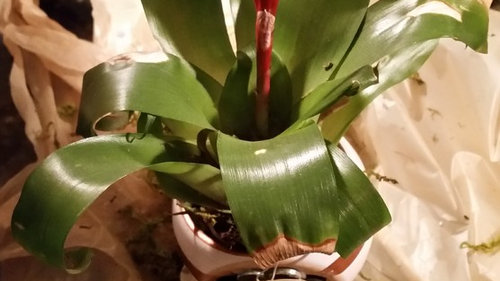
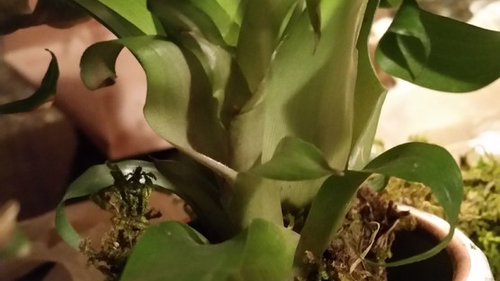
They were all not in good shape but I figured I should try and save one just to see if I could. I picked out one that already has 2 pups attached to it so hopefully They'll survive!

Now I'm not quite sure where to start....

It obviously needs a repot as it came in one of those magnet pots with no drainage. The plant appears to be a plug, so theres only a bit of dirt surrounding the roots and the rest was that fake moss.

However do I plant it a ratio of perlite to soil like I would a succulent (50,50) or more? Less? I don't have any orchid bark available.

The plant appears to be a species of vriesea. Don't know why I can't find the exact species. I swear I've seen it a thousand times.

I read it needs water in its crown? Constantly...But what about the actual soil? Would I water like I would an aeschynanthus or more spider plant?

Lastly, anything I should do to the actual plant before repotting?

This my 2nd go at Broms that are not Tillandsias. Tried pineapples 3 times and failed miserably. Hopefully my rescue actual turns out to be a rescue.


Comments (3)

  • 10 years ago

    Hi
    everyone.

    Mr Blubs – First of all let me say that
    your plant is definitely a Vriesea, but as for a cultivar name, I can’t help.
    It’s probably one that’s commercially produced in their thousands by tissue culture
    to be sold as a substitute for cut flowers.

    It’s always interesting to take up a
    challenge such as a brom rescue and it’s usually very rewarding. Bromeliads are
    very resilient plants and it takes a lot to kill them so just because they may
    look a bit “rough” doesn’t mean they are going to die, in fact quite the
    opposite often applies as “Mother Nature” has included a survival system within
    each plant.

    Whenever these plants are severely
    stressed by various causes such as, neglect, excessive heat, excessive cold,
    injury from objects falling on them, over watering, under watering, and even
    diseases such as rot, this survival system come into operation and the plant
    immediately begins to activate a plan to reproduce itself. This can be done in
    two ways, by producing pups or producing flowers which in turn can produce
    seeds. Once this is done the foundation for new plants are in place, and your
    plant demonstrates this by already producing new pups.

    Plants like yours are marketed with the
    intention of taking the place of a “bunch of flowers” so that when the flower
    dies off, the plant is tossed out and another is bought to take its place.
    Therefore the medium around the roots was never intended to make the plant
    grow; it was just there to support the plant and act as an embellishment to make
    it more appealing to the eye of the purchaser. In fact, quite often these
    plants are sometimes an attractive looking pot which often doesn’t even have
    any drainage holes.

    Looking at your plant, it seems to me
    it’s suffering a bit from under watering; this assumption is based on the age
    old rule that (1) Brown leaf tips means Not
    Enough Water
    ; and (2) Yellow leaf tips means Too Much Water. This could be a direct result from the way it has
    previously been potted and the mix it’s been potted in. You say, “The plant
    appears to be a plug, so there’s only a bit of dirt surrounding the roots and
    the rest was that fake moss”. Obviously your plant is also suffering from lack
    of nutrition as well, as the fake moss is an inert substance with no
    nutritional value and the little bit of nourishment in the soil would have
    previously been used up.

    Look at how these plants grow in nature;
    they usually grow attached to trees and therefore have their roots exposed to
    the air and never remain wet for very long. Obviously in pots we can’t expose
    the roots to the air, but we can do the next best thing and make sure they are
    in a mix that is open, free draining and doesn’t stay continually wet. This is
    a general requirement for all bromeliads that normally grow as epiphytes in
    nature.

    Bromeliads will grow in almost any
    medium that drains well, does not pack down, and provides stability. A ready-made,
    good quality commercial “all-purpose potting mix” or bark based “orchid potting
    mix” can be used as the base for a suitable bromeliad mix. To this you can add
    any number of ingredients depending on what’s available to you.

    The most common other ingredients that
    come to mind are, Tree Fern fibre, Coco Peat pieces, Perlite, Charcoal, small
    Polystyrene pieces, small sized gravel or Skoria, Pumice, pine bark, fir bark, coarse
    river sand, broken up brick pieces and no doubt many others. These are all good
    additives if they are available, and will all help to make the mix open and
    free draining while base mix ingredients will still retain sufficient moisture
    without staying wet.

    I have used all these ingredients
    successfully based on mixtures of 50% all-purpose potting mix and 50% of a
    combination mixture of some of these other ingredients listed. e.g. 50%
    all-purpose potting mix, 10% small polystyrene pieces, 10% charcoal, 20% Coco
    Peat pieces, 10% small Skoria.

    Alternatively if you can get a good
    quality bark based orchid potting mix, 50% of this could be mixed with 40% all-purpose
    general potting mix and 10% of either Perlite, charcoal, pumice or any of the
    other above inert ingredients to help keep the mix open and well-draining.

    The important consideration is that the
    potting mix must drain rapidly and not remain wet.

    With a plant in a condition such as
    yours I would give I a good soaking in one of the good quality basic Seaweed
    supplements on the market; these aren’t fertilisers but act more like a “tonic” or a “pick-me-up” which is what
    your plant needs initially.

    Once the plant is settled into its new
    mix and after being watered in, you could give it a misting of a half strength
    foliar fertiliser; this would give it an immediate boost of food and nutrients
    much quicker than any of the slow release types usually applied to the potting
    mix.

    I hope some of this advice is of help to
    you, but remember, the above information is just a guide on how I would treat
    this plant if it were mine, based on my conditions and the potting ingredients
    available to me here in Australia.

    All the best, Nev

    A few Vrieseas and Guzmanias in my shade house

    MrBlubs thanked splinter1804
  • 10 years ago
    last modified: 10 years ago
    Great thank you!

    I usually never try to rescue plants, but I always wanted to have a bromeliad! They seemed that they were still in an Okay condition so I thought I'd give it go!

    Instead of the bark (Cannot seem to find it here) do you think I could break up some Bark mulch and put that into the mix? I have a whole bunch of it in my outside garden aswell as 3 new bags of it. If not i'll have to look for some of those other ingredients.

    I was thinking that I could try to mount it to a peice of driftwood, but I think I'm gonna start off with the pot and maybe if I take care of it properly I'll have lots of pups to experiment with.

    Nice broms as always by the way!

  • 10 years ago

    Hi everyone.

    Mr Blubs - The bark mulch from your garden (if it's pine) should be OK as long as it isn't too new. If it's dark in colour and you can't smell the pine resin in it, I'd give it a try.

    If it's too new it robs the nitrogen from your mix. if it's from some other type of timber I couldn't say as I'm not familiar with the timbers in your country.

    All the best, Nev.

    MrBlubs thanked splinter1804
Sponsored
River Mill Construction
Average rating: 5 out of 5 stars2 Reviews
Delaware County's Customer Focused General Contractor