Software
Houzz Logo Print
hzdeleted_30144343

Help!!! Raised beds for tomatoes

10 years ago
last modified: 10 years ago
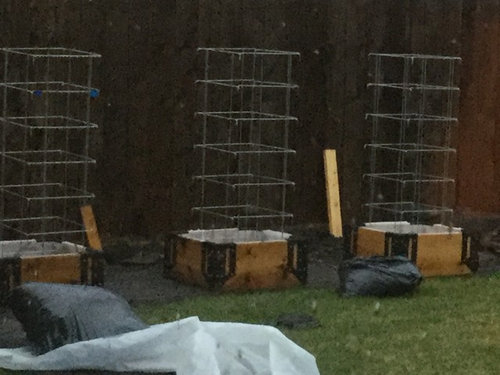
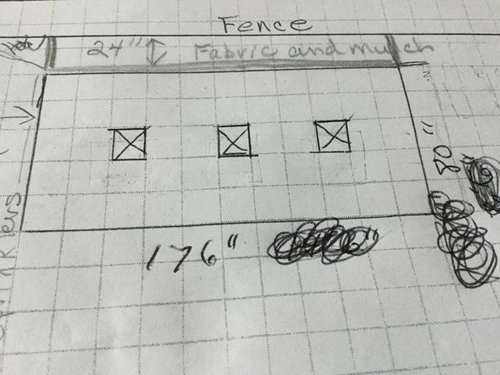
I am building my "retirement garden" and it has grown to be a patio surrounding tomato raised beds. My original plan was to put these raised beds...

On to this patio. The x on the drawing is where pavers are left out so there is a hole for drainage.

The raised beds would go directly over the hole, but would overlap because the pavers are 16" square and the raised beds are 24" square.

Now I am thinking that I could just make a solid patio just in case I change my mind down the road and want to move or remove the raised beds. The big question is IF I PUT THE RAISED BEDS ON THE PATIO WITHOUT A HOLE IN THE PATIO FOR DRAINAGE, DO THEY BECOME POTS THAT NEED POTTING SOIL OR CAN I STILL USE MY WONDERFUL GARDEN DIRT? I do plan on lining the bottom of the bed with fabric so it doesn't leak dirt all over the patio. YOUR THOUGHTS, PLEASE!!!

Rebecca

Comments (29)

  • 10 years ago

    A 24" sq. framed in box isn't a raised bed. It is still a container that just happens to be made out of wood. And adding landscape fabric to the bottom only makes it more of a container. So it would do far better with soil-less potting mix in it no matter which route you go.

    Dave

    User thanked digdirt2
  • 10 years ago

    Dave, I grew 4 tomato plants in a 3'x3' bed for many years and had great results with just my great dirt. Would a 2' x 2' bed make that much difference, do you think?

    Rebecca

  • 10 years ago

    It's all relative, Rebecca, and in some cases a matter of semantics.

    How one defines "great results", what constitutes a "raised bed" vs. a "container", how much root space an indeterminate tomato plant ideally requires vs. what many think is enough, etc. There is no one way to do anything.

    But there are better ways. There are norms, standards, proven comparative results, and more variables then you can shake a stick at. So it boils down to how much one wants to follow those standards or not. And every person makes up their own mind about that. Some problems we are forced to work around and others we create yourselves.

    All any of us can tell you is based on our own experiences as growers working within those standards. The norm for any indeterminate variety tomato plant is +/-3 sq.' and personally if I tried to grow 4 plants in a 3x3' bed the production would be minimal at best compared to using normal spacing. Can it be done? Sure. With much more work and less production.

    The norm for what constitutes a container is dirt that is contained, forced into a specific place, as opposed to that same dirt un-contained. The containment alone makes a big difference. It restricts the roots, affects the dispersion and drainage of water and nutrients, and is more affected by gravity. That's why we often say that container gardening is a totally different method of growing than is in-ground. It has its own set of problems and needs that simply do not exist when growing in garden beds.

    Raised, framed in beds are still 'containers' and normally treated as such when it comes to fill. The bigger the bed the less problematic the containment becomes. The smaller the bed the more it becomes a container and the greater the problems for the plants.

    So all I can tell you is based on my experience I would never construct such small containers to grow even 1 tomato plant in. Based on your drawing I would, at the very least, make 1 big long 3 or4x 8' raised bed as large as possible, open on the bottom and then build the patio around it. The production results would be 5 fold and the ease of care and rate of over all success would go up substantially.

    But the choice of course is yours.

    Dave

    User thanked digdirt2
  • 10 years ago
    last modified: 10 years ago
    Thank you, Dave for taking all that time to respond and to educate me. I think the reason I am leaning towards dirt is because dirt is all I've ever been successful with. I have tried many kinds of potting mix (coir, peat, vermiculit, perlite and various combinations of them all), and I don't have much success. I have read posts about people who grow tomatoes in containers and I just don't want to try to learn how to fertilize and water with potting mix. I have to water my dirt every other day and every day in the heat. I can't imagine having potting mix to deal with that way. I have such success with my dirt that I am trying to keep it... It's like an old family recipe for a cake that I have... My mother changed it originally to suit her needs. I wouldn't dream of tinkering with it because it is perfect as it is. I suppose that I am content with the amount of tomatoes that I get with my dirt whether it is the best it can be or not, that I will probably stick with that.

    Because I am 66 and tired of huge gardening, I am now moving on to a very small garden with room enough for 3 beds for 3 tomato plants, and that is still more that enough for our needs. I am just trying to decide whether to leave the hole open or closed.

    The other thing I just thought of is that my growing season is so short here (May 30 to Sept 20) that my tomatoes really don't have a chance to grow to full maturity. Last year, I tried 1 tomato in a 3x3 bed and didn't get any bigger production than I did before. I am trying a new fertilizer this year with less nitrogen and more P-K. Maybe that will help.

    Thanks again for your time Dave. You are always very helpful.

    Rebecca

  • 10 years ago

    Then I'd say leave the hole open. That's my vote.

    At 75 I can sure relate to wanting to cut back. Unfortunately I just keep expanding every year. Wife says at least when my time comes it will be easy to "plant" me. :-)

    Dave

    User thanked digdirt2
  • 10 years ago

    Thanks Dave!!! That is so FUNNY!!! I can't believe you are still expanding. I talked with a doctor friend the other day and he said he saw a patient that was 104 and she just stopped gardening last year!! So, lets just keep on digging!

    Rebecca

  • 10 years ago
    last modified: 10 years ago

    Rebwcca, I think your arrangement is very good.

    About the soil : The only argument against using garden soil/dirt in containers is that it will get compacted thus depriving the roots from oxygen. But if your soil is well amended with organic matter, the chances of compaction should be minimized. Plus your planters are between a container and raised bed. ( large volume) If you can get pine bark mulch, I would recommend adding one cu-ft of it per bed, to take care of compaction issue.My potting mixes are 60%+ pine bark (small nuggets and mulch).

    Good Luck !

    Sey

    User thanked Seysonn_ 8a-NC/HZ-7
  • 10 years ago

    THANK YOU, SEY!!! I have tons of pine bark mulch from my 14 year old garden path. The path is 3'x50' and I have been bagging it as I remove it because I felt like it was black gold!! The bottom of the path has turned to dirt and there is landscaping fabric that is providing a barrier from the dirt. I got a compost sifter to use and will use it on the largest filter. I will just add this to the beds and continue to add it as the dirt settles over the years.

    I think this will be perfect. THANK YOU!!

    Rebecca

  • 10 years ago

    Very good , Rebecca.

    There is a product by Kellogg, called for raised beds. It costs about 10 bucks for 3 cubic ft. Not bad.

    What it is , is called forest products. I think that is mostly pine bark mulch. Last year I was building another RB and bought one of those, plus some pine bark mulch, some steer manure , some garden soil. The things that I planted in that bed did real well. This year I check he condition of it, still nice n fluffy.

    Soil is just a medium. You can start with a medium w/ zero nutrients and then add the nutrients to it. Pretty much like Hydro gardening, start with plain water and add fertilizer to it. What soil does :

    -- retain moisture

    -- retain nutrients

    -- provide something for the roots to anchor.

    A good soil also has to have right drainage and aeration for the roots.

    So then you can use various kinds of medium w/ varying degree of success. I have grown things in plain garden dirt, in pots, many times.

    Sey

    User thanked Seysonn_ 8a-NC/HZ-7
  • 10 years ago

    This is great information, Sey!!! I thought I knew way more about dirt than I do. Now you educated me way further than I ever thought I would know and my gardens will love you for it!! Your timing couldn't be better!! I have decided to put my tomato beds in an area that has open dirt all the way... The shallow rooted plants like onions and lettuce will go on my patio. Thank you so very much for your help!!

    Rebecca

  • 10 years ago

    Dave, I'm not a container gardener, but I take seriously the idea that containers should use soil-free mix rather than good garden dirt. I respect your regular advice about that. But I don't have a good understanding why that should be. That is, when you take a big container, like the one proposed here, how does the soil biology and chemistry in the container know it's a container? That is, at some container size the micro-creatures and chemistry in it aren't going to know that it has walls and a floor. At some point, good quality garden dirt becomes as usable as soil-free gardening mix. But maybe not? Maybe soil-free mix is always better, but you'd just have a hard time filling your yard with that?

    I'm just trying to wrap my brain around this.

    User thanked daninthedirt (USDA 9a, HZ9, CentTX, Sunset z30, Cfa)
  • 10 years ago

    Dan, as far as I know/understand the only argument against using garden soil in containers is "Compaction" . This can deprive the roots from getting oxygen.And may also be hard on the roots to expand. This situation can be more serious in smaller container. For example, a small raised bed ( 3ft x 4 ft) is a container but I wouldn't waste money on filling it with soil less mix.

    If you mix good amount of compost and about 20% perlite you might be able to overcome that problem. I suggested adding pine bark to Rebecca for that reason.

    Sey

    User thanked Seysonn_ 8a-NC/HZ-7
  • 10 years ago
    last modified: 10 years ago

    The garden soil is going to "compact" just as much laying on the ground as it will in a container. Nothing about a container that makes soil "compact". Now, for seeding and germination, sure, a loose mix is essential. That's pretty much the case whether in containers or for direct seeding.

    Now it may be that for a plant whose rooting area is heavily constrained, like in a small container, you really need a loose mix to allow the roots to develop as fully as they would if they weren't in a constrained area.

    I'm just missing something ...

  • 10 years ago

    Dan, the simplest way to explain it is the effects of pressure (atmospheric normally) + gravity. Pick up a handful of soil in your open hand. It just lays there. Pour some water on it and it just runs off your hand in several directions. It is not contained, not restricted in any way.

    Now pick up another handful of soil and squeeze it into a fist. Note how it packs together in response to pressure. How much it will compact varies with soil types but the application of any form of pressure forces out the air between the molecules and compresses them together. Take that same fist full of soil in your hand and stick your hand into a container of water to get it wet. while keeping the pressure consistent. What happens to that soil when you open your hand?

    A container of soil it is getting pressure applied at 14 lbs per sq. inch constantly while meeting resistance on 4 sides. It can only go 2 ways to expand - up or down. Atmospheric pressure prevents it from exploding out the top for the most part but gravity will pull the soil molecules down over time. Pressure+gravity=compaction.

    The bigger the container the more dispersed over the surface the pressure is and the longer it takes for the contents to compact . But these are not all that big of containers Rebecca is talking about. 2'x2' is just a big flower pot. Potting mixes too will compact over time but the texture allows for greater air between the molecules so it take much longer to compact.

    Bottom line, can you grow in dirt in a container? Sure. But your results will be much better in terms of root development, nutrient use, water demands, production, and over all plant health if you use a soil-less potting mix.

    Hope this helps rather than confuses it even more.

    Dave

    User thanked digdirt2
  • 10 years ago
    last modified: 10 years ago

    Sorry, Dave, but your pressure argument isn't right. The container is getting 14 lbs/square inch from the atmosphere on the outside, but also from the inside. It's not a vacuum inside! There is no net outward or inward force on the walls from the atmosphere. If I had an inward force of 14 lbs/square inch on the side of my 4-inch thin plastic pot, it would be like a two hundred pound weight was sitting on it, and it would get squashed.

    The only force that matters is gravity. Gravity is the same in the container as in the ground. The direction of that force is down. I think what you're saying is that in a container, gravity tends to compact soil. That's correct. But for a flat bed, gravity works the same way. The force is all downward. The soil gets just as compacted. Now it's true that in a bed, the soil can spread out laterally if you're building a bed on a bump. Instead of compacting the soil, the bump will spread out. But if you're not building on a bump, the bed won't spread out because the bed next to you is pushing back at you just as hard.

    The dispersal of the force doesn't make sense either. The force of gravity is precisely a matter of what's directly over you. Not how wide you are.

    Now as I said, I'm guessing that in a small container, the roots are restricted, so they can't go wherever they want to go. In a compacted garden bed, they keep moving out as far as they can as they find gaps to grow into. In a small container, they hit the wall. So it seems smart to have a looser mix in a container to allow the roots to more efficiently fill the container. That seems to be a more reasonable explanation for why a very friable mix is more favorable for a container. Because the root ball in a small container is likely to be smaller than it would be if it were in a garden bed.

    What this would mean is that if your container is larger than the extent the roots would reach if they were in the ground, the plant won't know it's in a container, and garden soil should work fine.

    So I think you're right that a container needs more friable soil, but maybe the reason needs some tightening up.

  • 10 years ago

    I honestly don't know how to explain it any better, although I'm sure there is a way, other than to add one should note the different effect pressure and gravity have on solids like the container vs. semi solids like the soil. I think the fisted soil effect shows that difference.

    Sorry I couldn't clarify it better.

    Dave

  • 10 years ago

    Depending on the composition, garden soil also become compacted in the garden beds too. That is why the field are tilled.And that is why they cultivated with a hoe.

    Here is what happens in a small container.

    --Originally soil is a mixture of different size particles with air gaps. .

    -- As you keep watering (so very often) the smaller particles tend to settle down filling the small air gaps.

    You keep doing this for months after months and the soil get compacted , filling the gaps and pushing the air out.

    An example of compacting.

    When I plant a small tree or shrub, I make a dish like form around it and flood it few times. By doing this the soil particles settle down and fill the gaps around the roots, pushing the extra air out. .


    So in a way, any time you are watering a container, you are doing a mini flooding.Excessive rain can do it to. Since a small container is bound by the wall(s) compaction is higher than in he garden bed.

    Sey

  • 10 years ago
    last modified: 10 years ago

    Dave, Sey, and Dan, I appreciate all of your contributions and I thank you for them. All I can contribute is what my experience has been. I gardened in a raised bed garden for the past 14 years. 5 beds were 3x3' and 6 beds were 3'x7'. All were filled with 3/4 prairie dirt (loam) and 1/4 composted sheep manure and mixed. Every other year, I added a bag of compost to each 3x7 foot bed and 1/2 bag to the 3x3 foot beds, but I never tilled it in. I did not disturb the dirt ever... I just used a Korean hand hoe to dig trenches to plant onions, beans, and carrots in and a small shovel to plant tomatoes, and that was it. I watered with a spray wand and used organic fertilizers from Gardens Alive.

    When I took the garden apart this year, I noticed 2 things... The first was that the roots ran easily all the way to the bottom of the bed. The second was that I had covered the inside of my beds with heavy clear polyethylene from Ace Hardware. I fastened it on the top and bottom with staples and then put a trim piece of 2x2 on the top of that. I taped it with black electricians tape where needed. Those boards were completely free from decay on the inside where the plastic was intact. There were only a couple of places where it ripped and dirt got in and decayed the wood. My friend took the wood and the dirt and moved it all to his yard for another 14 or more years of use. Amazing. I hope to duplicate that garden on a much smaller scale and have the same success as I did before. Thank you all again for your help!

    Rebecca

  • 10 years ago

    All your points are valid ones Dan and I'd agree that root containment is a vital part of "when a container is or isn't a garden". Keeping in mind that raised beds, as we normally talk about them, are a relatively new concept in gardening, container gardening even more new. But I think an argument can be made that any soil that is contained is any way will have the possibility of developing some of the container gardening issues. Ex: putting a bottom in a raised bed vs. not doing it creates drainage and rooting depth issues.

    I also agree that all soil will compact eventually if it isn't regularly aerated. Some, depending on their composition, take longer than others. Soil-less mixes appear to put it off at least season long. Soil doesn't.

    Rebecca's soil may be as ideal as a soil-less mix. We have no way to knowing with out putting our hands on it. But I am concerned that she has no soil-less experience to compare her results to and IME I strongly suspect her results would be improved by switching to soil-less mix in those containers.

    Dave

    User thanked digdirt2
  • 10 years ago

    Ok, Dan. We can do things many ways, use different medium. Now the question is what is the optimum for success to make our efforts worthwhile and our resources have a good payback. I have mentioned in one of the post, that years ago I had used garden soil in pots. I think it was ok. Noway that I can evaluates the outcome now. So I say it can be done.Not all garden soils are the same. You can have a garden soil that you can punch your fist into it, looking like black gold. I think soil less potting mix is a new concept.


    Like you said , as container size increases it approaches to raised bed. As raised bed get bigger in size, approaches normal garden bed. So where do you draw the lines to separate them. ?

    Sey

    User thanked Seysonn_ 8a-NC/HZ-7
  • 10 years ago
    last modified: 10 years ago

    Well, I think where you draw the line to separate them is pretty clear. It's when the container gets much larger than the size of the root ball. At that point, the plant doesn't "know" it's in a container.

    But another way one can draw the line to separate them is when soil-less mix just becomes too expensive. Sure, I can fill my olympic sized pool with soil-less mix but it's gonna cost!

    Yes, raised beds can have many of the same problems as containers, mainly because if they're small the plants can "feel" the walls. In fact, the soil close to the walls may be getting uncomfortably hot in some climates, and the soil at the periphery may be drier as well as a result.

    Let me add that you guys are the gardening experts. I just wanted to inject some engineering physics into the problem.

    User thanked daninthedirt (USDA 9a, HZ9, CentTX, Sunset z30, Cfa)
  • 10 years ago

    I like this discussion!

    I think the part that everyone is missing is that I didn't till my 12" deep raised beds for 14 years. I disturbed the soil as little as possible. Water drained down quickly and they were very productive. I know this is a tomato board, but I grew about 200 torpedo onions in a 3x7 bed, and they were wonderful. I was raised on a farm in my early chilhood and I can tell you that our dirt was not soft, fluffy soil. It would have all blown away if it was. My soil seems full of life with lots of worms. I don't get that with a pot of soiless mix. My pots need constant water with a mix. My gardens get watered every other day when the temps are in the 90’s. Nutrients stick around the roots better with my dirt than with a mix... Just my observation. :)

    Rebecca

  • 10 years ago

    I think that it is more about drainage than compaction and water will compact the soil far more than gravity. It will depend on the soil make up as to how long it takes to become a problem. In this case as I understand it the bottom is totally open to the ground. As long as the ground beneath can drain well and the surrounding area drains water away then I would think that a loose well made up soil would not become a problem over one garden season. It is up to the gardener to see that all these conditions are met but in a well constructed system I think it should be ok.

    User thanked hoosier40 6a Southern IN
  • 10 years ago

    Hoosier, my tomatoes will be open to the dirt. The other beds that are on the patio will not be. However, I am going to put a layer of rock in the bottom of those beds, and place those beds on a few large metal washers as spacers so that they will drain well. Thanks for the comment.

    Rebecca

  • 10 years ago

    I don't think we are "missing it" Rebecca. It obviously works for your soil.

    It's just that your soil is quite unusual, dare I say rare. So for other reader's benefit I think it is important for them to understand that what you are doing wouldn't work for all soils and be problematic for most soils.

    Dave

    User thanked digdirt2
  • 10 years ago

    Oh, I understand you now, Dave. Thank you for explaining it to me. I agree with you completely, now that you told me everything. Happy Dirt Digging all!!!

    Rebecca

  • 10 years ago

    This comment does not answer your question, but have you considered Earthboxes? We grow all our tomatoes in them and are very happy with the results. They are well drained, the watering system keeps them hydrated, and no getting down on our knees, can do everything needed from a chair.

    User thanked ilaine
  • 10 years ago

    Ilaine, I expect if I live long enough, I will garden in a pot of some kind, but right now, I have all these cedar beds made and am anxious to get them set up and ready to plant... Just waiting on the construction of the patio right now. That is a good idea for he future, though... Thanks!

    Rebecca

Sponsored
Urban Upkeep LLC
Average rating: 5 out of 5 stars6 Reviews
Columbus High Quality Painting Expert