Software
Houzz Logo Print
jfeathersmith

Orchid show acquisitions

10 years ago
The Oregon Orchid Society had its annual show and sale this past
weekend. I'd been looking forward to this for months, so despite having
some other big plans for the weekend, I blocked off time to make it to
this. I only started getting into orchids at the beginning of last
year, pretty casually, so I've only been once before, but now
I'm /really/ into orchids.


The
display of specimen plants was great, and that and seeing the wide
variety of plants available for sale was actually kind of overwhelming,
because so many of them were SO NEAT and I knew NOTHING about them (so how could I pick what to buy???!!?), and
no pictures can possibly do justice to how wonderful they are, and I was
really totally bowled over by them in person (especially some of the
smaller, more unusual plants). I'm also mad at myself now for not taking
any notes about species names, particularly from the Ecuadoran vendor,
who had a lot of really tiny plants that I didn't want to stay away
from, but decided I was too ignorant of to take home. (I'm also
concerned that with the tiny plants, they could dry out way way too fast
in summers here.)


Anyway,
I bought 4 plants, 3 really new to me and one oncidium? intergeneric
that was also a bit of a gamble because it was unlabeled. Here they are:


Brassavola cucullata


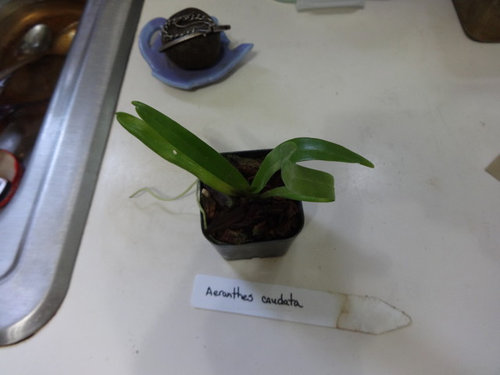
Aeranthes caudata. I read a page about African orchids a week or two back, and was really taken by how beautiful they are, but I'd pretty much forgotten genus names by the weekend - consciously, anyway; perhaps a part of me remembered and that's why I decided to pick up this one.

The sellers had pictures
with the plants to show their flowers, but they were close-up shots, so BOY WAS I
SURPRISED when my research at home showed these babies end up with
looooooooooong pendulous flower spikes, and loooooooooooong flowers, too. (I'm excited!!) At some point, I suppose the
Aeranthes isn't going to be able to sit on a shelf, unless I perch it
right on the edge . . .


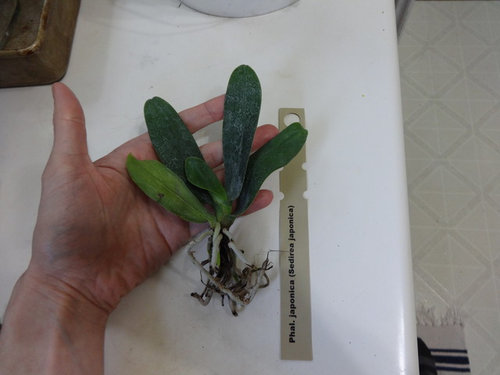
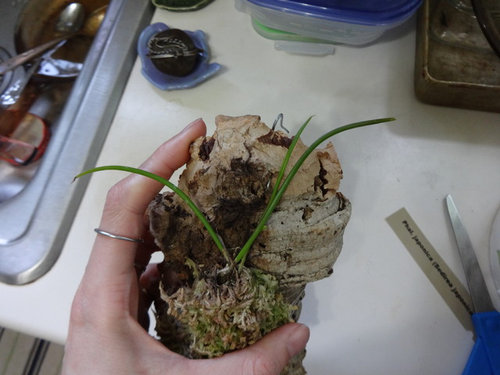
Phalaenopsis japonica (aka Sedirea japonica)


Not
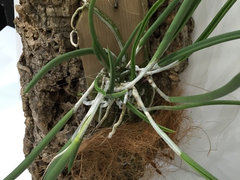
in the greatest condition, so I am concerned about it; I'm hoping I can get it more hydrated and
happy. (I'd also love to get rid of the water spots, but that's secondary.) One site I was reading earlier today said to never let their
leaves get wrinkled because that's basically a doomed plant. I hope that is
wrong. I also thought its care would be similar to common, grocery store
phals, but NO, it seems to have some striking differences. I gave it a good long drink and potted it up with a bark and perlite mix, so here's hoping I can get it more hydrated w/o more roots rotting and keep it happy.


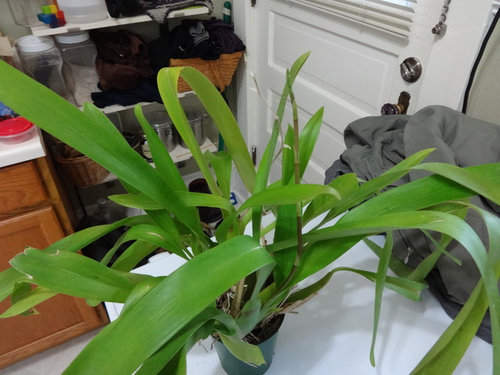
And
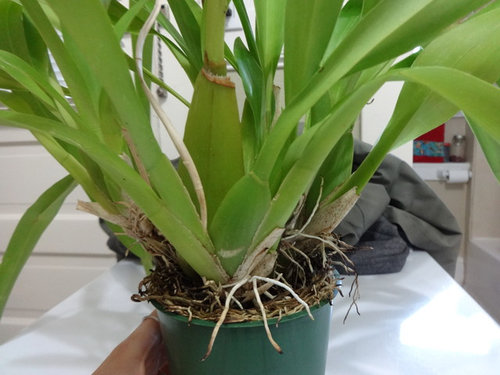
my mystery intergeneric, which I grabbed because it's about to overflow the pot,
and it had a flower spike growing, and look at all those fat happy
pseudobulbs! and that apple-green foliage! so I thought it would be fun no matter what the flowers
look like.


I found a couple more shorter spikes getting started when I
got home and admired it in more depth. The seller was fairly certain it's a catatante (onc. or colm. or wils., if I understand my notes right), which would
certainly be exciting to see in bloom! I'm definitely considering
repotting it when it's done blooming, but I don't know if I'll want to
separate it or keep it one big awesome mass.


Based
on the (brief) overviews of care I got from the sellers, I felt
reasonably confident about being able to keep these plants alive, but having now
done a LOT more research, I'm kind of freaking out. The
brassavola and the mystery onc/whatever I think will be relatively easy to keep
happy, but the others seem a bit more complicated and touchy.


(Nerves didn't
stop me from an additional impulse purchase online earlier today, a Dendrobium laevifolium, because it was on sale and I'd been coveting similar plants at the show; I
think it's time I admitted to myself I've been bit by the orchid bug.)

Comments (17)

  • 10 years ago

    They are so cute! I like sedirea, it is fine plant and fragrant too! I think it's easy grower.

  • 10 years ago

    I know how you feel. I remember my first show. You want to pick the right one but how? You did good. One trick I did that seemed to work was to buy a blooming plant each month to try to have blooms all year. After a while I decided to get the plants that liked the culture I had to offer rather than creating special environments for each plant.

    This is kind of a local issue. Joining a local society will advance your cause the fastest. Find out which types are common to collections. Take notice of what the non greenhouse growers keep. At some point in the addiction will start to contemplate your own green house.

    That comes with full addiction. Also at the meetings you will be asked to stand up and say "my name is blank and I'm an orcaholic". Welcome to the bright side...

  • 10 years ago

    The seller had a sedirea at the table in bloom (for display only, I think), but I couldn't detect the fragrance at all! My sense of smell has off days, I think; he said it was currently fragrant. It's a cute plant anyway.

    My first show was easier, I think, because I knew so little, so it was easy to just admire the plants as mysteries far beyond my knowledge. (I bought two last year, and the Schoenorchis is still alive and growing, just slowly.)

    I've been trying to only buy plants that can tolerate occasional drought, because I get a little spacey, and things can (and do) dry out here in the summer; I've got other houseplants that suffer that way, too, no matter how I try to check their moisture every day.

    I think I am going to start going to the local society meetings; I've got too many plants now not too, LOL. I don't want a greenhouse, though! I want the plants in MY space. (Or I want my living quarters inside a greenhouse, that would work too.)

  • 10 years ago
    last modified: 10 years ago

    The challenge is to grow a plant that might need some "weather" in a home with less weather. Someone should compile a list of plants that like indoor conditions.

    One from your list is pictured in the link below. Easy indoors? No idea, but you will have fun trying and if it blooms it will be a triumph.

    Brassavola cucullata

  • 10 years ago

    I have Brassavola nodosa. This plant needs a lot of sun, particularly in summer. But I can say it is easy plant for indoor growing, it likes to be on dry side and cooler temperatures are fine.

  • 10 years ago

    You made some nice selections, I hope they do well for you. I think you will find orchids can be more forgiving than most house plants.

    I have a few orchid books that I use to help me make selections. Seeing the plants before you go to a show will help you narrow down what you like. They also give you info on where the plant grows. If you see a plant that lives in the wild over a broad area and in a wide range of habitat, you can guess it will adapt to you easily. If you see a plant that comes from a limited area at a specific elevation you can guess it will be diffulicult. You can pick up other clues like, if a plant comes from a deciduous forest with seasonal dry periods, you can expect to need a cool dry rest in the winter.

    Another good resource is Andys Orchids web site. They have simple care info for a large number of orchid species.

  • 10 years ago

    I did try to get plants that can handle more-or-less "normal" indoor conditions, 'cause I am not up for trying to create tiny specialized enclosures. Anyway, I don't have a/c, and I keep my windows open a lot during the warmer months, so I get a little more "weather" than some people do, LOL, and it'll be plenty warm, but not /too/ hot in here during the summer. Then the phals will get to sit on the (enclosed) back porch for a week when temperatures cool, otherwise the apartment won't get cool enough to get them to spike. They might like cold nights, but I do not!

    Northern Orchid, for "a lot of sun" for the brassavola, what does that mean? Direct sunlight? For how long, and what hours of the day (morning vs midday?)? How much different does direct sun through a window make compared to if the plant were outdoors? Right now I've got it adjacent a south-facing window where it'll get direct morning sun for a while, and it'll get pretty hot by late morning/noon, then it will be shaded from noon on, but still very bright.

    Thanks for the reminder about Andy's, James; I'm pretty sure I've seen that site before, but I've been reading A LOT in the last several months, trying to make my own collection of culture notes, and things are blurring together . . . their summaries are nice compared to some others I've seen recently.

    What books would you recommend?

    You know, I've got a few kind of fussy houseplants already, especially compared to some of the orchids I had before the show, and I've been keeping them alive and growing (just sometimes unhappy), so I probably shouldn't be concerned, but. Anyway. I worry about my non-fussy houseplants, too.

  • 10 years ago

    That little statement "lots of sun" depends on where you are in the world. "lots of sun" does not apply at latitude 33S where the orchid pictured in a post above is growing in a glass-house. It is growing high up in that glass-house where the searing sun is broken by the hail guard shade-cloth and dirty glass.

    We wont even go into the temperature extremes where it is growing, suffice to say that a Phalaenopsis would not survive there. Hopefully, the orchid is can adapt to your moderate growing conditions.

  • 10 years ago

    Yeah, that, too (latitude, altitude, how cloudy it is here for 6 months, etc.).

    I got the brassavola from a grower in Seattle, which isn't terribly different from Portland, so I feel reasonably confident that if -I- pay attention, the plant will be fine. At least I am pretty sure I asked about growing in household conditions; I tried to remember to ask that specifically, though I spaced out on asking more detailed things like "what does that really mean, that it wants bright light."

  • 10 years ago
    last modified: 10 years ago

    I live in Alaska, and " a lot of sun" means for me as much as possible you can provide plus artificial lights. My plant grows on slab, has very healthy roots but never bloomed in two years. I understand that orchid does not have enough light, all new growths are smaller than original. I have southern windows (but I cannot keep plants on windowsill during winter) and I'm keeping lights all the time (but my lights are not exactly "growing light", just some high output LEDs). Unfortunately, in my conditions I cannot have vandas, dendrobiums, cymbidiums, but phalaenopsis and oncidiums are fine. Cattleyas are not growing well, but iwanagaras just thriving!

    Brassavola nodosa growing indoors in Alaska

  • 10 years ago

    Wow. That helps - thanks. That's a pretty plant! There was another brassavola I was eyeing, it might have been a nodosa . . .

  • 10 years ago

    Nodosa is easy grower, cuculata is bit complicated, but both need good and strong light during growth period. And good watering and fertilizing too.

  • 10 years ago
    last modified: 10 years ago

    I grow B.nodosa and cucullata in the same set of conditions, both are high light orchids. They are high up in a glass-house and get high light. Your problem in North West USA would be to get enough extra light via artificial lighting. The sun is the enemy here......

  • 10 years ago

    Yeah, I've accepted the fact that I'll need to get lighting set up for next winter, though I am hoping I won't need it during the summer, too.

  • 10 years ago

    Oh well. My first mistake was a reliance on artificial lights. Doesn't work well with brassavolas, vandas, dendrobiums. We are not getting virtually any sun from November till mid-January. Many orchids just cannot tolerate this period, even with lights. Hopefully, Oregon is better and good lights will help in the winter!

  • 10 years ago

    Our shortest days have about 8 hours of light - however, west of the Cascades, from Oct/Nov through April/May (and sometimes June) is our rainy season, so we have lots and lots of overcast days. :| Most of my houseplants seem to be okay with what light we get during that time, but I've got a couple that I have to keep within a foot of the south-facing window or they etiolate like crazy. I have others that don't look distressed, but would benefit from more light - a lot of my plants even started putting on new growth in December after a fall rest, which really surprised me! (Including some of those wanting MORE LIGHT.) But anyway, lighting's on my mind for several reasons.

Sponsored
J.Holderby - Renovations
Average rating: 5 out of 5 stars4 Reviews
Franklin County's Leading General Contractors - 2X Best of Houzz!