Software
Houzz Logo Print
robinava

Peppers not sprouting in flats

10 years ago

Weeks ago I planted a variety of hot and sweet peppers in covered flats and maintaining a temperature of 75-80 degrees. Some are from saved seeds while others are from new seeds. This year they are not growing. A few weeks ago I did a second planting and only a couple of seedling came up. Can anyone tell me what I am doing wrong?

Comments (19)

  • 10 years ago

    Sometimes it is just a matter of being patient since peppers will take a little longer than tomatoes, eggplant or Cole crops, hot peppers take longer than sweet types. But as you get past 2 weeks at those temps your germination chances diminish drastically.

    You could try soaking seed, soaking in gibberellic acid/ salt Peter soln. or just keep the soil moist until plants emerge. Your seed saving ,methods could play a role as well as seed storage. The trick of storage is to keep seed consistently cool and dry.


  • 10 years ago

    This is my first year of growing a variety of hot peppers. I soaked seed in diluted chamomile tea first. I did not get even germination and in some cases only one plant instead of 3. I haven't gone back to check if one source had poorer germination rates than the other. I recently took a seed starting and transplanting workshop. The instructor emphasized that the seed starting mix has to be damp or it will never get wet enough for the seeds. We spritzed soil in our little pots with water. Then placed seeds which we spritzed with a special solution of water with an aspirin and a large pinch of dried kelp. Added soil to cover. Spritzed with water again. But darned if I noted how much aspirin (I think it was half a tablet in a quart container) and I don't see it mentioned in the handouts. There's a possibility that your soil mix wasn't wet enough. My room is only 60-65 degrees but I used a seed hot mat which is on all the time.

  • 10 years ago

    Did you water the soil mix thoroughly? What type of soil are you using? I usually only need to water once and cover and don't water again for a few days after the seedling sprouted and is put under lights.

  • 10 years ago

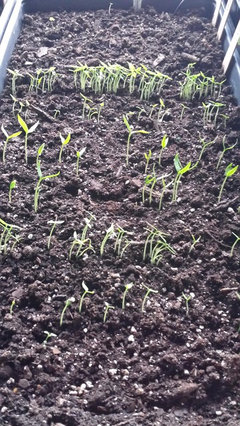
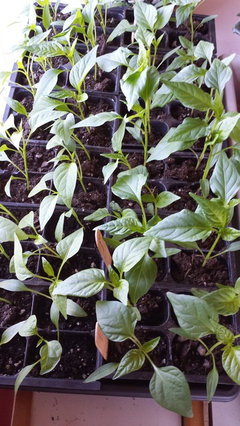
    I have no problem starting peppers in flat.

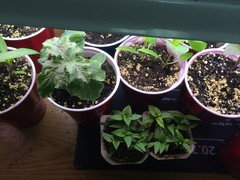
    Top and bottom ones are hot peppers. Middle ones are bell peppers.

    First batch, almost ready to harden off.

  • 10 years ago

    Redsun, I took the class because I couldn't figure out how people could start seeds so densely seeded (your top photo). Do you let your mix dry out when you try to separate the seedlings? I lost some tomato seedlings because soil was very wet and roots were damaged. I was using a plastic fork and maybe that was the problem. What kind of tool do you use?

  • 10 years ago

    Densely packed, just wet the soil before you hand separate but not sopping wet. The bottom two yougart cups have chocolate habaneros super densely packed. Hand separate semi-carefully and pot up. A few snapped roots are ok.

  • 10 years ago

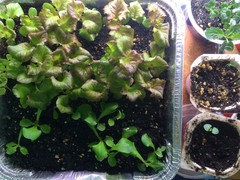
    I am doing Lettuce the same way right now they are hardening off and I will soon separate and plant them.

  • 10 years ago

    In the workshop she had seedlings in flexible pots, very lightweight plastic. By dumping them out with dryish soil, they were easy to separate. OTOH when I planted hot peppers I only put one seed in each of three sections of a 6-pack so it worked ok except I can put a lot more seeded starter cups on my one and only heat mat if I use the densely seeded method. I'm just amazed it worked so well.

  • 10 years ago

    defrost49, the potting mix is half wet/dry. I took out the seedlings using things like plastic fork, or letter opener. Do not wait until the seedlings are large sine the roots are tangled. Then I just separate them by hand. Pull the tiny leaves, not the stems. I may lost a couple of plants, but I'm fine with it.

    This way, I can start a lot of seeds in one flat tray.

  • 10 years ago

    Here are some of my cucumber seedlings. I know a lot people do not recommend start cukes indoors. But I have never had problem with this. Also I need to get some seedlings for friends.

    It took only a couple of days to start the fresh seeds. I can start a hundred or more.

  • 10 years ago

    I never pull leaves to separate plants. Much better to handle root masses to separate and only hold leaf to guide seedling in new cell (pot) as media is scooped around plant. The tools I use are table knife and soup spoon.

    Hard to believe from picture but this tray has 6 separate rows of different variety pepper plants. A knife (or letter opener) allows each row to be separated and removed in sections. This tray definitely should have been transplanted by now but I've been putting it behind others that are more desirable varieties.

  • 10 years ago

    Just finished transplanting last 6 flats of peppers to 6-packs. The 6 flats produced 29 flats of 6 packs, close to 2400 plants. I prefer slightly dryer media to separate root masses but I also toss smaller plants to the side and "Group" them together in 72 cell trays. Most plants are now in 48 cell trays. Sorting plants gives all plants a better chance after transplanting and takes less room than it all are put into 48 cell trays. I hardly ever loose a plant and I work fairly fast so small plants only have roots exposed for a minute or two.

    I do lettuce and cucumbers much different. Lettuce is usually planted as Pelletized seed to achieve one plant per cell in a 7x12 cell single form tray- and any doubles are tweezer pulled as soon as plants emerge. My cucumbers are started in flexible 4-pack cell packs ,3-4 seeds per cell. Those are transplanted directly to soil with minimum rootball handling. I would not recommend separating cucumber, melon or zucchini seedlings as is typically done with peppers and tomatoes.

  • 10 years ago

    I had the same problem this year starting peppers. I finally just planted a lot more than I needed and have enough now. I had a hard time getting them to shed the seed so they could grow. On some, I actually pulled the seed off so they would start growing after it had sat like that for days. I had no problem last year, so I can't imagine what the problem is this year.

  • 10 years ago

    This is exactly what I did. After almost zero results with all of the conditions being optimal and waiting and waiting I replanted another flat. Still only got a minimal amount of seedlings. Planted several varieties all with the same results. Have enough now to fill my needs, have not had this problem in the past either.

  • 10 years ago
    last modified: 10 years ago

    I have not had any problems using coir. Just note as soon as the appearance of the first true leaves start to show I start watering with 1/8 strength fertilizer. I also bottom water them, and pot up once they show signs of being root bound. Stuck on seed sheaths tend to mean you are planting too shallow.

  • 10 years ago

    Thanks for your reply. My concern was not the first leaves it was getting the seeds to sprout. Have not tried bottom watering just might give it a try next year, too late this year.

  • 10 years ago
    last modified: 10 years ago

    I was meaning to stress that I have had great results using coir to start seeds in, as when covered in a flat it retains moisture well. I do not worry if I see some white fuzz starting on the tops. That clears up after they sprout, and the top drys out some. This year the temps in my closet were enough to get germination without use of the heat mat. Last year I used the heat mat with great results. I had so so germination using Miracle Grow, and Jiffy mix for starting. I will never use the Jiffy again. There was no in between once sprouts came up. Either it dried too fast, or damp off happened. Miracle Grow was a little bit better. Coir worked best, and it is what I will stick with from now on.

  • PRO
    10 years ago

    This year is my first deliberate attempt to grow chilies from seeds since I've been in California (I planted seeds in the ground in central Texas, and they grew), and so far I have only about one sprout from almost a hundred seeds. I used peat pellets that I rehydrated, and I'm thinking now I should have used coir, but I had not heard of it before. A year ago, I had a volunteer pepper plant, and that made me think that it would not be so difficult, but so far I'm not having luck. I put a row of six pellets with tomato seeds, and all of those sprouted, but tomatoes grow wild in my yard also, as does lettuce, if I allow it.

    I have not been adding extra heat, but the room they are is always in the 70s, and I have a plastic cover, which I thought would retain enough heat. Should I invest in a heating pad or wait for warmer weather? Last winter it was in the 80s in my garage for a couple of weeks, and I probably should have started them then, but that is not dependable.

Sponsored
Top Choice for Reliable Tile & Stone | Franklin County, Ohio