Software
Houzz Logo Print
dogcatlady

Sudden problem with rugosa rose

10 years ago

Hello,


I have been dragging these poor roses from state to state in pots, waiting until I finally bought a house. I finally did, in Asheville, NC (zone 7A.) I was hoping to get them in the ground in the next week or two.


Suddenly there is something terribly wrong! It has been very dry here, and I gave them a good soaking last weekend; at that time, they looked great. Yesterday it poured. Today, one plant looks horrible (see photos) and about half the others have scattered diseased leaves that look like the same thing.


I'm not new to roses but I'm no expert either. It doesn't look like anything I've seen and I can't find anything on the internet that looks like this!


The roses started in VA, moved to SC, and now NC. If I can pinpoint one thing I did wrong it's inadequate fertilizer, but that doesn't seem to fit with the sudden onset.

ANY help would be greatly appreciated!!

Thanks,

Ann

Comments (16)

  • 10 years ago

    Actually, the roses are still in the same pots they've been in for about 4 years. I was planning to amend my soil---that's why I'm late in planting them----I do have lots of clay and I have lots of work to do before I get them in the ground.


    When I watered them last week it was way overdue---they were wilted. So I'm quite sure it's not water overload. Yes, it rained yesterday, but the timing just doesn't seem right for an over-watering problem. I will drain their saucers today, but I still don't understand what's going on!

    Thanks so much for trying to help me!!

    Ann

  • 10 years ago
    last modified: 10 years ago

    Ann: I didn't realize that your roses are in pots ... Plastic pots plus saucers is a killer-recipe for potted plants. For roses to be healthy, take off the saucer, and elevate them on bricks, or wooden planks so rain water can drain fast. Plastic pot retain water well, and Rugosa hate wet-feet. Just 1 hour of soaking wet is enough to turn Rugosa's leaves yellowish.

    People usually change the soil in small pot every 2 years, due to salt-accumulation from years of chemical fertilizer. Since Rugosa hate fertilizer, and plastic pots can't be flushed while sitting on a saucer, there will be accumulation of salt after years of chemical fertilizer usage.

    Even in hot climate like Texas, there's proven research that roses are healthier in Smart-pot (breathable fabric) than plastic pot. If the plastic pot sits against a saucer, rain-water can't drain out fast enough. Rugosa likes it dry (known as "beach rose") .. . I would drill holes at the side of the pot so water can drain out faster during rain.

    Even with Austin rose (water-hog), I have to drill at least 4 holes around the side of plastic pot (about 1 " above the bottom) .. and all my 20+ plastic pots are elevated on wooden planks, with at least 6 large holes on the bottom.

    Peatmoss-based potting soil can't drain fast enough ... for every rose that I take out from the pot, it's soaking wet inside. It's hard to find pine-based potting soil (drains faster), so I always mix perlite with the MG-potting soil, for faster drainage during heavy rain. The problem with peatmoss-based potting soil? It looks dry on top, but soaking wet in the bottom. That's why I use a plain-bamboo stick to test for wetness way below, before watering the pot.

    If your annual rainfall is near or exceed 40", Smart-pot or terracotta pot (breathable) pot is best .. those don't have to be elevated on bricks.

  • 10 years ago
    last modified: 10 years ago

    Hi Ann,

    This just a guess because I don't grow any rugosas. I propagated roses from cuttings and if there is a problem with a mister so that a tray dries out, then my cutting leaves will look like your rugosas leaves. This will happen even if I correct the problem before the leaves show any damage. In the next day or so the leaves will show those dry dead areas.

    I'm guessing that the leaves sustained damage during that short dry spell and with regular water, they will make a full recovery.

    I agree with you that this is not due to lack of fertilizer.

    My sister lives across the bay from Seattle in an area that is cold and wet in the winters and warm and dry in the summer. There I always see lots of Rugosas, not on the beach but in people's gardens and in mass plantings along the highways. My sis lives on a lot with heavy clay soil and Rugosas are one other few roses that she can grow.

    Hope you enjoy Asheville. I used to live in the area and it is a great place.

  • 10 years ago

    Whoops sorry Strawchicago. Didn't refresh my screen or I would have known that you had already solved this problem.

  • 10 years ago

    The pots are the same ones they've been in for 4 years. For 4 years I have tried to keep them not too wet and not too dry, although I guarantee I have let them wilt before---- but that may have been in SC where their spot was shady (I lived in an apartment and had no choice!) So that may be the only reason they survived. Maybe this is from the combination of too dry and good sun. Wouldn't that cause a typical leaf pattern that many people would recognize?

    I'm hesitant to directly blame the pots and and over watering, as I have tried very hard to keep these things going for so long! It's hard to imagine one good soaking and then a big rain 4 days later causing this. Also, I went to dump the saucer and it was empty!

    I don't know if I have fertilized them since VA. I don't think so. I was trying to keep them in suspended animation until I could get then in the ground. I didn't want them to go crazy growing or blooming or anything else.

    Thanks for your suggestions and thoughts! I will just try to take better care, and get them into some perfectly non-clay soil ASAP!

    Sorry you had to leave WNC Val---- it is heavenly! :)

  • 10 years ago
    last modified: 10 years ago

    Ann: A big rain will cause that leaf-problem. I recognize it since I bought roses and left inside the plastic grocery bag outside. After a heavy rain, and within one day, I saw the leaves of Duchess Rohan turned completely yellow: I had to prune it down from 2 feet to 6 inch.

    Last spring another person from Canada posted her Rugosa with the same yellowish leaf-problem. She had her in a plastic pot, on a saucer in heavy rain !! The year before another person asked the same question here why her Rugosa turns yellow in clay with rain. That's 4 people to confirm the yellowing caused by heavy rain.

    Never underestimate the heavy rain's damage. I once went outside during heavy rain to adjust my 3 rain-barrels, and saw the overflow which went into a 32 gallon garbage can: that filled up in less than 10 min. One heavy rain is enough to drown any plants in plastic pot. The yellowing is from "drowning", or lack of oxygen when the pot is soaked to max with water from heavy rain.

    Jim who used to post in this forum didn't believe my answer that rain can cause such yellowing. He called his friend who grows Rugosa and his friend confirmed it: In clay or poor-draining peaty soil, Rugosa turns yellow with heavy rain. Being a drought-tolerant rose, it CANNOT handle that much water at once, it simply drown.

    http://homeguides.sfgate.com/fertilizing-rosa-rugosa-45379.html

    "The plant is drought tolerant once established, only requiring an inch of water per week in the heat of summer."

    Here's from the pro: Spring Valley roses nursery:

    http://www.springvalleyroses.com/inthegarden/fertilizing.html

    " What Type of Fertilizer You Should Not Use:

    One fertilizer that we absolutely do not recommend is liquid chemical fertilizers like Miracle Gro -- particularly on Rugosa roses. If you do, you stand a very good chance of burning up the plant. Rugosas are the toughest roses we grow, but they just can't handle the high nitrogen and chemicals salts in Miracle Grow type fertilizers. If you don't believe us, just go ahead and apply it to the leaves or around the base of a Rugosa plant. You won't have to wait more than a day before the leaves turn yellow and crispy. Then, you'll believe us and start using compost instead. " Spring Valley Roses Nursery.

    Field Roebuck from Texas wrote a book "The Complete book on roses" which he gave different formulas for potting soil, with the emphasis that the MG-potting soil of peatmoss is meant for INDOOR use, and NOT for outdoor rain. The force of rain hitting on such a small container will instantly drown roses if it's in a peat-rich soil, without fast-drainage at bottom.

    The reason why Rugosa is known as "beach rose" is it's very drought-tolerant, and CANNOT handle being drown in heavy rain. I see that problem every year with my neighbor and her Rugosa rose .. She got tired of its turning yellow during spring rain in our clay, so she killed it: she poured gasoline on its roots and put a garbage can on top.

  • 10 years ago

    strawchicago, I hear what you are saying, and I appreciate the references. But I have had the same plants in the same pots with the same good-draining soil for 4 years. Actually, now that I think about it, it was really 5 years. Two in VA, two in SC, and almost one in NC. Last summer it rained almost every day and they were fine. The soil I have in those pots has apparently served them well through thick and thin. Last night's rain was completely drained from the pots and saucers by the time I posted this morning and checked the saucers.

    And please note: I have NOT fertilized them. And when I do, it'll be compost.

    I will just get them in the ground ASAP and keep my fingers crossed. I am planting them with a row of lavender, in a nice hot spot. I bought sand and gravel to mix into the soil so I think they will all be happy.

    Thanks again everyone!

  • 10 years ago
    last modified: 10 years ago

    Thank you, Ann, for your honesty .. that helped me to trace the real problem. Just found that North Carolina, esp. Ashville, is known for acid-rain. When the pot sits against a saucer, acid-rain & fertilizer salt can't be flushed out.

    Before putting that rose into the ground, I would flush, or soak the root-ball in a bucket of tap-water. Tap water pH is alkaline, above 7.5 (municipals add hydrated lime so pipes don't get corroded). Rinsing the root-ball will remove any salt accumulated in pots from previous years' fertilizing, plus neutralize the acid-rain effect on roots. Then I would do a pH-testing of the soil, to see if lime is needed.

    One year I got a band-rose from a nursery that had bleached & wilted leaves .. it was entombed in pine-bark fines, with pH below 4 when soaked in rain water. I had to dislodge the pine-bark in a bucket of tap water & rinse off any accumulated

    Below is a procedure called "Cheapest soil pH test using red cabbage juice" which I wrote in this forum, to check for soil pH & add lime in case soil is too acidic.

    http://forums.gardenweb.com/discussions/2132487/cheapest-way-to-test-soil-ph-using-red-cabbage

    One time I googled for the pH value of bagged top soil, a government site measured the pH of bagged soil in North Calorina and it registered 4, very acidic. My Chicagoland is very alkaline, and the pH of bagged soil came out near 8.

    When I checked on the pH of rain water, Wikipedia stated that the west coast has higher pH rain water, but the east coast has more acidic rain water. So I tested my rain-water in Chicagoland with fish tank litmus paper, and it registered 6, way more alkaline than known 5.6 pH of rain, I'm next to a limestone quarry.

    Google "acid rain" and North Carolina is listed among the states afflicted. Here's an excerpt about Acid rain from North Carolina State University. pH of vinegar is 2.4, it's alarming that acid rain can be that range.

    http://webprojects.oit.ncsu.edu/project/bio183de/Black/chemreview/chemreview_reading/acid_rain.html

    " Rain is always slightly acidic because it mixes with naturally occurring oxides in the air. Unpolluted rain would have a pH value of between 5 and 6. When the air becomes more polluted with nitrogen oxides and sulphur dioxide the acidity can increase to a pH value of 4. Some rain has even been recorded as being pH 2." North Carolina State University.

    Here's from The New York Times website, 4.4 is very acidic like peatmoss, there's regional variations. I gardened in CT before (South Windsor), it wasn't that acidic, but that part of CT was open land, with no factories nearby to cause acid rain. New York Times is right, my brother has to lime his soil in Michigan.

    " The states listed as extremely vulnerable to the effects of acid rain and the average pH of rainfall were Connecticut, 4.4; Kentucky, 4.4; Maine, 4.4; Massachusetts, 4.1; Michigan, 4.4; New Hampshire, 4.3; New Jersey, 4.3; New York, 4.2; North Carolina, 4.4; Pennsylvania, 4.2; Rhode Island, 4.4; South Carolina, 4.6; Vermont, 4.3; West Virginia, 4.3, and Wisconsin, 4.5."

    http://www.nytimes.com/1981/10/06/us/states-are-rated-in-acid-rain-study.html

    RALEIGH -- Gov. Jim Hunt will host a regional conference next year seeking solutions to smog, acid rain and other air pollution problems in the mountains of North Carolina and other Southeastern states.

    Air pollution and acid rain are linked to a number of related problems in the mountains: Haze that obscures views even on the sunniest days.Ozone smog that harms people’s health and damages trees and crops.Dying trees on high peaks in the Great Smoky Mountains and along the Blue Ridge Parkway. Acidification of soils, streams and lakes." http://www.enr.state.nc.us/newsrels/acidrain.htm

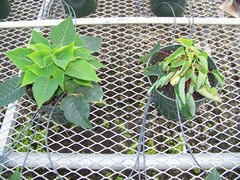
    Below pics are from the internet when I googled "plants in low soil pH"


    Below pic. showing both acid rain and salt effect on Poinsettia on the right:

  • 10 years ago
    last modified: 10 years ago

    Here's an internet pic. entitled "Acid rain damage to trees"

    More pics. of acid rain damage to plants:

    From National Geographic: http://environment.nationalgeographic.com/environment/global-warming/acid-rain-overview/

    "When humans burn fossil fuels, sulfur dioxide (SO2) and nitrogen oxides (NOx) are released into the atmosphere. These chemical gases react with water, oxygen, and other substances to form mild solutions of sulfuric and nitric acid. Winds may spread these acidic solutions across the atmosphere and over hundreds of miles.

    Acid rain makes waters acidic and causes them to absorb the aluminum that makes its way from soil into lakes and streams. This combination makes waters toxic to crayfish, clams, fish, and other aquatic animals.

    Acid rain also damages forests, especially those at higher elevations. It robs the soil of essential nutrients and releases aluminum in the soil, which makes it hard for trees to take up water. Trees' leaves and needles are also harmed by acids.

    The effects of acid rain, combined with other environmental stressors, leave trees and plants less able to withstand cold temperatures, insects, and disease. The pollutants may also inhibit trees' ability to reproduce. Some soils are better able to neutralize acids than others. In areas where the soil's "buffering capacity" is low, the harmful effects of acid rain are much greater.

    The only way to fight acid rain is by curbing the release of the pollutants that cause it. This means burning fewer fossil fuels. Individuals can also help prevent acid rain by conserving energy. The less electricity people use in their homes, the fewer chemicals power plants will emit. Vehicles are also major fossil fuel users, so drivers can reduce emissions by using public transportation, carpooling, biking, or simply walking wherever possible."

    http://environment.nationalgeographic.com/environment/global-warming/acid-rain-overview/

    Ann thanked strawchicago z5
  • 10 years ago

    I have friends who live about a half an hour from Ashville in Marion. You can see Mount Mitchel from their farm. They grow beautiful roses in that beautiful red clay that I miss so much, I trade it for my deep Florida sugar sand any day. They don't get spotting from Acid Rain.

    I grow roses in plastic pots for a nursery. I can say from my experience that roses can grow in the same pots and the same soil for many years. We don't have problems until there is more root than soil which makes the plant hard to keep hydrated. We get lots of rain and I have not had problems with over watering. Of course our pots have adequate drainage and release all that extra water within a few hours of the rain stopping, which in Florida can be hours or sometimes days. We water until the water runs out of the drainage holes and that will wash the soils of excess salts.

    I saw Rugosa roses when I was in Japan last year, one of the places that they are native. Japan experiences periods of high rain fall and they have very few sandy beaches. The Rugosas are found in many different soils but you do see a lot of clay in Japan, Rugosas are famous for their ability to tolerate salt spray and sandy soil, that doesn't mean good clay loam and regular fertilizer will hurt them. I asked my sister about her Rugosas last night. She told me that the only danger with fertilizing Rugosas is that they will take over the garden, HAH, she's funny.

    Enjoy the spring. I'm gonna to try to make it back there to see the wildflower blooms, I love the mountain rhododendrons.


  • 10 years ago

    Val, Mount Mitchell is where they got 60" of snow this winter! Happy to report we got about 12" that day!

    I still think the overdrying theory makes the most sense, and sort of explains the crisp delineation between normal and abnormal. Also, I may be reaching that point where root volume is more than soil volume! Acid rain does not seem to manifest that way, nor does it explain the sudden onset. Overwatering doesn't explain the problem either. I no longer remember what type of soil I used in those pots but clearly it wasn't a problem or they would have died long ago.

    If overdrying is the problem, I know they'll do much better when their roots can spread out more in their newly chosen spot. I think I will let them recover this week and plant them next weekend.

    If that diagnosis is incorrect, I'll know soon enough!

    I'll let you know what happens!


    Thanks again,

    Ann


  • 10 years ago

    Good luck

  • 10 years ago

    Just a quick visit, Straw, please tell me how you use the bamboo stick to test the soil for moisture?

    the discussion on acid rain reminded me of a time in my previous garden, when a while ago, a volcano in Chili erupted. The wind brought the massive column of smoke over the Atlantic ocean, straight over-and-past the south coast of SA, with a lot of rain. Nearly everything in my garden started wilting. I had no idea what to do, but it was confirmed that this event happened and that the column of smoke/dark grey cloud was in fact caused by the volcano, by the news the next day.


    the only thing I could think of right away was to use an organic high-Nitrogen solution with growth hormone, mixed with water. the garden took a long time to recover.


    I realize now, thanks to this forum, on how to heal soil organically... thanks for the info, Straw, Sam and Khalid!!!!!!!!!!!!!!!!!!!!!!!!!!!!!!


    Still waiting for my chair...missed you, will be back to normal soon :-)


  • 10 years ago

    Hi Ann, I had something which looked very similar to your rose, it was very rapid yellowing/drying of leaves. Here were photos of my rugosa: http://forums.gardenweb.com/discussions/3274907/what-is-wrong-with-my-rose-leaf-tips-crispy-plus-yellowing

    I believe it was due to calcium deficiency due to the roots at the bottom of the pot starting to rot due to it being pot bound and a heavy watering I had given it a few days prior.

    It sounds like the watering might not be the issue for you, but it might be the pot bound roots like you say. What helped me is to pull the pot off and examine the roots - that's when I noticed they were starting to rot.

    Ann thanked prairie_northrose (3b north of Calgary AB, Canada)
  • 10 years ago

    Hi Prairie northrose, your photos look amazingly similar to mine EXCEPT in one photo the problem is not at the tips but at the bases of the leaves which is a big difference! Maybe you had a combination of things wrong at that time?

    I think the bottom line is that by keeping the roses in pots they are much more susceptible to everything---overwatering, overdrying, excesses and deficiencies of nutrients and salts, and compaction/bound roots.

    My problem stopped in its tracks. The tips and dried leaves are now crumbly, and the rest of the plant is perfect, which I think 100% supports Valrose's theory. I'm surprised it never happened before! But as the other problems worsen from years in those pots, all of the other risk factors worsen and I think all sorts of problems would surface if I waited much longer.

    I think it's impossible (and also unnecessary) to identify what's causing the problem when a simple transfer to the ground or repotting would fix it. Now infectious disease is another story--of course diagnosis is far preferable in that case, although improving the rose's conditions might solve that too by making it less susceptible.