Software
Houzz Logo Print
aegis1000

Let Mites arise ...

10 years ago
last modified: 10 years ago

I'm seeing signs of Broad Mite in (3) plants.

I've isolated, and sprayed with Forbid and AzaMax.

Is there any other advice to try to salvage my plants ... or should I just get rid of them ?

Two are easily replaceable, ... one, ... not so much.

Comments (16)

  • 10 years ago

    I found this in Wikipedia :

    Management

    "While a number of miticides are labeled for control of this pest, insecticidal oils or soaps are usually just as effective and less toxic to the environment. For large area or greenhouse control, biological control agents are available, including several species of predatory mites (Wilkerson 2005, Peña and Campbell 2005, Fan and Petitt 1994, Peña et al. 1996). In addition, hot water treatments may be used to control the mites without injuring the plants. This involves lowering the plant into water held at 43 to 49° C (109.4-120.2° F) for 15 minutes ."

    Does it help ?

  • 10 years ago
    last modified: 10 years ago

    Thanks, Leon ...

    I've fought Broad Mites before ... and saved just a few plants.

    In other words, ... I lost.

    I'm thinking that it might be best to ditch the affected plants ... and, maybe, replace them later.

    I'm needing to discard some number of plants, anyway ...

  • 10 years ago

    Leon -

    there is a difference between control and total eradication. Whatever you found in Wikipedia - it belongs to the category - control. If you have mites on your roses - fine. At home - you have a monoculture food source, absence of natural predators, mild temperature - mites will propagate like a forest fire. Outside - if you reduced the mites 100 times - you are fine, the roses will do OK, natural predators will keep the remaining mites under control. At home - you had 10.000 - and reduced them to 2. You are back to a massive infestation in a month.

    Regarding the predator mites - it is again - control, will work in large greenhouses. If you look at the models of predator-prey numbers - predators destroy most of them and then starve - leaving several prey in hiding.

    Cannot say anything about Forbid in relation to broad mites. Had a fantastic success with Forbid in a case of cyclamen mites. Azamax is a Neem oil derivative. Also - control. Kills the mites on contact, doesn't kill the eggs, not systemic. There are pretty powerful systemic miticides around. Not cheap though.

    Aegis - if you take leaves from affected plants, dip them in 1/3 alcohol - and put them for rooting, you will be OK. But - if there is one infected plant - usually you can safely considered all of them infected. The infection spreads fast and shows everywhere - if it is not the case - may be it is something else?


    I.


  • 10 years ago

    I fought broad mites and used Forbid. On the advice of a very knowledgeable grower, I dipped the plants in the solution to get complete coverage. One treatment was enough and they were gone. About 18 months later, I found one plant with mites. This time I used Forbid in a spray bottle and treated the affected plant and its near neighbors. No more mites.

    Mites are the one pest I fear and I hope to never find them again. If so, I've developed a strategy. I will spray/dip my favorites, toss some and keep leaves of others after dipping these in the Forbid solution. Its easier to treat leaves than the whole plant.

    Hope you get rid of the little critters!

    Terri

  • 10 years ago

    Yeah ... I'm thinking ... toss the affected plants, toss or spray any adjacent plants, and see what happens.

    Fortunately, this was in an isolated corner. I've had Mites before, so I've been careful to use caution in how I care for my plants to prevent any similar spread ...

  • 10 years ago

    How do the durn things appear ? What are the symptoms that make one look to see if there's an infestation

  • 10 years ago
    last modified: 10 years ago

    I had broad mites. I tried the hot water dip. The geranium, the schefflera survived. The African Violets did not.

    I used Spectracide Triazicide to spray every 3 days. That or the tobacco tea worked.

    I recommend, if you can, replace the plants but mites can hide and live without plants for a long time. I routinely spray every newly introduced plant with Triazicide. No plant or plant material comes into the house without being sprayed, at intervals of a few days for 10 days. Everything is isolated for a while afterwards. Cyclamen mites must be sprayed with Forbid or one of the other specifics. Triazicide is only listed for spider and broad mites.

  • 10 years ago

    Leon

    Mites come in from outdoors or from plants brought into the house. I think mine came on begonias I bought at the garden center.

    I bought carnations a few days ago to grow indoors. I grow begonias, pansies, lobelia, geraniums and now carnations indoors. I have many windows, no neighbors and lots of light so that is possible for me. The carnations were sprayed and sprayed and are now isolated.

    Broad mite infestation is easy to spot on some plants, schefflera, diffenbachia but not so easy on African Violets. There are websites with photos. If you have them, you will know it. It looks like the plant has been hit by a blow torch.

  • 10 years ago

    Good info, I need to restock on bug juice myself. I hate having to toss a plant for bugs, but my collection is roo large to risk in its entirety. I get the worst issues in the warmwr months, when I leave my doors open to air out the house and all the little monsters can come in.

    Good luck, I hope you slaughter the little vermin and all your plants pull through. I am battling aphids on one of mine right now.

  • 10 years ago

    lucky123, can you provide a site I can go to in order to get some images of the infested AV's ?

  • 10 years ago

    Thanks.

  • 10 years ago

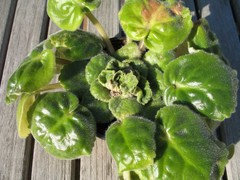
    I found a pic

  • 10 years ago

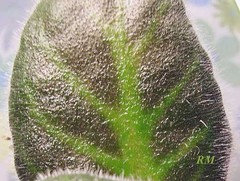
    Another one - this pic is made by Ruslan Mushustin, Ukrainian enthomologist.

  • 10 years ago

    Damage - on older leaves, the edges turn in, the surface of the leaf develops oily sheen and brownish spots. The older leaves die off faster, the plant is stunted - and easily succumbs to any infection.

  • 10 years ago

    Thank you for the information and pictures, Aegis and Irina.