

Oh Fungus…my nemesis
New England…Massachusetts
Sooo last 2 summers I have had issues with fungus in the lawn… I follow an organic program and have tried to avoid using fungicides where possible
The end of summer and Fall last year the fungus worsened (and perhaps the mild Fall/Winter had something to do with that) and now the areas that had fungus are not responding as well as the rest of my lawn
So…is the fungus still there due to a mild winter in New England? (freeze/thaw) If so, should I use a fungicide to treat?
If you don't think the fungus is still there how do I help the lawn recover? The rest of the lawn is doing well but it's very obvious where the patchy areas are (same as the fungus areas last year)
How can I prevent my nemesis taking over again this Summer? Besides good lawn practices should I use a fungicide as a preventative (I don't want to do this but also don't want to be behind the eight ball chasing this all summer)
Treatment so far:
Corn gluten meal (as a pre-emergent) April 1 and I will apply again this week (i.e. 4 weeks interval)
Jonathan Green's 'Magical'
Jonathan Greens 'Love your lawn love your soil'
Comments (33)
 10 years ago
Have you tried ordinary corn meal for the fungus? Application rate is 20 pounds per 1,000 square feet.
My experience with corn gluten meal as a prem was that it was worthless, but it makes an excellent fertilizer. For this summer, just to get ahead of the fungus, I would use only corn meal and nothing else.
Pippin thanked dchall_san_antonio
Pippin
Original Author10 years agodchall_san_antonio I tried corn meal the first year unsuccessfully… how does it work to prevent fungus and is it more than not successful?
Related Professionals
Morgan City Landscape Architects & Landscape Designers · Frederick Landscape Architects & Landscape Designers · Beatrice Landscape Architects & Landscape Designers · Mansfield Landscape Architects & Landscape Designers · Stockton Landscape Architects & Landscape Designers · Jacksonville Landscape Contractors · Southaven Landscape Contractors · Saginaw Landscape Contractors · Calgary Landscape Contractors · Orlando Home Builders · Covington Home Builders · New Orleans Home Builders · Augusta Home Builders · Kingman Home Builders · San Jose Home Builders- 10 years agolast modified: 10 years ago
Is there any peer reviewed scientific study on the effectiveness of corn meal other than what's referenced in the below post?
Cornmeal myth busted
Posted by Linda Chalker-ScottAs my colleague Fred Hoffman says, the horticultural silly season is upon us. This week I heard from one of our European readers, questioning the use of cornmeal as a fungicide. He referenced an online article entitled "Cornmeal has powerful fungicidal properties in the garden." He hadn't been able to find any reliable information and thought it might make a good topic for our blog. So Johannes, this rant's for you!
If you've followed the link to column in question, you'll see that the original "research" is attributed to one of Texas A&M's research stations in Stephenville, TX. But it's not really research - it's just an observation on what happens when you don't plant the same crop two years in a row; in this case, rotating corn and peanuts reduces peanut pathogens. This is hardly news - it's one of the reasons agricultural scientists recommend crop rotation as part of an IPM program. And have for decades.
Then we're referred to "further research" (at an undisclosed location) where cornmeal was shown to contain "beneficial organisms." Well, no, cornmeal doesn't contain organisms, beneficial or otherwise. Microbes can grow on cornmeal, and in fact cornmeal agar is commonly used in labs as a growth medium for many species of fungi. And has been for decades.
Nevertheless, we're informed that a gardening personality has "continued the study and finds cornmeal effective on most everything from turf grass to black spot on roses." This is directly refuted by Dr. Jerry Parsons, who by happy coincidence is an extension faculty specialist at Texas A&M. His informative (and hilarious) column on brown spots in lawns states "Lately there have been claims made that corn meal and a garlic extract is effective. This is absolutely false! Everyone trying to do the "environmentally friendly-to-a-fault" thing have been wasting their money. They would have been better off making corn bread and using their garlic for cooking purposes!"
Dr. Parsons continues: "Let me explain how these University tests and recommendations have been misrepresented in a desperate attempt to find an organic fungicide. The corn meal was investigated by a Texas A&M pathologist as a way to produce parasitic fungi used to control a fungus which occurs on peanuts." (This directly relates to my earlier point that cornmeal agar has a long history of use in fungal culture.)
It boils down to this: if you have a healthy soil, it will probably contain diverse populations of beneficial microbes, including those that control pathogenic fungi. You don't need to add cornmeal - it's simply an expensive form of organic material. So you can ignore the directions in the article on how to incorporate cornmeal into the soil, or make "cornmeal juice" to spray on "susceptible plants." Just nuture your soil with (repeat after me) a thick layer of coarse organic mulch.
(As a footnote, let me say how annoying it is when gardening personalities grant themselves advanced degrees or certifications in their titles. C'mon folks - if your information is so great, do you really need to pretend you’re someone else?)
Edit : Dr. Linda Chalker-Scott has a Ph.D. in Horticulture from Oregon State University
- 10 years ago
You want to get my blood pressure up, trot out Linda Chalker-Scott and her myths. Most of her myths are made up out of her head. This one has actual basis in fact. Unfortunately the facts have been unposted from the Texas A&M at Stephenville website. It was posted there from the mid 90s through the early 2010s and then disappeared. Further, as mentioned in the LCS message, Texas A&M would like to distance themselves from the concept of using corn meal. But wait! As I reread Dr Parsons' comments, he's changed his tune on the idea. Now he's calling it an expensive way to produce parasitic fungi..." He used to simply disavow it. Corn meal is the least expensive of all the organic materials - unless you count used coffee grounds that you get for free from Starbucks. These are similar to corn meal in that they produce copious amounts of the parasitic Trichoderma (try koh DER mah) fungus. Corn meal works by attracting Trichoderma as one of the decompositional microbes for corn. The population increases until all the corn fungi decomposers are gone. Then they turn to the rest of the environment and take care of the disease fungus. As it was stated in the original article, peanut farmers who follow up their harvest with corn meal would be able to replant peanuts year after year without having to sit out alternate years for the disease to go away.
Here's my experience. For years I had a low spot on my yard that held water longer than it should have. In about 2000 the grass there got a disease. The fungicides at the time required temps below 85 degrees to apply, so I could not use it in San Antonio. I dug up the grass and put new grass in. It got the disease immediately and died. It never cleared up by itself. In 2002 I heard about corn meal and tried it on my roses for black spot and powdery mildew. It worked on the roses so I tried it on the grass. It worked there, too. It was the first time in years I had green grass in that low spot. Back then corn meal was $3 per bag, so it certainly was not expensive. Even now it's only about $6-8 per bag, so I'm not complaining about the cost.
So I guess this is a myth that sometimes works for people. I've used it every year and had success. Others read about my experience, try it, and report back with positive experiences. Pippin did not have a good experience with it. When that happens I like to discuss it and maybe get to the bottom of the problem that caused it to not work, but that rarely happens.
The gardening personality Chalker Scott refers to, well, there are two of them, are Bob Webster in San Antonio and Howard Garrett in Dallas. I listen to both of them on the radio. Dr Parsons is also from San Antonio, so everyone here with a TV or newspaper is familiar with him. Personally when I read his advice, I run right out and do the opposite. He's never met a chemical that he didn't love. You can find him on YouTube if you like. Put on your Southern ears - he's very difficult to understand.
Pippin
Original Author10 years agodchall_san_antonio thanks so much for your comments - I only tried it once so I can't say that the one experience disproves the theory… can you give me some more detail as to how often you put it down? Or did you just apply it once in large amounts for it to work? Perhaps I didn't put enough down? I would prefer to use an organic method such as this than fungicides which go against developing a good soil and healthy microbes
- 10 years ago
avamom, I used cgm every month of the season, all summer long in San Antonio and all I got was an outstanding turf.
Pippin, I apply with a 2-gallon coffee can. To get 20 pounds per 1,000 square feet I eyeball a 10x10 foot area (100 square feet) and scatter the 2 pounds of corn meal into it. Then I reload the can and move 10 feet farther. If you have a large yard you could use a broadcast spreader to fling it out. Drop spreaders will work, too. If you have 2,000 square feet to cover, measure 40 pounds of corn meal and spread it as evenly as you can until it's gone. As I recall with my drop spreader I had it wide open and had to go over it twice to get it all down.
 10 years ago
Pippen, here's a link to US Soil Temps. You click on your state then further click on your location (keep zooming in). The soil temps are color coded. http://www.greencastonline.com/tools/soiltempmaps.aspx
Thanks dchail_san_antonio for letting us know you use it regardless of soil temps. I'm not sure I'm going to use corn gluten instead of Milorganite. As Pippen, I'm trying to stay away from more chemicals. We have had heavy recent rains here over an extended period so I'm wondering if applying an organic now may be prophylactic to prohibiting fungus grass damage.
Pippin
Original Author10 years agoI'm also concerned about the amount of rain we have had this week and its effect on the lawn - can anybody fill me in as to what kind of damage I could be causing by putting a fungicide down now? I am starting to wonder if the fungus I had last year which persisted in to late Fall is still around after the kind of winter we had
PS Last year when I put the CGM down no weeds but this last week they have all popped up…I think with the crazy weather we have had I didn't put it down soon enough even though I did so April 1 - I usually put down just before the forsythia flowers come out
dchall_san_antonio you put CGM down every month? Why do you do this? Isn't that going to be too much nitrogen esp if I have had a fungus issue? And what type of CGM texture do you use? I put it down with a spreader since I have about 5000 sq ft
Pippin
Original Author10 years agodchall_san_antonio(8 San Antonio)
Can you provide a little more info re corn meal used to prevent fungus? You commented that you put cgm down every month but I'm wondering how often you put corn meal down as a preventative?
My hypothesis re my lawn is that the fungus issues I had end of Fall last year went dormant over winter and with rain/ lawn mowing has reared its ugly head again (I am mowing high, irrigation in the morning, attempting to only water weekly though doing this in the extreme heat of late has left the lawn dehydrated)
I have dollar spot, leafspot and possibly brown patch…seems lie a great mixture - I'm most concerned about leafspot maing it to the next level of melting out if in fact it hasn't already begun that process
My question is this: if I apply corn metal immediately how fast will it start 'working' to eliminate the fungus or is the situation requiring a fungicide? (which I am desperate not to do since I have been working on an organic program to boost the health of my soil/lawn - at the same time I don't want to start losing my lawn)
- 10 years ago
j4 blurted: Is there any peer reviewed scientific study on the effectiveness of corn meal other than what's referenced in the below post?
Why the sudden urge for peer reviewed studies? Lack of that has never stopped you before (re aerating a lawn). :o)
Nothing in your post qualifies as peer reviewed science. It is just knowledgeable people making assumptions. In fact, the A&M study may well be good science, if not peer reviewed, but I guess we'll never know. dchall seemed to think it was a valid study.
Also, I find Parson's logic lacking. First he says corn meal is a waste of time to control bad fungus. Then he says healthy soil already has what it needs and you don't need to put down "expensive" corn meal, just use organic mulch instead. Why would we put either down on healthy soil? I guess he's saying that if the soil isn't healthy then corn meal won't work because it is expensive? Of course this ignores the probability that corn meal is far cheaper than organic mulch.
I agree wholeheartedly that peer reviewed research is the best route. Lacking that, anecdotal evidence like dchall and others provide gives some basis for continued observation. dchall is trying to build a case for/against cornmeal by observing the results that others have. He is collecting empirical evidence.
- 10 years ago
Serenade is something else to consider using. Do some research on the bacteria involved. It's not a chemical fungicide. - 10 years ago
@danielj_2009
The problem with backyard science like this is, lawns also grow out of fungal disease on their own. So if you dump a bunch of cornmeal and the fungal disease goes away, there's not necessarily a relationship of causality between the two.
- PRO10 years ago
I live in the tropics, hot and humid all year long. Fungus attacks normally starts during the monsoon season (Oct-Feb). And i can testify the corn meal works.
- 10 years ago
@j4: Maybe fungus goes away on its own in some cases, and not in others. Pneumonia goes away on its own, too, but the patient is dead by that time. Why not use it as a preventive measure in those situations where it works?
We have two guys just in this thread, dchall and Petrofac, who swear it works. It seems like they both have a long enough of a baseline with fungus on their property to say that the cornmeal did something.
Many great discoveries in astronomy were done, and continue to be done, by amateurs. Sometimes the experts have biases that they can't see beyond. Cue the music: "A'll we are sayyin' is give corn a chance..."
Pippin thanked danielj_2009 Pippin
Original Author10 years agoI have had this fungus problem for the last 2 years and since end of last year the fungus went 'dormant' and then has 'come back' even worse… so I'm not sure how long I have to 'wait' for it to go away on its own and in the meantime I don't want to lose my lawn which I understand can happen in the 'melting out' stage of leafspot… I bought some fungicide yesterday as a back up plan if the lawn starts to take a turn for the worse (I don't want to use it) but in the meantime I would like to try cornmeal… for the cornmeal advocates: how long did it take for your lawn to show improvement? Any online sources for bulk corn meal? (I have approx 5000 sq ft to treat) Did de-thatching help? Thanks for all advice
- 10 years agolast modified: 10 years ago
@danielj_2009(6b)
Funny how when it comes to ideas you don't agree with you require strong scientific proof, studies, papers etc. and when it comes to ideas you do agree with, the "testimony" of a guy that just landed on the forum posting for the first time is sufficient evidence. We call that hypocrisy around here.
We can agree to disagree, your lawn, your corn, if it makes you feel warm and fuzzy to use cornmeal, good for you.
Pippin
Original Author10 years agoj4c11 what do you recommend to treat fungus in lawn besides hoping it just goes away (which in my experience it has not)
- 10 years agolast modified: 10 years ago
j4c11 what do you recommend to treat fungus in lawn besides hoping it just goes away (which in my experience it has not)
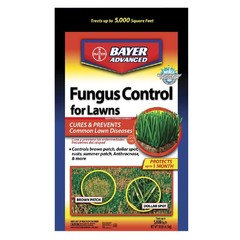
http://www.homedepot.com/p/Bayer-Advanced-10-lb-Granules-Fungus-Control-for-Lawns-701230/202019115
Pippin
Original Author10 years agoj4c11 so you don't use an organic program? chemicals the whole way?
- 10 years ago
I don't use an organic program. I mulch mow, mulch the tree leaves into the lawn, and apply synthetic fertilizer/herbicide/fungicide as needed. I keep chemicals to a minimum in my garden, but that's because I plan on eating to tomatoes, I do not plan on eating the grass.
- 10 years ago
Question:
Is there anything about corn in particular that attracts beneficial fungi to outcompete the bad one or would soybean meal work just as well? What about breadcrumbs?
- 10 years ago
The reason I used CGM on a monthly basis was that I was following morpheuspa in his quest to try and overdose his lawn with organic fertilizer. As I recall he used 1,300 pounds per 1,000 square feet over the course of a summer. That is tons of soybean meal and Milorganite. It never overdosed. So I decided to try using CGM every month to see what the effect would be on the grass and on the weeds. I saw huge improvement in the grass and no apparent effect on the weeds.
j4ct said, ...and when it comes to ideas you do agree with, the "testimony" of a guy
that just landed on the forum posting for the first time is sufficient
evidence. We call that hypocrisy around here.I call it "peer review." ;-)
More seriously it is two anecdotes. In my defense, I've updated my anecdote every year since 2002, so I have about 14 anecdotes in a row. I see results in 3 weeks almost every time. The two times it did not seem to be as effective was when we got torrential rains week after week. Still I have to wonder what the lawn would have looked like had I not been after it with corn meal. I was not running double blind studies - I was dumping corn meal after corn meal. We've gotten torrential rains for the past week with more coming tonight for the next several days. Saturday night we got 10 inches in 4 hours - enough to put 2 inches of water into my garage. Fortunately I keep my organics in Rubbermaid bins. But now I have to watch what little St Augustine I have to see what happens.
Pippen, if you would like to use corn meal, why haven't you? This thread is a month old. You could have been reporting good news by now.
Pippin thanked dchall_san_antonio Pippin
Original Author10 years agodchall it's got to do with twin 5 year olds, not enough time, a husband who has been traveling frequently overseas for work and difficulty locating corn meal close by … I would love to find a resource online which would make it easier for me to make it happen
- 10 years ago
j4 wrote: Funny how when it comes to ideas you don't agree with you require strong scientific proof,...It's not like that at all. I think dchall and morpheus and others like them in this forum are on to something for home lawn care. When somebody can explain the theory behind why aeration works for such a lawn (and better yet, can demonstrate it on an actual lawn) then I'll pay closer attention. The problem is, you probably can't find such a lawn in poor condition. According to theory as dchall and others have laid out, mechanical aeration is counterproductive in a lawn that is healthy/biologically active. I'm sure aeration works for soils that are of poorer quality, or for putting greens. I also think part of the problem is that homeowners see aeration on golf courses and football fields and assume it is good for them, too. But, I don't want to hijack this thread.
Likewise, there is a basis to believe that cornmeal will boost your lawn's ability to fight off bad fungi. There don't seem to be any real studies on it other than experienced people like dchall. I think his observations are enough to give some weight to the idea that it works.
Ideally, Pippin would use a fungicide on half the lawn and cornmeal on the other half, and see what happens, but then it isn't my lawn. If I were her, and it looked like the entire lawn could be in jeopardy, I would use the fungicide and just rebuild the population later.
Pippin thanked danielj_2009 - 10 years ago
Finally! Argument over. Drinks all 'round. Happy dance.
LOL. I've never said otherwise. I was being diplomatic when I blamed the problem on "poor soil." Said another way, I have yet to see a need for aeration on lawns where the lawn keeper knows what he's doing and therefore has healthy soil. Better? :o)
- 10 years ago
Regarding corn meal killing bad fungi: I have read two different things, 1) that the corn meal naturally contains an excess of trichoderma and it consumes the bad fungi (probably wrong), and 2) that the trichoderma population out competes other fungi when feeding on the corn meal, and when the corn meal is consumed, it goes on to eradicate the bad fungi.
Whether this is true or not I have no idea. All I know is some people have success with it and others don't. Rather than concluding "it doesn't work," it would be interested to see if we can figure out why it works sometimes but not others. I have to think that is also reinventing the wheel. Has nobody, seriously, ever done any controlled study over the long term other than the mysterious A&M study?
- 10 years ago
The only A&M study I've ever seen regarding corn/CGN?cornmeal was the pre-m claim. That one was discounted as not effective, however, at least one follow-up attempt to replicate postulated that years of continual use may build up enough of the protein/hormone to become fairly effective. One of the reasons I don't use corn. I might want to germinate turf again someday.
- 10 years ago
I'm going to go out on a limb here and say that corn is a complete non-factor, except in the sense that it's food for the fungi and therefore encourages a population bloom. I would dare say that something like rice or wheat or soy would make an equally suitable food source and would also cause a population bloom. However, cornmeal is the cheapest, so it makes sense to use it.
Pippin
Original Author10 years agoDoes anybody have any theories about thatch causing/contributing to the problem? If so, how do I de-thatch effectively? While I may need to use a fungicide to combat the problem I have now I would like to prevent the situation occurring next year where possible…or will having kentucky bluegrass and a rainy/humid environment (New England) always be an issue?
Pippin
Original Author9 years agoUpdate one year later:
I applied cracked corn (due to price but would have preferred corn meal) and soybean meal/ alfalfa meal a bit over a month ago
Outcome:
Significant improvement in fungus issues ... I do not have the issues of previous years and if I had to put a number on it I would say an 80/90% improvement after approx 4 weeks - it has also resolved most of what was there when I applied it
We have had massive rainfall - unseasonal to get so much over summer... that coupled with humidity has been a recipe for lawn fungus - neighbors lawns are certainly suffering from this
I am a believer and thrilled with the progress so far!










User