Software
Houzz Logo Print
webuser_346377

Soil test results

10 years ago
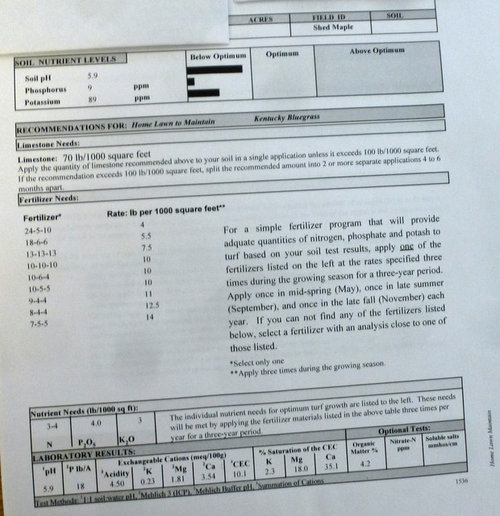
The data,
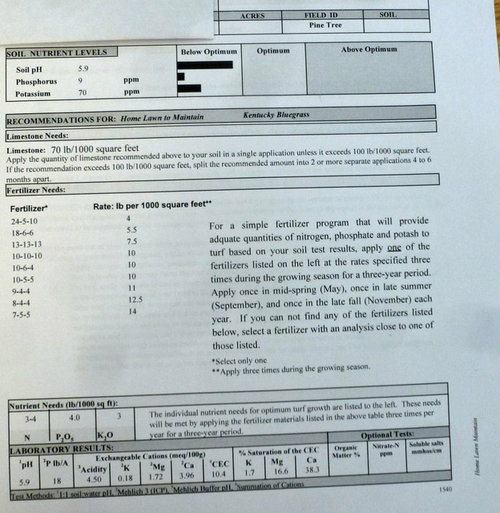
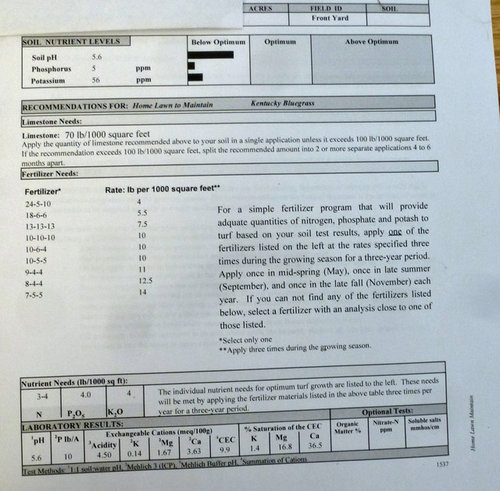
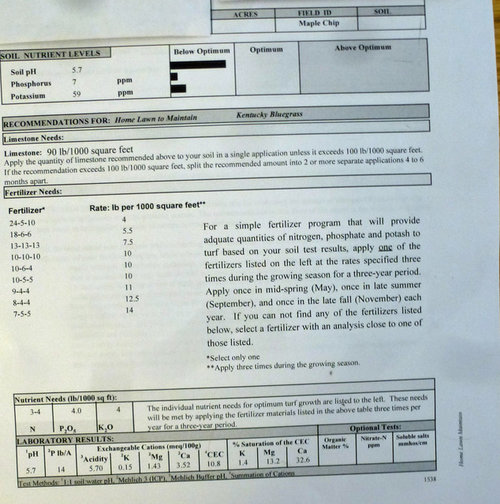
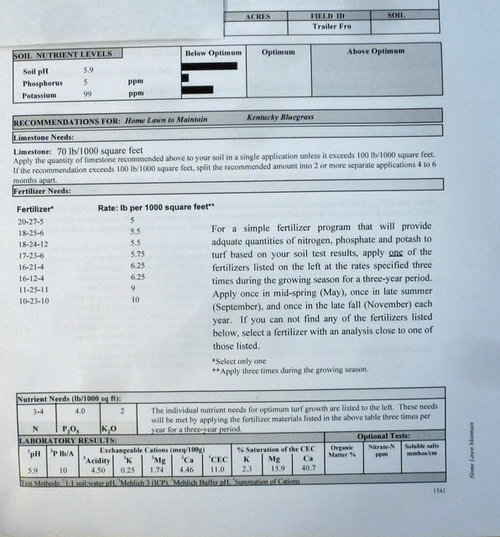
Northern New jersey lawn, damp yard, clay like soils. Fair amount of
weeds, moss in some areas. Had 5 tests done in 5 different areas.
General report says need lime. Would like to use Sol U Cal, too much
lime for me to put down now. I don't understand the magnesium/calcium
readings- Which Sol-U-Cal would be correct for the following report?
Areas listed in upper right corner (Field ID)And overall, how would you
rate the soil?


Comments (15)

  • 10 years ago

    Why avoid magnesium? Is CEC of 9-11 good? What about potassium level? I feel I need a chemistry lesson to figure this out.....

  • 10 years ago

    I don't know how much magnesium you have because they don't show ppm or lb/ac. But the percentage compared to calcium is off from what is considered ideal, like a 6:1 or 7:1 calcium to magnesium ratio. CEC of 9-11 is way better than a sandy 4 or 5. Not as good as a 15-20. You're in the middle, so not bad. Yes, you need potassium and will be getting it in the fertilizers they recommend, particularly the balanced fertilizer (where the NPK numbers are the same). You are especially low on phosphorus. That's in the balanced fertilizer too. I am doing some reading on soil chemistry but still have much to learn.

    HU-346377 thanked beckyinrichmond
  • 10 years ago
    last modified: 10 years ago

    Why avoid magnesium?

    Magnesium levels over 300 ppm or magnesium saturation levels greater than 15% result in what is commonly referred to here as "tight" or "hard" soils. Magnesium causes soil particles to dispense (and compact), reducing water infiltration and degradation/prevention of soil structure (aggregation). Your soil's high Mg levels are responsible for the "clay like" characteristic you identified. Adding lime will help adjust your ratios and lower the saturation % as well as raising your PH to the 6-7 range.

    Is CEC of 9-11 good?

    CEC reflects the ability of the soil to hold nutrients (N,P,K,Ca,Mg, S, etc.)

    10 isn't a problem. You are pretty much stuck with your CEC- we all are. Adding OM can slowly and slightly improve that.

    What about potassium level?

    Your K is low (for a CEC of 10, it should be about 140 ppm.) The soil test gives recommendations to correct this, your phosphorus and PH.

    HU-346377 thanked User
  • 10 years ago

    Becky,

    FWIW, based on his 4 tests, his Mg is about 200 ppm and his Ca is about 750 ppm- give or take. If that helps.

    HU-346377 thanked User
  • 10 years ago

    Actual PPM doesn't matter that much as it's going to vary by your CEC (how dense your soil is, in a very indirect way). My magnesium levels are 343 PPA in the lawn, but that's a perfectly reasonable (optimal, actually) number for my CEC. It would be ridiculously high in a sandy soil and quite low for a clay or muck soil.

    Mosses flourish in damper soils regardless of anything else. People claim they prefer acidic soils over anything else (slightly true), but really, they'll grow anywhere, sunlight or shadow, as long as the moisture is there. They're weak, can't kill other plants, and will die under any competition. There are moss killers on the market (ferrous sulfate), but they aren't really needed.

    Becky, I'll give the full read below. Let me know if you have any questions since you're working on learning how to do this. I rolled the tests together and I'm using the last one--Trailer Fro. They're all very close to each other.

    pH 5.9: Low, but not awful. While we do want to kick this up, it's kind of an incidental that the pH rises. pH is only a symptom.

    CEC 11.0: A midrange soil, probably a sand-silt mix. It holds a decent level of resources, doesn't shift too quickly, but it's easy to make it change when we want to. There's no real "optimal" CEC, you have what you have and that's the way it is (although raising levels of organic material will raise your CEC a little). The "best" CEC range is 10-20, but that's an enormous range from sand with silt right up to silt with clay. Most soils sit between 6 and 15.

    Phosphorus 10-18: With the MIII test, I'd like to see about 25 here. The easiest way to change this is with starter fertilizer, and just get the cheapest. They all work the same way.

    Acidity 4.5 meq/100g: The same as your pH, this is just a different way of stating it. Becky--you'll see this as Exchangeable Hydrogen and expressed as a percentage of EC on Logan tests.

    Calcium 35-40%: Quite low across the board. We use calcitic lime to adjust this, and I advise the use of Encap, Mag-I-Cal, or Pennington Fast Lime. Other limes will contain elements you don't need in this manner, work too slowly, or require too much mass per given area. My recommendations are for those three.

    Magnesium 11-18%: The lower end of the range is fine, the middle is perfect, the top is a little high. In the areas with the most magnesium, the soil might be a touch tighter to dig, but your levels aren't extreme for your soil.

    Potassium 1.4-2.3%: Low in the lower areas, trimmer than I'd like in the others. In all cases we can add the same as excess K isn't an issue (and can actually help!) We use potassium sulfate (sulfate of potash) to fix this, which you can get from some garden or landscape stores, or they'll order it for you. Rather than 140, I'd actually prefer that you be in the 160-170 range to give some cushion against leaching (and 200+ wouldn't bother me, K isn't toxic at any reasonable and most unreasonable levels but does provide heat, cold, insect, and disease resistance to the plant).

    Recommendations:

    Now: Apply starter fertilizer at the bag rate.

    June 15: Apply 6 pounds per thousand square feet of Encap, Mag-I-Cal, or Pennington Fast Lime.

    July 1: Apply 3 pounds per thousand square feet of potassium sulfate.

    September 1: Apply starter fertilizer at the bag rate.

    September 15: Apply 3 pounds per thousand square feet of potassium sulfate.

    October 1: Apply starter fertilizer at the bag rate.

    October 15: Apply 6 pounds per thousand square feet of Encap, Mag-I-Cal, or Pennington Fast Lime.


  • 10 years ago

    Webuser, what Morph is recommending gets you the same thing (phosphorus and potassium) just in a different way. Morph is giving you 3 lb of phosphorus for the year in three applications (now, Sept, Oct) and 3 lb of potassium in two applications (July, Sept). The starter fertilizer also gives you nitrogen (not quite 3 lb). The soil test recommendations on the report are for balanced fertilier in 4 cases (NPK roughly the same), starter fertilizer (high 2nd number in NPK) in the last. Three applications of balanced fertilizer will get you 3 lb. of nitrogen, phosphorus, and potassium for the year. Applications of just starter will give you mostly phosphorus, followed by nitrogen, and a bit of potassium. Morph recommends one of the faster limes (Encap, MagiCal, Pennington). The SoluCal is a similar product but I imagine Morph can't vouch for it so he recommends what he knows works. I have used SoluCal (and Solu-Lime, which I suspect is the same thing). I have also used Pennington and MagiCal. I still need lime every year. I have the impression it raises pH faster than ordinary lime but it doesn't last. It is more convenient to use and you need a lot less product to get a quicker effect. Make your own decision. But go by the bag rate if you use SoluCal instead of putting 70 or 90 lb/K down at a time. Morph, why just 6 lb/K? The maximum rate for Encap, MagiCal, Pennington is 9 lb./K. Another question for Morph: so the phosphorus number here is from a different kind of extraction? I thought Logan used Mehlich 3.

  • 10 years ago

    In this case, the calcium sources I'm recommending are calcium carbonate--a double punch. The Ca displaces H+ ions, while the carbonate turns to carbonic acid. That's unstable, and degrades to carbon dioxide and gets lost to the atmosphere, further raising the pH, while the resultant free hydrogen combines with the remaining free oxygen, creating (neutral) water.

    In this case, he doesn't need the maximum rate, he's actually pretty close to being on-track, and I'd rather do this more slowly than risk an overshoot and set back the soil biology.

    Yep, the P number here differs as the test is the same type but differs slightly in the details. For numbers like this, a standard of 25 is good. For Logan, multiply by 8.

  • 10 years ago

    All calcitic lime is calcium carbonate and works the same way, doesn't it? Like you say, it's the carbonate ion rather than the calcium that has the pH effect. SoluCal is a calcitic lime and ordinary calcitic lime (which would work very, very slowly) is calcitic and they also work with the carbonate action. Dolomitic lime has magnesium in addition to calcium and he doesn't need any more magnesium. Dolomitic lime, like ordinary calcitic lime, works very, very slowly. Encap, MagiCal, Pennington, and SoluCal have undergone a process to make them more soluble (not necessarily the same process but something has been done to make them dissolve better). They also stay in place better, according to the literature.

  • 10 years ago

    >>All calcitic lime is calcium carbonate and works the same way, doesn't it?

    Nope! Technically, most limes are an admix of (mostly) calcium carbonate and some calcium oxide (burnt or slaked lime) with some calcium hydroxide thrown in just for funsies (and via reaction with water in the air).

    Local limestone is listed as almost 20% calcium oxide by the time it hits the bag. Why I cannot say; that's a really high percentage and CaO is highly reactive stuff, chemically speaking.

    The speed of reaction is usually the particle size. A sieve of 200 will react fairly quickly with the soil. Something the size of a tiny pebble might still be around next year or two years from now. Many's the southern lawn grown in limestone chips, but they don't react much due to small surface area/volume proportions and the fact that it won't react except in an acidic environment.

    It would have helped if I'd read your question more slowly. The particle size governs speed of reaction, and also the amount that can be used at any one time. Otherwise we run the risk of setting off a high-pH zone at the top of the soil while the lower soil is still acidic. Plants aren't pleased by that, although they can survive some of it.

  • 10 years ago

    Here's a link to SoluCal. Go down and select the label for Enhanced Calcitic Lime. The label shows 95% calcium carbonate. 95% passes 100 sieve, 90% passes 200 sieve. Seems like it's comparable to Encap, Pennington, MagiCal. For ordinary lime, read the label to see what's there. It will vary.

  • 10 years ago

    You can definitely add SoluCal to the list of acceptable limestones! And if I can remember that next time, I'll start doing so. :-)

  • 10 years ago

    Most agricultural lime does not contain calcium oxide. Calcium oxide is quite unstable and will convert to calcium hydroxide and then carbonate when exposed to water. Most agricultural lime is a combination of calcium and magnesium carbonate (calcitic and dolomitic limestone). Dolomite is actually a bit more soluble than calcite and dolomitic lime will react more quickly than calcitic lime. Always, smaller particles will react faster. The extra magnesium won't hurt anything.

    To convert from meq/100 g to mg/kg (same a ppm), multiply K by 390, Mg by 120, and Ca by 200. Use ppm and ignore saturation percentage. Voluminous research has shown the saturation percentages of K, Ca, and Mg do not relate to plant performance; ppm concentrations do.

    The soil pH matters because the aluminum in clay minerals starts to dissolve when the soil pH drops into the mid to low 5's. Aluminum is toxic to most plants. Raising the pH makes aluminum precipitate and not longer cause problems. Generally, you want to raise pH to between 6 and 6.5.

  • 10 years ago

    Azdoctor, my concern when first reading this post was that webuser said he wanted to use SoluCal and the soil tests said he needed 70 or 90 lb/K. I wanted to make sure he read the bag and knew the maximum for one application (which is 12 lb/K). Given that he has plenty of magnesium and needs lime, why not use calcitic lime? That will not only raise the pH but also improve the calcium/magnesium ratio, which could help improve flocculation, even if not necessary for plant nutrition because minimums have been met. What would your recommendation have been? What do you think of a hybrid approach of using a fast-acting lime for one application and a larger amount of slow ordinary lime (50 lb/K is the maximum, right?) at another application? I'm thinking maybe anyone who needs a lot of lime might want to consider putting it down right after aeration so it can get deeper down instead of just sitting on top. Early fall might be a time for that when the grass will have a chance to recover from getting beat up. Thanks for the conversion factors.

  • 10 years ago

    Use either dolomitic or calcitic lime. It won't make much difference. Aerating before application may help move lime down into the soil a bit. Don't add so much that it smothers the grass, but otherwise there is no benefit to splitting applications.