Software
Houzz Logo Print
gorbelly

Septoria already

10 years ago

We've had a stretch of terrible weather for tomatoes--rain, cool temps and no sun for basically 2 straight weeks--and some of my plants already have very early signs of septoria now. Do you think it's best for me to spray and hope for the best or replace them? Most of my varieties are not available at nurseries, and I'm not really sure that nursery plants are going to be a solution, since, from what I understand, septoria is airborne anyway and has as much of a chance of being an issue with any plants bought in the area. And it's late to be starting from seed. Grrr.

Comments (11)

  • 10 years ago

    Sorry to hear about the problem developing for you this early. The wicked early spring weather and all the diseases that it often leads to is one of the big reasons I delay planting my tomato plants rather than pushing them in early.

    As for what to do - spraying either way with fungicide of your choice is going to help - but I'd replace them. Unless you have some rare variety that you just have to grow fresh, symptom-free plants with a protective fungicide spray gives better odds of a productive season than ones already infected. The effort to carry them through in the hope of some fruit wouldn't be worth it to me. JMO

    Dave

    gorbelly thanked digdirt2
  • 10 years ago

    I would treat them with an anti fungal right away and continue through the growing season. You can't cure it, but you can slow down its spread. I get this every year and it rarely affects the fruits. It weakens the plants, and probably reduces yield. I've never had it completely kill a plant.

    gorbelly thanked Ohiofem 6a/5b Southwest Ohio
  • 10 years ago

    I had septoria last year, but the tomato plants were large and vigorous by the time it showed up and outpaced it pretty well. This is really early for it to happen, though, and I'm not really sure the young plants will do well going forward. Last week of April is pretty normal plant out time here (2 weeks after average last frost date), but I just had rotten luck with the weather. I may try a mixed approach, getting a couple new plants, starting the earlier varieties from seed again (provided there is a normal amount of sun, they should grow pretty quickly this time of year), and seeing whether a couple of the least affected, more advanced seedlings will soldier on. I suspect that replacements, even the ones from seed, will eventually outpace the plants that are already affected, as long as I can keep them from getting the disease early. Maybe I should look at this misfortune as an opportunity to push the envelope and experiment a little. After all, I do this for fun, not for income, and it's not the end of the world.

  • 10 years ago
    last modified: 10 years ago

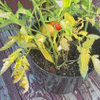
    I took a closer look now that I'm calmer about it, and only the Cherokee Purple (2), Black Cherry (1), and Red Robin (1) have manifested lesions. CP and BC are definitely going to suffer--I'm going to replace those. Luckily, those are also two that I can probably buy as plants, and, if not, it's probably not too late to start seed. Red Robin already has flower buds, since it's a microdwarf and I started it pretty early, so I'll just prune, spray, and let it continue and see how it goes. That one's just a curiosity grow, anyway.

    Two other plants have some feathery looking chlorosis, but it doesn't look like lesions are going to form, so I'm hoping it's just a nutrient deficiency from all the rain or possibly remnants of sun damage from an incident during hardening off. Most of the rest have no lesions or patchiness, just some uniform yellowing in the newest leaves which I think is just a plea for nitrogen and sun.

    The ones that have me going back and forth are a couple that still had cotyledons and had spottiness and yellowing on those cotyledons only. Maybe that's just cotyledons dying off? Maybe having removed the cotyledons on those and having sprayed will be enough? Maybe I'm in denial?

  • 10 years ago

    Sounds like a good plan. I should have added that my plants that survived septoria were full size and already producing fruits. I would be a little more worried about new transplants.

    I'm curious about your plants that still have cotyledons. How old are your plants? I up potted my tomatoes at about 3 weeks and buried them up to the first true leaves. I transplanted and buried them more deeply one more time before the plant out. If they still had cotyledons at plant out, they would have been at least six inches below the soil. Did your plants actually have cotyledons after being planted out?

    gorbelly thanked Ohiofem 6a/5b Southwest Ohio
  • 10 years ago
    last modified: 10 years ago

    Yes, a few did. They're dwarfs, though, in (unfortunately too large to move easily out of the elements) containers and not planted deep, as they are very stocky. They're about 6 weeks old.

  • 10 years ago

    *sigh*. The plants that I was hoping were just patchy from all the rain are showing lesions now. Well, there are still old-timers in the area who insist you shouldn't put tomatoes out until Memorial Day, so I won't be all that far behind, I guess.

  • 10 years ago

    Gorbelly, do you fungicide?

  • 10 years ago

    Yes. Last year, I sprayed copper and an organic antifungal based on neem alternately, and that seemed to keep my plants going and producing well. But the septoria happened much later, when the plants were already flowering and fruiting. I did apply copper once this year, but we had so much rain that I guess it didn't stick around long at all.

  • 10 years ago

    I thought I was being patient by waiting 2 weeks after my LFD! Maybe I should stop reading tomato enthusiast forums, where people are really pushing the envelope and giving me a distorted idea of when is a good time to start plants and plant out and spend more time with old timers!

0
Sponsored
Urban Upkeep LLC
Average rating: 5 out of 5 stars6 Reviews
Columbus High Quality Painting Expert