Software
Houzz Logo Print
easnyder

Desert invasive weed or native plant?

10 years ago
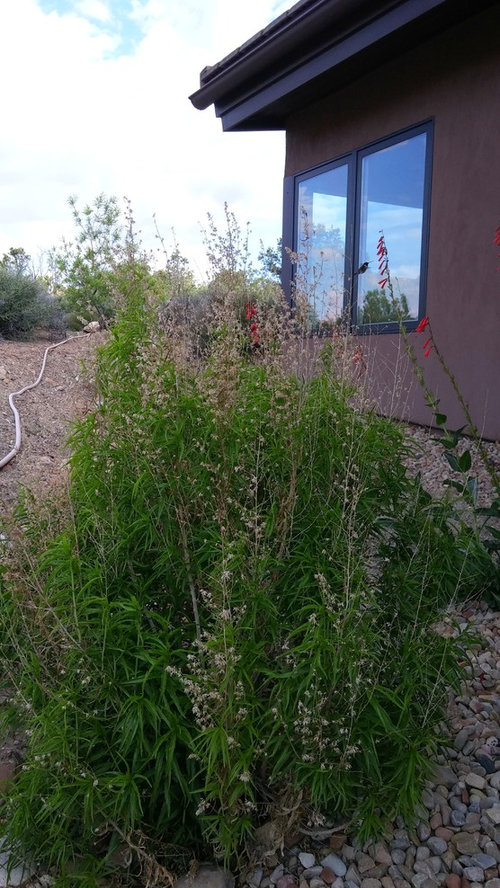
Of course, in the desert, it could be either!

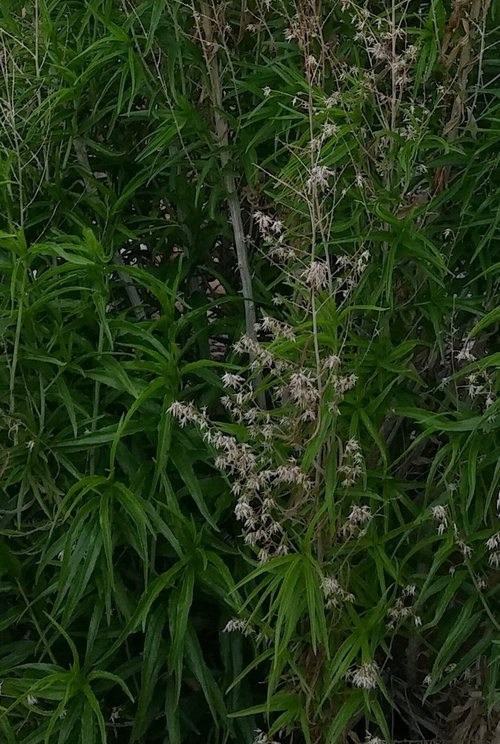
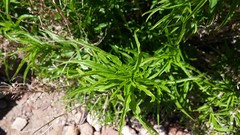
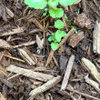
We live in Springdale, UT outside of Zion national park, in the pinyon juniper forest/desert. Zion is the intersection of the colorado plateau, the great basin, and the mohave desert, so we have flora from all 3 areas. This plant popped up 3 years ago at the base of one of our roof gutter drainage pipes.


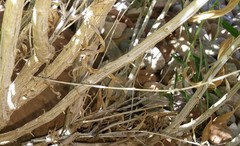
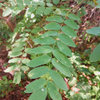
It has small (but easily breakable) thorns on the base of the stems. It has inconspicuous blooms on stalks in the fall. And it loses it's leaves for the winter, with new growth starting the next spring on the existing base stalks. It is also grows relatively quickly (about 3-5") per year.


I have looked up every plant in the Zion Native Plant list, and I am unable to find it anywhere. Any help would be greatly appreciated!


Liz

Comments (19)

  • 10 years ago

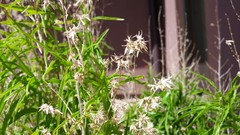
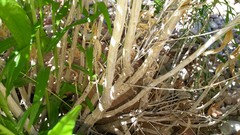
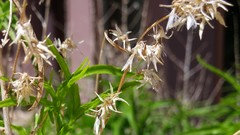
    I'm surprised that no one recognized this yet because it's very distinctive. Could you give us a couple more shots? Closeup of the dry flowers/seeds (6 inches or less away), and maybe a closer picture of the leaves and how the plant branches.

    I love the Penstemon in the background. Is it P eatonii? Mine never looks that good: too much wet and not enough heat.

  • 10 years ago

    Hey there! Thanks so much for responding!


    Yes, that is p eatonii - it is just beginning to pass it's peak. However, our p palmeri is in full force. We had a relatively wet winter (gracias a el nino), so our wildflowers are abundant this year!

    As for the mystery plant, I've been trying for 3 years to figure out what this guy is. If I recall, the fall flowers were quite inconspicuous....and I believe the petals were quite small in ratio to the pistol/stamen? I never did take a picture of the blooms, much to my dismay.

    I definitely appreciate the assistance. I hope these pictures can help!


    L

  • 10 years ago

    That is truly gorgeous! Sadly I still don't recognize your plant but the new pictures provided information that I definitely needed. Hopefully one of us will be able to figure it out soon.

  • 10 years ago

    LOL, thank you so much. I actually feel a little better. I've managed to forage out most of the flora around our house, and this one just has me completely stumped! It's nice to know I haven't missed something dreadfully obvious.

  • 10 years ago

    I would love to see photos when it does bloom. Great photos both of the unknown and the Penstemon.

    You live in one of the most beautiful parts of the world!

  • 10 years ago

    Thank you guys for taking a look. We do feel VERY fortunate to be able to live where we do - it's quite humbling seeing all that nature has to offer!

    I've posted on another plant ID site, and I've also emailed the NPS to see if they have anyone who might be able to help. I used to have a contact, but apparently she left sometime between 2013 and now :-(

    I'll let you know if I hear anything back....and I will also try to get some pictures when it blooms later this year. I seem to remember barely being able to see the blooms at all.

    I've decided the pattern and drooping of the leaves remind me of our desert willows....the blooms remind me of big sage....and the seeds remind me of the Asteraceae family. Perhaps I should temporarily give it a nome de plume of Big Willow Aster ;-p

  • 10 years ago

    Thanks, marinaka! I can see where my description and the rosette leaves might point to gaura. We actually have gaura coccinea as a native here - and I have several other cultivars (pink and white) that I have planted in my yard. That being said, I don't think my unknown is gaura - for one, it blooms in the fall. Second, the flowers are millimeter(s) in size and you almost can't see the petals or the pistols/stamen. In fact, I'm not sure I did see the petals last year, but assume they must have some? Third, the leaves of this plant are more pointed (as well as rippled at the edges) and as they fall off at the base, they form thorns. Finally, the seeds are hairy like an aster-type plant, and none of my other gaura seems to have hairy seeds.

    That being said, I'm certainly no expert. I'll keep going through all the cultivars on wikipedia just to be sure. I would love to find out that I am wrong! Great thinking! And thanks!

  • 10 years ago
    last modified: 10 years ago

    Following back to types of onagraceae, the leaves do resemble some types of Epilobium (angustifolium?), but the flowers are tiny tiny and very inconspicuous and bloom in the fall - the leaves, however, are very similar.

  • 10 years ago
    last modified: 10 years ago

    Could you give us a verbal description of the flower and/or a plant that has similar flowers? Your description above made me think that they would look like campanula prenanthoides, but do they look more like Erigeron? Are they tubular like your penstemon? Small like veronica persica? What color? The worst part is that I feel like I've seen this plant, or similar, somewhere... sometime... and I just can't place it!

  • 10 years ago

    Can you photograph the thorns? I would be curious to see them.

  • 10 years ago

    The flowers...if memory serves....were *maybe* 2mm in size at most (something the size of big sage flowers). They were so inconspicuous, the only thing I remember is having difficulty finding petals - in fact, I can't remember if it did or did not have petals. I don't believe they were tubular b/c I remember I could see the pistol/stamen....but just barely. Color would have been a cream or maybe a lighter yellow.

    The thorns, I believe, are only on the woody base - it appears as though they are from where previous leaves were on the stalk.

  • 10 years ago

    I believe *likely* the flowers were more like the campanula and less like erigeron based on my ability to distinguish the pistol. They were much smaller than the veronica persica pictures......if any of that helps. I'm sorry I cannot remember a lot about the flower - simply because it was so small. I just remember thinking 'does this thing have petals?'

  • 10 years ago
    last modified: 10 years ago

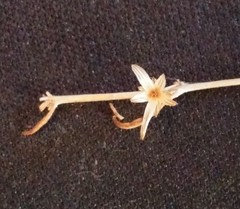
    To give a little perspective....the leaves are 3 inches long - the part that is leftover after the flower is 2-3mm - and from the few leftover seed tufts, they are coming from a small bracket (??) that is 1mm or less in size. The seed tuft looks similar to that of an aster or gaillardia, but instead of being globe shaped, it is more of a fan shape coming from that microscopic bracket.

  • 10 years ago

    I was able to go out and find a single bract (that's the word I was looking for earlier - ugh) that may have a dried flower in it? I honestly can't tell. The distance between the two farthest points on the flower/bract is 2.5mm.

  • 10 years ago
    last modified: 10 years ago

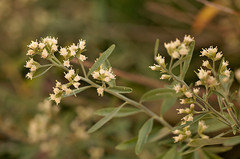
    Ok, going in a whole other direction here. From the first, your plant has looked like the foliage and stems of many baccharis species to me. The dried pods look like some other baccharis. But I was having trouble merging the baccharis species that have matching foliage and pods, at least from photos I have been able to find. Take a look at this page for Baccharis salicina. Perhaps it dies down due to hardiness issues, but comes back from the roots in the spring? Since no one else has nailed it yet, I thought I'd throw my impressions into the ring.

  • 10 years ago
    last modified: 10 years ago

    Oh my gosh! You got it! Thank you!!!

    It used to be called baccharis emoryi (here in Zion) , and it got reclassified as baccharis salicina.

    What threw me off when I looked at your link were the toothed, and wider leaves. But when I typed in baccharis with zion national park, this is what I got!

    zion/white_wildflowers/baccharis_emoryi_i93.html

    That's it to a "T"! Tiny flowers with no discernable petals, and elongated, more lanceolate leaves!

    I can't thank you guys enough! Apparently it's one of the riparian plants here. It must have mistaken my gutter drainage for a wash LOL!

    Woo hoo!

  • 10 years ago