Software
Houzz Logo Print
dulahey

Creating a Butterfly Garden.

10 years ago

My next project is going to be the creation of a butterfly garden, or perhaps just a natural vegetation area that I will not mow.

I'm not even sure what all I would plant in it. Milkweed is the only sure thing so far. Other than that, I was just thinking a variety of wildflowers. I'm definitely open to suggestions. Anything that doesn't require a lot of maintenance would be fantastic. My goal is to just let things keep reseeding themselves every year and "let it go". (this might be a bad idea?)

The ideal spot for this is an area of my yard that has 100% sun, but has very thin topsoil (about 2") on top of sandstone. The bermuda doesn't grow real thick in this area and I have trouble with lots of weeds, so I'd like to transform it into something. But with that thin of topsoil, I am thinking that I'm going to have to make the area into a really large raised bed.

My biggest question is how should I handle the bermuda grass? Do I need to completely remove all bermuda as if I was going to create another vegetable garden? or can I completely ignore the bermuda and let everything go natural. Or is the proper answer somewhere in between?

I'm looking for any and all tips, suggestions and help. :)

Comments (3)

  • 10 years ago

    Personally, I would remove all the bermuda grass first. Otherwise, you'll never get rid of it and it will attempt to outcompete all the wildflowers you plant for the butterflies.

    For butterfly and bee plants in our pastures, I planted one (or more) of the wildflower seed mixes from Wildseed Farms, which I'll link below:


    Wildseed Farms Wildflower Seed Mixes

    For the butterfly/bee plants within the fenced-in garden, I was more selective and either direct sowed seeds in the places where I wanted flowers for the birds and bees or raised seedlings from seed and transplanted them into the garden. Now, most all of those plants are either perennials that come back on their own or reseeding annuals that have reseeded themselves well for many years. My only real work in those areas is to weed out invasive weeds that try to infiltrate the beds.

    In my garden, the plant that is most attractive to butterflies is a tall version of verbena called Verbena bonariensis. It reseeds easily and is a butterfly magnet. It blooms roughly from March through November (and sometimes earlier and sometimes later) as long as I deadhead it occasionally. It does not look at all like the bedding plant type of verbena most people are used to seeing, so I'll link an image of Verbena bonariensis here:


    Tall Verbena

    I have these scattered around the garden and sometimes it is hard to see the flowers because there are butterflies all over them.

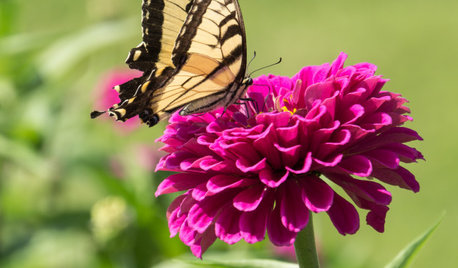
    Many butterflies also are very attracted to zinnias, and for the butterflies, I prefer old-fashioned open-pollinated zinnias, not newer hybrids.

    In order to attract butterflies (and bees and hummingbirds) and keep them around, you need not only flowers that offer them pollen or nectar, but some plants that their larvae will eat as they grow. Yes, that means you are planting stuff on purpose so the caterpillars can gobble it up. Because one of the main types of butterflies at our place is swallowtails (several different types), I always have lots of food plants for them (fennel, bronze fennel, dill, parsley, etc.)

    I grow lots of flowering plants whose large flowers are actually comprised of many tiny flowers, like yarrow, dill, verbena bonariensis, tansy, silver tansy, etc. These are particularly attractive to the tiny flying creatures we want to attract to our gardens.

    It always is better to grow your own from seed than to purchase plants. One thing we have learned in the past few years is that many of the flowers sold in stores for butterfly/hummingbird/bee plants (as well as standard annual bedding plants and perennials) are still being treated at the wholesale grower with systemic insecticides, meaning the insecticides are taken up within the plant tissue and remain there for the life of the plant. Often, these insecticides are neonicotinoids that have been implicated in the decline of the bee and butterfly population. Thus, well-meaning people who think they are purchasing/planting flowers for the butterflies, bees, hummingbirds, etc. may actually be planting pesticide-contaminated plants that can harm or kill the butterflies, bees and other beneficial insects. This is a very frustrating realization for people who are trying to do something good only to find out that instead they may have planted some plants laced with pesticides that will kill those little creatures.

    Now, a word about the bermuda grass. When we bought our land, it was fallow farm land that had not been farmed in at least 20 years but which had been leased out for use as cattle grazing land. It never was mowed. When we walked through the property multiple times checking it out, we saw fields full of native grasses and wildflowers. There was no bermuda grass in sight. I was overjoyed. Eventually we bought the place and began spending weekends up here clearing out the brush, and cutting down trees so we could fence in 14.4 acres. You can imagine how many weekends we spent up here with a chainsaw clearing a path for a fence. After about a year, the clearing and fencing were done, and we were ready for the builder to start construction of the house, which he did in late summer/early fall.

    The last thing we did before the builder started was we mowed down our native grasses/wildflowers as low to the ground as possible at the construction site. It was a drought year with very little rain and I don't remember the grass making any sort of comeback that fall. In the spring, though, after rain fell, the grass began growing and it was not our lovely pasture grasses and wildflowers---it was bermuda grass. Everywhere! I was so disgusted. An old farmer neighbor who stopped by and noticed the bermuda grass was giddy with delight as he pointed out that we wouldn't even have to plant a lawn. How lucky could we get? "Ye. We're lucky all right." I said to him, but inside I was cringing and wishing I could have the native grasses and wildflowers back again.

    I was not a rookie landowner, and this was not my first rodeo, so I did understand what had happened. As long as no one was mowing, the native grasses and wildflowers (which mainly are clumping types of plants) were dominant in the field, and the bermuda grass couldn't compete with them. Plus, as long as the native grasses and forbs were tall, they also helped shade out the bermuda. So, to the naked eye, there wasn't even any bermuda grass present. However, when you regularly mow down the tall native grasses and forbs, that mowing paves the way for a running, creeping type of lawn grass like bermuda to take over and dominate, which is what it did. Nowadays, we selectively mow down the pastures as needed, but we immediately let them grow and get some height again. We generally mow them down after the cool-season flowers have set their seeds and again after the early warm season wildflowers have done the same. We do not keep them short all the time, or the bermuda takes over and the wildflowers vanish.

    I do not know what happens if you start out with bermuda and just stop mowing it. Would it weaken and go away? I doubt it. Because it establishes such a solid sod surface, even a lack of mowing won't make it disappear. That's why I think you'd have to take it out in order to start a wildflower patch for the butterflies.

    One thing I don't bother planting any more is milkweed. It is hard for it to survive in my clay soil in general, although it will live for a few years and then slowly decline. Also, the whole world plants butterfly weed/milkweed, so I try to plant other things. Also, and this is the main reason that I don't plant it any more, we have several kinds of native milkweeds that fill many of the pastures around us. It makes no sense to me to try to plant some butterfly weed or milkweed in my garden, which is limited real estate of course, when the butterflies have hundreds, if not thousands, of native milkweeds in the fields that surround our place.


  • 10 years ago

    There is a wonderful book, Butterflies of Oklahoma, Kansas, and N. Texas that will give you a lot of good information about the butterflies that are common in our area and what they nectar on and what their host plant is. I try to grow milkweed, but honestly I don't ever get monarchs to lay eggs in my yard. I'm not really sure why. But black swallowtails are usually around, and in my yard, I attract gulf fritillaries because I grow passionvine. The last couple of years I have been growing pipevine trying to attract pipevine swallowtails. A friend sent me eggs last year and it was so much fun to raise them. Unfortunately I had to be out of town the week they all eclosed and flew away :(

    The book I linked above looks like it is available and on sale, but I have also found it on Ebay and Amazon when I couldn't order it.


  • 10 years ago

    oh, lantana is a great plant, and there are perennial versions of it. Miss Huff is the named version, but you can find it sometimes in nurseries under just "perennial". Don't trust big box stores that call them perennial, they generally aren't.