Software
Houzz Logo Print
hzdeleted_28510257

Deep and infrequent

10 years ago

With summer heat headed our way here in NC, I've been giving some thought to watering technique. I've been able to get away with little to no watering this year due to mother nature, but once things heat up water will need to be applied.

I remember reading somewhere that during periods of sustained high temperatures tall fescue roots die back. Is there any study or anecdotal evidence as to how much they die back or if this is even true? If roots only go say 3 inches deep in the summer seems like one would be better off watering half an inch of water twice a week rather than one inch once a week, with half that water being past the root zone and of no use to the plant.

Comments (17)

  • 10 years ago

    If I were an online fact rating site, I'd call the statement, "Fescue roots die back in hot weather" as "half true."

    The little, threadlike feeder roots (that are cheap to grow and not worth keeping around in poor weather conditions) do slough off into the soil when the weather gets hot. The grass isn't really interested in eating all that much (or, why we don't recommend summer feeding to any great extent), and the threadlike, high surface area rootlets lose water easily and are expensive to maintain.

    So off they go. They'll regrow in fall when soil temperatures drop and moisture levels rise.

    Assuming adequate to not extremely low moisture, the thicker structural roots, deeper roots, and water-seeking roots stick around (but don't grow).

    In times of severe drought, the grass will start to give up root mass, contracting back toward the central root systems and core plant mass. Too much of that will kill the grass, of course, but it takes a lot--and the roots, again, will regrow when conditions improve.

    User thanked User
  • 10 years ago

    You want to train your roots to seek water deeper rather than shallower. Water when there are signs of drought stress. Then don't water again until there are signs of stress. As the surface dries out, the roots don't find water close to the surface so they grow down where the soil has more moisture. Down is where you want them to be. Signs of stress are a change in color and grass not springing back up from footprints. If the grass is stressed, water it right away. If you don't want to water to the six inch depth, at least water to 4 or 5. You can check with a screwdriver. Alas, with the hot summers in VA and NC, cool season grasses just don't do well. Do what you can. You may have to overseed in September to make up for summer losses. The grass that makes it through this summer will grow even deeper roots this fall (prime growing time) and next spring and will be more resilient next summer.

    User thanked beckyinrichmond
  • 10 years ago

    I can't direct you to a particular study, but root die off/slough off is commonly estimated by university turf specialists to be between 1/3 and 1/2 of total root mass annually (primarily during summer). I've never seen a study (well one, but it was very questionable) that indicated that roots actually "seek out" water. Studies have determined that they will proliferate when an area of soil where moisture and/or nutrients are abundant.

    User thanked User
  • 10 years ago
    last modified: 10 years ago

    @yardtractor

    Any indication as to where the root mass is lost? Is it lost in the top half or the bottom half? The surface dries out quicker so it would stand to reason that shallower roots would be the ones to die off while deeper ones would remain, which would support the water deep theory during the summer as well.

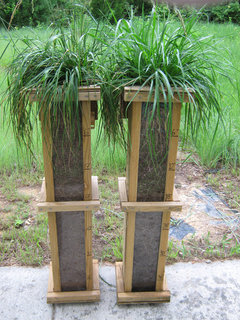
    I have always wondered how deep tall fescue roots will grow. This article has an excellent depiction of exactly that. It also shows the effects of grazing(mowing) on root mass. Wonder if my HOA will be ok with mowing to 4" only every 30 days. Guess I'd be making hay at that point.

    http://www.gaininggroundvirginia.org/resources-index/demonstrations/

  • 10 years ago

    morpheuspa gave a good explanation of what/where root mass is lost. It's a good question. I've researched it to no avail. To me, it would make sense that the majority of the loss would be in the finer roots, but would this be in the deeper areas as it would take more energy to pull water up over a greater distance or shallow roots, as the uppermost soil will have less moisture than deeper down? On the other hand, when rain returns, the upper soil is going to be replenished with moisture before it percolates down, so would the turf keep more shallow roots to take advantage of this and recover quicker? Or is it a little of both? Let me know if you find something.

    There are studies that show a direct relationship between height of topgrowth and depth of roots.

  • 10 years ago

    Regardless of the heat above, as you dig deeper into the soil, the temps cool off dramatically. This happens even in hot desert sand. If you have grass roots down deeper (deep and infrequent) your grass will be better off simply from the moderate environment of temperature and moisture.

    Drought should not be an issue if you're watering. Drought means you're not watering.

  • 10 years ago

    @dchall_san_antonio

    If you have grass roots down deeper (deep and infrequent) ...

    How deep do you suppose roots will go following your standard watering schedule and standard mowing practices for tall fescue(4", 1/3 cut)? If the bulk of the water is in the top 6", is there any reason for fescue to go much deeper than that?


  • 10 years ago

    The roots will go as deep as the environment is friendly. The environment includes moisture, temperature, chemistry, and biology.

    Is that vague enough? ;-)

  • 10 years ago

    The roots will go as deep as the environment is friendly. The environment includes moisture, temperature, chemistry, and biology.

    Is that vague enough? ;-)

    Haha, it's vague enough that I'm none the wiser :-).

    I'm not sure that it's necessarily true though. The article here would seem to indicate that even though the soil conditions are favorable - the one clipped only every 30 days is able to take advantage of the whole 36 inches - the plant that's cut to 2" every 7 days has a limit on how deep the roots will grow. Presumably because it has to put a lot of energy into top growth. I suspect that cutting every 4 days to 4" will have a similar effect, thus limiting how deep the roots will grow in your average lawn even if soil conditions are ideal. I'd be very interested to know what that average limit is. Maybe I'll have to put together some of those boxes, I'd like to test the Primo enhanced root growth theory as well.

  • 10 years ago

    That's a lot of boxes. You could also do two boxes both cut at 4", but one watered deep and infrequent and one watered much less and another set were you let the grass go drought dormant and see where the root die off occurs. But if you are up to it, it may give some useful visual results. I'm willing to watch :)

  • 10 years ago
    last modified: 10 years ago

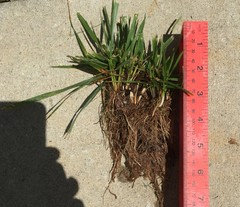
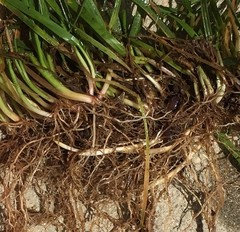
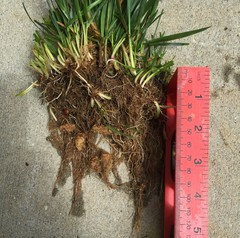
    Ok this is what I'm rolling into summer with. The hybrid bluegrass has been tillering and producing rhizomes aggressively - don't know if it's related to having applied Primo or if this is the normal rate of development. In most places it is overtaking the fescue and they were both planted just last fall. Hopefully overseeding this fall will re-establish the balance.

    I will take samples again at the end of summer to see the impact on the root mass.

    Edit : can you spot danielj's buddy in the picture?

  • 10 years ago

    I saw the little wormy guy right away! I named him j5c12! :o)

    I think the fescue root box demonstration is really interesting, but we have to be aware of the differences between the box and real life conditions. What's different?

    1. The boxes use nice fluffy potting soil, not a normal density profile for 36" of earth,

    2. The boxes are set in a greenhouse, which means the temperature from the tips of the grass to the bottom of the roots is identical, and may be 80 degrees or so. This is a far cry from real conditions, I think.

    We already know that, in the normal grass height scenario, roots grow about as deep as the grass is high. If you let the grass grow crazy high, it appears probable from the box demonstration that the roots will get long in the real ground situation. So I'm not sure how much more information is gained from more boxes.

    @ j4: Have you done a Logan soil test? Do you know what your organic % is? The higher the organic level, the better the water holding properties. (and you'll never have to aerate again, to boot!)

  • 10 years ago
    last modified: 10 years ago

    I think there is a point of diminishing return with regards to taller grass heights leading to longer roots. The more foliage on a plant, the more demand there is for resources to support it. The demand will also spike once the plant starts producing seed heads. As the roots dig deeper for those resources, they will surely find them. However, as the roots dig deep enough they reach a point where the resources are more scarce. Moreover, the areas where the resources were once abundant become depleted over time to keep up with the demand.... In a dense stand, I imagine this would lead to thinning of a stand as some plants die off from competition. Just a theory, though. Would make an interesting study.

  • 10 years ago
    last modified: 10 years ago

    @danielj_2009

    I have not done a soil test yet, but curiosity is getting the best of me, I will send one in.

    Is there a source of organic matter that's low in nitrogen? I like synthetic fertilizer better because I know what's getting released and when. But if organic matter has other properties beyond being a nitrogen source like water retention I'd like to hear about that. I'd also like to hear about how organic matter added to the surface moves 4-5 inches down to the root area.

  • 10 years ago

    The organic matter that matters are the microbes living in the soil. If you want further reading I can post a link, but you have to like biology. These microbes (bacteria, fungi, microarthropods, and other classes of critter) form a food chain that is so complex they call it the soil food web. Every species lives at a certain condition of temperature and moisture. Generally this stratifies them at certain depths. When the surface feeding microbes spit, pee, poop, sweat, clip their fingernails, get a hair cut, and/or die, then those biological byproducts are decomposed by other microbes from theirs or an adjacent stratum. Water washing through the soil can carry the byproducts deeper into the soil, too. This happens all up and down at all soil depths. The process takes about 3 weeks to move nutrients from the surface down to the roots.

    Modern organic fertilizers feed the surface microbes with real food. These fertilizers have ground up nuts, beans, and seeds in various proportions, so it really is food. The surface microbes decompose the food and begin making byproducts for other microbes to decompose.

    Does that help or raise more questions?

  • 10 years ago

    Corn meal or cracked corn has no nitrogen to speak of. Any of them are pretty low and slow releasing so I don't think you are in danger of screwing up your N levels. I think morpheus even says the NPK levels of the organics can't really be compared to the synthetics exactly.

    I also put down about I think 30 lb sawdust/1000 sf last year. It was in the form of "equine pine" pellets, which has nothing but compressed sawdust in it. Supposed to take a long time to break down, but is good for soil structure. I also did it because it was very cheap and spread nicely in my spreader.

    You already know about leaves, also low in N. I've been putting down as much as I could get my hands on, and my % organics have come up nicely in the last two years. I'll check again in July.