Software
Houzz Logo Print
topthumb

Need advise for tomato plants

10 years ago
last modified: 10 years ago
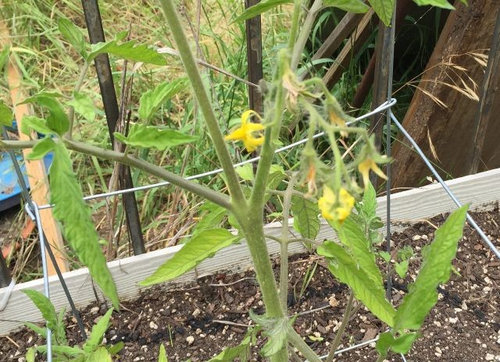

Planted 8 different varieties of tomatoes but all seem to have the same problems except for the cherry plants. This is the first year I have tried raised beds and put in 4 yards of fresh mixed topsoil from Hilton Landscaping specially mixed for gardens.

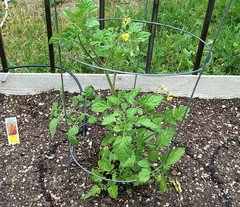
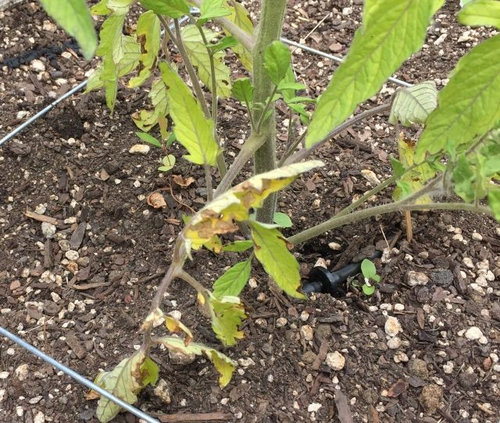
I'm not sure if it's a problem or not but the bottom leaves are dying off and the rest of the leaves are curling. The coldest is has gotten since planting outside has been 47F and the warmest so far in the mid 80's. Rain has been seldom(once or twice a week) but not heavy and during spans of 5 or 6 days I water about a gallon per plant weekly.

Here's a couple pics, could it be just too much water? The blooms have been there for about a week now and are starting to dry up and fall off.

Comments (43)

  • 10 years ago

    I don't see a lot of leaves on those stems. Are they getting sunlight? As to curling leaves, yes, too much water may be the problem. Is the top of the soil wet a lot of the time? What's in your "mixed topsoil"? Some real soil, I hope. If it's all compost and peat moss, your plants are simply starving. Yes, "garden mix" is sometimes to ADD to gardens, but not to plant gardens in. I have to assume the blooms are falling of without setting fruit because the plant is stressed.

  • 10 years ago

    Nice looking plants. Just lope off all those lower diseased and soil touching branches. I would follow-up with a fungicide application. Otherwise plants look healthy IMO.

  • 10 years ago
    last modified: 10 years ago
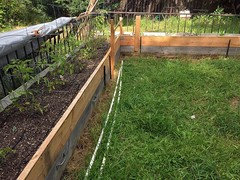
    danin... They get about 8 hours of sunlight a day right now but as the year prgresses they will get more. Right now it's mostly cloudy skies though. The soil on top is sort of dry but as you dig down it starts to get damp but not soaked. As for the "mix", this is what they say: "Topsoil Plus 50% Topsoil, Aged Sawdust & Composted Manure (AKA Gard-N-Grow". I also added some worm castings to the soil. I decided to use this soil because my neighbor has been using it in his raised beds and he has had outstanding results. We have been getting some rain maybe a few times a week but not a lot, maybe 5 minutes of showers each time so once a week I've turn on the drippers which are 1/2gal/hr for about two hours. Here's a pic of the raised portion and a pic of one of my cherry 100 plants which look much better. The other plants are Medford, Willamete, Oregon, and Early Girls.


  • 10 years ago

    Sometimes, fresh garden soil with a lot of compost can hold the nitrogen and other nutrients.

    Lower leaves yellowing is due to dilution of nitrogen and too much water/rain.

    I would trim those leaves , as the can be magnet for disease. JMO

    Sey


  • 10 years ago

    Sounds like your soil is good, and they're getting plenty of light. Damp at depth is what you want, moisture-wise. The fact that you have cherries that are thriving suggests that nothing is wrong with your bed. I see a sucker that look quite healthy, so it may be that the older leaves were just somehow stressed. Were they hardened off before planting out?

  • 10 years ago

    At about 5" high I started putting them outside when the temps were above 60F and then bringing them in at night. When they were about 10" tall I planted them. FYI, this happened to them about 10 days ago then they perked up again when I didn't water them for about 5 days so maybe it's too much water. I don't know if it matters or not but I have green bean plants that already have beams plus my strawberry plants have fruit on them. Everything was planted at the same time.

  • 10 years ago

    do not ignore Barrie's comments...I believe he is right on the money.

  • 10 years ago

    Already did that fireduck, even on the cherry that had some on the ground. Even put a screen over the strawberries to keep the Jays from eating them. :)

  • 10 years ago
    last modified: 10 years ago

    "Aged Sawdust"

    That alone could be the problem. Carbohydrates, in this case, cellulose, feed bacteria that remove nitrogen from the soil. The problem will go away after the sawdust has decomposed which may take longer than a year.

    You might try foliar feeding with urea, 3 tbs./gal.. If successful, the plants will green up in 5-7 days (not much suspense).

  • 10 years ago

    I think nitrogen deficiency might be right. I don't think you're looking at disease. You're seeing chlorosis, and just in the older, more mature leaves. Also thin foliage. All characteristic of a nitrogen problem. Yes, uncomposted sawdust can do that. I'd just apply nitrogen rich liquid fertilizer to the soil. That's by far the easiest way to go.

  • 10 years ago

    You got some good advice already. I just wanted to say that I really like the way you situated your raised beds around the edge of your lawn. Looks great!

  • 10 years ago

    Me too! What a super idea!

    Linda

  • 10 years ago

    BTW, I have a bag of Amonium Sulphate 21-0-0. I thought the first number was nitrogen. I have only used this on some flowers to change the color of the flower though. Would this be any good for tomatoes?

  • 10 years ago

    I love the tortoise enclosure!

    I would save the Amonium sulphate for acid-loving plants (e.g. Blueberries, Azaleas, Rhododendrons, evergreens and for changing the colour on Hydrangeas, if you prefer blue to pink).

    Not sure about that first number being nitrogen. You wouldn't want high nitrogen for your tomatoes now because it would cause lush green growth at the expense of flowers and fruit. Instead, go for ferts that are more balanced such as 10-10-10, or ferts where the middle number (phosphorous) is a little higher.

    Linda

  • 10 years ago
    last modified: 10 years ago

    "BTW, I have a bag of Amonium Sulphate 21-0-0."

    Try spraying just one plant with 1 tbs./gal. for three consecutive days and wait a week to see whether there is an improvement.

  • 10 years ago

    Again, I think the simplest way to go about it is just to apply nitrogen to the roots by application to the soil. Foliar spraying can work, but you have to be careful. For one thing, it doesn't work at temps over 75F because the leaf pores close. Secondly, especially young leaves are more sensitive to chemical phytotoxicity. Be careful. Ammonium sulfate is strong stuff.

  • 10 years ago

    I'll be picking up some stuff today and apply as directed. I also have a soil tester coming in today so I can see what's going on. I'll try and take care of everything today as I am going out of town and will be back on Saturday/Sunday. Hopefully the plants will still be alive. :)


  • 10 years ago

    "Again, I think the simplest way to go about it is just to apply nitrogen to the roots by application to the soil. "

    If there is enough sawdust in the soil, application of nitrogen compounds to the soil will be completely ineffective because bacteria will consume the nitrogen before it can enter the plant. I recommended foliar feeding because it is certain to put nitrogen into the plant and thereby prove or disprove the hypothesis that the chlorosis is caused by a nitrogen deficiency. As for phytotoxicity, why do you suppose I recommended that this be done to just one plant?

    "For one thing, it doesn't work at temps over 75F because the leaf pores close. "

    No. The opening of leaf stomata is mediated by blue light and open stomata, although preferable, are unnecessary for foliar absorption of spray materials. A good time of day to spray is just before dusk.

    Incidentally, someone told me that urea spray forces leaf stomata to open but I have no way of confirming this.

  • 10 years ago

    OK, I forgot I had a meter for testing moisture and pH plus light. The moisture down at the roots is reading in the green at 6 and the pH is reading just under 6 which is on the alkaline side of the meter. Of course the light reading is maxed out. I got my soil tester today and will give you what I find.

  • 10 years ago
    last modified: 10 years ago

    Well, in the interest of getting the sawdust composted properly, adding nitrogen to the soil might be a smart thing to do. Some of it will get used to turn the sawdust into humus. Otherwise, you're going to be doing a whole lot of foliar feeding! The idea is to make the soil suitable to supporting plants. Besides, the bacteria will not consume all the nitrogen before it enters the plant. That's a gradual process. Not unless those bacteria are all clustered around the roots, preventing nitrogen from getting to the roots. That's not how it works.

    I should add that "aged sawdust" is not plain sawdust. It's a vague term, but I think it is sawdust that has been around for a while and is partly decomposed. It's pretty black.

    You might be right about leaf stomata, but all the advice on foliar feeding I've ever heard says to do it at lower temperatures. I don't do foliar feedings myself.

  • 10 years ago

    I have experience with soil mixed with about 25% sawdust (by volume) and nothing would grow in it for two years, despite me adding large amounts of ammonium nitrate.

  • 10 years ago

    If it's raw sawdust, and in large amounts, maybe the best solution is transplantation. Of course the cherries seem to be doing OK, according to the OP. They should respond to lack of nitrogen in the same way as the bigger ones.

    One would like to believe that a soil mixed for gardens by a landscaping company wouldn't have loads of raw sawdust in it. But who knows.

  • 10 years ago

    The Lilly Miller 21-0-0 is good stuff for a lot of greens and also for tomatoes, provided :

    ---- Your pH is not too low already.

    ---- The soil is rich in P and K already.

    If you get the Ammonium sulfate formula and break it down in atomic mass, you will see that it has a good amount of S (sulfur), which can be acidifier.

    Those are my scenario right now. I have to get more 21-0-0 IF
    ever in doubt I would use MG 24-8-16 (Blue powder). That is the
    proportion that most plants need and use. Plust it is fast acting.

    Sey

  • 10 years ago
    last modified: 10 years ago

    Yes, but the price is too high : $2.5 to $3.00 per pound, PLUS SHIPPING.

    I can buy the 21-0-0 for about 0.80/lb

  • 10 years ago
    last modified: 10 years ago

    That ebay stuff is $50/25 lbs. I can get Lilly Miller 21-0-0 at Lowes for $14/20 lbs. About half the strength, so effectively it's $30 for the same amount of nitrogen as the urea-based stuff. But yes, if your soil is acidic, you might want to avoid the ammonium sulfate.

    Edit: Sey beat me to it.

  • 10 years ago
    last modified: 10 years ago

    "Yes, but the price is too high : $2.5 to $3.00 per pound, PLUS SHIPPING.

    I can buy the 21-0-0 for about 0.80/lb"

    1. The price of urea is $2 to $6.95 per pound INCLUDING SHIPPING.

    2. "PLUS SHIPPING" means the cost of shipping is extra.

    3. You ignored the previous conversation about foliar feeding. Urea is best for foliar feeding.

  • 10 years ago

    Pee on them then! Easy to foliar feed and the price is right, but you might burn them unless you drink lots of beer first! {LOL}

    Linda

  • 10 years ago

    Beer makes pee less corrosive to plants? Who knew? But maybe if you drink lots of beer you miss the plant entirely.

  • 10 years ago

    ;-)

  • 10 years ago

    The price of urea is $2 to $6.95 per pound INCLUDING SHIPPING.

    You are paying way too much then. I can get Urea for ~$25 for 50 lbs. at the farm feed stores around here as well as a local gardening shop.

  • 10 years ago
    last modified: 10 years ago

    My soil analysis indicated that Sulfur is 4 to 7 ppm and optimum level is 80ppm. So I use ammonium sulfate (21-0-0) . Plus my soil is high in P and K but low in N. Also , my pH is within pretty safe range (6.2 to 6.6)

    So in my case using ammonium sulfate is a win win situation.

    I just bought a 20 lbs bag of it @ $14.

    That pays to get a soil test. Then you know what you should do.

    Sey

  • 10 years ago
    last modified: 10 years ago

    "low in N ... you know what you should do"

    You still don't know whether that low N is due to sawdust, in which case, adding ammonium sulfate to the soil may not be as effective as foliar feeding.

    Please, keep us informed of your progress after you apply it to your soil.

  • 10 years ago

    Adding ammonium sulfate to the soil would sure be effective in rapidly breaking down any uncomposted sawdust, and it would contribute to the nitrogen uptake of the plant at the same time. But, as I said, "aged sawdust" usually implies something somewhat digested.

    Foliar feeding in this case is a very near term strategy. That is, you may get nitrogen into the plant, but the plant may still be sitting in very poor soil. So you're pretty much committing yourself to regular foliar feeding. It's like giving a seriously dehydrated person an injection of fluids instead of giving them a drink of water.

  • 10 years ago
    last modified: 10 years ago

    Just got back from California and what do you know, I have fruit on the plants! I'm still going to test the soil and see what it tells me and I'll let you all know. I'm going to be very busy this week though with a new furnace and A/C installed but hopefully I'll get to it soon enough. Right now though I have a gopher trying to get into the garden area. Luckily I put down hardware cloth under the boxes so I don't think he can get in unless he can jump about 2' up!

  • 10 years ago

    Tested the Nitrogen level and there is none, well at least none showing in the test. So I added some urea 46-0-0 to the plants yesterday and will test again in a couple of days. Right now the plants look much better and I have fruit on every one of them.

  • 10 years ago
    last modified: 10 years ago

    Finally was able to test the rest and this is what I came up with:

    K3

    P4+ (darker than the highest)

    PH = 6.5

    and of course from the test I got before, there was no nitrogen detected.

    On a good note, all of my plants have fruit on them and they seem to grow daily! I swear the plants themselves have grown a foot in one week. I've never had that before

    Any advise now on how to make sure my tomatoes get nice and big?

  • 10 years ago

    "Any advise now on how to make sure my tomatoes get nice and big?"

    The conventional method for growing record sized tomatoes involves leaving only one or two fruit on the plant and then pinching off all other growing points.

    There are novel chemical treatments to increase fruit size, e.g., see

    http://ijfas.com/wp-content/uploads/2014/08/930-934.pdf

    Actually, I am going to try that.

  • 10 years ago

    I don't want record size fruit, just a good sized one that would make a good sandwich with one slice. Thanks fir that link

  • 10 years ago

    Big Zac and Brandy Boy are good varieties for sandwich sized tomatoes.

    Nitrogen is not important for the size of fruit and, too much nitrogen will increase the incidence of blossom end rot. During fruit production, you want just enough nitrogen to keep the leaves green to maximize photosynthesis. A tact that I sometimes use is to only fertilize once at planting time with 2 tbs. fertilizer, e.g., MG, per gallon of water in each planting hole which makes the plant initially grow fast but slow down after fruit are produced.

  • 10 years ago

    OK, sounds good to me. I did add some nitrogen last week because the test showed none to be seen. The plants look much better now and the fruit is growing good, better than ever before.

  • 10 years ago

    Snip off any dead leaves. Low moisture could be why the leaves are curling.