Software
Houzz Logo Print
pepperagusa

Japanese Maple hasn't grown in 3+ years

10 years ago
Hi forum,

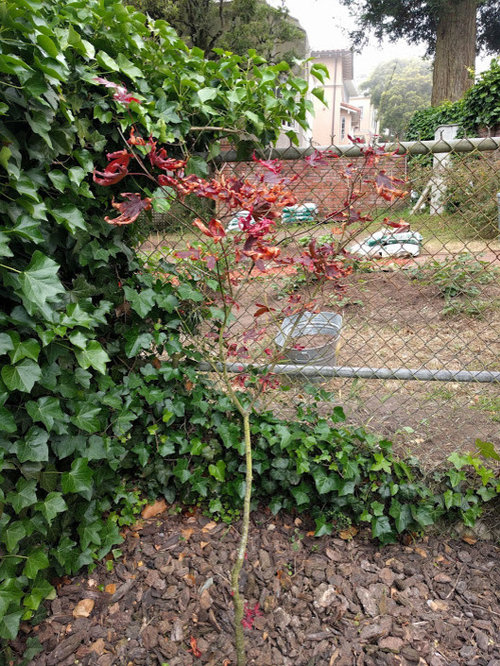
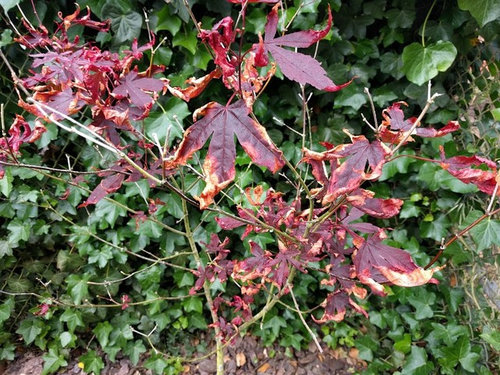
The Japanese Maple that I bought and planted 3+ years ago hasn't grown much and barely produces any leaves.

This spring, it bloomed around the end of April. Now the leaves are drying out. I water it about once a week, and I've always had mulch all around it.

Not sure what to do. Any advice? I'm in San Francisco in a pretty foggy area, not too far from the Japanese Tea Garden, which has amazing maples!!!

Thanks,

Peppe


Comments (22)

  • 10 years ago

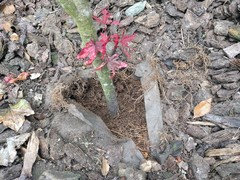
    What did the roots look like when you planted it? Was it rootbound or have circling roots? Did you open them up at all? Is it planted too deeply? Take a photo where it the trunk meets the soil- the root flare should be visible.

    It's declining, that's for sure. If it was me I'd dig it out and take a look at the roots and see what's up- at this point you have nothing to lose because otherwise it's a goner.

    Peppe Ragusa thanked cearbhaill (zone 6b Eastern Kentucky)
  • 10 years ago

    Thanks for your reply!

    I just moved the mulch around and found that there were two layers of synthetic weed blocker basically all the way to the trunk (I had forgotten that I put weed blocker under the mulch!). I wonder if that was "suffocating" the roots. The root flare is quite superficial, and it looks like the visible roots are very thin.

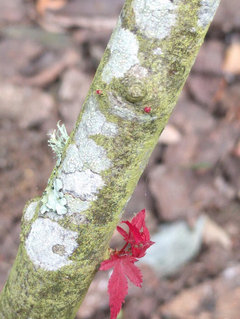
    Also, there are brand new leaves (from a couple days ago) sticking out of the main trunk, and a few tiny red buds on the trunk as well.


  • 10 years ago

    Definitely get rid of that fabric and then re-mulch it really well but not right up to the trunk- run your fingers around the base after you mulch. Those roots look like they were searching for moisture and it all looks really dry. Do a long, soaking watering and then keep up with it twice a week or so always watering deeply and thoroughly- that's your best shot at saving it IMO. It just looks dried up to me, like the water wasn't penetrating well or going deeply enough.

  • 10 years ago

    I could be wrong, but it looks to me like the tree was planted too deep initially, and the submerged trunk has put out a lot of (adventitious) fine roots.

    It's hard to know without digging it up, but I suspect the tree is declining at least in part to being planted too deep and having issues with being rootbound or root girdled.

    http://www.itreeservice.com/pdfs/planting_too_deep_and_other_problems.pdf

    Peppe Ragusa thanked magpiepix 5b/6a
  • 10 years ago
    Thanks! I think you guys may be right... it does seem too deep after all. I will remove fabric and mulch from around the trunk and try to expose a little bit of the flare. Or should I dig it up entirely and replant higher?
  • 10 years ago

    Sounds good - will do.

    I'll report back in a few months :) Thanks again!

  • 10 years ago

    I think it's often best to do root work when the tree is dormant. If the tree makes it that long, I'd wait.

    I had to do this once with a really sad one purchased at Home Depot. I've never seen such a rootbound tree, and it had many advantageous roots strangling the trunk because it had been planted too low in the pot. I couldn't work on it when I bought it during the summer, so I planted it and waited until spring (before it leafed out).

    I dug it out, kept the roots wet, and tried to de-tangle the root ball at least partially by dipping it in a bucket and gently teasing them apart. I won't lie-- it's slow, annoying work. I'm not sure I'd do it again, unless it was a tree that meant a lot to me.

    I also cut off the trunk roots, and planted it much higher (on a slight mound, too). Then during that first season I regularly treated the low wounds (where the strangling roots had been) with copper spray.

    As an alternative? Maybe consider buying a new tree. You can get 4' trees for $25 plus shipping from places like Whitman Farms, and they're guaranteed to be healthier than what you have.

  • 10 years ago

    Well? How did it do?

  • 10 years ago

    :) So now the tree has no leaves but it doesn't seem dead. I think it might be dormant.

    The trunk was quite deep but I removed a good amount of soil, watered it weekly and added some plant food. Not sure if it's a good time to take it out and replant it.

  • 10 years ago

    It's almost fall - ideal planting time! If it was me, I'd dig it out entirely, pry apart the roots with a chopstick and make a few cuts if it was too tangled up. This won't hurt your tree, esp if it's dormant looking (but not dead already). Then maybe till up a nice large area for it, esp. If you've got clay, and if your soil is alkaline, maybe add a cubic foot or two of peat moss and till that in, too. Replant shallow, mulch deep, and see what happens in spring!

  • 10 years ago

    I sounded like Treebeard right there for a second

  • 10 years ago

    Sounds good! The weekend is around the corner ;-) Thanks so much for reviving the thread and for the advice.

  • 10 years ago

    Have you ever watered it? The area looks dry.

    If you live near the Tea Garden in Golden Gate Park, there's a lot of fog but not much rain. I used to visit the park during the 60's when I was stationed at Travis AFB in Fairfield. AKA Haight-Ashbury district.

    Mike

  • 10 years ago

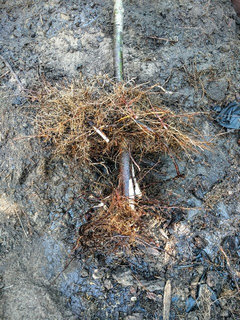
    Ok I finally dug it out. Amazing how deep i had planted it! The top of the root flare was at least a foot and a half deep! It developed a lot of adventitious roots - as soon as I touched them, they separated from the root flare.

    I replanted it in a container with good soil and left the top roots almost visible.

    Unfortunately I hit the bar of the trunk with the hoe in the process of digging the tree out. Hopefully it won't hurt it too much.

    Thoughts? Thanks for all the advice btw!

  • 10 years ago

    Oof! Yep there's your trouble right there. Maples do not mind root pruning, though it should be done when entirely dormant. If your tree is alive, and you remove all the adventitious roots, keeping the proper flare and root bundle just above ground, you might be surprised by what a pretty tree you have in spring. Do it a favor and put your container in the garage over the winter. It's been through a lot! I hope it lives, and it's got a shot now.

    Peppe Ragusa thanked Leslie Tarly Z 5a
  • 10 years ago

    I was just wondering about that. Winters in San Francisco are not too cold (rarely under 45-50 deg) so I thought I would keep it outside. My garage has basically no light and I am worried that's a bad thing for vegetation in general.

  • 10 years ago

    Oh in San Fran it ought to be fine, sorry. In a pot a JM loses two zones of winter hardiness, but you're in a perfect climate for the species and can afford to lose more than that, before it succumbs to winter chill.

    Still. A garage is a good idea for critters however, if you've got any. It won't mind the dark...it has no leaves over the winter so that won't bother it at all. It's a weak plant. But I agree in the Bay Area it ought to be fine climate-wise, almost no matter what.

    Peppe Ragusa thanked Leslie Tarly Z 5a
  • 10 years ago
    last modified: 10 years ago

    Burying the tree 18" over the root flare is what has caused the problems to date. This has essentially suffocated the lower set of roots and I doubt many, if any, of them are still viable. If this were not a grafted tree it would be stone cold dead by this point in time!!! But because named JM's are almost always grafted, you have now developed a root system associated with the scion rather than the rootstock. These are not adventitious roots but viable feeder and anchorage roots coming from the top grafted portion (the scion).

    Although this is not a great time to be doing any of this sort of activity, I'd be inclined to remove the lower trunk and roots just below the upper (graft) set of roots and replant. This is just the opposite of what Leslie suggested but IME, is far more likely to produce a satisfactory outcome. I am pretty certain the rootstock and its roots - everything below the top bundle of roots - are no longer going to be viable and the removal of the upper, graft roots would just result in the death of the tree. You can containerize it if you wish, but I'd just replant in the ground. JM's are far easier to manage in the ground than in containers. Make sure these upper roots are buried just below the soil surface....so that the soil just barely covers them.

    And just so you can be prepared, I would say that the chances of this tree surviving what has been done to it to date and what is proposed are at best only about 50%-50%. Sorry :-((

    And take this message forward with you for all future tree plantings -- the root flare should always be positioned at the soil surface or slightly above. Always, always, always!!!

    Peppe Ragusa thanked gardengal48 (PNW Z8/9)
  • 10 years ago

    Thank you for the detailed reply, gardengal48!

    However, I already removed the thin roots and replanted with the bottom roots. The thin ones just came off in my hands, they were barely connected to anything! They were just sliding up and down the trunk like a donut, so I cut them and dumped them. I don't see any sign of grafting, so hopefully what I did will work, otherwise I'll be happy to spend $25 on a new tree rather than spending my weekends on this lost cause :-)

    Anyways, thanks again to everyone who chimed in. Really appreciate it!

  • 9 years ago

    Wait you posted in August 17 the tree has no leaves, thats not even the right time for Japanese maples to be losing leaves.. or any deciduous tree in general. My area loses leaves in november, maybe its a location difference but I've never heard of a deciduous tree losing all of its leaves in the summer.

  • 9 years ago

    I want am update in the spring. Thank you for keeping us informed.

Sponsored
Kuhns Contracting, Inc.
Average rating: 5 out of 5 stars26 Reviews
Central Ohio's Trusted Home Remodeler Specializing in Kitchens & Baths