Software
Houzz Logo Print
importhatch

Need some help with my first yard

10 years ago
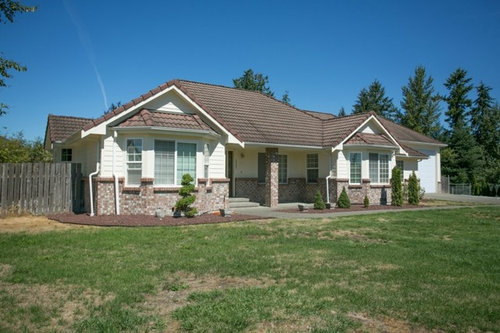
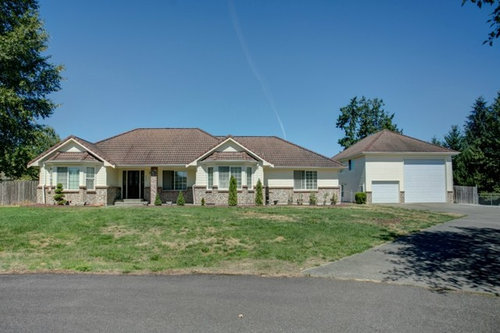
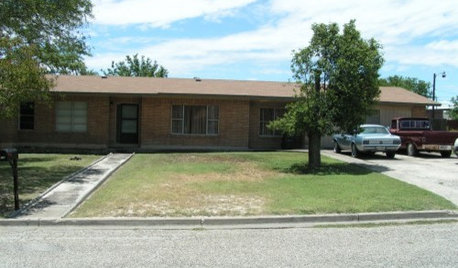
I am new to the forums and I have a couple questions about my yard. House is located in Tacoma, WA. I bought a house last October and was trying to get the front yard presentable for the summer. This is my first yard and this is what the yard looked like last summer before I moved in:


The yard was severely neglected as you can see. The goal for summer 2016 was I just wanted a yard without bare spots and that was mostly green. Here is what has been done since November of last year:


Fall 2015: heavy dethatching and plug aerating, Winter weed and feed (I got started a little late and missed the window to overseed)


Early Spring: Dethatch heavily, plug aerate, overseed, Starter fertilizer, top coat and watering.


Spring: Couple bags of Milorganite and about a month later a dose of:

Scotts 5,000-sq ft Turf Builder with Halts Crabgrass Preventer Lawn Fertilizer (30-0-4)


I did not want to kill the crab grass at this time because I was still trying to get rid of the bare spots for the summer of 2016 but at the same time did not want the crabgrass to keep spreading. Everything was going well and the yard had great color and was really starting to fill out. At this time I was mowing at 3" height about every 3-4 days.


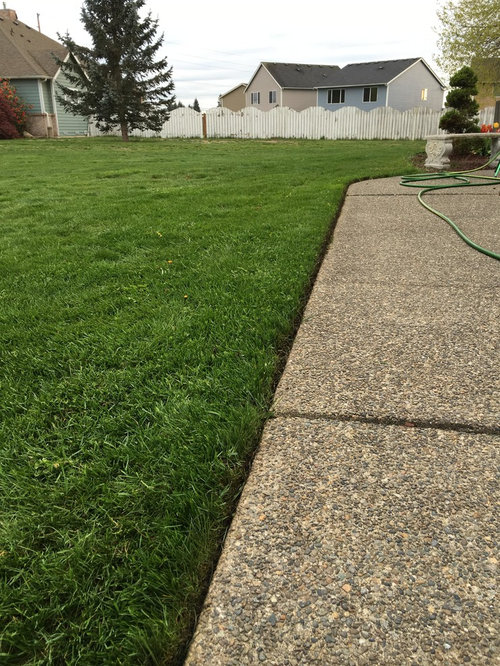
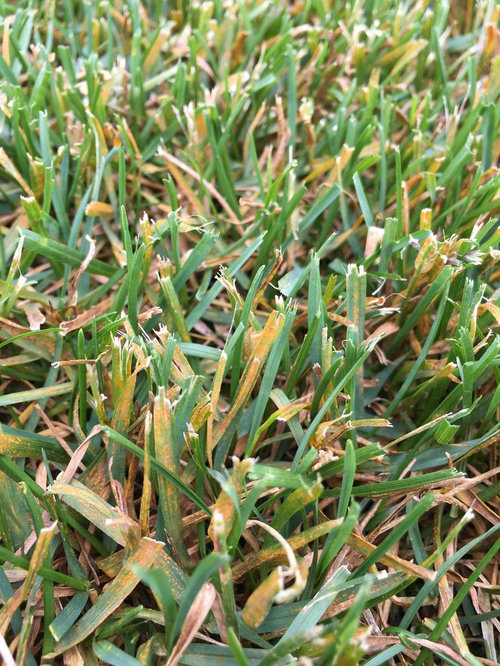
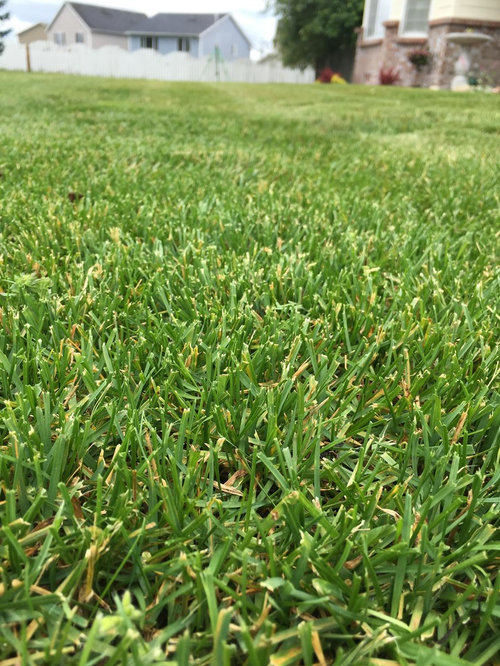
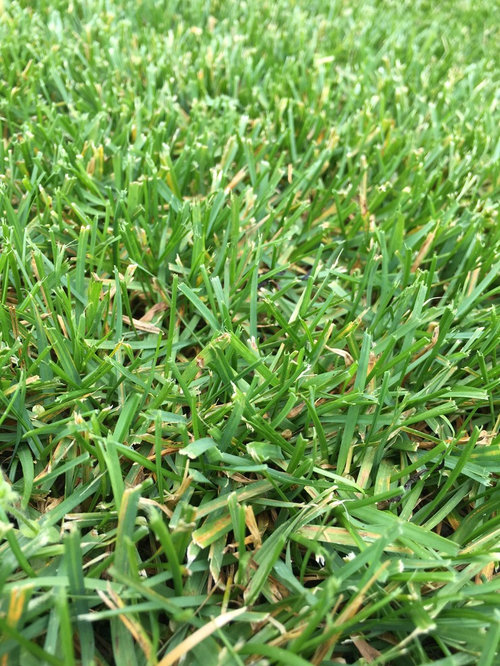
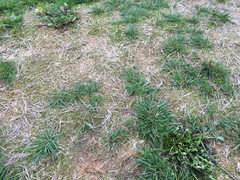
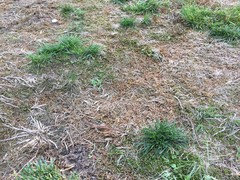
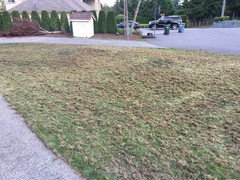
About 2-2.5 weeks after I put the Turf builder with Halts Crab grass on the blades of grass started to get a orange/golden tinge to them. Here is the yard and upclose photos of what I am saying:


The top photo is the worst of it and the lower photos is what the majority of the grass looks like.


My question is what exactly is going on? Is the grass experiencing nitrogen shock or maybe a potassium deficiency? Maybe the crabgrass preventer hurt the grass?


My soil PH is around 6.8 and I have not tested for potassium as of yet.


A few months back I picked up some

Scotts 15,000-sq ft Turf Builder Weed and Feed Lawn Fertilizer (28-0-3)

that I was planning on putting down early June to combat some weeds and clover but now I am weary......

I need to figure out what is exactly going on with the grass first..... Any ideas?


Thanks in advance,


Chris-


Comments (24)

  • 10 years ago

    On a side note your mower blades really need sharpening.

  • 10 years ago

    Weird I was so focused on the grass didn't even notice the cut. These are brand new blades from John Deere, wonder what the deal is.

  • 10 years ago

    Actually, that's quite an improvement and it's looking pretty good. What type of grass is that? If you know.

  • 10 years ago
    last modified: 10 years ago

    That's exactly the problem, brand new blades are normally dull/un-sharpened. Reason is they don't want neither staff nor customers handling sharp blades. You can sharpen them yourself with an angle grinder or take them in to be sharpened..

    Propiconazole treats rust along with other fungal issues. It is the main ingredient in granular form in Bayer Fungus Control for Laws, found at Home Depot and Lowe's.

    Yager thanked User
  • 10 years ago

    I would guess it was thatch. It was a layer of what looked like dried grass that you could just rake out with a plastic rake, completely dry and dead. I do not have pictures of it after I dethatched but there was huge amounts of this

    I was watering daily when I overseeded to keep the seed wet and I did a top dressing mix of soil/grass clippings (maybe 1/4" depth or thinner) and after that I was watering 2 times a week for about 20 minutes on each section. We did have some oddly warm weather in WA this spring with some rain mixed in but no heavy rain really. I overseeded with:

    Sta-Green 20-lb Sun and Shade Grass Seed


    http://www.lowes.com/ProductDisplay?catalogId=10051&langId=-1&productId=50140328&partNumber=551973-303-2149629822&storeId=10151


    The grass that has came in from this is not effected as the grass shown above. It is rich green and healthy.


    I am going to raise my deck back up and sharpen my blades and see if this helps.


  • 10 years ago
    last modified: 10 years ago

    Thanks j4c11, I will check that out and go from there. so you think this is a fungal issue as well? It doesn't seem to be getting any worse, maybe even getting better slowly. I just found some pics of when I dethatched I'll throw those up

  • 10 years ago


  • 10 years ago

    That is not textbook thatch, it is the remnants of the dead turf. No matter, it needed to be removed before seeding for good seed to soil contact. Dethatching was a fine and has it's advantages for preparing a seed bed.

    A primary reason for only one fertilization befror the end of Summer and applying that feeding around Memorial Day is to avoid making the grass more susceptible to disease. That does appear to be a fungal disease. You would need to identify and apply an appropriate fungicide. However, as you say the turf appears to be growing out of it, just leave it alone. Keep an eye out for any re-occurrence and treat with a fungicide.

    Your mower is, as mentioned, tearing the blades rather than making a clean cut. This can also make the grass susceptible to disease. Do check your blade and properly sharpen it by maintaining the proper angle and not sharpening from the under-side (but do remove the burr). Make sure your mower is running at full throttle and cut no more than 1 to 1 1/4" of grass off at a mow.

    Yager thanked User
  • 10 years ago

    Yes I just pulled the blades off my mower and sharpened them. I mow every 3-4 days and cutting less than an inch off. I just applied the Bayer Granules Fungus Control for Lawns so we'll see what happens. It says to apply every 2 weeks, I'm hoping it greens up in a timely manner. Gonna lay off the watering and hope for the best.

  • 10 years ago

    Why was it mentioned to not add top soil or sand other than where standing water is?

  • 10 years ago

    I added some sand and soil/compost mix when I overseeded. The stuff I read online said it was good to have a top dressing over the seed when overseeding.


  • 10 years ago

    I agree. Wasn't sure why dchall mentioned not to top dress with topsoil.

  • 10 years ago

    Mother Nature does not topdress when She seeds grass lands. The livestock or wild grazing animals wander or stampede through the grass knocking the seed off and walking/stampeding over it. The best way to simulate that effect is to seed onto bare soil and either walk/run over it (small property) or roll it down with a roller.

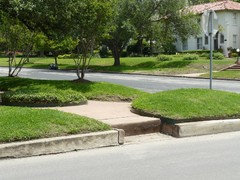
    Several years ago I started photographing yards with too much top dressing. Top dressing is insidious. The yard pictured below was top dressed 1/4-inch per year...every year...for 40 years. That's 10 extra inches of soil.

    Note that they needed to buttress the soil to keep it from washing out over the sidewalk. Here's what it looks like when they don't do that...
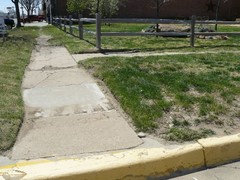
    This one is harder to see, but the soil to the right is at least 8 inches above the sidewalk. You should be able to see the sidewalk off to the right, but the mound of dirt is blocking the view. Now look into the distance. There's so much soil over the sidewalk that grass is growing out over it.

    My point is that when you topdress, even once, you're changing the drainage in your yard. One bad thing that can happen is rainwater will become dammed up and flow back into the house - or worse, into your neighbor's house. So if you don't need to topdress, then don't. The only time you need to add soil is if, for some reason, you have a low spot that holds standing water.

  • 10 years ago

    I follow your logic now... My lawn is exceptionally bad, it's new construction and the developer had stripped all of the top soil when our house was built. Knowing this, I plan to top dress my lawn with soil.


    In the cases you stated above, I think it's overkill. However, each lawn has it's own unique story, and mine is in need of some help.


    Thanks for the info, look forward to more posts!

  • 10 years ago

    Poor sandy soil may benefit from a small dusting of compost to enrich the soil, but it will break down. Just don't bury the grass.

  • 10 years ago

    Okay before you add any soil, did the contractor grade your lot so that it drains away from the house toward a ditch or to a paved road? It is standard practice for builders to "take out all the good soil leaving poor subsoil." Everyone thinks that happens, but almost always the remaining soil is not that bad. Both the chemistry and biology can be corrected very easily. If you bring in new topsoil, then that new topsoil is going to have its own chemistry and biology issues. Usually the problem with poor soil is an imbalance of salts like calcium, potassium, sodium, and magnesium. You can't fix that with more soil, but you can with a soil test and some corrective chemicals. If you're going to end up fixing it anyway (with normal good gardening practices), then why not just start with what you have?

    So before you do anything do this: Send a soil sample to Logan Labs in Ohio (not to your local university or county extension service). For $25 Logan Labs will test the soil and email you a report that is incomprehensibly complicated. Post the results here and morpheuspa will read it and tell you what you need to add, when, why, how often, and where to get the stuff you need. That alone is worth $250 from professional soil analysts.

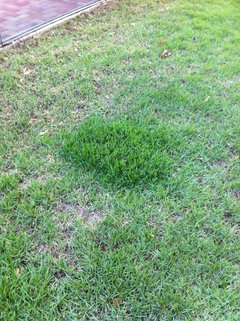
    While you're waiting for the results to come in (less than a week), you can go ahead and work on the soil biology. That's done with organic fertilizer. The modern organic contain ground up nuts, grains, beans, and seeds. It turns out you can buy those ingredients at any feed store. Morpheuspa likes soybean meal and Milorganite. He likes them because they are good materials and he can get them locally. I can't. I like corn meal, alfalfa pellets (rabbit chow), and corn gluten meal...because they are pretty good and I can get them locally. The application rate is 15 pounds per 1,000 square feet. You can apply any day of the year, or every day of the year, without fear of damaging anything. The idea is to improve the soil biology. In 3 weeks you'll see a difference in the plants and grasses growing where you applied. In fact, here's a picture...

    This pic shows the effect of alfalfa pellets. You can see the improved color, density, and growth after a month.

    If your soil seems to be hard even when it's moist, then you can spray it with a surfactant like any clear shampoo. App rate is 3 ounces per 1,000 square feet. I sprayed my soil in San Antonio back in 2012 and it still gets so soft after a rain that it's a little hard to walk on.

    These three things will cost you roughly $30 and change. They are easy to do, will tell you a lot about your situation, and will get you started in the right direction.

    Or you can do it the hard way. You can bring in more soil, ruin your existing drainage, flood your house, and still have soil that needs to be tested and biologically improved. Well, maybe that part about flooding the house is a little over dramatic, but it has happened, so yes, I'm just trying to scare you into doing it my way. I started moderating organic lawn care forums back in 2004, so I've read and absorbed a lot of material since then. You're benefiting, maybe, from problems I've seen and seen resolved. Best wishes to you, and I say that not to blow you off, but because I hope what you end up doing works well. I probably raised a lot of questions, so feel free to keep asking.

    Oh and I wanted to say +1 to yardtractor. You called it thatch so I picked up on that. You had dead grass and it needed to be raked up. That happened, so I retract my earlier nitpick about thatch.

    Yager thanked dchall_san_antonio
  • 10 years ago

    And like DC said, no topsoil, it's the wrong material.

  • 10 years ago

    Just to be clear I am not bringing in any soil , sand, etc. I have a couple low spots but besides that the grade of the yard is good.

    I have been using milorganite on it and have 4 more bags of it. I had read about the soybean meal but was unable to find it in local hardware stores. I did not think about checking farm supply, we have a handful of those around the area.


    Do you think in my yards current state I should apply some more milorganite and/or soybean meal? I am going to be away for a week and would like to leave it in the best possible condition before I go.

    Good call on the soil sample, definitly going to do that.


  • 10 years ago

    Sorry Yager. Seems I hijacked your thread... I do plan to add soil or compost to my yard. I have a sample in to our local university cooperative extension (Penn State).


    I'll stop replying to this thread, and generate my own...

  • 10 years ago

    I'm just north of you in Shoreline area, and I noticed the same thing going on in part of my yard. Up close it looks like tiny spores on the leaf of the grass blades. We had very light rain this year every day for months... wonder if that has something to do with it.

  • 10 years ago

    Well just to update I have applied the Bayer fungus control and another dose of milorganite. My yard has bounced back and is started to fill out. I have upped my cutting length to 3.75" and it seems to be choking the weeds out. I also did a spot spray of spectracide weed control and pulled any other weeds. I'll update a picture this week. I need to setup a game plan for the rest of the summer/fall to try to get this yard in the best shape possible. Would it be best to post another thread about that? Thanks in advance.


  • 10 years ago

    Good to hear you're finding some success! How much yard & are you planning to reseed? A fresh thread wouldn't hurt, this one takes a long read.

  • 10 years ago

    I was planning on digging out some large patches of crab grass and various other grasses this fall and then overseeding. The front yard is about 4000-4500 sq ft.

Sponsored
Peabody Landscape Group
Average rating: 3.5 out of 5 stars8 Reviews
Columbus' Reliable Landscape Design & Contracting