Software
Houzz Logo Print
pippiep

Help! What does "rough" mean re: plumbing?

10 years ago

The work has started! Today, they're putting in a utility sink in the basement and removing a chunk of baseboard heat in the kitchen for a wall that will be shortened. Additional plumbing will be a new prep sink in the (new, not yet installed) island and two toe-kick heaters.

What exactly is considered "rough plumbing"? And when do I know it's done?

I owe payment on completion of the rough plumbing. I already wrote the check because I was in a hurry and didn't check the contract; he just said it's xxx.xx for today. I told my husband to call if he had questions, but he left it to me anyway. Now he's saying to only give half plus the cost of the sink.

I guess I need to be more prepared! There will be electrical work done in the basement on Tuesday, but lots more to do in the kitchen once they start demo. At least now I know not to give the total amount that's due on the completion of rough electrical... But when is the point of completion?

Comments (14)

  • 10 years ago

    It's all the plumbing in the walls--usually with just a little bit sticking out to make the final connections much later. It's a big job but you never notice it because it's not visible (hopefully!).

  • 10 years ago

    Rough plumbing is the "ugly" stuff. All the stuff that happens before the "pretty" stuff goes in i.e. sink, faucet and the like. That's my understanding. :-)

  • 10 years ago
    Thanks! I just spoke to the plumber (wanted to have some idea first). There's still a TON to do beyond today for the "rough" part. So I don't know why the GC asked for the payment, when it's not going to be done today. Now I know! I'll talk to him more about it when he gets back.
  • PRO
    10 years ago

    "Rough" in this sense means the stuff behind the walls, but that can be critical when you've got tile going up on a wall that has wall-mounted faucets. If the valve isn't placed perfectly plumb, the spout won't be level. If the valves aren't spaced exactly, two adjacent valves may have different tile spacing. Of course they have to be level to each other. Ask me how I know:

  • 10 years ago

    Both rough-in plumbing and rough-in electrical are everything that needs to happen before the insulation and drywall goes up. "Rough" is just a specific stage during construction -- rough plumbing happens after framing and before drywall.

    What your rough plumbing will look like depends on the job. You mentioned a utility sink and prep sink. In really simple terms, when sink plumbing rough in is done, you'll see what looks like three different pipes running through the floor/ceiling/wall and ending sticking out of the floor/wall roughly where the sinks will go with caps on the end of the pipes. Usually for each sink, there'll be one big pipe (the vent/drain), and two little ones (hot water and cold water).

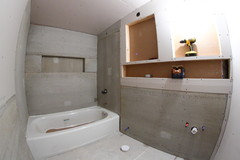
    After the wall board goes in, you will no longer be able to see the pipes snaking through the walls/floors/ceiling. You'll see only the three capped pipe ends that stick out, like so:

    On the far right in that picture, you'll see the rough-in plumbing for the bathroom sink. The big white pipe is the drain/vent. The little red pipe is the hot water line. The little blue pipe is the cold water line. The pipes aren't always those colors (for example, if you have metal pipes rather than PVC, the hot/cold lines would be copper), but the one-big-and-two-small-pipes configuration is pretty standard for sinks.

    I have no idea what kind of plumbing your heaters might need. That didn't come up in our remodel.

  • 10 years ago

    You may ask your GC for the results of the rough plumbing inspection. When it's passed he can ask you for payment.

  • 10 years ago

    Wait until after inspection before paying. I made the mistake of paying the electrician before and it took a lot of arguing and time before he came out again.

  • 10 years ago

    Omelet-- we did that, and it's been SO HELPFUL.

  • 10 years ago
    last modified: 10 years ago

    I learned a lesson second hand. Before paying the GC, ensure the workers and suppliers have been paid and get a lien waiver from them. If they have not been paid, write the check to both of them for what they billed the GC. Also, do a county records check - free - and search the GC name for court cases a few times during the process.

  • 10 years ago
    last modified: 10 years ago

    That would be a 'waiver of mechanic's lien'. It indicates that the workers have been paid for their services and won't come back and sue you for non-payment by the GC. Or try to charge you more.

  • PRO
    10 years ago

    "Before paying the GC, ensure the workers and suppliers have been paid and get a lien waiver from them."


    That's a bit premature on a rough-in. I can't imagine a GC paying a sub for a rough-in and agin after a final. If you've done due diligence on your GC and have a well-written contract with retainage this shouldn't be a problem. As a sub, I wouldn't sign a lien waver until I'd been paid.

  • PRO
    10 years ago

    The rough plumbing is not done until it's been pressure-tested. On a remodel, they can't completely pressure test drains, it can only be a visual test.

    Casey

  • 10 years ago

    There are people far more expert here than me but I'll add that since rough-in is everything in the walls, it includes the valves for the shower/bath and when, as in my case, you have a wall-mounted vanity faucet it includes those valves, too.

    I'm not sure whether having the tub in is strictly required for rough-in, but it seems to always be done, as in my case and in the picture above.

    My GC doesn't care when my toilet and sink come (finish is a ways out) but he wants the tub soon (and it potentially had a four week lead time.)

    As a curious first-time remodeler, it's been a lot of fun to learn all this.

    And to thank the powers that be that I can trust my GC.