

Squash not producing :(
The plants look awesome and are loaded with small squash, but they just won't mature. When i planted them, I added garden tone, lime and cottonseed meal to the soil. Any suggestions? James
Comments (41)
 10 years ago
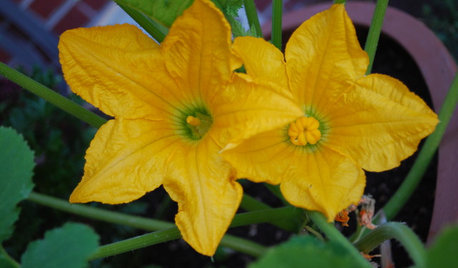
Are the small squash located just behind a blossom? If they are they need to be pollinated by a male flower. Male flowers do not have the little squash behind the blossom. Mine are loaded with little female blossoms/squash but not even one male blossom yet. I am just waiting (not patiently either) for a male blossom to develop so I can pollinate the females by hand.
JamesY40
Original Author10 years agoThese are pollinated squash. They have grown a little, then just stopped.
Related Professionals
Fort Myers Landscape Architects & Landscape Designers · Atlanta Landscape Architects & Landscape Designers · Portland Landscape Architects & Landscape Designers · Fresno Landscape Architects & Landscape Designers · Modesto Landscape Architects & Landscape Designers · El Paso Landscape Architects & Landscape Designers · Quincy Landscape Contractors · Emporia Landscape Contractors · Sugar Land Landscape Contractors · Victoria Landscape Contractors · Danville Landscape Contractors · Allentown Landscape Contractors · Scranton Landscape Contractors · Chattanooga Accessory Dwelling Units · College Station Accessory Dwelling Units- 10 years ago
If they grew a small amount and then stopped growing, then either pollination did not occur or incomplete pollination occurred. I'd hand pollinate if you're available to do so in the early mornings when the pollen is most viable.
The best squash fruit are produced by more than one bee visiting a female flower during the brief pollination/fertilization window. The more bees the better. In the absence of lots of bee visitiations, incomplete pollination often results in a partial pollination/fertilization that allows the fruit to briefly enlarge but then it drops off the plant and rots because it wasn't pollinated and fertilized well enough. That is most likely what is going on.
An alternate possibility, though a less likely one, is that a fungal disease is hitting the flowers and infecting them before pollination occurs. By the time pollination and fertilization are achieved, the fungi has spread and the young fruit rots and falls off.
If you've had a lot of rain the last couple of weeks there like we've had here, I think all the squash trouble is related since bees are less active on rainy days and fungal infections are more common when moisture levels are higher. If you could get a few dry days back to back, the squash problems likely will go away.
- 10 years ago
James, I'm hand pollinating mine this year, just as a little extra insurance. I go out in the mornings with a q-tip, or I just pick a male flower off, and I hand-pollinate my female flowers. Seems to be working for me. Otherwise, I have a lot of aborted squash.
- 10 years ago
You might want to look at this website: http://forums.gardenweb.com/discussions/1918281/hand-pollination-of-squash
 10 years ago
Let's talk blossom end rot. So why are there differing opinions that I read on gardening websites concerning calcium foliar spray? I see several brands for sale and recipes to make your own. Then I read articles saying that foliar feeding won't work with calcium spray, that the squash take calcium up through the soil. What's a gal to believe? And if my soil needs more calcium, how to do that since everything is already in the ground? My ph was 7.0 when I had it done early this year and I believe it didn't mention the need for calcium (better go re-read the report!) thoughts? I'm asking because one of my zucchini feels soft on that end and is not growing anymore, if it is BER, I'd like to "nip it in the bud"!
JamesY40
Original Author10 years agoUpdate on squash. I do think the issue is poor pollination. However, the squash that are growing are growing to about 6 in long, very slender, warty and dark orange. Hope things change soon. Maybe it will stop raining for a few days.
- 10 years ago
Research has shown that calcium foliar spray is not helpful because a lack of calcium in and of itself is not the cause of Blossom End Rot.
BER is a disorder caused by problems that interfere in the way the plants distribute the calcium that they have and most often the BER results from inconsistent moisture levels. The inconsistent moisture levels can run the gamut from exceptionally dry soil during periods of drought to exceptionally wet soils during periods of heavy rainfall. The best way to 'cure' BER is to maintain consistent soil moisture levels. During hot, dry spells, we do this by mulching heavily to retain whatever soil moisture there is, and during exceptionally rainy spells, there's not much we can do except wait for the soil to dry up some.
When soil moisture levels are average, the plants absorb the nutrients they need, including calcium, via their root systems and then the plants' vascular systems distribute the nutrients throughout the plants. During periods of very dry or very wet soil, the plants' roots are unable to function normally and cannot take up the calcium to send through the vascular system. Ok? It isn't that the calcium isn't in the soil, it is that the plant roots cannot absorb it. This next step is key. Because the life of the plant is more important than the life of any single fruit, the plant 'pulls back' the calcium from the fruit in order to keep the plant itself supplied with calcium during this period of stress. When this occurs, the lack of calcium in the fruit leads to the symptoms we see that we describe as BER.
There are some other stresses in addition to drought/excessive rainfall that also can lead to BER, but they are less common. One of these is the feeding of excessive nitrogen to the plants which causes the plant's above-ground growth to outpace its root growth by a great deal, leaving the root system unable to supply the plant with enough calcium (and other nutrients) until the root system grows enough to catch up with the massive topgrowth. Once again, it isn't that the soil doesn't have enough calcium but rather than the plant, for reasons beyond its own control, cannot adequately absorb/distribute the calcium. Another form of stress that sometimes leads to BER is merely the formation of many fruit on a young plant that really cannot support that many fruit yet. This probably is more commonly with tomatoes than squash, but it can happen when a squash plant sets a lot of fruit all at once too. In this case, the plant is too immature to adequately support all the fruit it has set and cannot supply them all with calcium due to its immature root and vascular system. Once the plant grows a bit more, this problem resolves itself.
Normally, in the kind of weather we've been having lately, any BER that appears is related to excess moisture. When the soil dries out, it will go away.
What often happens is that a gardener gets online, figures out that BER is the problem, runs to the store and buys calcium (often in a spray formula) and applies it. Then, when the plant begins working properly, they give the credit for the improvement to the calcium they applied when, in reality, the growing conditions had improved on their own and the BER went away accordingly, which is what always happens. Every gardener will encounter BER from time and time. I just ignore it (unless we are in drought and I haven't been watering, in which case I might water to see if that helps) and it goes away on its own. I've never added calcium to any plant with BER to fix the BER and, yet, the BER always goes away.
And, finally, there are many, many disorders of squash and other cucurbits and some of them can cause the fruit to look like it has BER. Sometimes people whose squash plants have choanephora fruit rot mistakenly believe their plants have BER. Choanephora fruit rot also tends to develop during periods of high moisture. You can see photos of these various disorders of squash at the Texas A&M University Cucurbit Problem Solver Webpage. Click on the photo of the disorder or disease to read more about it:
I hope the explanation and the TAMU webpage help. I'm willing to bet that if what you're seeing is BER, it will go away on its own when the main stressor (likely excess rainfall and excess soil moisture) goes away. If you don't already grow squash in raised beds, planting them in raised beds or on mounds of soil simply raked up a few inches above grade can make a huge difference when rainfall is heavy and you might want to try that next year.
Dawn
JamesY40
Original Author10 years agoDawn, great information. I think you have described my squash's condition perfectly. James
- 10 years ago
James, Thanks. I'm always happy to help and I'm glad maybe we have figured it out.
Dawn
 10 years agolast modified: 10 years ago
Y'all, I killed my first squash bug tonight. It was so unexpected--I wasn't even thinking about squash bugs--I don't even have any squash fruit yet. I was sitting on the ground near the volunteer pumpkin patch and weeding. My attention was on the large number of ants and aphids on and around the pumpkins...and also the ladybugs, some of who seemed a bit lethargic...at least in my estimation. Can't they eat the aphids a bit faster?!
Anyway--the squash bug. I noticed a particularly lazy ladybug just sitting on the mulch, so I gently poked it and it took off like it was running from something (probably my finger) and then I saw it! The squash bug! Just taking a stroll on the pumpkin patch. In my mind the ladybug was first being still to escape Squash Bug's notice, and then took off when I touched it. Of course, that's probably not what happened at all. The ladybug was just taking a little nap and I startled it, and it wasn't hiding/running from Squash Bug at all. Am I the only one to make up garden narratives as I'm working in the garden?
Anyway, I killed Squash Bug and carefully watched the pumpkins all evening.
Then that brought to mind my korean squash. (some of Dawn's from the Spring Fling). It looks like it's about to make some fruit. Yay! So...squash bugs and C. moschata? Do squash bugs like C. moschata? I know they are resistant to SVB, but how does the squash bug affect them?
- 10 years ago
Hazel, I haven't seen any squash bugs yet, but I did find a stink bug. I hate those things.
- 10 years ago
Squash bugs sometimes will visit C. moschata and it is advised that you carry out a 'scorched earth' policy and kill every squash bug you see, which is easiest if you do it the first day you see them, and then immediately check the undersides of all leaves for eggs, and remove those eggs and destroy them. Then, watch for them and kill them. Throw them in the trash. I wrap them up in duct tape or with the sticky paper off a lint roller, after using the lint roller to remove the squash bug eggs from the plant leaves. Don't leave them on a leaf and throw it on the compost pile because the squash bugs will survive and hatch and make their way to the garden.
The reason squash bugs are such a problem is that carry plant diseases, so to keep your plants healthy, you want to keep them free of squash bugs.
While C. moschata type squash or not necessarily disease-resistant or disease-tolerant, they seem to have some sort of ability to tolerate diseases to some degree, but I have seen one or two of the C. moschata plants die in my lifetime. I think that most of the time they simply grow rapidly enough to outgrow whatever disease tries to hit them. While C. moschatas grow decently fast in mild weather, once the real heat sets in and they are getting plentiful sunshine daily, they grow incredibly rapidly. It would be hard for any plant disease to spread rapidly enough to kill them once the rapid growth sets in. The C. moschatas are so perfect for us because they are native to topical climates and grow like mad in the heat. While they are not necessarily totally resistant to any diseases the squash bugs carry, they seem to have a lot of tolerance of those diseases. Sometimes some of the C. argyrosperma varieties also tolerate a lot of squash bug activity, but not as much as the C. moschatas do, and I don't even bother much with the C. pepo and C. maxima types any more because the squash vine borers and squash bugs love them too much.
Pumpkin plants are pest magnets. The lady bug might have been resting, might have been planning her strategy, might have recently morphed from larva to adult and was contemplating the meaning of life and asking "why am I here?" Who knows.
If the lady bugs you saw were adults, then they will not eat aphids at an endless rate. If the lady bug is a mature bug who is about to lay eggs, it will eat up to 10 aphids for each egg it lays. So maybe your lady bugs already had eaten all they needed to eat and were preparing to lay eggs. Or, let's not forget, there are many species of ladybugs (6000 species or more worldwide) and not all of them behave the same. There's some that don't feed on insects but instead feed on other things like pollen or fungi. So, while those kinds of ladybugs might perplex us if we see them not feeding on ladybugs, they still are fulfilling a role in the garden.
Here's some info on how many aphids lady bugs potentially will eat:
I generally do not make up narratives while in the garden because I have to stay extremely focused on detecting venomous snakes. Ha! That issue will make you forget insects even exist in the garden. Now that I'm having more frequent snake encounters, I am switching to summertime mode which means always wearing leather work boots in the garden, being especially watchful for snakes, not sticking my hands down into a bed for any reason (especially weeding) if I cannot clearly see that a snake is not there, etc. The last thing on my mind at a time like that is insects. I wish insects were the worst thing I'm likely to encounter in my garden.
I do make up narratives for venomous snakes and they go something like this: "Uh oh. That was close. Thanks for not biting me. Now, stay right there and don't move. I cannot let you out of my sight or you will disappear. Let me take my cell phone out of the pocket of my garden apron and call for someone to grab a gun and come shoot you." That's my type of garden narrative. Oh, and my biggest garden question is not whether or not the squash bugs are here yet, it is more along the lines of why I see so many more venomous snakes in the garden than non-venomous ones. That really perplexes me.
- 10 years ago
Yikes! Snakes. That's something I haven't encountered yet. Our property is flat and out in the open, not a lot of trees--which is good and bad. Our stuff is open for anyone to see = not good. There are other properties in the neighborhood who back up to wooded areas--I'm sure the snakes are there.
And...I found a leaf with eggs. I actually brought the leaf in and picked off the eggs and washed them down the drain. I didn't see another squash bug though.
- 10 years ago
We're just too close to the river. And, we almost bought land directly on the river, and I'm glad we didn't do that. It is bad enough here. I used to think the snakes were worse in drought years because they run out of foods in the fields and forests and come here looking for baby chicks, eggs, frogs in the garden, voles, etc. Then we experienced too many wet, flooding months in wet years with the river at or above flood stage and the river bottom lands flooded, and all the snakes fled to higher ground. So, it is hard to tell if they are worse in wet years or bad years, but there's too many of them here.
- 10 years ago
I am so glad that is not a problem I face. Snakes are very scarce around the house, now the feedlot is a whole different story. Water moccasins come up from the river and hang around the lot. Those suckers are aggressive!! Ugh, just shivering thinking about them.
- 10 years ago
Water moccasins moved to our very beautiful lily pond in the back yard, just a few feet from the back door, during the drought of 2011 and never left. After a couple of years of shooting them and never really getting rid of them, we filled in the lily pond. It was too dangerous to keep it that close to the house if we couldn't keep it free of the water moccasins. They are aggressive and they scare me. I'd hear a frog screaming and would know a water moccasin was in the lily pond eating the frog and would run out there to check, and that water moccasin would look up at me and open its mouth and show its fangs. That is the kind of stuff that causes nightmares! Other than that problem, as long as we stay out of the creek and out of the ponds, they don't bother us and, of course, we try to avoid bothering them.
- 10 years ago
Several years ago a neighbor was putting a crossing across a large creek that runs into the river. He was using a hugh dozer with tracts. One evening we were checking hay in a field next to where he was working. Walked over to talk to him and he had the water moccissins so stirred up they were swarming and biting the tracts of that dozer. It was like something out of a horror movie. I will never forget them.
JamesY40
Original Author10 years agoGee, that makes the little grass snake I found in the yard today really lame.
- 10 years agolast modified: 10 years ago
That made me laugh, James. I didn't even find a snake...just a giant spider and a couple of squash bugs.
- 10 years ago
stockergal, That's what I hate about them----that insane aggressiveness. I pity the person who is bitten by one because it is both very dangerous and very painful. I truly hated to give up my lily pond and its beautiful water lilies, but once the cottonmouths moved in and couldn't be kept out just by continually shooting and killing them, filling in the pond was the only option. You cannot have a lily pond in your back yard if you cannot keep cottonmouths out of it. That's just foolhardy. Thankfully most people here in OK survive the venomous snake bites of the types of snakes we have here, but on rare occasions a person will lose a limb like that Fort Hood soldier did last year.
James, Well, lame is better than crazy aggressive! Consider yourself lucky.
Hazel, Those are the kinds of insects I can handle. I hated spiders growing up, but as a gardener I love them and leave them alone, as long as they aren't black widows (which some years like to hang out in the caged tomato plants which means that I kill them, but more often lurk in dark corners of the barn or potting shed). Just yesterday I was watching a little crab spider drag away a young grasshopper. Yay! My garden is heavily populated with spiders and they do tons and tons of pest control. I do wonder why God made squash bugs.
Dawn
- 10 years ago
I do not like spiders but have learned to live and let live. Grass snakes still give me the shivers but I leave them alone too.
Dawn, as far as God and squash bugs I thinks he's just messing with ya!!! Ha ha
- 10 years ago
I leave grass snakes alone too. I've even slowly developed almost a fondness for rough green tree snakes. They are about the color of canna leaves, and often wrap themselves around the canna leaves and hang out waiting for a good, yummy insect comes along. Is is their color that makes this me tolerate them? I don't know. I hate, hate, hate constrictor snakes like black rat snakes because they'll wrap themselves around a half-grown chicken or guinea, squeeze it to death and then eat it. I hate chicken snakes too. Really, if the non-venomous snakes would stay away from the chicken coops, I'd leave them alone. But they won't, so I don't. Snake trespassing in the henhouse is punishable by death.
I checked the squash plants while I was out harvesting (and, wow, did it get hot early!) and saw no signs yet of squash bugs or SVBs. I must be living right, but I know that one squash bug is around here somewhere! I know God created squash bugs for a reason other than driving us all crazy, but what in the world could it be???? Pondering such things will make a person crazy. Now, back to the kitchen to finish the canning.
JamesY40
Original Author10 years agoUpdate on the squash. They are finally producing those yummy squash I 'be been waiting on. I've seen two SVB moths, and hoping they have moved on.
- 10 years ago
I went out early to work in the gardens to beat the heat. The wind was nonexsistant so it was hot by 10:00. Baling hay as fast as we can. Two more large fields and we will have all the oat hay up and can start on the alfalfa. So the circle goes!!!
Got a phone call at 3:00am this morning (never good) and my mother in law had fallen in the bathroom. Thankfully she only cut and skinned her arm. My sister in law is up from Mexico and is staying with them. If not she would have laid there till morning, when her husband takes out his hearing aids he can't hear anything.
So it has been a stressful day.
- 10 years ago
James, I'm glad you're getting the squash. Maybe they were just waiting for heat and sunshine, which have arrived in abundance now.
Stockergal, Even pretty early in the day it felt hot. I guess I'm not acclimated to it yet either.
Sorry it has been such a stressful day. It is a good thing your SIL was visiting and staying with them. Maybe your MIL needs one of those Medic-Alert things we were discussing earlier. Hopefully tomorrow will be a better day.
Dawn
- 10 years ago
My squash have been exploding with fruit and growing like mad. Why I just cant be happy and leave it at that is beyond me, but I know that I will soon see my first squash bug and no matter how hard I battle them, they will multiply faster than I can get them under control (I don't think there is even such a state). I think I was a bit too eager to have my squash and over planted for the space I allowed. I have 2 buttercup, 3 zucchini and 3 yellow squash. I probably should have thinned each variety by one, but I'm greedy like that, I guess. And this is the first time I have planted buttercup, I didn't expect it to vine so aggressively, I found a buttercup vine 15 feet over, spreading into my yellow squash. Too many leaves to be able to check each one, so I'm just doing random checks for the eggs, and I'm spraying the bases of the vines with BT a couple times per week. This is the first year I have tried BT, I really hope I can ward off the borer.
I dread the squash bug. Dawn, I try to see a purpose for them, too, but cannot. I know one of these days I will go out to do my check and I will see one, two, a dozen, a dozen dozen, I will pick eggs, try to smash older bugs, spray with a soap solution, all the while hearing the Psyco shower scene in my head. I read about how to "control" them but I honestly think it will always be a losing battle with those nasty things. Why, oh why, oh why.
- 10 years ago
Hailey, I dread the arrival of the squash bugs too. Some years, if I am extra busy and don't want to deal with them, I just ignore them and let the plants die. I hate doing that, but in a bad year (and by bad year, I really mean a drought year) when we are busy every day with grass fires or whatever, something's got to give and, for me, it is the scouting for and disposing of squash bugs that is the first task I drop due to lack of time.
Sometimes I wonder if people who use synthetic, broad-spectrum insecticides can grow squash plants without trouble with all the pests we organic gardeners deal with on practically a daily basis....not that I would run out and buy a synthetic, broad-spectrum insecticide if I knew that it would keep them away, but it is an issue I ponder.
Squash vine borers will drive a gardener to distraction. Some people slit open the vine when they see SVB frass and remove it. You can carefully slit just enough of one side of the vine to open up a wider slit in the vine so you can remove the borer and kill it. Then, take that part of the vine and put it on the ground and pile several inches of dirt over the slit area to cover it up and help it heal. Sometimes, though, when you do this, you find several borers in the vine in the same place and not just one. I hate SVBs. I don't fight them real hard. I just grow C. moschata types instead. So, for me, zuchinni and yellow summer squash are spring crops only, or until whenever SVBs arrive and kill them, and the wide-ranging, vining C. moschata types are the summer and autumn crops.
Some people also inject Bt 'kurstaki' directly into the plant stems, and some inject beneficial nematodes into the vines, all in an effort to kill the SVBs. This is just more than I am willing to do.
Dawn
- 10 years ago
My zuchini is way overcrowded, the massive leaves block the sun from getting down where the fruit and blossoms are. I'm not getting the fruit production I'd hoped for. Am I right that they can be pruned? I read that it's possible, just don't cut the stems. That right there makes no sense to me. How do you remove leaves without cutting the stem??? Just snip off the leaf where it sits on top of the stem? Then I'll have all of these stem stubs sticking up??
- 10 years ago
A few years ago I got so mad at squash bugs that I bought permetherin and nuked the squash plants with it. It killed them, and pulled the squash and replanted. Never got another squash bug that year. I haven't done that again. I haven't put anything on my squash this year, and I'm about to lose two to something now (yellow and zucchini), but I don't see any squash bugs on them. I know I've had SVB moths hanging around, but the leaves on these two are stippling and I don't know if it's spider mites?? I'm not sure, but I'm gonna leave 'em till the leaves hang over, and then yank them because I have backups waiting to be planted.
 10 years agolast modified: 10 years ago
Hailey, please don't prune till Dawn or Macmex or another authority answer you. I have removed a few leaves from a bush type zuke, mostly so I could get to the fruit, without a problem. A vining type might be different. The leaves are doing the work of Photosynthesis, while the fruit and blossums hang out in the shade. The fruit might sunscald without leaves. If there is a fungal issue, then opening the plant up for more air circulation might help. If you avoid bugs, I think the heat will boost your production. Just watch out for powdery mildew.
JamesY40
Original Author10 years agoJust pulled my squash and killed at least 100 SVB grubs. Hope to keep the population down.
- 10 years ago
Hailey, You really don't have to thin, because any day now the squash vine borers likely will show up and thin the plants for you. See there, that's a good argument for planting too many plants too close together---so you can get a harvest before the SVBs get the plants.
If you want to prune, you can, and some people do. I only prune off leaves that have already died. One problem with pruning with any of the varieties that have hollow stems is that the remaininfg piece of any stem you leave will be sort of an open spot for a pest to tunnel into or for a disease to infiltrate. So, ask yourself if the perceived benefit of pruning of leaves outweighs the potential problems that could result.
As Amy mentioned, the leaves are conducting photosynthesis that fuels the plants, and shading the squash so it won't be sunburned and ruined. For this reason, I am mostly a non-pruner myself, but it is your garden and you should do whatever you think is best.
If you choose to prune, cut off the leaf and its stem, cutting just above the place where the stem comes out of the larger stem it is attached to, taking care not to cut into and damage the larger stem.
Mary, Well I guess that answers my question about whether going nuclear with a pesticide would work. I don't like using chemical pesticides, so I probably won't do it....but maybe I'll dream about doing it, and in my dreams, of course, I'll have a perfect squash and pumpkin patch that produces all summer long.
Stippling probably does indicate spider mites. Place a sheet of white paper, plastic or cardboard underneath a leaf and shake the leaf. If little critters the size of the dot over the letter "i" fall onto the paper and begin moving around, there's your spider mites. If nothing falls, my best guess without seeing the leaves is that maybe one of the mosaic viruses that infect cucurbits is hitting your plants.
I am seeing some cucumber mosaic virus sypmtoms on my cucumber plants, but I think the bacterial wilt transmitted by the cucumber beetles will kill the plants before the spider mites do. I never expect cucumbers to last all season in our climate, so whenever the plants die, they die, and I'll be happy with whatever we've gotten from them anyway. I certainly cannot complain as I've been making pickles like a pickle-obsessed madwoman, so in a way, it may be an odd sort of mixed blessing when the plants finally die because then I won't have to make important decisions like what sort of pickles do we need more of. (Answer: none of them.) I've been pickling for weeks and weeks now, and it has to end a some point.
James, That is just awful and I hate to hear it. How many plants did you have? I've never seen 100 squash borer grubs in one season, much less in one planting.
Dawn
JamesY40
Original Author10 years agoDawn, I had a total of 8 plants. There were over a dozen grubs in each plant.. Terrible!!!!
- 10 years ago
That is terrible. The stuff of nightmares! I noticed on my massive zucchini plant a big spot that looked like borers tore it up and the leaves collapsed. I got in there and just cut that part off along with even more leaves, really took a good look into it and there were no borers, can't imagine what happened but there was all of this slime, like slug slime all over it. Well, on a good note, no borers and it opened up an area of the plants that now I can access the fruit much easier. I haven't had a bumper crop of squash this year…yet anyway. I've been snipping off more soft, moldy yellow squash and zukes than I have good fruit. Oh well, one of these years maybe. My pole beans are a dud, again! Two years running, tall flowering vines and zero beans. Something's wrong with them anyway, the leaves, from the bottom up are yellowing and drying up then falling off. I think I'll pull them tomorrow and plant a vining something or other in its place. I planted a second planting of bean seeds about 3 weeks ago, they're about 4" tall now. Time will tell if they're healthy and will produce, I don't know how the heat affects green beans but I think I'm about to find out. And I'll keep trying till I get a good crop! Haha. I've been looking into all of the varieties of C. moschata and will try to order seeds for next year. I don't know, if I can get seeds in the ground by month's end, would it be ok? I wish my town had a decent seed store. Enough will the sad, on a better note, my Thai peppers are so cute! Can plants be cute? Mine is. Bell peppers are flowering, tomatoes are ripening, cucumbers are thinking about it, I have several buttercup squash, 2 that are nearly ready, I think, they're about 6" across and its "zucchini pasta" for dinner tonight!
- 10 years ago
Hailey,
Sometimes when zucchini plants collapse like that and you cannot find squash vine borers in the stem, the plants have contracted one of the wilt diseases or gummy stem blight. Check out the linked page from the TAMU Cucurbit Problem Solver and see if anything there looks like what you observed on your plant.
As long as you get the seeds in the ground by the end of the month I think they'll be fine. I ordered some seeds from Southern Exposure Seed Exchange about two weeks ago and had the seeds in my hands 4 days after I ordered. When I order seeds from Kitazawa Seed, I usually get them 3 or 4 days after ordering online. Most of the time, Terratorial Seed and Willhite Seeds ships equally fast, but they may not have many C. moschata types if that is what you're looking for. Those are the companies I trust...oh, and Johnny's Selected Seeds too, when I need seeds immediately during the growing season. There are other great seed companies but they don't all ship as quickly as the ones I mentioned.
With beans that are giving you all vine, leaf and blooms but then failing to set beans, the issue usally is the heat. It is likely you may be planting them too late (even if you are planting them at the recommended time) and they just can't manage to set blooms and form beans before the heat arrives. Sometimes the heat just shows up too early. Pole beans are often iffy here in springtime because sometimes we go from too cold to plant beans to too hot for pole beans to set beans all too quickly. You can nurse healthy pole beans throug summer and they'll produce in fall's cooler weather, or you can replant for fall. Heat-related blossom drop in beans is similar to the same issue with tomatoes, but many beans form blossoms and set beans at slightly higher temperatures than tomatoes, particularly a few heirloom pole beans varieties long grown in the south, like Rattlesnake. Leaves yellowing from the ground up might mean nothing. For example, those lower leaves are the oldest and once they are not as important as they once were, they tend to yellow and fall off the plant. Sometimes it is just that those oldest leaves age out, and other times it is because growth above them shades them out. Or, sometimes it might be a sign of disease.
To get around the issue of pole beans being iffy on production after the heat arrives, I plant bush bean plants insanely early (March) to get a good crop, plant pole beans just a bit later, and then plant lima beans a tiny bit later. Between the three, I usually get beans of some kind, and this year so far we've had tons of bush beans and filled the freezer with them, now are getting pole beans, and the limas have flower buds so we're waiting to see how they do. In a cool summer like 2012, I may have bush bean succession plantings producing all summer, but in a hot dry summer, that just does not happen. That's why we grow southern peas....to make up for any failure by the beans to actually produce beans. Both pole and bush snap beans usually produce great in fall from a late summer planting.
Since we can't have the weather the plants like here, we just have to work with whatever we get and having a second chance with most crops in fall helps out a lot with that.
Dawn
- 10 years ago
Hailey, I just pulled up 2 huge zukes that badly wilted. I found a SVB buried down deep in the first one, and no saving it. I didn't even bother trying to find the SVB in the 2nd one because it had that same rotten look as the first, and I knew it was in there. SVB #1 went to SVB heaven, and #2 will cook in the garbage bag/trash. I'm sure there are SVBs in the remaining plants, but I'll try to get the growing fruit off before I pull and bag them. I have new plants ready to go into the ground anyway.
Mary




JamesY40Original Author