Software
Houzz Logo Print
jaliranchr

Modified bale gardening

10 years ago
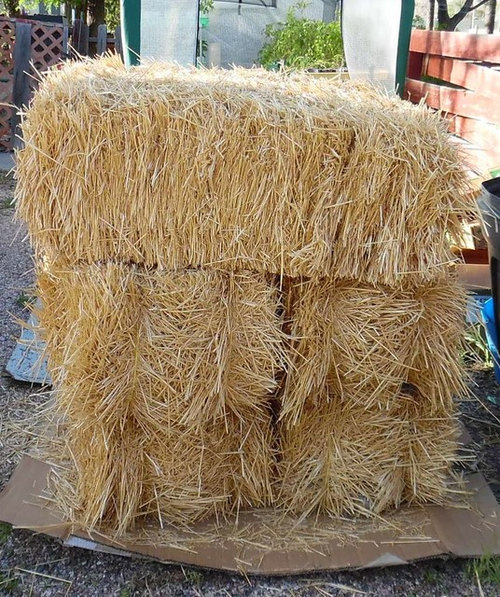
Here I go again with another method to try. I have some gorgeous local wheat straw ($4/bale) for some bale gardening. I'm going by Craig LeHoullier's method and spiking them with high nitrogen to start the decomposition before planting.

Now, RMGers, my question. Do I want to wrap some plastic around the outside of the bales, given our aridity? Craig is in NC and doesn't have this issue. I'm on the windswept prairie of eastern Colorado. I tried felt smart pots a couple of years ago and that didn't work because they dried out way too fast. I'm suspecting the bales would fall victim to the same situation unless I do something.

I'd like some feedback or alternative suggestions. This is another of my experimental trials. Potatoes and peppers are going in these bales.


Comments (7)

  • 10 years ago

    It's an appropriate experiment, Jali'.


    I remember that you have used containers for your tomato gardening. I can't see how wrapping "compost" in plastic film would be much different. You will lose the ability to transport them although I have read about a kind of fun way one gardener uses for a very early crop of potatoes. She uses feed bags, compost and a basement which must have large windows. After several months in late winter growing in her basement, she has her husband lug the bags outdoors. Oh yeah, she uses "dear hubby" labor ...


    I recently had a library book here at home, Straw Bale Gardens, by Joel Karsten. He has a very careful schedule for wetting those bales. They will be enormously heavy!


    I follow Craig LeHoullier on Twitter and have read his blog now and then over the years. Dr. LeHoullier also grew his tomatoes in containers for many years.


    Consistent moisture, fertilizer and time will turn that straw into compost. I don't know how quickly or how soon or successfully plants can be grown in it. A careful keeping of records and following a schedule looks like it would be the best path to success.


    I have been somewhat dismayed that strawbale gardening as a general thing and with somewhat nebulous meaning has been tried so often without good reports of success. Years ago Nichols Garden Nursery had webpages devoted to a trial over several seasons. I checked the other day. Those pages have been taken down.


    On another forum, a small one, 5 threads have been started on strawbale gardening by 5 different gardeners over the last 7 years. The first 3 gardeners never returned to report any success. Only the gardeners with threads in 2015 and 2016 are still active on the forum. The one last year has changed some things and is doing it again this year. The fifth gardener has been a forum member for years but is already expressing reservations about her first-time attempt.


    I really want to be encouraging but it must require a practiced gardener's hand. The plastic film would be a new and worthwhile approach.


    Steve

    jaliranchr thanked digit (ID/WA, border)
  • 10 years ago

    I have read about growing blueberries here in a bale of peat moss as the only means to get them to survive here because of their need of an acidified growing medium - the daunting thought of digging a hole in my clay soil large enough to accommodate one of those huge bales kept me from attempting that one - but had never heard of growing veggies in a bale of straw! And you don't have to bury the straw like you do the peat moss, just use it like a container....

    So, what are the advantages of growing tomatoes, etc., in a bale of straw, as opposed to growing them in the ground or in a "normal" container? (I know, just get the book and read it, but I am lazy and hoping you can give me a synopsis as to why it intrigues you, jaliranchr.)

    Holly

    jaliranchr thanked oakiris
  • 10 years ago

    There is an elderly gentleman who owns an apple orchard by Cedaredge. He told me all about his orchard and garden when we stopped to buy some cider. Anyway, he was using bales to make it easier for him to continue gardening. Different climate but he had just the bales and drip irrigation. Any supports were through the bale or with the green steaks and wire. I thought I had a picture but couldn't find it. It was a healthy and productive garden. Careful with the color of the plastic if you go that route. Could black plastic plus decomposition temperature get too warm/steamy on a summer day? Maybe you were thinking clear plastic. Just a thought.

    jaliranchr thanked Alyssa Schear
  • 10 years ago

    Thanks all. Don't worry, I won't let it go anaerobic. That is a concern to be sure, but I have some clear shrink wrap that is about 8" wide and I was thinking a pass or two around just to help keep some of the moisture in. That would help but still allow air to circulate. I know how fast my compost pile dries out. The bales are on ground where I killed some obnoxious annual bluegrass that is thick early and thin later in the summer so there is thirsty ground to absorb any excess.

    I watered in a cup and a half of 30-0-2 lawn fert on each bale to start the decomposition and speed it along. I'll do that every other day until day 7 when I cut the amount down, then shift to a balanced fert. Then, I'll put the seedling peppers in, surround by some fresh, clean Pro Mix. The taters will be surrounded with Pro Mix, as well. I have several lengths of 1/2 inch PVC pipe with small 3/16th holes drilled along the length that works well as a solid drip pipe, and one is the perfect length for four bales.

    As many of you know, I'm rather well experienced with container gardening. I shocked most of my tomato growing buddies a decade ago, proving you can grow a healthy crop of 40-50 plants in laundry baskets lined with cardboard. I've since moved to 10 gallon grow bags. So trying a bale experiment seems a natural progression of my trials.

    What the container plots have done for the soil underneath cannot be diminished. Where I had the laundry baskets has been the site of many rotations since, with its loamy richness. Where the bags are will be the same, soon. The bales are designed to decompose and become compost to feed the soil. Where these are will feed another rotation next year. And so it goes.

    I hope this goes well. Honestly, I think it should. And if it expedites the potato maturation and harvest, that would be a definite plus. Potatoes have always given me spotty success and abject failure. This is worth a shot.

    Thank you all for the input. I appreciate it. Nothing ventured, nothing gained.

  • 10 years ago

    Looking forward to reading more about your bale-gardening experiment, jaliranchr - hope there will be some photos included, too!

    Holly

    jaliranchr thanked oakiris
  • 10 years ago

    I am in Sheridan Wy. Although I have not planned on doing straw bale gardening this yr...I have done it the last 2 previous yrs w/ success. I have used fresh "new bales" as well as bales that were old and had gotten wet/moldy and were slated to be burned come winter. (got those for free :-) I put at least 2 bales together....sometimes 4. I did not have a problem w/ em drying out. I think prepping them is the most important part. I put a layer of chicken poop and some compost on top after several days of soaking the bales. I also have used some old blood meal i had around. I do not think it matters...just needs nitrogen to break down the straw. I kept track of the temperature w/ a high quality thermometer....they heated up quick!....and then when they returned to ambient temp I planted. Tomatoes, eggplant and some broch plants, all did well. At the end of the season I had sexy soil from those broken down bales!...a great addition to my alkaline/clay/rocky and otherwise poor soil. I am considering burying the bales 6 inches or so this yr so it would be in contact w/ mom earth and add goodness to my raised garden beds. Cheers and good luck!