Software
Houzz Logo Print
hellkitchenguy

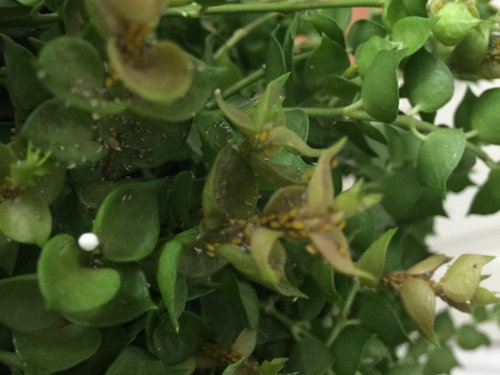
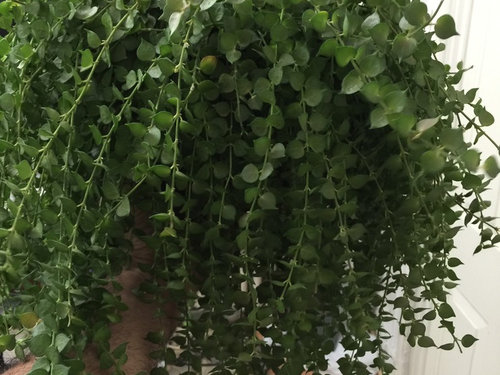
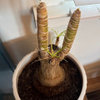
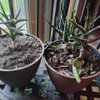
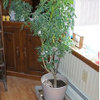
My Dischidia has bugs

Seems like my Dischidia Million Hearts has bugs. Every time the weather is nice I run it up to the roof for sunlight. I guess it caught bugs up there.

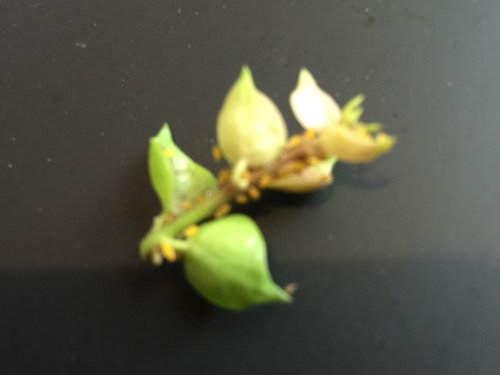
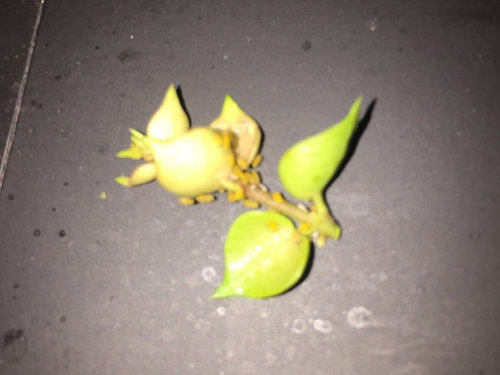
All the new growth is covered in with clusters of tiny yellow things that move.

I'm going to throw it in the garbage, and it breaks my heart. I've pampered this plant now for two years, and it's thriving. If my manta are going to catch bugs when I bring them out, then I'm going to just throw them all in the garbage. I'll just keep my hanging Pothos and a few of the snake plants. I'll have to chuck my Jades, my cacti, etc. It's all very disappointing. I do know that I'm not going to spend months spraying insecticides and taking them out with swabs

Comments (17)

  • PRO
    10 years ago

    Manuel, you don't need to throw out your plants just because they get bugs. What you've got there look like aphids, which are quite easy to control, and no insecticides. Here's what I would do. First, cut off the stems that are filled with bugs, close them up in a plastic bag, and throw THAT out. Then mix up a spray bottle with soap and water - 1 tsp soap to 2 cups water. You can use many different types of mild soap - castille soap is good, either purchased (Dr Bonner's is available in many places now) or DIY (soak a bar of castille laundry soap in 1 gallon of water for a week or so. Shake it up before use.) Hang your plant where it can drip without harming anything, and spray - spray down from the top, up from the bottom, and in from the sides. The object is to thoroughly soak all surfaces and folds of leaves and stems. Do this once a week for 4 weeks, your plant should be fine.

  • 10 years ago

    Wouldn't an insecticide be more efficient? I am taking your advice of trimming off the new growth where they all seem to be congregating, but I can't see spraying soap. I really don't have an out of the way place where I can leave them for a few weeks.

    Thanks for the advice

  • 10 years ago
    last modified: 10 years ago

    Insecticide will work, but many DIY sprays tend to work just as well (I've had many experiences with aphids; I only use Insecticides if nothing else is working.) Try the soap spray and if it doesn't work, a simple google search will bring up loads of easy DIY sprays. The spray I use is just cooking oil (Vegetable, Canola, etc), water and the teeniest dash of rubbing alcohol. Shake it up really well and like Ficus said, spray up and down. You could put the plant in your bathtub and afterwards give the plant a good spray (as well as clean your bath!) I do that a lot in the winter months. If you really want to opt for an Insecticide, go for something on the natural side, like Neem oil. It's a beautiful plant; it'd be a shame to see something like that go in the garbage.

  • PRO
    10 years ago

    In the long run, soap is MORE effective than insecticide, because insects become immune to different poisons and infectious agents. They can't become immune to soap. Also, poisons are poisons - spraying them around your house isn't good for you, either. Most common insecticides are banned somewhere in the world. To effectively control insects, you still need to spray insecticides more than once, because the eggs are largely immune, so the bugs that hatch need to be treated again after they emerge.

    You can use a strong insecticide with extended residual action, but that may not be good for you either. You can also use systemic insecticides, but they may not be good for the plant. Why would you want to use all these possibly dangerous chemicals, when soap is perfectly effective?

    The big chemical companies have conditioned us to think we need to use insecticide, just like they've conditioned us to think that yards have to be monoculture grass supported with extensive chemical use. Once you wrap your mind around the notion that you don't have to use insecticide, that you can use soap, life becomes so much simpler. [Sorry, guess I should have issued a rant warning there, huh? Soapbox is now back in the closet.]

    You don't have to hang your plant somewhere special; you don't have to quarantine it. As emi suggested, you can hang it in the shower while you spray it and it drips off, then move it back to its usual spot. If you're worried about the other plants getting aphids, spray them lightly with the soap mixture once a week for awhile, and keep an eye on them. That (checking for bugs every week) should be part of taking care of plants anyway.

    Come on man - you're not going to let a few little bugs force you to throw out your beautiful plants, are you?

    hellkitchenguy Manuel thanked The Ficus Wrangler
  • 10 years ago

    Cut nothing now. Hose it down with water every other day for a week and you should be rid of them. Keep an eye on it after that and repeat as necessary.

    tj

    hellkitchenguy Manuel thanked tsugajunkie z5 SE WI ♱
  • 10 years ago

    OK. They all seemed to be congregated on the new growth, so I trimmed off a few inches off many of those branches where they were clustered like grapes. I think I got most of the clusters. Now I'm going to try to get some insecticide

  • 10 years ago

    I didn't trim much. Maybe 2 or 2.5 inches, which is not a bad thing, since I find when I trim it, this plant branches off. It has more than one growing tip

  • 10 years ago

    Manuel, you can find insecticidal soap in any garden center. That's what I would recommend over ANY home brewed elixir. The commercial product is more efficient, pH balanced, free of fragrances and other additives, and is safer for the plant while being harder on the insect.

    Generally, aphids can be squished with your fingers very easily, too. Plain water plus squishing works great!

  • 10 years ago

    I just thought of something else....those aphids are very yellow. Do they have little black legs? Look closely, now.

    If so, they are milkweed aphids which are quite host specific about the plants they feed on and won't go outside the Apocynaceae family, in which your Dischidia belongs.

    That means that those pesky yellow aphids won't infest your other plants. Compare your aphids with THESE.


  • 10 years ago

    Rhizo, I just stared at them. Really had to stare, as they are tiny. They do have those little black legs. I do think that's what they are

  • 10 years ago
    last modified: 10 years ago

    Insecticidal soap is just a normal type of soap - not some special pesticide. The manufacturers just pick a which soap to put in the bottle to reduce the damage done to your plants (typically long chain molecules).

    Human safe and plant safe are not the same thing. The difference is that if you pick up some soap of your shelf at home it could be a short chain version that is phytotoxic. And plants really don't need lotion or scent additives either, as Rhizo mentions.

    If you have cheap plants then use cheap soap and risk it. But if you have an expensive collection with rare or sensitive plants, I would recommend using a product designed for specific treatments.

    Natural does NOT mean safe. If you look at any organic pesticides, they typically require the use of chemical resistant gloves, respirator/mask, and full clothing. Same requirements as when using synthetic pesticides.

    Natural does NOT mean it won't kill your plant. Since you mentioned succulents, neem oil will kill or severely damage Kalanchoe. Many houseplants have sensitivies, so it's good to always check prior to use. This applies to synthetics too.

    Not saying anything against natural pesticides, just that these are common misconceptions.

    Honestly, the vast majority of synthetic pesticides are created based on natural ones. Mother nature is a real pro at developing nasty/toxic/potent things - the easiest way is for scientists to copy what's already there.

    For aphids, alcohol and water spray is normally enough, as mentioned above. =)

  • 9 years ago

    The alcohol/water spray has been mentioned here so I'd like to ask a question about that. I used this spray on my hedera ivy about a month ago and it killed a gorgeous, thriving plant. Has anyone had any experience with this and ivy? Or is this just an example of a plant I should have researched for sensitivities before spraying it? Thanks in advance.

  • 9 years ago

    good catch on the aphids, Rhizo. I didn't know that plant was in the milkweed family.

    spjin ~ you should always test a spray, even commercial ones. I can't speak to whether or not ivy is sensitive. How much alcohol did you use? Was the plant well watered first? Did you keep it out of direct sun?

  • 9 years ago

    I never treated the plant. I trimmed a couple of inches every branch, since they were mostly concentrated on the newer growth. They still remained. Then in September they all died away. None left... Don't know why or how

  • PRO
    9 years ago

    spjin - alcohol and water is not really a very good thing to use. Much better is mild liquid soap (you can use horticultural soap if you want, but you don't have to) and water, 1 tsp soap in 2 cups water. Some people like to add a bit of alcohol, like 1 tsp, for treatment of mealy bugs and aphids, but honestly, I've always had just as good results with just soap and water. But I'm wondering what you were treating for? If the plant was gorgeous and thriving, did it have a problem? And if it had mites (which hedera are terribly sensitive to,) it might have been those that killed it, rather than the alcohol and water, which doesn't much affect mites. And if you sprayed only once, perhaps all you did was piss them off, and encourage them to double their efforts to mount an invasion. They have to be sprayed weekly for 4 weeks, to keep killing off the young as they hatch and before they can lay new eggs.

  • 9 years ago

    I thought I saw mites and was in fear that the thriving plant would decline. I think I pissed them off. ( ;

    I've repotted them in a smaller pot, whipped up some castille soap and water insecticide and I plan on using that if they appear again. I've bought more ivy and will try again.

    On another note, you had responded to a post months ago about pruning a fiddle leaf fig. You commented something to the effect that as long as the plant was happy inside it would adjust to being pruned. I ended up pruning it and the plant has been putting out new leaves and branches for the past couple of months. I also had great success with air layering the top part of the plant. I put up a long post about it because there seemed to be so much interest in general about these plants. Thanks for the advice you'd given there because it worked out beautifully!

    http://forums2.gardenweb.com/discussions/4359056/my-fiddle-leaf-fig-pruning-propagating-trial-and-error#19061671