Software
Houzz Logo Print
klunker

Prairie start-up

10 years ago
last modified: 10 years ago

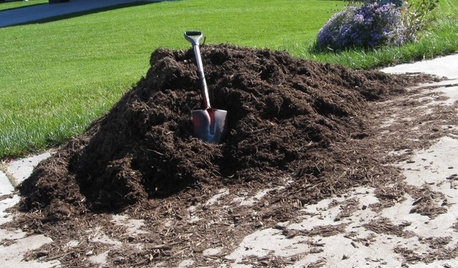
I have about a 3 acre field that we are building a house in. The field was an overgrown old crop field. Last farmed approx 15-20 years ago. It was being encroached upon by small box elders, white ash, shagbark hickory and elm. The biggest tree was no more than 4-6 inches in dia. with the vast majority of them approx. 1" in dia. I got rid of them last summer leaving just stumps. The field otherwise was dominated by canada goldenrod. Anyways we started the house recently and there is a large area around the house site that was stripped of top soil. We now have 4 giant piles of top soil to be put back down when the house is completed late this fall.

There is a large chunk of the field that I have mowed twice this year and just sprayed with round-up Wed. morning. My plan was to spray it again later in the summer and if I had to once again in the fall. Then burn it to remove the thatch and plant it with seed in late fall/early winter. I feel good about this section of the field.

The rest, the disturbed area, once the top soil is spread back around has got me puzzled. I'm wondering if I can plant it after its been reworked. There should be no growing weeds at that point. I would think that being piled up anything in there would of been smothered. But I know there has to be lots of weed seeds in there too. So maybe I should wait a year after spreading. I'd be trying to keep anything from growing on the bare soil for a year. I'm concerned about erosion. So any thoughts? Wait a year and fight weeds and erosion for a year or plant right away and maybe pull weeds as they show up among newly planted prairie.

Oh, this is in SE Wis. Not a very hilly spot but its easiest to describe the contour as flat, gentle slope down, flat area with house, gentle slope down. Soil is good, somewhat clay-lots of fine silt.

Thanks for any words of wisdom.

Comments (26)

  • 10 years ago

    I'm far from knowledgeable but I'd agree with you as far as the weed seeds go. It's not that they will be 'smothered', the seeds can likely survive decades and longer buried, it's that the 'topsoil' is likely blended river silt or some other finer blend of soil, or the deeper scraping off a former farm field (in which case it might have a hefty seed load. I'd spread it and seed his fall. If it does turn out to be exceptionally weedy a late spring and two or so summer mowings would probably nip back the weeds and favor the young perennials you are trying to establish.... Unless of course you're looking to establish an annual wildflower type meadow. Then id probably still go ahead and seed since a plot of bare dirt would depress me more than a weedy meadow :)

  • 10 years ago

    I planned on doing a mow job in the first summer of growth as you suggested.

    Obviously the issue is letting the spread dirt sit for a full year before seeding or seeding right away and hoping the desirable stuff can keep its own and eventually take over. Maybe would be OK if I seed right away in the fall and then mow 6-8" next summer. My biggest concern with letting it sit for a year is erosion. Maybe the weeds will grow enough so that erosion won't be an issue?

  • 10 years ago

    Cover crops are another tool we use, which I should have mentioned. You are exactly correct-you don't want bare soil. A cover crop-winter wheat, winter rye, oats, rye grass............there's a bunch, depending on your timing.....can do wonders for your project.

  • 10 years ago

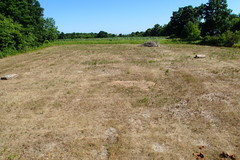
    Well I've spray about 1/3 of my 3 acres with a round-up type herbicide. This was in the beginning of June. Since right now there is very little growing. I am actually surprised, I thought there would be more regrowth of small weeds. Here is a picture of the upper end of the field. Its a little more than an acre in size.

    I'm going to let it go maybe another couple weeks and then give it another shot of Round-up.

  • 10 years ago

    Have you had much rain since the initial spraying? That's really the trigger for weed regrowth, although like you say, it is at least somewhat surprising to not be seeing more growing there. When we do this, I'm always wishing we had the budget for additional blanket-sprayings. Weed growth tends to be robust, and some weed types are able to produce flowers/seed in between our applications some years.

    Just reviewed your initial post, and I see you are in the SE portion of my state. As such, I am surprised by the lack of weediness. What gives...I wonder to my self. We've had a ton of rain just north of you in E. central WI. Not like up by Ashland and Hurley-man, those folks just got washed away by as much as 14 inches in a single event! But we're moist.

  • 10 years ago

    Best I can figure by rainfall totals in June we had just under 4" and in July so far we have had 1 1/2". Not alot, but not like its drought conditions.

    The bare topsoil piles have had a good crop of weeds spring up along with stuff that was already in the area, Small seedlings, canada G-rod, grass and some poison ivy.

    Cause of the re-sprouting poison ivy I sprayed the growth on the topsoil piles. I don't want any of the topsoil that will be in the yard or the garden to have poison ivy in it. Best to kill it now was my thought.

    As far as the other stuff best I can figure is maybe the thick thatch layer is keeping the weeds down. But then I also have a area that I am keeping mowed for the future septic field. I raked that area clean of thatch and have been mowing it and I don't think its seen much new weed growth. Existing stuff re-sprouting but not much new weed growth.

    Could it there is just not alot of weed seeds in the seed bank? Hard to believe.


  • 10 years ago

    Right! A first time for everything, I guess! In any case, you're doing the right things.

  • 9 years ago

    well I gave it another shot of glyphosate in early Aug. There were some weeds starting and some small tree seedlings. About 3 weeks after that I spot treated tree seedlings and grape vines. Those grape vines grow fast. One good thing I noticed is the deer like grape vines.

    Now I'm waiting a couple of weeks to see what it looks like and decide if I'm going to burn off the thatch or just run over the area with a dethatcher on the back of my tractor.

    I think the dethatcher has an advantage in that it will also scratch the soil surface to aid in seed to soil contact over the winter.

    On the other hand I'm thinking the reason the weeds were very minimal is that the soil was not disturbed at all.

    At any rate the thatch is breaking down on its own. There are lots of areas that you can see soil. If I had to put a guess on it I'd say 10-20% of the ground is bare soil.

    I have some other areas that will eventually get planted too. I'm try to decide if I should do some of them this fall too. They are small little areas (maybe 5-10 thousand sq ft). They are in the same condition as the field I've been talking about but some are for all practical purposes bare from thatch, they are bare soil.

    Last thing is some of these areas are on a slight slope. There has been erosion on these spots but not so bad as to be cutting gullies or anything, just some movement of fine silt downward after every rain. I'm think that if I cover them with straw after planting it'll help to stop seed wash away. Anyone have any experience with this or have a better solution? I'm all ears.


  • 9 years ago

    Sounds like things are on pace there, klunker. Good deal. We use everything from inexpensive straw mats to blown-in hydro-mulching on our projects. So yes, some form of erosion control will be needed for any sloped areas. Adding in a cover crop is probably a worthwhile investment as well. Oats, rye, winter wheat-we've used lots of different cover crops.

  • 9 years ago

    If your using a cover crop do you plant earlier in the fall?

    I'm think of seeding just before the snow flies so as to limit seed lose to birds/critters. I'd actually prep the spot and watch the weather. Ideally plant hours before or during light snow fall if not windy.

    I've looked at mats, they seem pretty expensive. Got any sources?

    Thanks

  • 9 years ago

    Because our system is fairly large, we use the services of native landscaping contractors, who then purchase the various supplies for projects. We're able to take advantage of economies of scale and set out three-year contracts for this work.

    Since I've been involved in this, all projects have been dormant-seeded in the second half of fall. Your basic idea sounds right on to me. And with your ability to closely match conditions with activities, you should be able to get the thing up and running. On that cover crop, thinking about it, I don't recall our having ever had to seed twice into the same plot, so no, I do not believe we ever pre-planted our cover crops. I should say, it does get a little hairy trying to fit all the moving parts together. We've been looking into higher-end emats and hydro-mulching for a couple new pond projects coming online in the next few years. One of our top priorities is to control erosion during the grow-in phase. So we may actually be upping our game a bit there, but in general, if there's anything for a slope at all, we do tend to emat.

  • 9 years ago

    Well I have a bag of seed ready for planting. I also sprayed the fields again Friday. I know it was iffy on the timing of the spray but the weather has been so poor and I had family issues that came first.

    I looked at mats and have come to the conclusion that they cost more than the seed. So I'm still unsure how to handle the erosion issue once the fresh soil is spread around. I doubt I'll have any time to plant any seed in the freshly spread stuff. And if I do it'll all wash away before it germinates anyways. I think straw is the cheapest way to go. But it carries the potential for weed seeds. So I think I'll end up covering the freshly spread soil with straw before the snow flies. Then in spring plant cover crop. Allow cover crop to grow till mid-late summer then get 2 sprays in before planting the rest of the area next fall before the snow flies.

  • 9 years ago

    Our "dormant seeding" date was usually right about now-mid-October. But because warmth is so firmly in place yet-we hit 70 F yesterday and will go higher today with rain and T-storms-we're going to plan for a bit later. The idea-which you already know-is to plant the seed late enough that there will be no chance of sprouting that fall.

  • 9 years ago

    my plan on when to plant in the fall is to wait till just before first snowfall to avoid providing a meal for birds.

  • 9 years ago

    Yup, that too!

  • 9 years ago

    well I've burned the brush pile, tried burning off the thatch. Didn't work, it was to thin I suspect. I "roughed" it up first with a spring tooth rake that I ran behind my tractor. I then tried just lighting it up. It didn't really burn that nicely, kinda smouldered. Maybe it was partially decayed. It was dry enough. Anyways I ended up raking the whole .6 acres by hand. I raked the thatch in rows. I'll use it as a very thin mulch after seeding. The soil now is in excellent condition. Lightly scratched. The seeds will be in contact the soil as best as can be. Now I have to wait for the right conditions.

  • 9 years ago
    last modified: 9 years ago

    Yeah, with this long fall, we're just now getting around to seeding in a few re-do patches. So you're in sync.

  • 9 years ago

    Well I got my seeds planted this morning during the start of a minor snow storm. Only 3-5 inches predicted. I hand broadcast the seeds. Mixed the 1st half with masons sand and spread them left to right, spread the 2nd half going front to back.

    The temp. was cold enough so that the sand was freezing into clumps. I had to crush it by hand and mix with seeds.

    The wind help spread the stuff around and the snow made it so it was easier to see where the seeds where falling.

    Now I just have to wait about 6 months to see what happens. Anticipation!!

  • 9 years ago

    Good stuff Klunk. Do you plan to do a high mowing next growing season? We use that in early-phase prairie plantings to reduce weed seedhead formation on thistles, queen anne's lace, sweet clover. etc. It's only the beginning of getting the weeds under control, but an important first step.

  • 9 years ago

    I can if I have to. I have a flail mower that I can raise up to approx 6".

  • 9 years ago

    Yeah, or even just a string trimmer will do sometimes. It's not essential that one does this but it can help. Spot-spraying-to control thistles, queen anne's lace and sweet clover are normal parts of our efforts.

  • 9 years ago

    well my "prairie" is more like a who's who of noxious weeds, winter cress and queen annes lace wall to wall, the only saving grace is there is an abundance of black eyed Susan about ready to bloom. But with all the weeds I took the mower to it and now it looks really sad.

    please, someone tell me it'll get better.


    I think I made a fatal mistake last fall before seeding when I raked all the dead thatch up. I think it just scratched the surface enough to lay open a bounty of weeds for this springs growth. Am I right on this?


    anyways the larger areas that I have to plant this fall I'm going to hit them with Glphosate only 2-3 times this summer/early fall before seeding and leave any dead mat'l where it lays. I'll find out next spring how it goes.


    Now I got to decide what kind of seed mixes I am going to plant.


  • 9 years ago

    You'll be surprised next year by how many of the seeds you planted have actually taken hold and are beginning to settle in. Was the Queen Annes Lace seed in the soil already? I ended up hand pulling (very small meadow) and after two years it went from infestation to next to nothing.

  • 9 years ago

    I have to assume the seeds were already in the soil. I know most of these weeds do not compete very well. They are quick start ups with very little "longevity".

    I'm not worried that I'll have a few queen annes lace or a few other weeds in 2-3 years from now. But as it stands now its weed central. I was hoping I'd see some other small plants that might be the start of a prairie planting. I'll keep watching and hoping.

  • 8 years ago

    I know its been a while (2 months) but one thing to consider would be to establish your prairie grasses first. In our restoration sites, we first attempt to get the grasses established. We mow several times a year to knock back weeds and it also allows us to apply 2-4D herbicide which will kill the broadleaf weeds while not killing the grasses. Once the native grass is established (and bear in mind this is measured in numbers of years) and the site is considered "successful" we then go back and plant our forb seeds.

Sponsored