Software
Houzz Logo Print
fullmetal82

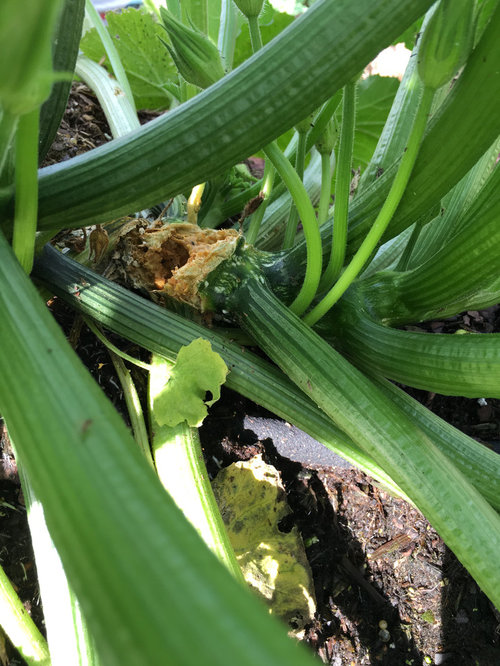
Is this a squash borer

10 years ago
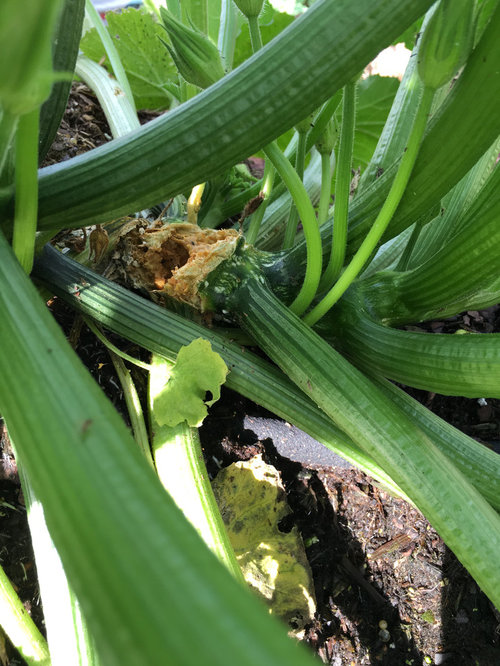
Our zucchini plants are getting bigger by the day and we find new zucchini popping up each day. Here recently I noticed that the base is starting to crack and there is an orange substance around them. Is this the damage of a borer? I did an Internet search and I haven't noticed the adults around the yard. The plants don't seem to be dying and only a few leaves/stalks are damaged.

Any advice would be much appreciated as we are new to gardening.


Comments (10)

  • 10 years ago

    Yes, that is what the damage looks like.


  • 10 years ago

    Is there anything I can do about it at this point?

    I check the plant daily but I've never seen the larvae or the adult.

  • 10 years ago

    You can slice into that stem to find, and kill, the larva. You could inject some BTK (Bacillus theringiensis - Kurstaki) into the stem ahead of that larva. You could remove that stem and destroy it along with the larva.

    kimmq is kimmsr

  • 10 years ago

    You can also try to kill the borer by poking a thin stick into the hole and probing. If you use bacillus theteingiensis, you should be very precise in applying it. It'll kill tomato worms, cabbage worms and squash stem borers very effectively.

    It'll also kill any butterfly. Although it has no effect on people, animals, etc., you should apply it judiciously on a day when there's no breeze. Try to spray it so that all the squash stems are wetted, along with the underside of the leaves. Repeat this every 3 days or so. You can apply it even on the day of harvest. For cabbage/ cruciferous vegetables and tomatoes, you don't need to spray it unless you see evidence of worms--either chewed leaves or fresh caterpillar droppings, because those worms are always on the surface.

    I hope this helps!

    Rick in CT

  • 10 years ago
    last modified: 10 years ago

    Thanks for all the advice/suggestions everyone.

    Thus morning we went through the plants and pruned the wilted/bored leaves and stalks as best we could and found several small larvae and a few large ones. We also applied some Worry-Free insecticide on the damage spots to get the extra small larvae that were hard to get.

  • 10 years ago

    Bacillus thuringeinsis-Kurstaki must be ingested, eaten, by the leaf eating larva up to a certain age to be effective. Since butterflies do not eat leaves it will not have any affect on them, although it may have on some butterfly larva if not used with due care.

    "Worry Free" insecticide is a pyrethrin based insecticide.

    kimmq is kimmsr

  • 10 years ago

    That's true about adult (non)ingestion, but I would practice great care with any insecticide drift. For example, I have milkweed growing nearby, and won't risk killing desirable species such as Monarchs while spraying other areas.

    I don't know how worry-free pyrethrins would be, for the same reasons. Also, I believe pyrethrin is a much broader spectrum insecticide. The fact that a product isn't directly hazardous to humans doesn't mean it's ok to be careless with it.

    --Rr

  • 10 years ago

    I think it's given the brand name "worry-free" because it can be applied closer to harvest and is supposed to be considered and "organic" pesticide rather than its sister product Sevin.

    I agree that the same level of care should be observed when dispersing this pesticide as it is a very broad spectrum insecticide as the label indicates.

    So far in my gardening experience, I've only dispersed pesticides of any sort at dusk and, in this case, in a small target area to avoid hurting the bumble bees, dragon flies, spiders, and other helpful bugs.


  • 10 years ago

    Pyrethrin based insecticides and Carbaryl (Sevin) are not "sister products. Prethrin based insecticides come from "natural" sources (the roots of a Chrysanthemum) and has a relatively short life in the environment which makes that acceptable to organic growers. However, the pyrethrin based insecticides are very broad spectrum meaning they kill a wide range of insects including Beneficial's just as Carbaryl, which has a very long life in the envrinment, does. Pyrethrin based insecticides should be a last resort solution to any insect pest problem, not the first product grabbed.

    This article may be of some help in controlling this pest.

    https://attra.ncat.org/attra-pub/viewhtml.php?id=138

    kimmq is kimmsr

  • 10 years ago
    last modified: 10 years ago

    Thanks for the article. From what I gleaned from it, it looks like a later planting may be my best chance to avoid them next time as biological means are not effective against the borer. Luckily I should have a long enough growing season to accommodate a planting after the borer adults have laid eggs and left for the season.

    Also sorry if my wording made me seem confused about the pesticides, by saying "sister product", I only meant that they are both from the same company (Garden Tech) and that the Worry-free line is marketed as the natural, organic pesticide as opposed to the Sevin product. Not that the two chemicals are related in any way.

    Also, the plants so far appear to have done well after we manually removed the borers that we could find and we've even harvested a couple of tender, tasty zucchini from them!

Sponsored
Haus Studio
Average rating: 4.8 out of 5 stars28 Reviews
Franklin County's Preferred Custom Cabinetry & Design Studio