Software
Houzz Logo Print
sebastien_leclerc

Need help with constantly damp backyard.

10 years ago
last modified: 10 years ago

Hi guys, we moved in our house last november. After the snow melted and the ground thawed, we realized there was a problem with the backyard. Now matter how many dry days we have, the area around the pool is always mushy. There is a small canal dug around the pool area and behind the shed. It is always filled with standing water. The backyard is stepped and there is a mountain behind us.

Here's a panoramic picture of the yard: http://i84.photobucket.com/albums/k18/idkf1/Terrain/PANO_20160611_1808383.jpg

When viewing from the street, the area right of the house is pretty much unusable. It's thick moss and hasn't been maintained at all. It is dry though. The area on the left is our parking lot with our drainage field next to it. The grass there is pretty nice. Lots of weed but slavageable with patience. In the picture, the topmost canal runs over only half the backyard. The bottom canal drains towards the right but actually leads nowhere/on the neighbor's property. Legally I have to control the water flow on my property so something has to be done about that. The pool is 24'.

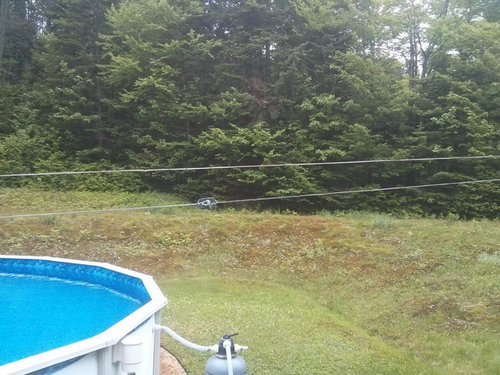
View from the deck. You can see the small canal around the pool area.

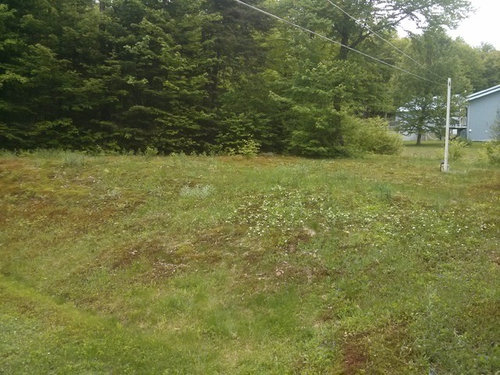
View to the right. The white pole is where are water well is. This is the area that is unusable for now.

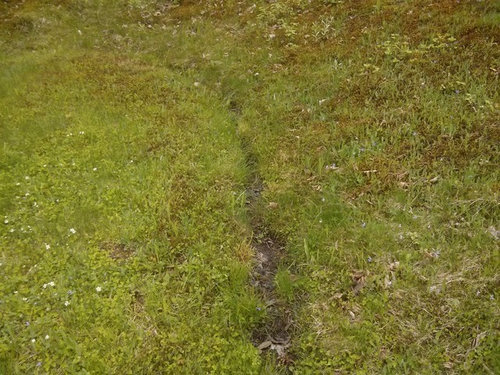
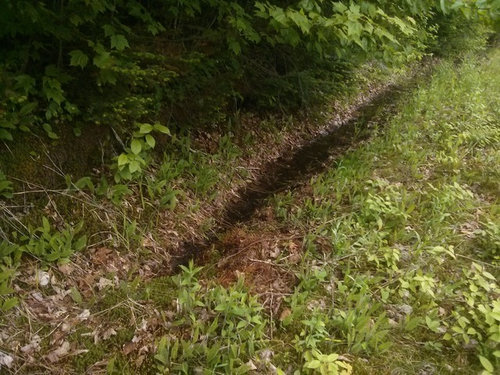
The canal starts at the bottom of this picture

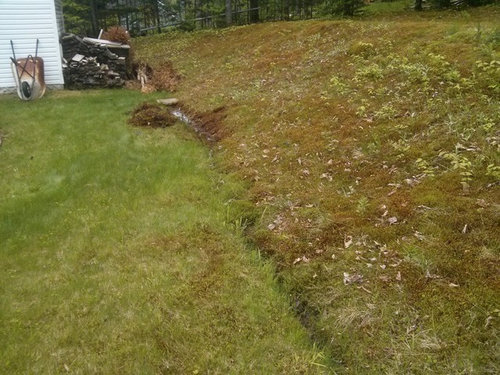
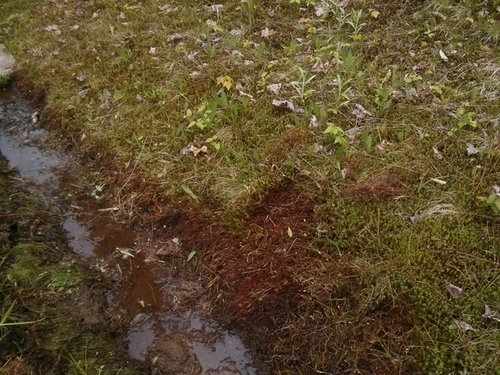
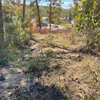
Behind the pool and shed. I dug a bit to see what I was dealing with. The slope is always wet.

Closeup of the dug area. The water fills back fast. On the left is grass and on the right is some sort of thick, rooty moss. If I'm standing close, I can hear water.


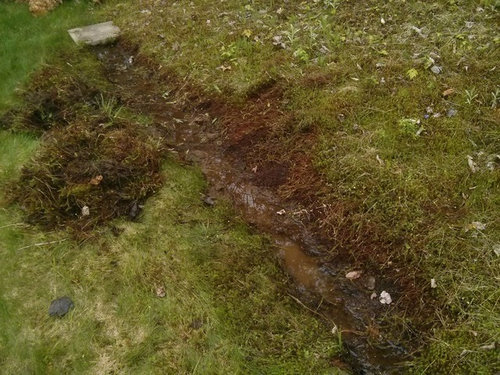
This is the topmost canal. LOTS of water draining here. It lead to a common canal shared with the neighbor. Not sure why it doesn't go the full lenght of the backyard.

So... how do I keep my yard dry? Do I extend the topmost canal, dig it deeper and install a drain? Do I dig the bottom canal and install a drain? Both? Re-grading the whole yard is out of the question for now. New house, new baby, no money for that.

Thanks a lot!

Oh and the ground is really rocky here if that changes anything, like making renting a trencher useless.


Edit: Forgot to mention there are canals on both sides of the street since we are in the mountains.

Comments (11)

  • 10 years ago

    The area near the pool is flat with no obvious high point. It seems a bit higher behind the shed but not much. It accumulates near where I dug (before I dug, that is). It should be relatively easy to grade properly behind the shed.

    Not much on our property has been properly maintained. The swales are filled with dead leaves, roots, moss and weeds. It seems like they were wider a long time ago.

    My left and right neighbor don't seem to have this problem because their yard is sloped, not stepped like mine.

  • 10 years ago

    Oh and I can't wait to get rid of that moss. You have no idea how many mosquitos live in there. I'll have to wear a beekeeper's suit when I rip this off :D :P

  • PRO
    10 years ago

    It appears that you are collecting water in a "swale" (of sorts) but that the swale is not tilted in a direction so that it can drain. It's more like a tiny, skinny moat.

  • 10 years ago

    I does work better as a moat than a drain. Unfortunately it only serves as a mosquito breeding ground.

  • PRO
    10 years ago

    As a general guide to creating a proper swale, you'll need to consider where its high point (that I asked you about earlier) is. Let's call it the HP. (If it's behind the shed, you'll still need to consider that grade should slope downhill, away from the building, in all directions. To make this happen, you may need to lower the HP. If not, fine.) From the Hp, following the drainage path, you'll need to make sure that the drainage path has width (for carrying capacit) and is continuously descending at least 3" for every 10' of run. This will happen running in both directions ... to the right of the HP and to the left of it. If, hypothetically, you made the path 2' wide, you could visualize this as if it was a 2' wide grass walkway inset and wrapping abound your yard. As this path continuous it will pass your house (on the right and on the left) and eventually meet yard that also slopes in the general drainage direction, or possibly a drainage swale/ditch near the street, or the street itself, where water will be carried farther away from your property without the continuation of a special drainage path (swale.) Concurrent with the drainage path, grade surrounding and running alongside it, will slope toward the path so that water from other parts of your yard run toward the drainage path.

    Naturally, you would not want an engineered-looking, flat grass path rigidly surrounding your yard and standing out as oddly different from the surrounding yard. While respecting the grade of the path itself, you would reshape (grade) the soil surrounding and alongside it so that all blends gracefully. In addition, you would route the path such that its location acknowledges features of the yard; it might curve to miss a tree for example, so as not to disturb its roots, creating additional work and expense.


  • 10 years ago

    In addition to cleaning out/reshaping the channel to divert storm water runoff to the roadside canal, you should try to absorb as much water as possible on site, with a rain garden. Lots of state of the art designs for you to study, plus Frederick Law Olmsted's ingenious design for Staten island from c 1870! The bright side is to consider that having water - especially on a mountaintop - is a great gift once you harness it.

  • 10 years ago

    I assume you are on well and septic. Get all the documentation on both filed with the county health dept or whatever body regulates it, get topo maps, and talk to anyone with knowledge of water in your area -- like your well and septic companies, town planning and building departments, etc. All of this knowledge will help you understand the source and flow of the water.

  • 10 years ago

    If you have a septic then do what kitasei says first. Then you need to create a french drain and an area to discharge excess water (for heavy rain periods). The french drain will remove most of the puddling and excess water needs to go somewhere that has good soil for drainage.

    Otherwise french drain will resolve your problem.

    Good Luck.

  • 10 years ago

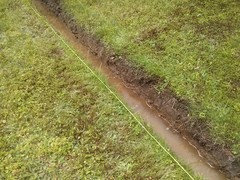
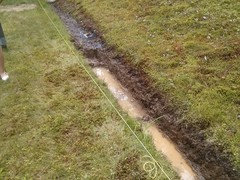
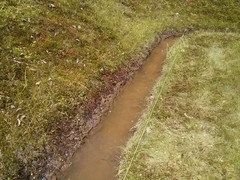
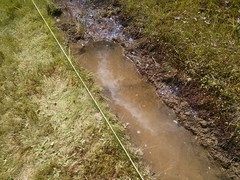
    Thanks all for the advices. I started digging yesterday. Easier than I though but lots of rocks mostly fist sized and smaller. Once I figured out what worked best it went pretty fast. Shovel, pickaxe and a wheelbarrow was all I needed. I still need to dig deeper though.

    It's a feet and a half deep at this point.

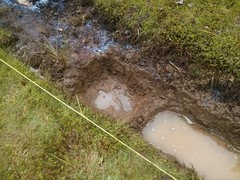
    This amount of water accumulated within a few hours after I was done. No rainfall that day or the day before.

    This is where I stopped for the day. It got too hot and humid.

    This little amount of water pooled up in five minutes.

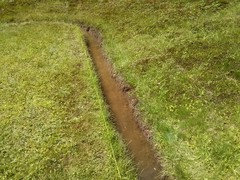
    The next day, I officially had a moath around a part of my pool


    Soooo a lot of water here, no rain either during the night. I trenched about 1/3rd of what I need. I have an old pool pump to drain the moath before I start digging. I'll start on the other end though before getting there. I didn't expect that much water to be honest.

  • PRO
    10 years ago

    Nice to see you are following string line so it is not ugly.

    You should have local drainage expert examine, diagnose and prescribe.

Sponsored
Hope Restoration & General Contracting
Average rating: 4.7 out of 5 stars35 Reviews
Columbus Design-Build, Kitchen & Bath Remodeling, Historic Renovations