Software
Houzz Logo Print
bmk161

Caterpillars on Evergreens

10 years ago
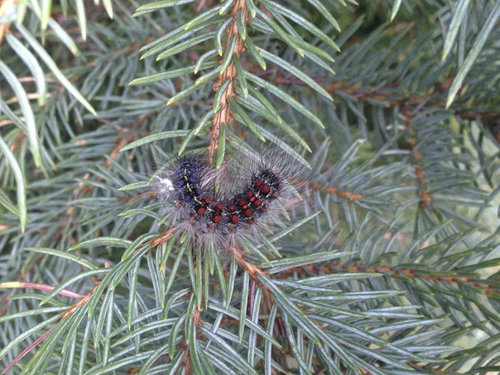
Hi,

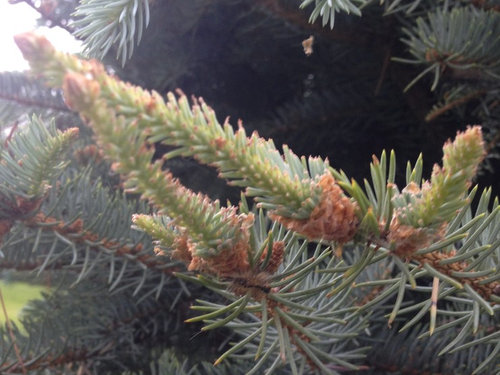
i just noticed a lot of caterpillars on my evergreens, namely my blue spruce but some on other kinds. They look like they are eating new growth. I'll post some pics. I have Thuracide (BT), would that be the treatment?

Help!!

Comments (22)

  • 10 years ago

    Gypsy moth larva. Will completely strip spruce, hemlock, and arborvitae, and heavily damage pines. If the trees are defoliated, they will die. Individual branches stripped will die. The cats are probably too big for BT to have much effect. Sevin or malathion will take care of them, spinosad probably too. The cats typically eat old foliage first. Where are you at?

  • 10 years ago

    I'm in MA. So BT will not work? I have about 40 on one tree and that has the most, others are less. They already did a number on a river birch. How best to fight this year and protect next year?

  • 10 years ago

    When I lived in CT our neighborhood got together and hired a large commercial sprayer to do about 5 properties totaling around 10 acres. Used sevin.Did a good job and saved the hemlocks, only to lose them to the adelgids several years later. I'm not aware of anything that can be done to prevent an infestation. What do your surroundings look like? A severe infestation can cover thousands of square miles and strip everything. I've seen it look like Jan in June. Don't have them here in middle TN, but they're on our doorstep.

  • 10 years ago

    I looked it up and it sure looks like a Gypsy moth to me too. I found a website that might be of help to you. It's the Minnesota Department of natural Resources. Look under Nature then invasive species and you will find the little buggers there along with things you should do to help with your problem. There are also a host of other sites if you Google Gypsy Moths. Good luck !

  • 10 years ago

    This is proving to be a very bad year for gypsy moth infestation in New England - the worst since 1980. So far, it is mostly in CT and MA. A strain of fungus released for gypsy moth control in CT appears to be working pretty well. Once the caterpillars reach this size, Bt is usually not effective. As kentrees12 noted, spinosad will work and is very safe. It's only drawback is that it must be applied frequently. Hand picking is another option and your county extension service or state agricultural department can be of great help with other suggestions.

  • 10 years ago

    Thank you. Would it hurt to spray BT as well?


    are you thinking a product like this would work?

    https://www.amazon.com/Monterey-Garden-Insect-Spinosad-Concentrate/dp/B002BP12LI

  • 10 years ago

    Kentrees is correct-those cats are beyond the point where BT will deal them a death blow. Strips of burlap tied around the trunks of large trees will trap relatively large numbers of them for disposal in soapy water, etc. The malathion idea, while sound, does carry with it the extreme likelihood of off-target effects.

    For next year, organizing an earlier BT application might be possible. Incidentally, that must be a bad infestation; When we had our first big wave move through here, sure, they nested and laid eggs in trees like spruce, but they did not feed on them. Severe indeed.

    Finally, learn what the egg masses look like. Felty patches, especially on the undersides of branches, can be sprayed with methylated seed oil (MSO) which then suffocates the developing eggs/larvae within. This is a good and safe way to kill thousands of them before they've hatched. Using a dye is recommended as it quickly become bewildering, remembering which egg masses you've sprayed and which you haven't.

  • 10 years ago

    These trees were just planted, brought in from PA. They don't seem to be on all of my trees, just some. I'm going to try and pull off a bunch of them and look through these recommendations. How long do these stuck around? I didn't see any kind of nests but will look again today

  • 10 years ago

    Tom:

    A severe infestation will defoliate EVERYTHING. What I've read about evergreens is that the young cat's are unable to eat needles until they gain some size. Then they will actually migrate to conifers, Norway and blue spruce and eastern hemlock are favorites. Back in the old days when we had real winters, the northern tier of states were somewhat protected as the exposed egg masses were killed by the cold, only those beneath the snow would survive and that served to keep outbreaks to a minimum.

    I've wrapped plastic around trunks and applied grease to trap the cats, didn't work well. I certainly understand your opposition to using broad spectrum pesticides, and for the most part agree with you, but when my 100' hemlocks were at risk of death from an imported insect it was a no brainer, they got nuked with sevin.

    akamg:

    I'm disappointed to hear of the severe infestation in southern New England. I'd hoped the combo of viruses and parasites would keep the populations down to nuisance levels, I guess not. I "lived through" the 1980 outbreak, I may start a separate post about it to school the youngsters on the board LOL.

  • 10 years ago

    So where are you guys at with chemicals, Sevin or spinosad? These guys are certainly eating but i think i can control/kill them.

  • 10 years ago

    Fortunately haven't seen a Gypsy moth since 2004, and those were fungus-infected & dying. Fingers crossed. Occasionally tent cats become so numerous that they'll attack oaks (other than the usual cherry host), but not in the last couple yrs.


    The way to tell tent cats from gypsy moths cats is that tents have no red spots -- only pale blue spots.

  • 10 years ago

    I'm not sure what the situation is in other areas of the country, but gypsy moth has been an increasing problem in New England. The fungus is effective, but not so much in dry, cold springs. If the fungus remains more or less inactive when the gypsy moth caterpillars are small, it is not a very good control at all. In addition to gypsy moth, winter moth continues to be a major problem. If that were not enough, spruce budworm is experiencing a population explosion. There has been widespread defoliation in Ontario and Quebec and pheromone traps in northern Maine indicate rapid growth of infestations.

  • 10 years ago

    Is the fungus that controls them something you can get and apply to the yard? I had planted bare root apple trees this spring and they were all over them.....applied the BT and it seemed to push them back a lot but they were small then. From reading, these guys should be nearing the end of their cat stage soon.

    I bought Sevin and spinosad so i plan to hit them with the sevin today, manual removal of them tomorrow and then i'll take a stab at the spinosad.......need to see how the wind is blowing the next few days.

  • 10 years ago

    Sevin is also a broad-spectrum insecticide. As Kentrees points out, there are cases where such is justifiable. Each one of us much use our own judgement on that matter. PSU, the two fungal pathogens (of gypsy moth larvae) that I'm aware of are: entomophaga maimaiga and nucleopolyhydrosis virus (Sp?). Check either of these out on the web and see what you think.

    What we've seen is that even following a severe outbreak-we had such an outbreak back in the 90's....devastation is too strong a word for the outcome. Sure, it's not helping the trees any to be defoliated, but in truth, they are equipped to handle this. It's only when repeated severe outbreaks occur that tree death becomes widespread. As bad as it got around here-immature larvae raining down on your head on their webs-it never got to that point. Perhaps it was worse out east-I don't know. Some of our oak-laden parks did look awful for a while but by and large, those trees recovered. Oaks, birch, apple and a few more are favored hosts BTW. Maple is hardly ever munched on and conifers-as already discussed here-are only attacked in severe infestation years. In fact-and now I'm repeating myself-around here, spruce never was anything except a platform upon which to lay eggs. There was never any damage.

    One curiosity is that of shagbark hickory. Also not a preferred host, nevertheless man does momma gypsy moth love to use the numerous bark flaps on that tree to deposit eggs. We found it necessary to strip quite a bit of loose bark off of shagbark hickories in the bad years.

    These fungal pathogens have done remarkably well in years having cool, wet springs, in keeping the numbers down. Then too, it's somewhat cyclical, divorced from ambient conditions. In any case, even though we had what was considered a severe outbreak, it seems to me that it never got as bad around here as in say, Pennsylvania and other eastern states. We just never had the broad defoliated landscapes I saw in photos from out there.

  • 10 years ago

    I'm surprised to see them eating the evergreens because there are other perfectly good leaves out there that have not been eaten and i would have expected them to go there first. They did a number on my river birch but it is not completely beat up and if they stop feeding soon (or i kill them) it should recover quickly. I'm going to take a walk around the neighborhood tonight and see if anyone else has eaten leaves or if its originating at my house.

  • 10 years ago

    The 1980 gypsy moth outbreak in southern CT, as I remember it, 36 years after the fact.

    Back in those days greenup started in early May, give or take. I noticed something strange on a barely sprouting staghorn sumac. Very small hairy cats, all hair in fact. Just hatched gypsies covered the sumac. I began to look at other stuff, and realized everything was covered. Where they came from in such numbers was a puzzle, as previous seasons egg masses didn't indicate there would be a severe infestation. That spring was warm and fairly dry, ideal weather for expanding foliage and cats.

    By late May the cats were eating the foliage faster than it could grow. The cats began ballooning, traveling on the wind on silken threads. People began complaining of rashes on exposed skin, albeit mild, but rashes nonetheless.The media got wind of the situation and there were reports on the local news. This was back in the days when the internet was but a gleam in Al Gore's eye.

    By early June the cats were on the move, they had denuded large areas of forest and ornamental plantings, and they were hungry. The cats were everywhere, they got in houses and vehicles, dropped on people walking beneath trees and were a general pita.

    By late June everything was denuded and the cats were starving. They moved in great masses out of the trees looking for fresh fodder. Some roads became as slick as black ice from the smashed bodies. Spruces, hemlocks, doug firs, and arborvitaes were stripped bare. The pines, whose candles hadn't expanded yet had all the old needles eaten, so candle growth was very stunted, but at least the large trees survived, small ones not so much. The cats have a rotten habit of climbing to the top of conifers and eating their way down. When I would go out first thing AM, I could smell the resin on the air from overnight feeding of the hemlocks. By now the story had made the national news.

    The cats do most of their feeding at night, and on hot days they tend to leave the treetops and migrate downward were it's cooler. Early AM the the cat poop sounded like light rain on the ground beneath the trees. Trees heavily infested had branches that looked as though they were coated with fur. By late June the cats were starving. Anyone with a commercial spray rig became rich overnight.

    The first areas stripped were beginning to grow new foliage, the cats had moved on. One scene I will never forget: the cats had stripped everything from a residential property and were on the front lawn eating the grass.

    During this episode the cats ate everything that wasn't sprayed. Countless conifers were killed outright. EVERY species of deciduous tree,save one, was denuded. By Independence Day the frenzy was over. Most cats had starved or were killed by disease. By August, trees had refoliated. Oaks regrew leaves that were normal size, most everything else did not, their foliage being less than half normal size. Very few egg masses were found, the following year there were no cats to speak of. Spring greenup was normal.

    Years previous to this had featured drought, and lesser gypsy outbreaks. The forests were stressed. The most common forest tree in CT is oak. Some areas are predominately so, and oak wilt began to make inroads. UConn foresters predicted that in time with repeated outbreaks of insects and diseases the forest would transition from oak-hickory to birch-red maple. Fortunately this prediction has failed to come true. When I left CT in 1985 the forests were not in good shape. The oak-hickory forest is stressed to this day.

    The species not touched by the moths? Green trees that stood out like beacons in a landscape that looked like January in July? Liriodendron tulipifera. For whatever reason the cats wouldn't touch it, even to death by starvation. At the time I wondered if scientists could figure what it was that prevented the cats from eating the foliage, synthesize it and make a product that could be sprayed over forests as a deterrent to the moth. Guess not.


  • 10 years ago

    You're definitely right in the fact that they are all at the top of the tree and working their way down.....Love the Al Gore reference LOL

    I sprayed my new apple trees with BT and the leaves recovered very quickly. They didn't touch my peach trees

  • 10 years ago

    Well I now have a "drip line" of dead caterpillars on the ground around my trees haha. That Sevin did the job. I only treated the river birch and the blue spruce and did some hand picking on the others. I plan to spray everything this weekend with the spinosad which is a little more "collateral damage" friendly to others.

  • 10 years ago

    Yes, as bad as GM is, it is often the over-reaction that is worse. We had media frenzy and some completely idiotic actions by a few residents, like the couple that had their entire yard sprayed with organophosphate insecticide, probably diazinon-and ended up ruining their siding and a bunch of other stuff. Strange times.

    All in all though, we've had to concluded that bad as our initial invasion was-and it featured many of the signposts that Kentrees mentions happening in CT-it could not have been quite so severe. Never saw any conifers eaten, only used as egg-laying sites. Then, along came a series of wet, cool springs and what seemed like an insurmountable issue just kind of went away. Not for good though, I'm sure.

  • 10 years ago

    You might want to subscribe to the UMass Landscape Message which will help notify you of problems before they reach the stage that you end up using something like Sevin which will kill nontarget species and has some evidence of human toxicity if not used with care.

    Remove eggs after they are laid where ever you find them as the moths can fly around, and next season be prepared with the Bt early (UMass linked above will help with the timing). We used tape strips on trunks with Tanglefoot to prevent larger caterpillars from limbing trunks as well.

  • 10 years ago

    Back in the late 70's - early 80's, whole mountainsides on the Blue Ridge in MD were denuded by gypsies. Many trees died outright, but eventually oak/hickory/ash seedlings and resistant trees like tuliptree and red/sugar maples reforested those slopes.

  • 10 years ago

    Beng, I remember those images. In fact, that is precisely my point: We were at the epicenter of GM expansion back whenever that was...somewhere in the 90s, yet I never saw it look as bad here as those images from out east.