Software
Houzz Logo Print
richard_brum

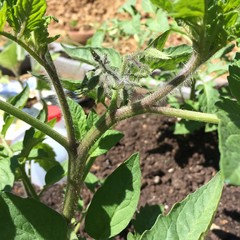
Purple Tomato Stems?

10 years ago
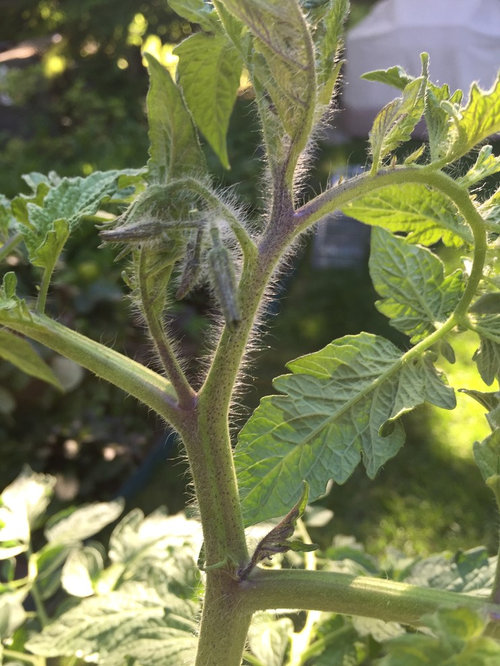
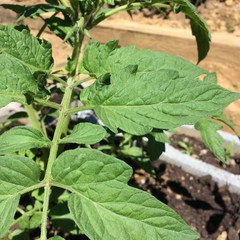
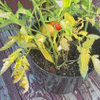
Anyone have any ideas as to what is causing this? Right now it's only on the stems at the very top of the plant (Park's Whopper Improved). Rest of the plant looks fine- about 4 feet tall and setting fruit.

Comments (27)

  • 10 years ago

    Plant is in an earthbox-style self-watering planter with a fertilizer strip. Would it be beneficial to try an Epsom salt foliar spray?

  • 10 years ago

    I would just leave them be. Trying to solve a problem that will work itself out anyway is bound to give more problems than it will ever solve.

    Richard Brum thanked centexan254 zone 8 Temple, Tx
  • 10 years ago

    Not a problem.

  • 10 years ago
    last modified: 10 years ago

    "Plant is in an earthbox-style self-watering planter with a fertilizer
    strip. Would it be beneficial to try an Epsom salt foliar spray?"

    Epsom salts provides only magnesium, nothing else so no it wouldn't be of any help and potentially harmful

    Without knowing many more details about your specific plants age, size, how long since transplanted, sun exposure, etc., location, climate, etc. anything we tell you is general info only so keep that in mind. Lack of details will always affect the accuracy of the advice.

    So, when dealing with Earthboxes (I have 12 of them and have used them for many years) or similar self-watering set-ups the problem is that the fert strip doesn't last all season as advertised. Depending on how much top watering the box gets from rains and such it is good for approx. the first 4-6 weeks only.

    So many of us who use them (see the EB forums) have discovered over the years that supplemental feedings are needed for best results. The easiest way to do this is to buy a well-balanced N-P-K + micro-nutrients liquid fertilizer or your choice, dilute it per the label directions and add it to the water in the bottom of the box approx every 7-10 days.

    In this particular case of phos deficiency, as I said above the issue normally resolves itself. Give it a few days, a week. If it doesn't green up or if it appears to get worse then you can try adding a very small amount of a well-balanced diluted fert to the box.

    Dave

  • 10 years ago
    last modified: 10 years ago

    No, epsom salt only supplies magnesium and will not correct a P deficiency.. As Dave said, assuming your soil contains sufficient amounts of P it will correct itself so long as there isn't a PH issue or nutrient imbalance.. It wouldn't hurt to give the container a good flush (water with 5 times the volume of the soil, then drain), and then just apply a balanced bloom fertilizer (soluble at this point in the season). Foliar feeding can remedy minute deficiencies but I consider it an absolute last resort when it comes to tomatoes - Not only does it promote foliar disease, but it also disrupts transpirational pull.

    Richard Brum thanked Mike
  • 10 years ago

    Richard, don't cut those "suckers."

  • 10 years ago

    "Depending on how much top watering the box gets from rains and such it is good for approx. the first 4-6 weeks only."

    Interesting - I was not aware of this. Thanks!

  • 10 years ago

    I didn't refresh the page as I was writing my previous comment in between working ;), and I just noticed that I basically parroted Dave.. Unintentional, but great minds they say lol

  • 10 years ago

    Always a phosphorous (or other) deficiency?
    Not that "Park's Whopper Improved" is one of them but, don't some of the Purple or Black Tomato varieties have darker, purplish stems?


  • 10 years ago

    I can't attest to all of them as I have only regularly grown Cherokee Purple, Black Krim, Eva Purple Ball, Carbon, and Black from Tula. But no purplish stems I have seen on any of them.

    Dave

  • 10 years ago

    > no purplish stems I have seen on any
    of them.

    Dave,

    ..and no darker? no differences in tint/pigmentation?

    Have you observed any differences in the plant at all or do they appear as any other tomato plant except for or until the darker fruit comes?

  • 10 years ago

    This is a severe case of hypochondria by proxy. Higher than normal anthocyanin content can be caused by many things including lighting conditions. The main purpose of anthocyanins is UV protection. A tomato plant does not get 4' tall with a phosphorus deficiency.

  • 10 years ago
    last modified: 10 years ago

    Don't let aruzinsky's dismissive and smug attitude bother you, OP. I think a tomato plant can have temporarily low levels of something when they go through a period of high activity, just as any organism in a growth spurt or in challenging circumstances can temporarily use certain needed nutrients more quickly than they are available. The fact that the plant is 4' tall and setting lots of fruit now could actually be the reason that new growth is showing signs of possible phosphorus deficiency, not the proof that it couldn't possibly be short on phos.

    That said, I tend to agree with Dave that it will likely sort itself out on its own fine. However, it's possible you might get more production if you fertilize gently and with restraint now with a dilute liquid formula designed for fruiting plants. Maybe not much difference either way, unless the issue persists for more than a week, though.

  • 10 years ago

    Actionclaw and Dave,

    I'm trying a Brad Gates' Black Beauty this year, and it has definite purple tinges to the stems. It's big and healthy and growing in the same place as a Big Beef that is similarly healthy and showing no signs of any off color at all. Cherokee Purple, which is nearby in similar if not identical soil, is not showing any signs of purple coloration, and none of my other plants are, either.


    Here's a Black Beauty stem. The purple is rather more pronounced when you view it with the eye--cameras are bad at capturing color accurately in bright sunlight. But note that the purpling does not extend into the foliage, not even the new foliage, the way it does on the OP's plant, which is not a black or blue variety.


    For comparison, here's the perfectly normal foliage of the Big Beef next to it.

  • 10 years ago

    "Have you observed any differences in the plant at all or do they appear as any other tomato plant except for or until the darker fruit comes?"

    Not that I have noted in my journals. Doesn't mean they don't exist, just that they weren't noticeable enough to come to my attention. The only ones I have growing this year that I could eyeball directly are Black Krim and CP and I looked them over good this AM - nothing purple. Look just like all the others growing around them. But then my plants are on consistent low-dose fertigation set-ups so transient nute issues are pretty much covered.

    Dave

  • 10 years ago

    I sprayed some Miracle Gro on the leaves the other day and since then the purpling has decreased substantially. Obviously can't know if it actually did anything or not, but, fruit continues to grow nicely.

  • 10 years ago

    "I think a tomato plant can have temporarily low levels of something when they go through a period of high activity, just as any organism in a growth spurt or in challenging circumstances can temporarily use certain needed nutrients more quickly than they are available."

    Wrong. That theory is only true for nutrients that can't be recycled within a plant but phosphorus isn't one of them. See

    http://msue.anr.msu.edu/news/knowing_nutrient_mobility_is_helpful_in_diagnosing_plant_nutrient_deficienc

  • 10 years ago

    Nothing says that a plant in a state of rapid growth and fruit/flower production can't have a mild transient deficiency just because the nutrients are mobile. If there isn't an ideal amount of a given nutrient in the plant in the first place, the fact that the nutrient can move around doesn't actually change its quantity.

  • 10 years ago
    last modified: 10 years ago

    "Nothing says that a plant in a state of rapid growth and fruit/flower production can't have a mild transient deficiency just because the nutrients are mobile."

    There is no transient deficiency for mobile nutrients in NEW growth because they are recycled from old growth. Deficiencies of mobile nutrients show up first in old leaves.

    "If there isn't an ideal amount of a given nutrient in the plant in the first place, the fact that the nutrient can move around doesn't actually change its quantity."

    It has already been established that there was no "in the first place" phosphorus deficiency because the plant is 4' high. If it magically suddenly developed a phosphorus deficiency, the bottom leaves and stems would turn purple first. If you look at pictures of phosphorus deficiencies, whole plants are purple, never just the new growth.

    See

    http://allaboutgrowingtomatoes.blogspot.com/2014/03/phosphorus-deficiency-in-tomato-plants.html

    and note "Check both the top and bottom of the leaf for purple veins. This is evident on new growth as well as older leaves."

  • 10 years ago

    Pictures on the Internet that categorize nutrient deficiencies always show moderate-to-advanced states. That's a different level of information than observations by experienced growers like Dave and others here, who don't have to be as black and white about it and can provide insight into the more subtle signs the plant gives us.

    Regardless, I would hardly characterize anyone here, all of whom are assuring the OP that this is no big deal, as "hypochondriac by proxy". That's just you being disingenuous to make others look stupid and yourself look smart, something that always seems to backfire on you.

  • 10 years ago

    "That theory is only true for nutrients that can't be recycled within a plant but phosphorus isn't one of them. See..."

    Wrong.

    Plant mobile (recyclable) nutrients are nitrogen (N), phosphorous (P), and potassium (K). Manganese and sulfur are moderately mobile. Immobile nutrients are Iron, Calcium, Manganese, Zinc, Copper, and Boron.

    But as the article auzinsky linked clearly states that mobility is NOT instantaneous; the "recycling" is NOT instantaneous. "Most nutrient deficiencies need a certain amount of time after growth begins for symptoms to occur. Deficiencies are often revealed when the plant is at maximum growth or
    at other times of high nutrient demand such as fruit development."

    So transient symptoms of phosphorous deficiency are obviously possible and indeed, quite common. Given adequate moisture, adequate amounts of that nutrient, a non-skewed pH, adequate soil temps, and minimal soil compaction those symptoms will resolve themselves.

    Dave

  • 10 years ago
    last modified: 10 years ago

    ""That theory is only true for nutrients that can't be recycled within a plant but phosphorus isn't one of them. See..."

    Wrong.

    Plant mobile (recyclable) nutrients are nitrogen (N), phosphorous (P), and potassium (K). "

    Wrong. Apparently double negatives confuse you. I said phosphorus ISN'T one of the nutrients that CAN'T be recycled. That means phosphorus can be recycled.

    " "Most nutrient deficiencies need a certain amount of time after growth begins for symptoms to occur. Deficiencies are often revealed when the plant is at maximum growth or at other times of high nutrient demand such as fruit development." "

    Phosphorus isn't "Most nutrient deficiencies." Ionic phosphates are immobile in soil, especially clay soil. If the soil has enough phosphorus to support 4' of growth, the plant will not suddenly develop a phosphorus deficiency because the expanding root system will penetrate new soil thereby acquiring phosphorus that was previously unavailable to it. Plant roots have a strong tropism to grow in the direction of the maximum phosphorus concentration gradient, more than any other nutrient except maybe water.

    But, because of soil immobility, a phosphorus deficiency in a plant cannot be corrected by adding a solution of ionic phosphates to the surface of clay soil because the phosphates will stay near the surface until the soil is tilled. An apparent exception is urea phosphate because it is covalently bonded. I think urea phosphate is an ingredient of the newer formulations of Miracle Gro, so if the OP wants to take a precaution, check the labeled ingredients and maybe water the soil with a solution of Miracle Gro.

  • 10 years ago

    Except 1) there is no guarantee that root development or uptake ability will always 100% keep exact pace with the demands of the plant and 2) OP is growing in containers.

    aruzinsky: so if the OP wants to take a precaution, check the labeled ingredients and maybe water the soil with a solution of Miracle Gro.

    LOL. All this look-at-me-everyone-else-is-dumb-i-am-smrt posturing and scrambling for Tomato Alpha Male position from you, and, really, it comes down to the same advice everyone else is giving him: don't worry, fertilize a bit if you feel you need to do something, purpling will probably pass on its own.

  • 10 years ago
    last modified: 10 years ago

    "OP is growing in containers."

    Not noticing that is the only my bad that I admit to. And, for all you know, there is clay soil in the containers.

    "purpling will probably pass on its own."

    No, I don't know that or care about purpling going away and I told the OP to do the same.

  • 10 years ago

    "Plant is in an earthbox-style self-watering planter with a fertilizer strip."

    By any small chance, is this located under a south facing window or south facing white wall? Also, by any small chance, are you located at a high altitude?

  • 10 years ago

    Nope, and nope.

Sponsored
Snider & Metcalf Interior Design, LTD
Average rating: 5 out of 5 stars25 Reviews
Leading Interior Designers in Columbus, Ohio & Ponte Vedra, Florida