Software
Houzz Logo Print
liberyx

Which one is S. zeylanica?

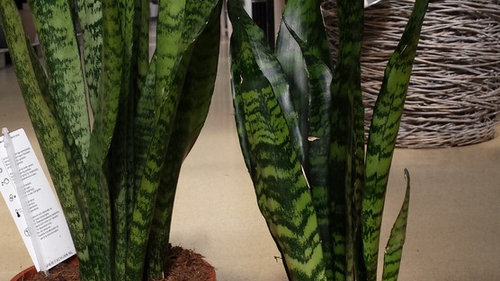
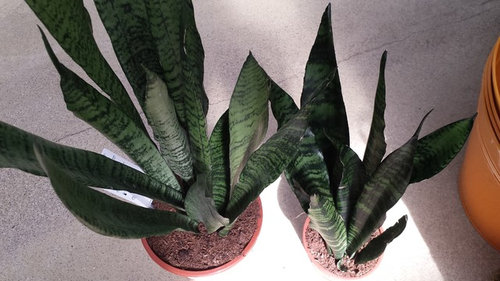
Today in garden center (Stuttgart/Germany):

Two quite different Sans with labels. Which one is S. zeylanica? Or are they both? For me the right one looks like S. black coral, quite popular hier.

And what do you think?


Comments (17)

  • 10 years ago

    Totally agree with you. But, isn't zeylanica really just another name for trifasciata?

  • 10 years ago
    last modified: 10 years ago

    I always wondered if Trifasciata and Zeylanica were the same.

    On my Black Coral, the shorter (younger) leaves are much much lighter. Your shorter leaves are the same color. On May 3rd, I posted "Who is This Guy?" There's a picture of the Black Coral I bought. You'll see the difference is leaf color.

  • 10 years ago

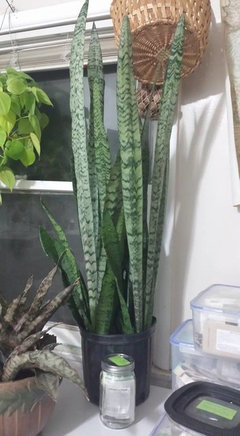
    Silly me passed up the book by Juan Chahinian on trifasciata varieties, betcha the answer is in there....I'm thinking yes, there IS a species zeylanica that resembles in no way what the common named Zeylanica is, S. trifasciata. That's how I keep it straight in my head anyway. 'Zeylanica' is as common as laurentii but I find it to be very beautiful. Here is a pic of mine.

    Here is a link to a description in Kew Bulletin, the real S. zeylanica has a red margin. Kew Bulletin on S. zeylanica

  • 10 years ago

    Chahinian has a page and pic for zeylanica, says it's a separate species and comes from India. Leaves grow to 2 feet, 1 1/4 inches wide and curved backwards. Easy to see it doesn't look like trifasciata. The book was written in 2005, so there might be newer info out there.

    Russ

  • 10 years ago

    So, my guess was right...

    Wow, but now we are all professionals
    in issue zeylanica-taxonomy! J

    Thank you to all for your
    great input.

    Tiffany, I saved your
    links - very interesting.

  • 10 years ago

    Great detective work Tiffany. That's why I was so surprised Chahinian treated them as separate species, zeylanica has been known as a synonym for trifasciata. From your links, that error apparently started with Belgian botanist Emile De Wildeman who lived 1866 to 1947, when he proposed the name 'zeylanica v. laurentii' for trifasciata.

    I'd like to find the species zeylanica that Chahinian describes, it's obviously very rare. The sans Juan pictures is very plain-looking, but sans from India fascinate me for some reason, maybe because all the others come from Africa.

    Russ

  • 10 years ago

    Liberyx, I see you're in Poland, do you know about the magnificent sansevieria source Ernst Specks in Germany? Waiting lists are long for his rare sans, but at least you have access being where you are. There is also Alan Butler's huge sans resource, Brookside Nursery; once in England, France and Italy, now in Spain. Both do mail order within Europe.

    Russ

  • 10 years ago

    Hi Russ, you are really well informed about European
    sources of sans.

    I have read a lot here in sans forum and I
    know that you have great plant collection. I am a newbie at Sans, but I saw some of
    the names earlier and some are new for me. I will check it, thanks.

    And I’m sure that
    my small collection will grow. :)

    Oh, and by the way, you have in the U.S. some good addresses also ;)

  • 10 years ago

    Thanks to something Russ wrote, I bumped into this - interesting: http://www.tucsoncactus.org/html/2012_July_meeting.html

  • 10 years ago

    Now THAT sounds like fun! Maybe we here on the forums can set up a go fund me for a trip to Africa - Tanzania. Wishful thinking???? Yeah...I thought so too. :-)

  • 10 years ago

    If I ever made/make it to Africa I may never come back, I want to see Morocco, the Atlas Mountains, Tunisia, Burkina Faso and their Azawakh dogs (desert dogs), lowland and highland gorillas, Zimbabwe, Victoria Falls, Kenya, Capetown, Table Mountain, Kenya, Madagascar....Where there's a will there's a way, LOL. Look at that young man who sold newspapers and paid his entire college tuition!

  • 10 years ago

    I will confess, I've already checked out how long the drive is to Tucson, what the best time of year to go is, etc. I'm willing to take a road trip to check out Arid Lands and B&B Cactus Farm. Hey, the train goes there even, plants can be barerooted and packed in a suitcase...just sayin.'

  • 10 years ago

    One of my dear friends lives in Tuscon. She's just now telling me she know nurseries that sell sans. I'm quite sure I could get you names.

    I could just see you in a train with a seat in either side of you filled with bags of sans.

  • 10 years ago

    If I lived in the western states I'd be making those trips to Arizona and California looking for sans. That area is the mecca, the rest of the country is a comparative wasteland as far as sansevierias. I don't know of any sources in the US that are as active and involved in importing and selling rare species as those in Europe and the rest of the world. Germany would be a great place to live for a sans collector.

    Liberyx, I traded sans cuttings with a fellow in Warsaw for many years. I have lost track of him and haven't been able to reconnect for a couple of years now. It takes about 10 days for parcels to arrive, but sans make the trip fairly well. Most made it successfully and I have many sans now from him, some with ES and a species number, from Ernst Specks.

    Russ


  • 6 years ago

    This is a very old thread, but I looked into it on account of zeylanica discussion. Russ1023, if you are still here, you might want to investigate a group called Sansevieria.pl on FB - I strongly suspect that your friend from Warsaw is very active there. The species you speak about, he has been showing them just a couple of weeks ago and the collection is amazing.


Sponsored
Schlabach Woodworks
Average rating: 5 out of 5 stars21 Reviews
Franklin County's Reclaimed Wood Professionals