Software
Houzz Logo Print
hzdeleted_28510257

Soil Test

10 years ago
last modified: 10 years ago
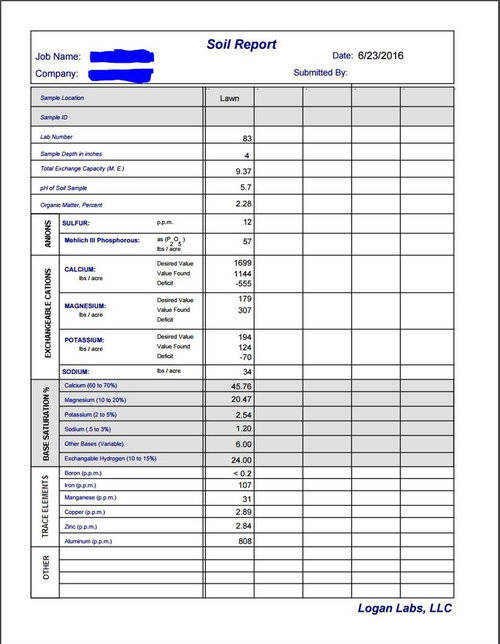
Soil test results have arrived!

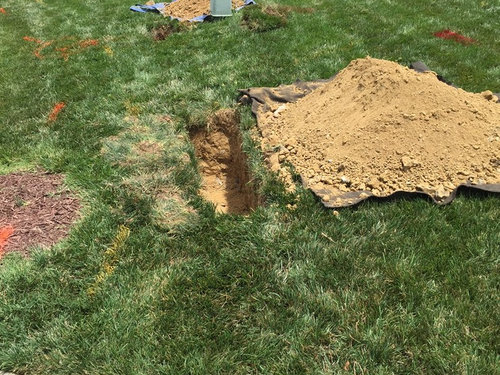
The soil I have is an Enon sandy loam that looks like this:

What are your recommendations?

As a side note, the pH tester I bough at Lowe's said 6.5 last year. It is going in the trash.

Comments (48)

  • 10 years ago

    Please folks, not everybody all at once :-)

  • 10 years ago

    Ha! You must do the dance & chant the name of MORPHEUS MORPHEUS bring your knowledge upon this faithful soul! Or soil...

  • 10 years ago

  • 10 years ago

    Best. Post. Ever.

  • 10 years ago

  • 10 years ago

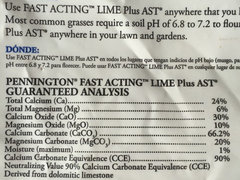
    Thank you sir. I anticipated the lime recommendation and went to Lowe's to buy some yesterday. Pennington Fast Lime now contains MgCO3, it's not much(10% I think) but there's some in there. Is that still ok to apply?

    Any recommendations for raising phosphorus faster than via starter fertilizer?

  • 10 years ago

    I told you the dance & chant would work!! Now I gotta clean the coffee off my monitor & outta my sinuses, thanks a lot!

  • 10 years ago
    last modified: 10 years ago
    Here's the ingredient list from Pennington FAL for your review:

  • 10 years ago

    Hum. It's tolerable if necessary, but in this instance? Let's go with Encap or Mag-I-Cal if possible. I'd prefer either no magnesium or very, very little.

  • 10 years ago

    I hereby take 100% credit for j4 getting a soil test. :o)

    Maybe there are some things there that might potentially help you with the fungus problem, especially the low OM%. I suppose with sandy soil you probably have good drainage, but then again raising the OM% is supposed to agglomerate the soil more (creating peds), so you never know. It can't hurt.

    I attribute a lot of my higher OM% to bringing in vast amounts of leaves in the fall. Leaf blow all your adjoining neighbor's leaves, steal leaf bags from other neighbors. The only caveat is that you might be importing some weeds, which isn't too much a problem if you're using premergs. It might be worth the risk if it gets the OM% up. I did have one bag that had sticks and small chunks of cement!

    Anyway, interesting to see your results.

  • 10 years ago

    Agglomeration & Peds?! Seems I have some googling to do!

  • 10 years ago

    pH: raise it to 6.3 to 6.6. Don't worry about Mg. Use either calcitic or dolomitic lime.

    Potassium: in the medium range - you're unlikely to see a response to added K.

    Phosphorus: Already high; don't add any.

    Nitrogen: During growth periods apply 3 to 4 lb N per 1000 ft2

    That's all you need. As for boron, potassium, etc. recommendations from others, do a little test. Fertilize a few square feet with these other nutrients and see if you can tell the difference. rust your eyes!


  • 10 years ago

    Sorry - a typo in that last one. That nitrogen recommendation is for a full season, not monthly. Monthly rates should be about 0.5 to 1 lb N/1000 ft2 depending on the growth you're looking for. More N = more growth.

  • 10 years ago
    last modified: 10 years ago

    @azdoctor

    Thank you for your recommendations. I understand some of these additions may not produce visible effects, but what about effects on the overall well being of the plant, ability to recover from stress etc, things that are not necessarily visible to the naked eye?

  • 10 years ago

    If you can't tell the difference, was it worth adding? If I go out and take very specific measurements, I might be able to detect a statistically defensible difference, but so what? If you care about how your lawn looks and performs, trust yourself!

  • 10 years ago

    morpheuspa: You cannot tell soil texture from the CEC! There is a relationship, but not a direct one. I can show you very sandy soils with a CEC of 8 meq/100g and I can show you a clay soil with 8 meq/100g. I can show you a sandy soil with a CEC of 20 meq/100g or a clay soil with a CEC of 20 meq/100g.

    This is not a critical issue, but you have it wrong!

  • 10 years ago

    az: just curious. Are you saying that the grass does not need boron at all, or that if there is zero boron the grass won't be as good, but you won't notice the difference?

    It seems like saying your body doesn't need selenium. You won't miss it at first, but after awhile you're gonna need it. It is always good to challenge accepted methods from time to time, but of course just saying something is or isn't so does not convince anybody of anything.

    Thanks.

  • 10 years ago

    ALL plants need boron. It is an essential element. But boron deficiency is uncommon in turf grasses. If you will notice morpheuspa almost ALWAYS recommends boron. I have worked with turf grass and other crops for over 40 years and have never seen a turf grass boron deficiency (although I've seen both boron toxicity and deficiency in many other crops). You are more likely to cause boron toxicity than you are to actually get a positive response. Fix everything else and if you still have problems try some boron. But do it scientifically - apply to a small area or areas and look for differences. Trust yourself!

  • 10 years ago

    What would a boron deficiency look like in a grass?

  • 10 years ago

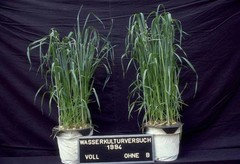
    I can't find photos of turf grass deficiency symptoms (gives you an idea of how rare it is), but we do sometimes see boron deficiency on grain crops. Here's are a couple of photos of boron deficient wheat with slightly distorted leaf margins, sometimes split, and somewhat thickened leaves. When severe, the growing point can die. Root growth can be impeded as well.


  • 10 years ago

    @azdoctor

    Thank you for sharing your experience with us. Could you take a look at these folks here as well, they seem misguided and I think they could greatly benefit from your expertise.

  • 10 years ago

    az: I'll take your word for it on the wheat. I can't tell what I'm looking at, honestly. I have found morpheus to have well-researched opinions and I assume there is data to support the boron levels he recommends. Hopefully he will chime in and give his 2 cents.

  • 10 years ago

    Don't assume. Ask for the data. Judge for yourself. Many, many recommendations are based on beliefs or feelings. We all struggle when facts don't agree with our beliefs, but facts are facts, whether we believe them or not.

    I can show you plenty of data showing turf grass response to nitrogen or iron, salinity, and soil pH. Boron? Not so much.

  • 10 years ago

    >>Hopefully he will chime in and give his 2 cents.

    He will not. Too many readily available sources disagree with him.

  • 10 years ago

    I just wrote this for another poster:


    "I'm no expert, but what I have read suggests that boron ~0.15 is deficiency that will demonstrate visibly FUBAR results in your grass, levels ~1.0 will demonstrate toxicity. Varying places say a happy place is 0.5 - 0.7. Your lab results have you at 0.2 ppm. That's really close to having a problem that you really don't want to have. No you may not see a change by adding boron, but isn't that the point? You want to ensure that your soil does not shift into sever [sic] deficiency cause more problems".

  • 10 years ago

    And you? You got an answer. :-) It's just not a battle I'm interested in fighting again, nor am I particularly interested in explaining Logan's methodology on phosphorus yet another time. It's on their site.

  • 10 years ago
    last modified: 10 years ago

    @morpheus

    What are your thoughts on using super triple phosphate to raise phosphorus a little faster than with starter fertilizer alone?

  • 10 years ago

    I'm fine using TSP or starter--I tend to design things for starter due to the fact that it's pretty cheap, the lawn needs feeding anyway, and everybody can get it. Would that I could find a potassium source that fit that bill!

    Really, I don't recommend applying more than 1 pound of P equivalent at any one time, and waiting at minimum one month between applications (and not stacking too many apps too close together). P perks down very, very slowly. While a high-P layer of soil at the top isn't a huge issue, it's still not the best thing to be doing (P is antagonistic to plenty of other elements and will block absorption of them from that layer).

    So if you want to feed normally, you can simply use 2.2 pounds of TSP per thousand square feet to get roughly the same amount of phosphorus. I'm more comfortable keeping P apps on lawns out of summer, but if you irrigate it in, it won't hurt.

  • 10 years ago

    Thank you. It gives me some options for next spring - I will re-test and if still deficient I can apply some TSP March then again mid April without having to add more nitrogen until mid to late May when I can use starter again.

  • 10 years ago

    That'll work perfectly! Just make sure the ground is completely unfrozen before you do so. Phosphorus can run off via erosion very, very easily, which is a waste and a water pollutant.

    Likewise, for use in fall, make sure there's at least a month before full ground freeze happens. I usually recommend cutting off P applications with the October first feeding just to be sure, and sometimes September for some northern states and the Prairie Provinces.

  • 10 years ago

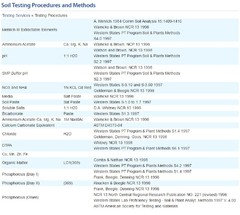
    Logan Labs extracts P with Bray 1, Bray 2, or Olsens. These are widely used extractants. Their results should be comparable to other labs and subject toidentical interpretation.

  • 10 years ago

    One. Last. Time. No, that's incorrect. http://www.loganlabs.com/doc/General-Guidelines-for-Soil-and-Paste-Analysis.pdf 

    Their own recommendations run about 100 PPM/200 PPA, which is well above the thirty number you keep bandying about. Comparative tests with UMass simultaneously with the same sample also confirm this.

  • 10 years ago

    BTW, UMass uses Morgan's extractant (a combination of sodium acetate and acetic acit). According to Logan Lab's website they use different extractants. Not equivalent!

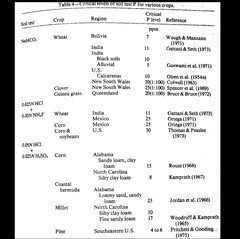
    Check out the following table showing critical (minimum) P levels. Not too many in the 100 to 200 ppm range.


  • 10 years ago

    Lastly, there is a big difference between ppa (lbs per acre) and ppm (parts per million). ppa is about 2x more than ppm.

  • 10 years ago

    This thread used to be funny & useful. Nobody cares who is right or wrong if they're bored to death & stop reading

  • 10 years ago

    I assure you, I'm done with him. It would bore you to watch me point out the contradictions and lack of reading skills in his statements above. Hell, it would bore me, and I live here.

  • 10 years ago
    last modified: 10 years ago

    morpheuspa

    ME 9.4: Sand and silt, so I'd say a sandy loam is a pretty good call.

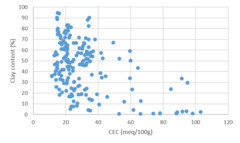
    ME stands for Cation Exchange Capacity, units milliequivalents per 100g. How is it related to soil texture? The data below are from the Natural Resource Conservation Service (the federal agency that does soil characterization and mapping). If you have a soil with a CEC or 20 meq/100g, how much clay does it contain? 20 to 85%. It could be a loam, silt loam, sandy clay loam, clay loam, silty clay loam, sandy clay, silty clay, or clay. You can't tell the texture from the CEC. NEITHER CAN MORPHEUSPA!

    He's got some stuff right and some stuff wrong. We all do. But it's disturbing that some people are uninterested in learning and are, instead, threatened (or bored) by information.

  • 10 years ago

    Just for the record, I didn't guess or use the CEC to state the soil is a sandy loam, I looked up the soil survey for my address on the USDA website and it said it was an sandy loam of the Enon series:

    https://soilseries.sc.egov.usda.gov/OSD_Docs/E/ENON.html

    If I'm reading the document correctly, past 11 inches deep it's no longer sandy loam, it's clay. I wonder how that will impact the grass if I manage to get the roots past this point - in theory clay holds more water and more resources.

  • 10 years ago

    >>I wonder how that will impact the grass if I manage to get the roots past this point - in theory clay holds more water and more resources.

    Not significantly in terms of resources, the grass' feeder roots are mostly in the top four inches. In terms of water, it may help you out a bit. But getting structural and water roots down almost the full foot can be a challenge, if it can be done at all. For KBG, that's exceptionally difficult. For fescues and ryes, difficult...but potentially workable over time. For something like alfalfa, they'd've already gone well past that and are currently seeking Earth's mantle. :-)

  • 10 years ago
    last modified: 10 years ago

    I see azdoctor is back for a toss.

    az,

    How much lime do you recommend he apply to raise his pH from 5.7 to between 6.3 and 6.6 and why pH 6.6 and not 6.5 or 6.8?

    j4, you've been here long enough to know better. :(

    Boron is less than 0.2. Zero is less than 0,2. I'm no fan of bothering with boron as very little is necessary for healthy turf; however, considering that recommended sufficiency levels for boron fall between .4 and 1.5, if my boron level was less than 0.2, even I would add boron.

  • 10 years ago

    corrected.

  • 10 years ago

    j4, you've been here long enough to know better. :(

    What I did?

  • 10 years ago

    I applied borax today, but I didn't have any Milorganite, nor did I want to put up with the smell of it. So I started looking around for another carrier, and spotted a bag of sand I was using for potting mix. It was nice and moist from being outside in a rain. Got about 10 cups of sand in a plastic container and added the specified amount of borax. It mixed together very well because the borax and sand granules are similar in size, and the sand was damp. I then used this mixture to sprinkle out of my hand while walking. Worked very well and made for a very fast and even application, took about 10 minutes to do 3,000 sq ft.

  • 10 years ago

    It seems that boron is well established as something grass needs. I don't know how the ppm level was established, but I'm going on faith that somebody figured out a reasonable range for boron. AZ says he's never seen a lawn exhibit a deficiency in boron, so why worry about it? To me, it is so cheap and easy to apply, then why not? As long as you don't dump the box of borax on your lawn while measuring it out, I think it unlikely that you will harm anything. I see it as insurance.

    Personally I don't mind the smell of milorganite. Smells like faint perfume to me, and is odorless once applied anyway. It isn't particularly easy to get boron to coat the milo easily and stay coated during broadcast. I always see the borax accumulated at the bottom of the spreader.

  • 10 years ago

    ^ I agree.

    I think sand is a better carrier than milorganite for boron, you get a very even mix and very even coverage.

  • 10 years ago

    Sand's fine, and I don't object in the slightest using it once per year in smaller amounts. Over very long periods or larger amounts, it can change the makeup of your top soil layer, but...that's not likely here.

    Soybean meal, corn meal, or anything like that would also be a perfectly good carrier. I tend to suggest Milo because it's of a known consistency and almost everybody can get the stuff at a reasonable price.

    >>AZ says he's never seen a lawn exhibit a deficiency in boron, so why worry about it?

    Just for idle fun, look up "hidden hunger" in terms of plant feeding. Your plants can step around a lot of shortages by using a related element, or invoking a mechanism that lets them ignore the shortage (at least within limits). The term is also used in human (and animal) physiology to denote a micronutrient deficiency; you can also side-step most processes, but it's not the best thing for you.

    In plants, hidden hunger can even apply to macronutrients, most notably potassium (which is the great ignored macronutrient in the plant world in many cases).

    "Deficiency" doesn't mean "optimal performance," it just means you aren't seeing symptoms of the shortage.