Software
Houzz Logo Print
landesmegan

Repotted Jade plant

10 years ago
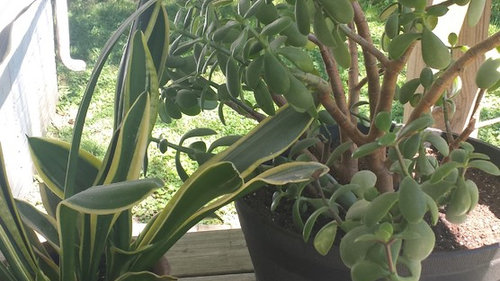
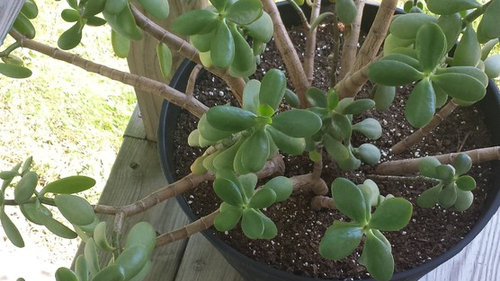
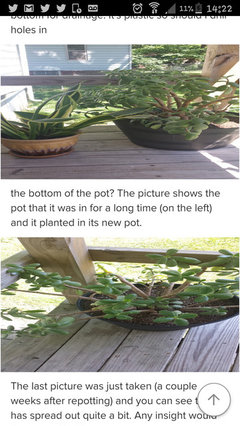
I recently repotted a root-bound jade plant. I now fear that the pot is too large. Also, after doing some reading I fear that the pot that my bf bought me was a bad choice due to no drainage. It currently has large rocks in the bottom for drainage. It's plastic so should I drill holes in

the bottom of the pot? The picture shows the pot that it was in for a long time (on the left) and it planted in its new pot.
The last picture was just taken (a couple weeks after repotting) and you can see that it has spread out quite a bit. Any insight would be appreciated.

Comments (18)

  • 10 years ago

    I think the pot is the right size, but you need drainage.

  • 10 years ago

    Ok, thank you for the replies. Do you think my idea of drilling holes in the bottom will be sufficient or should I just buy a new pot?

  • 10 years ago

    I have often drilled holes in plastic pots, both when the pot had no holes at all, and when it had too few. The result is exactly the same as buying a pot with pre-existing holes. Old plastic could crack if it's brittle, but new plastic should be fine. It's kind of fun, too.

  • 10 years ago

    Just drill holes.

    Josh

  • 10 years ago

    Thank you all! I've had this plant since it was tiny and want to ensure many more years with it.

  • 10 years ago

    Why do the pics always looked flattened on GW when viewing from my phone? Never used to with the old GW

  • 10 years ago

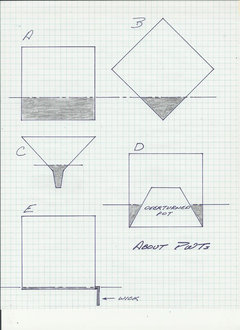
    I'd drill (or melt it through the plastic with a hot nail head or soldering iron) at least 1 hole through the bottom at the perimeter and insert a wick into that hole. After you water, allow the wick to hang over the edge of the table and tilt the pot so the wick is at the lowest point. This will remove a LOT of extra water from the soil.

    The rocks can stay as ballast IF there is at least 1 continuous strand of soil running from the main body of the soil all the way to the bottom of the pot. If you have that continuity, water won't perch - but I'd get rid of the rocks & use the wick.

    Compare figures B and E to A for an idea of how tilting your pot and adding the wick can do to help you get rid of excess water retention.I'm assuming you used a commercially prepared potting soil based on peat and other ingredients with fine texture. Usually, these soils are too water-retentive to suite jade well. Your choice of soil is a key choice because of how much influence it has on your ability to keep the root system happy, and "if the roots ain't happy, ain't no part of the plant happy." ~ C. Whitcomb, PhD

    Al

  • 10 years ago

    The spreading of the branches could be due to soil being too wet, and plant is slowly weakening. Hope you drilled the holes, that should help a lot. Very nice plant, would be shame to loose it.

    It also looks like it wants more sun - is it mostly shade where the plant is located?

  • 10 years ago

    I had it in an area that was getting afternoon sun but it burnt some of the leaves. I have it in a more shady spot now and I think it is happy.

  • 10 years ago

    Sorry that happened! Increasing the sun for any plant should be done gradually or burning can result.

  • 10 years ago
    last modified: 10 years ago

    This Jade has been acclimated to being in the direct sun from about 10 AM until about 4 PM.

  • 10 years ago

    Depending on what light level any particular plant is conditioned to, it might or might not be able to adjust to full sun, no matter how gradually you try to ease it into that light level. If we assign light levels numbers from 1-10 with 1 being very low and 10 being full outdoor sun all day, a plant conditioned to a level of 2-3 might only be able to adjust to a light level of 5-7 w/o burning, even if you were to acclimate over several months; whereas, a plant conditioned to a light level of 6 or 7 might be able to make the adjustment all the way to 10 w/o burning.

    The reverse is also true. A plant moved from a light level of 7 might be able to adjust to a level of 5 or 6, but will shed foliage if the light level drops to 3-4.

    These are just hypothetical illustrations to help growers understand that there is only a range of light levels a leaf is capable of adjusting to w/o damage from photo-oxidation or being shed.

    Al

  • 10 years ago

    Al, are you speaking about to certain individuals in regard to their history, or per species?

  • 10 years ago

    I don't understand what you're asking, Tiff.


    Al

  • 10 years ago

    Sorry, my bad. I couldn't tell if your post was in regard to just Jade plants or a theoretical about all plants.

  • 10 years ago

    All plants, but to varying degrees. We already know that when light levels are reduced significantly, many plants shed their leaves ..... and some are quite famous for that proclivity. Plant leaf structures are also unable to adapt to significant INCREASES in photo loads, also to varying degrees. Leaves that originated in low light conditions simply might not have the ability to physically change their structures enough to provide the protection from damage the leaf's photosynthesizing machinery needs to remain viable. Once the photosnythesizing machinery is damaged and the leaf's carbohydrate production is such that it is equal to or just slightly greater than it's LCP (light compensation point - the point at which its carbohydrate production equals its consumption), an abscission layer forms at the petiole's is attachment point and the leaf is shed. Some fraction of the latent buds above the bundle scar (the scar that remains where the leaf was attached) will become active after the leaves abscise and produce branches with new leaves perfectly adapted to carry on photosynthesis at light levels the leaves find themselves growing in.

    I've mentioned several times that I often move healthy trees straight from the basement into full sun with no acclimation process - knowing the leaves will burn & fall off. If the tree is healthy, this ultimately speeds growth and development because the short setback while leaves are shed and replaced with leaves well-adapted to the full sun site is outweighed by the marked increase in ramification and the fact that the new leaves are so much more efficient than the old leaves would have been, even after a lengthy process to acclimate them to higher light levels.

    Al

  • 10 years ago

    Thank you! That clears things up for me, and totally agree!

Sponsored
Haus Studio
Average rating: 4.8 out of 5 stars28 Reviews
Franklin County's Preferred Custom Cabinetry & Design Studio