Software
Houzz Logo Print

Comments (10)

  • 10 years ago
    last modified: 10 years ago

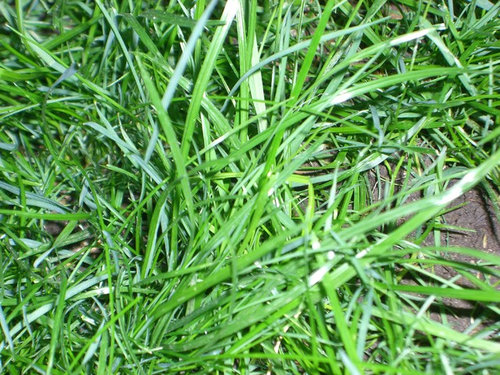
    It will help to know where you live to eliminate some of the possibilities. Also what kind of grass do you already have, and is there some of that in this picture? Does it get seed heads or flowers? A picture of that would help.

    And if you could take the picture again on a cloudy day or in the shade, that would help us see through the high contrast of the sunny day pic.

  • 10 years ago
    last modified: 10 years ago

    Is the picture below
    better?

    Additional info: I
    am in Ontario, Canada, in zone 5a on the boundary of zone 5b on the Canadian
    Plant Hardiness Map and in zone 4b on the US Plant Hardiness Map. I seeded a bare
    area that resulted from the removal of a large cedar tree with an all purpose sun and shade mix from
    Scotts. The label on the package says Creeping Red Fescue, turf-type Perennial
    Ryegrass, Kentucky Bluegrass and Annual Ryegrass. The area gets morning sun
    but it is partially shaded by a very large honey locust tree (the picture in the previous posting is bright because of flashlight, not sun).

    Of all the types of
    grasses that grow (or start growing) on that bare spot, I like this one the
    most because of its fine texture and it feels soft and cool to the touch. I
    like to overseed the rest of the entire lawn with just this type of grass.

  • 10 years ago

    Given the lighter green color and waxiness of the blades in the first picture, looks like nutsedge. It's a grassy weed, not a desirable turfgrass. This page provides a good description of of nutsedge: http://www.ipm.msu.edu/agriculture/field_crops/yellow_nutsedge

  • 10 years ago

    I was thinking nutsedge, too. While it might feel soft now, once it matures it sends up very sturdy seed head stalks. When you mow them off they are sharp and spiky to walk on.

    Nutsedge loves swampy conditions and rarely grows in a real desert. How are you watering? How often and for how long do you water?

  • 10 years ago

    Not sure it is like the pictures on the linked webpage. Is it not one of the grasses on the seed package? How come it can be something else?

    It's the first month after seeding, and I still water almost daily for an hour as there are still bare spots and sparse growth in the area where the tree was.

  • 10 years ago
    last modified: 10 years ago

    If the stem is triangular shaped, then it definitely is nutsedge. Nutsedge is a water-loving plant. All sorts of weed seeds and tubers are present in your soil waiting for the optimum environment to germinate. So when you started watering everyday, you provided the nutsedge seeds and tubers a perfect germination environment. Nutsedge tends to be a lighter shade of green (almost neon yellowish green) than fescue (I assume you have mostly fescue lawn in Ontario?) and will grow much faster than your lawn, therefore it'll stick out like a sore thumb. Nutsedge usually spreads through rhyzomes and will produce small tubers (AKA nutlets; like a potato plant). In hot and dry times, the blades may die but the tubers will stay alive and well underground waiting for better conditions to come along so it can sprout again. The best way to kill it is to use a herbicide such as Sedgehammer, Sedge Ender or Ortho Nutsedge Killer. If you don't use a chemical solution, you could try to handpull the nutsedge when it is still in the 3-4 leaf stage. If you wait until it's past 3-4 leaf stage, it more than likely will have grown tubers at which time when you pull on the plant, the tubers will break off and remain in the soil and compound your infestation. The tubers are quite small, like pea-sized. So if it's already past 3-4 leaf stage, I personally wouldn't even bother to pull it as it's a lost cause. I'd go straight to the herbicide route. Any of those above mentioned herbicides will get it all knocked out within 2 weeks with one application.

  • 10 years ago

    Okay 15 meter penalty for not mentioning that this is new seeding.

    For new seed you should be watering no more than 15 minutes a day spread out at 5 minutes each at breakfast, lunch, and dinner. Your watering reinforces the nutsedge idea. The end of May is a really bad time of year to drop seed, because of the summer weeds germinating at the same time, and because new seedlings cannot take the summer heat. You might get a pass for your location on the heat, but not for the weeds.

    An easy way to tell what the weed is is to let it go to seed to see what the seed head looks like.

  • 10 years ago
    last modified: 10 years ago

    I tried to ID again,
    but still can't tell for sure. I cut a couple of specimens with a pair of scissors, the
    stems seem to be more round than triangular under a magnifying glass. The color
    of the specimens is green like on the second picture (which was taken without
    flashlight) with no yellow tint as on the first picture (which was taken with
    flashlight). On the other hand, the specimens sprouted earlier and have grown faster than other
    grasses in the seeded area.

    I have an area in my
    garden that I let grow wild and it looks indeed like an unmowed fescue meadow
    with that wavy look like on Google images. It is home to garden birds and other
    small wildlife that I love. I plucked a (young) specimen that I have been trying
    to ID to compare with the mature fescue but it was not comparable at all. I am
    reluctant to dump chemicals so close to that wildlife habitat. I was pulling weed
    between interlock brick the other day and saw a shadow moving under my hand.
    When I reflexively pulled my hand back, I saw a chipmunk apparently looking for food in my hand. It kept looking at me for a little while, like it was expecting food before moving away. Got to make accommodations for these things.

    Thanks for the watering tip. When is the best time for seeding/overseeding the lawn?

  • 10 years ago

    When nutsedge is young, it doesn't quite have that distinct triangular shape yet. Nutsedge has a very distinctive a mid-rib (groove) down the middle of the grass blade. The herbicides that I mentioned are pet safe once dry.

    The best time to overseed is late August/early September for cool season grasses. The cooler temperatures are optimal growing conditions for fescue root development in preparation for winter dormancy and the following summer. Overseeding in spring is the second best time, but you risk losing more baby grass as they may not have sufficient time to develop deep roots to withstand the dry/hot summer temperatures.

  • 10 years ago

    It's ryegrass.