

July Harvest/Conversation Thread
Since the June Harvesting Thread was a great way to continue the garden conversation all month long, here's a new one for July.
What are you harvesting now? We are still getting the last few dozen of the peaches, but the plums and blackberries are done. Every few days we get a small handful of strawberries, and are starting to get figs.
In the veggie world, the tomato harvest continues but I've begun yanking out plants so it will drop over time, and the hot peppers are coming on strong. The sweet peppers have been more slow to set fruit. Pole snap beans are still producing, but the heat may be about to put a stop to that. That's okay, as the pole Lima beans have finally begun setting beans, so I'm looking forward to that harvest beginning sometime over the next few days. We're still getting a lot of squash and marveling that neither the squash bugs nor squash vine borers have shown up here yet. The last of the long-day storage onions finally fell over this week, so I need to pull them. Most of them finished up earlier, but a couple dozen had necks that just wouldn't give up, so I left them alone and let them stay in their little corner of the onion bed just to see how long they would last.
Other than tomatoes, the largest harvest is coming from our six varieties of pink eye purple hull peas. I am picking them about every other day. It is nice to have all the peas we can eat daily. I think I could happily eat fresh southern peas cooked with bacon (and sometimes onions and hot peppers) every single day, and having cornbread with them is a requirement.
Then there's the pickling cucumbers. They've been producing forever and I've been busy canning every single type of pickled cucumber product imaginable....and I am getting kinda tired of them. I hate to take out cukes that still are producing though, so the recent ones are being used for either Mock Apple Rings (aka cinnamon pickles) or Jalapeno-Cucumber relish. The plants have all sorts of foliar diseases and cucumber beetles all over them, and some plants have succumbed to bacterial wilt, but we still have lots of cucumber plants and lots of cucumbers. I'm probably going to take them out in another week or two and replace them with something else. One way I've been dealing with the harvest is by feeding the chickens some chopped up cucumbers as afternoon snacks.
Salsa-making is about to end at our house, and I'm ready for it to end. I have made about 25 batches of Annie's Salsa (I lost track of the number of batches along the way) and have prepped tomatoes to make 5 more batches today. Then I think I'll be done with that and will move on to canning other tomato products. It's time.
This week, for the first time this season, when I went to the canning aisle at a local Wal-Mart (for us, local is the nearest store roughly 25 miles to our north or about 20 miles to our south, so not real local) to buy jars, I noticed that there were some empty places on the canning aisle where canning jars had been, so the canning season must be picking up around here. So far, I've mostly just canned fruit jellies and jams, salsa, pickles and cucumber-based relishes, and sauerkraut, so I'm ready to move on and diversify into other products. With the rest of our produce, if it doesn't get eaten fresh and I don't can it, it ends up in the deep freeze (we have 3 of them because somebody who lives here plants a garden every year that is too big) or in dry storage (garlic, onions, potatoes).
I haven't done much with preserving herbs yet, but I have collected dill seed already (for the spice rack, not for sowing) and tomorrow I plan to harvest a lot of dill weed to dry. I also am going to harvest basil tomorrow to make pesto. Once salsa-making isn't occupying all my time, I get to do a lot of more minor food preserving and I'm ready for the change.
Our weather is really supposed to heat up in the coming week, not that it's been very cool this week, so the more little food preservation projects I can do indoors, the better. Otherwise, I might be out in the garden weeding, and with the constant parade of copperheads to the garden lately, weeding might not be a smart idea.
Most of the flowers look great, but only because I've been watering them. They normally don't look nearly as good by the end of July as they look at the beginning of July.
Since it isn't raining and we aren't watering the lawn, we aren't having to mow as often, so hooray for that.
That's what is going on at our place as July begins. What is going on with yours?
Comments (216)

Okiedawn OK Zone 7
Original Author10 years agoauthereray, I suspect we have too many other things they like more. If we didn't have so many grasshoppers and such, maybe they'd appreciate hornworms more. It is odd, but I've noticed other pickiness in their eating habits too. Most of them love small frogs, and I'd rather they left the frogs alone, but I can't follow them around all day like a nanny trying to keep them from eating frogs either.
lonejack, Maybe my chickens are just old and lazy. Well, except for all of this year's new ones, which may be so young they haven't even seen a hornworm yet. I just released the last six newest chicks from the brooder so they can free-range this week. They still are kinda small, so I'm counting on the older chickens to keep them safe from chicken snakes and rat snakes. The new chicks will eat anything so far, just to see whether or not it is edible. They're fun to watch---kinda like seeing a little child running through the yard for the first time ever.
- 10 years ago
Oh yes mine love small frogs as well and this year there seems to be an abundance of them. Last year one of mine got ahold of a baby copperhead while free ranging and that was quite an episode to watch. By the time I managed to get the snake away from the hen it was nearly torn in half but the dangerous half was still alive and luckily so was the hen.
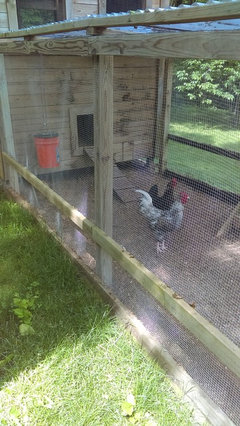
Rooster Cogburn and his girls
 Garden pictures · More Info
 Related Professionals
Elgin Landscape Architects & Landscape Designers · Macon Landscape Contractors · New Orleans Landscape Contractors · San Marcos Landscape Contractors · Fall River Landscape Contractors · Escanaba Landscape Contractors · Ithaca Landscape Contractors · Harrisburg Landscape Contractors · Elkton Accessory Dwelling Units · New Braunfels Accessory Dwelling Units · Danbury Accessory Dwelling Units · Janesville Accessory Dwelling Units · Chula Vista Accessory Dwelling Units · El Paso Accessory Dwelling Units · Lagrange Accessory Dwelling Units 10 years ago
Just hot. Peppers are getting leaf roll, I'm assuming from heat stress. They're in dappled sunlight all day. Dropping blossoms too. I wasn't able to check everyone tonight, I got home from work too late. Tomorrow evening. In-ground planted tomatoes aren't taking off like the potted ones are. I'll be at TMD sometime Saturday, and I'm collecting my questions for them. They have alpaca poop compost. Anyone tried it? Going seed shopping this weekend too - thinking I'll use my extra grow bags for bush beans. Maybe a bit of okra if I can find a place for it, and seeds. But definitely beans. Can't find winter squash plants anywhere, so I may or may not get to those this year. And I've figured out that next year I need more pollinator plants around. I see very few bees, etc.
 10 years ago
What is everyone's asparagus doing?
My asparagus are first year plants---planted in March of this year. Their ferny parts are getting tall, but they are still making lots of the part that is the edible part. Is the ferny stuff what becomes of the edible part when left alone? Does that even make sense? It's just producing quite a bit. Still. And, honestly, I've ignored it since May except for watering it twice maybe.
My garden is a wild jungle. And mostly neglected, although I watered it all today. It makes me feel anxious on days like this--it's just so out of control. The watermelon are vining into the seminole pumpkins and there's grass and weeds everywhere in the pathways. Saw several small grasshoppers and tried to get the chickens to pay attention to them, but they were obsessed with watching my every move and/or digging in areas that I would prefer them NOT to dig in.
Regardless of the bugs, I'm still collecting tomatoes every day. Peppers abound. Those silly, silly summer squash plants decided to perk up and look lovely and are making fruit. Very thankful, even if stressed a bit. Thinking about just mowing the paths tomorrow as there is no time to weed them properly.
- 10 years agolast modified: 10 years ago
My basil is starting to get leaf roll. Never seen that in basil before. Any ideas? Can I still harvest and eat it? And any secret for growing sunflowers? Can't seem to get them to germinate. Too hot?
Okiedawn OK Zone 7
Original Author10 years agoLone Jack, That's a nice chicken enclosure. Can you let them out to free-range or is that too dangerous where you live? We have a coyote stalking our chickens. I chased him away yesterday, but I bet he is back lurking in the woods right now hoping a chicken will leave the yard and wander off into woodland. There's no way around it. We need to put a tall fence between the yard and the woodland (I've wanted one for years, but my husband has resisted the idea because he likes to look off into the woods with no fence to obscure the view), but probably will have to wait until winter because our woods are crawling with copperheads, pygmy rattlers and timber rattlers at this time of the year.
Rebecca, I'm sure all the leaf roll is heat stress. It should resolve when better weather conditions return. Right now I mostly am seeing bees only in the early, early morning hours. I suspect they are trying to stay cool at midday just like the rest of us. Sometimes I see them in the evenings as well, but I'm certainly not seeing as many now as we had a month ago. July probably is not their favorite month.
Hazel, Yes, the ferny foliage is what unfurls and grows from the spears as they mature. The foliage is important to the plant because it is helping the plants store away energy in the root systems, and that stored energy is what will give you great growth and lots of spears next year in late winter/spring. My asparagus is about 7-8' tall, fully ferned out, producing some berries, and leaning over and flopping over all over the place, which is typical at this time of the year. The good thing is that it all is so dense and thick that it shades the ground beneath it, which helps keep the weeds to a minimum.
My garden is totally out of control, and it makes me uneasy too. I yanked out a few weeds this week while harvesting early in the day, but everything is merging all together in one big jungle and I can't stick my hands into darker areas to weed because there might be a snake in there. Usually I lose control of the garden in July and August in the heat, and then work frantically to get the weeds out and regain control of it in September. It is just too hot right now to try to pull out the weeds and to keep all the vining plants in their proper assigned area. They grow and ramble and do as they will, and I just have to deal with it. Mostly, when it is this hot, I just don't look at it, or I glance at it all and try not to focus on the way various vining crops are growing across aisles, climbing pepper and tomato cages, and merging together into one big mess of green. Thanks to the miracle of modern irrigation it all is still green, but if this heat keeps up and no rain falls, I'm going to have to stop watering at some point.....like, when the water bill arrives at the end of the month and causes Tim's head to explode. He won't say anything about how high it is, but he'll have that deer-in-headlights expression from the shock of how much it costs to keep a garden green in this weather.
My chickens are like yours---the have their own little agenda in their tiny brains and don't care what I want. Some days they voraciously eat every grasshopper they come across, and other days I do believe a grasshopper could ride around on top of a chicken's head and the other chickens wouldn't bother to pluck off that hopper and it eat. They seem to get tired of whatever they're eating the most of at any given time, and when they get tired of something, they just stop eating it.
Rebecca, Yes, basil (and pretty much anything else) can get physiological leaf roll when it is hot. Mine has had some this week and so have the zinnias. It is just so hot. They'll be fine when the weather moderates a little bit more.
It likely is too hot for sunflower seeds to germinate readily outdoors. Once the soil temperatures are above 85 degrees, sunflower seed germination really drops off and even ceases to occur. You can sprout them indoors by soaking the seeds in a cup of water for a couple of hours. Then, remove the seeds from the water and roll them up inside a moist paper towel or coffee filter and put them in a zip-lock bag zipped closed. Check every morning and evening for sprouts. As soon as you have the first sign that seeds are germinating, you can sow them into their permanent growing spot. Only sow the ones that are germinating. Leave the others in the ziplock and continue checking twice daily. You'll usually get most sunflower seeds to sprout in this manner. You might not get 100% germination, but you'll probably get at least 75%.
Dawn
 10 years ago
We got our first cuke today. Perfect pickling size. I need to go dig through the jungle and see if there are more, enough for a jar of pickles any way.
- 10 years ago
Thanks Dawn for the compliment on my chicken house!
Yes they are allowed out to free range for a couple hours most days but it has to be somewhat supervised with someone out in the yard with them. We live on 5 wooded acres with plenty of predators including bobcats, coyotes, foxes, coons but I have only lost one hen to a predator who snuck up our creek bank and ambushed her when I was in the house getting a beverage. I came back out and the rest of the hens and rooster were freaking out. I did not realize what happened until I corralled them back into the run and was one short on head count. Found a pile of feathers next to the creek.
Okiedawn OK Zone 7
Original Author10 years agoWe lose far too many, but we have almost 15 acres and at least 10 of it is heavily wooded. We are near the Red River with the river to our west, south and east, and there's lots of Wildlife Management Area along the river, so wildlife is too, too plentiful. Still, the smart chickens learn pretty quickly where to roam (Hint: NOT in the woods) and the dumb ones don't survive. Darwin's theory of the survival of the fittest (or, lol, the smartest) is at work in our chicken flock. We have had coyotes within 2-4' of the house several times this summer and it is driving me crazy. We've had them hunting mid-day in winter before, many times, but normally not in summer. I don't know if the three rounds of river flooding this spring and summer flushed them up out of the bottomlands this year more than usual or what, but usually in the summer we hear them more than we see them. This year we are seeing them in the yard far too often.
We only let the poultry free-range when we're home, so at least if we hear something we can run to them and try to save them. Once, the guineas were carrying on and Tim ran outdoors and spotted a red-tailed hawk trying to fly off with a guinea in its talons. He ran and grabbed the guinea and took it away from the hawk. The guinea only lost a few feathers, but spent the next few days lying low and hiding. I would have done the same. We never caught that hawk trying to snatch our poultry out of the yard again that summer. Apparently a close encounter with a human being upset it enough that it left our birds alone after that.
- 10 years agolast modified: 10 years ago
My eggplant is sick. It started after the yard guy let the flying grass from the mower cover the leaves, I think. I washed it off, but it's still yellow and dropping blossoms. I don't have anything on the yard right now, so it's not herbicide or anything like that. Do eggplants get blight?
Dawn, are tomatoes the only thing you really push the recommended planting dates on, or are there other things? And will your seed pre-sprouting technique work on most any seed? I know some things you don't want to use it on, like root crops. Okiedawn OK Zone 7
Original Author10 years agoRebecca, Yes, eggplants are in the same family as tomatoes, peppers, potatoes, etc. and get the same diseases.
I push planting early as much as I can with everything. Too many repeated hot, dry years down here in southern OK (2003, 2005, 2006, 2008, half of 2009, 2011, 2012, 2013, 2014....) have taught me that I need to beat the heat as much as possible to achieve success. It would have been easier to list the years when summer heat and drought didn't impede the harvest, and that would have been 2002, 2004, 2007, part of 2009, 2010, and 2015).
I just wrote in detail about this over on the tomato thread. It has been a struggle to find a way to plant early and not lose plants to repeatedly late cold nights, but once I started using DeWitt's super heavy duty winter weight row cover (gives protection down to about 22 degrees, and I've had it protect plants down to 18 degrees or colder with a double layer of it), that gave me the ability to plant as early as the soil was warm enough and to just cover up plants on really cold nights. There isn't any point in planting when the soil is too cold because plants won't grow, but this year the soil warmed up plenty early.
Seed pre-sprouting works with/for anything. I use it for most things, but not for carrots and other picky root crop divas. You can pre-sprout carrots and sow the sprouted seeds but I find it time-consuming, annoying to have to handle the teensy sprouts, and you often get misshapen carrots. It also doesn't work well with parsnips and salsify, but I presprout beets all the time. I use it a lot with flowers and herbs too.
This is Oklahoma where the weather changes every 3 hours and we have to be prepared for Mother Nature to throw everything at us, including sometimes the kitchen sink. I have found that I have to do absolutely positively everything I can do to work around the weather. If I sit around waiting for it to cooperate with me, that almost never happens. Better to push hard and plant early and protect plants than to keep waiting for that perfect window of opportunity that rarely opens here. When we are abnormally hot in winter and spring and fruit trees and native plants start blooming and leafing out early, that is Mother Nature jumping up and down and screaming to get our attention and warning us to hurry, hurry, hurry. I've learned to ignore her warnings at my own risk. It is absolutely crazy. We moved here from Texas only coming 80 miles north of where I'd gardened all my life. I thought that 80 miles wasn't much of a difference. Ha, ha, ha, the joke was on me. I have to deal with both colder winter conditions here in general, and hotter summer conditions, so it feels like overall we lost both ways. Really, though, our weather is so erratic here that the most important thing is just to be watching it carefully and reacting to it as needed. We can't foretell the weather, but we sure can spot warming trends, especially in a year when winter just wasn't really wintery at all.
- 10 years ago
I have summer squash! Yes, it's nearly August, but I have summer squash finally. I also had 6 adult squash bugs and 3 leaves with eggs, but I pulled those off with tape. Is it just me or are some squash bug eggs harder to remove than others? Of course the ones in the veins are difficult, but it seems like some squash bug moms must have extra sticky glue-stuff.
Paula, if you see this I'm wondering if you would mind posting a picture of the tomato trellis thing you and your husband made. I have several tomato plants that aren't caged . I ran out of cages and now they've grown so tall. I honestly thought they wouldn't make it--they sat on my porch until the end of May looking pathetic. But they took off and I've staked them and will hope for the best. They are still going strong despite the heat and hornworms. They look bad. Anyway...I like your tomato trellis/cage thing.
- 10 years agolast modified: 10 years ago
"Extra sticky glue-stuff", LOL, that struck me funny! Yes, some eggs refuse to come off and you end up tearing the leaf.
- 10 years ago
hazelinok, Good for you, I'll take summer squash any time I can get it. Usually I am lucky to get any squash at all because the squash bugs are so thick it is impossible to kill them all, but for some reason they were late in showing this year and I made more squash than I ever have. Don't get me wrong I like fried okra but I really like fried squash. With a little luck you might be able to have squash until fall. I picked several squash yesterday afternoon. I like Yellow Straight Neck Squash. I found some new hatched squash bugs and a patch of eggs which I tried to destroy. The eggs are sometimes very hard to find and some are even harder to scratch off.
- 10 years ago
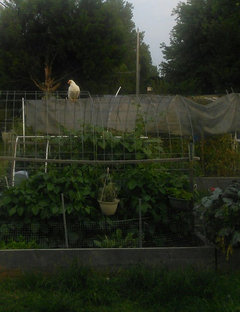
"Stupid" wants her wings clipped. That arch is 7' high. She'd have no problem with the chain link fence.
Okiedawn OK Zone 7
Original Author10 years agoHazel, Yes, some of those squash bug moms seem to be supermoms who use superglue. I just tear a hole in the leaf in that case, removing the piece of leaf the eggs are attached to.
We still have not seen any squash bugs or SVBs and, even though I hate to admit it, I am getting tired of squash. Not tired of eating squash, but tired of picking it, washing it, slicing it, blanching it and freezing it. I know I'll be happy to have squash in the freezer later on, I've even been slicing some up and feeding it to the chickens every afternoon, along with the last stray cucumbers that the last few plants are producing. Our chickens love both cukes and squash.
Normally, the SVBs and the diseases spread by squash bugs would have killed all the squash plants by now, so having too much squash wouldn't even be an issue. I planted three succession plantings of three plants each and all nine are alive and well and producing. No small family needs 9 squash plants, but I didn't expect they'd all survive for so long. In a more typical year, at the very least, the first two sucession planting would be dead by now and we wouldn't have too much squash, but we'd have enough, and I'd be fighting to keep the last succession planting alive.
There is one squash plant that has been wilting badly and looking sickly, so I may be about to discover that squash bugs or SVBs have found us, but it also could be bacterial wilt, which cucumber beetles spread. We've already (finally) lost about 75% of the cucumber plants to bacterial wilt and we still have cucumber beetles around, so I've just been keeping my fingers crossed and hoping the beetles don't spread the BW to all our melons. I don't care if they spread it to the squash at this point because we have had enough of that.
Amy, We have had many stupid chickens this summer who keep flying into our dog yard, even though it has an 8' tall fence around it. We have to check the dog yard first before we let the dogs go out into it so we can chase, catch and remove any chickens from it or we end up with overly excited dogs and a dead chicken. We've only lost two chickens to the dogs, but have removed chickens from the yard many times, including once on Monday, (and have lost more to coyotes), but you'd think that an 8' tall fence and the sporadic presence of 4 dogs in that dog yard might keep the chickens out of the yard. The chickens have acres to roam and the dogs only have a few hundred square feet, but the chickens just cannot respect the fence enclosing that few hundred square feet.
Chickens have brains about the size of a human thumbnail, I believe, and based on the way they act, I think it is a very slow-operating brain. It is a wonder they can free-range and survive at all. Some of the smart ones are really smart though, and know to hide themselves well when danger presents itself. This includes getting up on the porch and lining up on the porch swing and porch railing, where they must think they are safe from hawks (maybe they are) and coyotoes (the porch won't stop them). I spend a lot of time in summer hosing off the porch and swing with a water hose and scrubbing away chicken poop. I love our chickens and they keep our yard pest-free but they are a lot of work.
Dawn
- 10 years agolast modified: 10 years ago
It has been a strange year for cucurbits in my gardens here in Missouri. I have had an invasion of squash bugs on my cucumbers since about the time they started to produce in late June. I gave up on hand picking after a week or so but I still got good production and have about 18 pints of gherkins and another 15 quarts of larger pickles put up. The cucumbers were planted in my garden beds next to my house. ~100 yards away in my front gardens I planted summer squash and melons in early June after the Broccoli and lettuce were done and so far no sign of squash bugs on them and I have been picking squash for a couple weeks now and the cantaloupe have 15+ fruit in various stages from tennis ball size to netting stage. The cucumbers look like hades but as long as the squash bugs are hanging out there I am going to leave them be to try to keep them isolated and away from the squash and melons. My chickens don't mind bitter and misshapen cukes late in the season.
Okiedawn OK Zone 7
Original Author10 years agoIt just seems like a strange squash bug year in many places, but let's not complain.At least they aren't running rampant destroying everything (so far).
I looked at my sickly looking squash plant this morning and it had perked up a lot, but I do think it has bacterial wilt. I am not seeing a lot of cucumber beetles now, but they've already done a lot of damage and moved on. I don't care. We're all pickled up for the foreseeable future.
If the squash plants die, they die, and I'll put something else in their place and move on.
Since it was so much cooler this morning (note, y'all cannot hear my sarcastic tone since I'm typing this instead of saying it aloud), I worked in the garden all morning. When I came in at 11 a.m., the heat index was only 97 degrees. Woo hoo! It almost felt good outdoors. Or, I should say I felt pretty good until I walked into the cool, comfortable house and realized how nice it felt indoors compared to how hot I had been while working outdoors all morning. Once I was indoors, I couldn't believe how long I had stayed outdoors in the garden. Do I not have ANY sense at all????
I cleaned out another tomato bed and weeded it, and then weeded the melon bed where I had planted icebox melons in June. The first icebox melon is almost ripe. Then I harvested tomatoes, lima beans and cowpeas. I didn't harvest all of any of those three, but did harvest enough to keep myself busy shelling peas and beans all afternoon, and I think we'll have BLTs and either peas or beans for dinner, along with a cantaloupe and some sort of apple dessert made from apples given to us by a friend yesterday. If I'd stayed outdoors another two hours, I still wouldn't have harvested all of the lima beans and peas, so I had to give up on the dream of getting all caught up on harvesting today. Oh well, tomorrow is a new day. Maybe it will rain today (so far the rain has eluded us for 2.5 weeks now) and cool us off and I"ll be able to work out in the garden for a while this evening.
I'm going to have to pick up the pace and pull out a lot more of the summer garden plants to make room for the fall garden. This whole process would be so much easier if the summer plants would just die and make the decision for me. Instead, they sit there all green, fat, happy and producing, which makes it really hard for me to pull the trigger and yank them out.
I only saw two grasshoppers in the garden today (while there's dozens and dozens, if not hundreds, of them in the bar ditch less than 100 feet away), so letting the chickens free-range in the garden seems to be helping even though they do occasionally peck a low-hanging tomato.
- 10 years ago
Reminds me I wish we could have chickens, but since we're 42 miles away it wouldn't work. I do remember helping my grandmother "harvest" the chickens.
Still harvesting cukes tomatoes and Delicata squash, and the Sugar Baby melons are getting close.
 10 years ago
I feel inadequate as I have nothing put up this year. It has been a battle for sure but I am still fighting. I am picking lots of beautiful cucumbers and tomato and peppers but they sell before I can get them off the vine. Not a problem but an indication I need to plant a lot more of everything. Of course the tomato issue was not my fault I planted 136 and I am down to half. Many of the plants just couldn't fight the paraquat, heat and? I am going to plant something under the extra drippers today.
- 10 years ago
Don't feel inadequate, luvncannin! How cool that you're selling your stuff so easily. Love it.
Okay...my Korean squash and Seminole pumpkins have squash bugs. Do I not worry about that? I did clean off eggs and squash a few adult bugs on the korean squash, but the seminole is so massive that I'm not sure I'll have time to remove everything from them. I can do some. They set their first fruit.
What is everyone's experience with these types of squash and squash bugs?
- 10 years ago
Well my sweet banana pepper plants are finally producing and I picked 3 tonight. I wish I would've gotten more plants but I wasn't sure they'd even make it with this heat since I got a late start. My huskee cherry tomato plant is loaded with blooms. Now if I can only keep those stupid tomato horn worms away as I've already killed 2. I did not know that tomato horn worms liked basil!! I couldn't find him, or her, but I KNOW it's on there bcz I saw the trail. Overall my tomato plants are looking pretty good and I think I'll really start getting some in once it starts cooling down. On the other hand, my basil and chocolate peppermint look UH-MAZING!!! I would like to make some grilled chicken with basil pesto but don't have a recipe so I'll be searching for that later.
On another note, we got a new addition to our family.....a little female mini schnauzer we named Lilo (sassy little thing). I think I finally have found my gardening buddy!! I took her with me a couple times to the beds and the third time she jumped up in the bed and was all sniffing around. Now I will start walking over and call to her and say, "come on, let's check the garden" and she'll come running!!!!
- 10 years ago
Planted the rest of the tomatoes tonight. Everything got a nice rain earlier too. Will rip out the dead/dying tomatoes this weekend, and plant green beans and maybe bunching onions. How did someone who hates to sweat and hates to be dirty end up gardening in Oklahoma? It's beyond me.
Okiedawn OK Zone 7
Original Author10 years agoKim, It's amazing you have plants still producing after the paraquat and that you can sell the produce before you even pick it. I'm in favor (always) of planting more, more, more.
Hazel, Squash bugs carry diseases that affect all cucurbits, so C. moschata plants are just as vulnerable to the squash bugs as every other cucurbit. It is not that C. moschata plants are Supermen with higher tolerance of squash diseases, so you need to do what you can to protect those plants. While their solid stems keep SVBs from tunneling through the plants, there is nothing special about the plants themselves that repels squash bugs. If I were in your situation, I'd spray the squash bugs with neem oil or Spinosad, or I'd spray the bugs individually with Take Down spray when I saw them. If you allow the bugs to survive, they will multiply and overwinter in your soil and next year you'll have a million of them and they'll pop up out of the ground pretty early. A gardener who wants to grow any cucurbits at all has to have zero tolerance for squash bugs and (if they were to show up) squash vine borers. What often gives C. moschta types of squash an edge is their rampant, wide-ranging,rambling growth. While they are not immune to the diseases carried by squash bugs, the plant themselves usually can outlast the diseases by outgrowing them, but there's no guarantee.
In all the years I've grown C. moschatas, particularly Seminole since I've grown it the longest---around 12 or 13 years---I've lost two plants to disease that may or may not have been given to them by squash bugs early in their lives. It was in a really tough drought year when the plants weren't as strong and rambling as usual due to lack ot rainfall and incredible heat. I found 4 squash bugs on a Seminole and killed 2 but the other 2 got away and lived for a few days (they had moved to the Armenian cukes, which I weren't checking for squash bugs) before I found them and killed them, and by then they had spread disease to the two Seminole plants and to the Armenian cukes. The Seminoles died (only year I've had that happen) and the Armenian cukes did not.
That's a really good track record, but it exists partly because I do everything I can to kill squash bugs when I see them. Well, everything short of spraying a synthetic, broad-spectrum insecticide. I know from experience that if I let a squash bug or two stick around, suddenly there's dozens and before long there's hundreds, and if you let them stay, that's like letting a pernicious weed like pigweed go to seed in your garden---you'll be paying for that for years and years. It isn't even necessarily the damage they'll do to this year's plants that is the worst thing---though it would hurt to lose the Seminole plants this late in the season when they normally produce fruit through the first freeze, it is that they would establish a population in your garden that would give you trouble for many years. Putting on gloves and handpicking squash bugs and drowning them in soapy water is my least favorite gardening chore of all time, next to hand-digging bermuda grass out of the garden, but it something I have to do to keep my plants safe. If you don't have time to control them via hand-picking, spray the plants with something and try to keep their population from exploding. If you see tiny gray squash bug nymphs that have just hatched out, those are easy to kill with a couple of squirts of insecticidal soap. I just found several dozen leaf-footed bugs this week that had just hatched out on my Burkina de Faso southern peas on Tues or Wed and sprayed them with insecticidal soap. I don't know if they all died, but I've been picking southern peas daily and haven't seen one since.
I can tolerate and ignore all kinds of garden pests figuring the birds, reptiles, amphibians and beneficial insects will take care of most pests for me, but there's nothing I've ever seen in my garden that preys on squash bugs, so it is up to me to be the predator in their case.
Melissa, I've been picking the first sweet banana peppers this week too, and mine were turning red. I have a lot of varieties of different peppers in the garden this year that are new to me, and I've basically just been ignoring them (they are at the far north end of the garden, sort of out of sight and out of mind) and waiting for them to color up to their full rich mature colors. Now I'm going to have to figure out a way to use so many at once. I'll probably set aside a few for fresh eating and can the rest. My poblano peppers are nowhere near full-size yet, but there's plenty of them so I'm looking forward to being able to harvest them in August.
It is highly unlikely that there's a tomato worm on our basil and tomato worms generally are repelled by the basil's aroma and, in fact, basil is on the list of companion plants grown to keep hornworms away from the tomato plants. A common pest of basil is cabbage worms, who would rather feed on brassica family plants, but which will move to other plants (notably, in my garden, lettuce and basil plants) after your brassica plants are through producing for the year and you've removed them from the garden. Earlier this summer I did have green cabbage worms on both the basil and lettuce, though I hand-picked and destroyed them and haven't had a problem since. You can protect all your plants from caterpillars, if needed, by spraying with Thuricide or dusting with Dipel, both of which contain Bt 'kurstaki'.
It sounds like Lilo already is in training to be a great garden companion. I have had some dogs that were great in the garden, stayed in the paths and out of the beds, slept in the shade of the arbor, etc. and could stay out there with me all day. I've had other dogs who decided green tomatoes were tennis balls, raised beds were meant to be dug up, etc. and they didn't get to be garden dogs very often....usually only when I was cleaning up the garden after a freeze or working in it in winter when there wasn't really much of anything they could harm. Because of our snake problem, I'd rather not have dogs in the garden anyway at the height of the summer and they'd rather be inside in the air conditioning too, so I am usually dog-free when I'm in the garden. You're lucky to have a sweet little young dog who can learn good gardening behavior from the beginning. Our big dogs got better as they got older and calmed down, but it still never was a good sight to look up and see Tim walking through the garden gate with 3 or 4 big, rowdy dogs back when they were young and highly energetic and often destructive.
Rebecca, It is puzzling, isn't it? There's nothing I'd go out into the extreme summer heat for other than the garden. Gardening is an extreme affliction that forces us to be temporarily hot, dirty and miserable in the summer months.
I've been yanking out plants all week to make room for fall and the garden is so full that you can't even really tell things are being removed, but I've been doing it slowly and carefully, after harvesting everything left on them that is usable, so it has been a really slow process. Today I'm going to start on bean plants that are in full production, and I sort of hate to do that, but by the time I've harvested all that's left on this row of plants, I'll have so many beans to shell that I'll probably be sick of beans, and then there's still another 40' long trellis of lima beans to take out on another day. They were a little later to produce so may get to hang around another week or two. It may take me that long to work my way to them. I have shelled lima beans and/or southern peas, and often both, every single day this week and there's no end in sight. This is a typical July/August "problem" and I'm used to it, but there are days when I stare at that bucket of shelly beans or peas and don't want to even think about spending the next few hours shelling. I'd rather shell and cook them (or freeze them) green than dry so buying and using a pea sheller is out, but the idea of letting them dry on the vine and then shelling them by machine gets more attractive every year.
I need to pick up the pace on plant removal or the fall garden isn't going to have anywhere to grow, but I have been staying out in the garden until the heat index hits 100-103 every day, so it isn't like I'm a slacker. There's just so much to harvest, and it is hard to pull out plants without harvesting what I can from them. I'd be going along faster if I'd let the last harvest go, but I won't waste the harvest that way. We are down to the last dozen or so old spring tomato plants now, and those are still producing so will get to stay a while longer, and that's why I am able to move on to taking out southern peas, dead and dying cucumber plants and bean plants this week.
I need to get off this computer and get out to the garden now before I lose the cool morning air. It hasn't been raining here, our temperatures have been slightly cooler but our heat index is almost as high as ever, so the outdoor conditions are brutal by 9 a.m. I've lost hope that we'll get any significant rainfall down here this week.
Dawn
- 10 years ago
Dawn - it looks like you may be getting a few sprinkles this morning but the system is kind of petering out as it moves south. Probably just enough to raise the humidity to unbearable levels. I am looking forward to a few days in the 80s here thru Sunday before it gets back up to the mid 90s again next week.
- 10 years ago
Okay. Will pick squash bugs tomorrow. That's what I was afraid of--the following years and squash bug population. Do chickens eat squash bugs? Probably not if we want them too. They prefer tiny seedlings that you don't want them to eat.
And now for another topic: Late Blight. One of you experienced gardeners mentioned that Late Blight is not usually a concern because we are dry in the summer. However, as of yesterday afternoon, we got 4 inches of rain and it's raining now and has been for a few hours. Many of plants are already yucky looking--they have something but are still making fruit. How will I know if Late Blight shows up on already messy looking plants? And are plants that are already fighting diseases more vulnerable.
Melissa, congratulations on your new garden buddy. Lilo sounds lovely.
Hope everyone is getting rain who needs it.
- 10 years agolast modified: 10 years ago
I got rain - yay! Of course, I'd planted and watered in 6 tomatoes yesterday. The grow bags were soaked through, and the in-ground plants were looking a bit shellshocked. No idea how much, but obviously a good drink for them. I'll have to make sure to pick up some copper spray tomorrow, just in case August wants to be wet. I assume dry but very humid can lead to late blight, or other fungus, because the water is in the air where the leaves get it? That and I had early blight. Dawn, you mentioned putting sulfur in the soil to kill blight. Any special kind, or just a general cheap sulfur powder?
I'll be putting in bush green beans (from seed) in August (according to OSU). Anything I need to know about them? I plan on both bush and trellis beans next spring, along with sugar snaps. (Wow, I need to stock up on grow bags this winter...)
Oh! Composting. Can I just dig kitchen scraps, leaves, grass clippings, etc, into the grow bags over the course of the winter and let them break down? Would they be compost by spring?
Is there a 'grow tomatoes' dance I need to be doing or anything?  10 years ago
I harvested one okra, today. The first of the bunch to come in! I picked it so more will come in.
- 10 years ago
I picked 5 lbs of jalapenos this morning. I took the last few ripe tomatoes and used them to make some fresh pico de gallo, and I canned 8 half pints of candied jalapenos. I made a little extra jalapeno syrup to can 3 half pints of that, because I like to use it as marinade, and also as a dipping sauce. I've got 3 chicken breasts marinating, and I guess I'll have grilled chicken tacos with pico for dinner. I may take a few of these jalapenos and stuff them with cheese and wrap them in bacon. Maybe watch a good movie while I munch on my south of the border supper! :)
- 10 years ago
Bon, have you ever had hot buttered vinegar okra? I know it sounds weird, but down south I had a friend who would gently boil whole okra till it was just tender, and then she'd drop a good hunk of butter, and a good splash of vinegar, salt and pepper. Oh my goodness...she got me hooked on that. So buttery, vinegary good.
 10 years ago
Why are my okra not producing ?
Amazing, I planted clemson spineless. Same as I did last year , in the same place in the garden. Last year I got more okra than we could eat , all winter. This year, nothing ........or very little.
Its perplexing.
Okiedawn OK Zone 7
Original Author10 years agoLoneJack, That rain really tried to make it to Love County. I would check the radar on my phone occasionally and was rooting it on as it moved southward from OKC, not that it helped any. Actually, we had a few sprinkles and lots of clouds. The temperature dropped all the way from 81 degrees down to 80. I started getting excited, grabbed all my garden stuff and went to the house. By the time I got to the house, the sprinkles had stopped, the clouds parted and the sun came back out. The temperature zoomed quickly from 81 to 84. The electronic rain gauge recorded 0.00". I went back to the garden and worked a couple more hours. This evening I watered the garden because it was bone dry. I picked about 5 gallons of pink eye purple hull peas and lima beans today, and spent the rest of the day (and I really do mean the rest of the day---I finished around 9:15 pm) shelling peas and beans. It was tedious to shell and shell for hours, but now we have a lot more peas and beans put up in the freezer for winter.
I am tired of summer, and we still have August to go. Today the Mississippi kites were harassing the chickens all day long and the chickens spent a lot of time hiding. It was only slightly cooler today. We hit 98 degrees at our house and the heat index hit 104. I hate to see what will happen when the heat "returns" next week, because it never really left us this week, although a heat index of 104 is better than a heat index of 110, so at least there's that.
Hazel, Overwintering insects are the worst, so I do everything I can in fall to disrupt them, but the best thing is just to not let the population get big enough that there's many left to overwinter. The time spent trying to stomp out the current population often pays off the following year when the aren't many overwintering insects to at least get off to an early start. Eventually squash bugs show up most years, but the fewer you start with in spring or early summer, the easier they are to control.
Rebecca, Powdered sulfur---the cheap kind---works just fine, but it can lower your soil pH so be sure to research it and understand how much sullfur it takes to affect pH. Since I have highly alkaline soil, I use it on purpose as a soil additive to lower soil pH, but you wouldn't want to do that if your soil pH was already low or perfect.
I do not see much disease most years in August because it hardly ever rains here in August. If you get a lot of rain, your experience might be different. My worst weather usually is the first two weeks of August, so I'm just sort of counting the days and waiting for mid-August to get here so that, hopefully, we then start seeing improvement in the weather. In our very first year here, Tim's sister and her family were visiting from Pennsylvania around the second week of August and we hit high temperatures of 111-112 on their first couple of days here. We were about as shocked as they were. In Texas, if we got any hotter than 105, that was just unbearably hot weather, so anything above that is still a shock to us. Leaf-eating pests like grasshoppers and blister beetles are usually the worst problem in August, sometimes joined by leaf-footed bugs and stink bugs. Other than the heat and the bugs, August is a perfectly delightful month. Okay, that is a lie. The only good thing about August is that you're closer to September than you were back in July, and usually in August the heat starts dropping after mid-August and so do pest levels.
I've never tried composting in a grow bag. It might work, but it might not. Normally, the bigger the compost pile, the better it breaks down because a larger pile can build up more heat. I think you ought to give it a try, but keep an eye on the grow bags and make sure you're getting compost and not something slimey and disgusting. My typical winter compost pile is 30-40' long and 6-8' wide and 4-5' tall, and a pile that size steams like crazy in the middle in the fall after I add the autumn leaves and fresh clippings from the overseeded winter rye grass lawn. I don't know how much heat could build up in a grow bag.
Mary, I picked a bunch of peppers and canned 14 pints of candied jalapenos, but also saved about 45 peppers for poppers. I could live on jalapeno poppers---they are a whole meal in themselves---you get the veggie from the jalapeno, the dairy from the cream cheese/cheddar cheese stuffed into the cavity and your meat from the bacon on top. I have a dog who begs for one, but all I do is peel off the bacon and give it to him. I don't want to deal with a dog with an upset stomach from eating a jalapeno, and since he's never had jalapenos, I have no idea if his stomach could tolerate one. He'll sit and watch them cook, so I know he likes the aroma of them when they're cooking.
lcdollar, That is perplexing. Is it flowering?
Dawn
- 10 years ago
lcdollar, I don't know about you, but it did not get hot enough early this year. The timing of the weather has been off. If I had been sharp to capture the early warmth in Feb/Mar, I might have had success, but I waited for summer, but the summer heat that okra loves came late this year. How 'bout yours?
- 10 years ago
Turbo, I've never heard of this for Okra. It is something that I would like. I've no doubt. My family loves it when I flash freeze breaded okra. I fry it up and they eat it like popcorn. There's never enough okra. ha
 10 years ago
hazelinok -
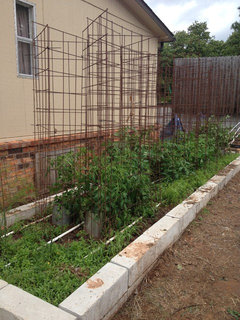
This is from 2015. We used 4" square CRW cut in 2' x 6' panels. We form a triangle and zip-tie the pieces together. We've got some extra pieces out in front that really need to be moved because the grass has grown up around them by the plum thicket. Got enough to share some with you! Hollah at me and come by sometime!
Wow...that bed looks so different this year. The asparagus (at the forefront of the pic) did well and I added walking onions there. And FINALLY got mulch in the walkways!
- 10 years ago
Not for Okiedawn to read!
I made a bunch of watermelon rind pickles and believe they might just be the best I've ever made. I make extra and give them away. My main customer is my doctor he is just like a big kid, when I tell him that I have worked up the garden he wants to know if I plan to plant any watermelons. When I go for an appointment I take him a jar or two and he get's big time happy & excited. He told me that his grandma used to make them when he was a kid and that he could never get enough of them. My neighbor say's that his grandma used to make them so I give him some of them too. He told me that he eats them for breakfast.
- 10 years ago
chickencoupe, that could very well be the problem with my okra, it grew slowly this year. It is blooming, just not very many okra pods. I have a lot of blooms now, hoping it starts producing.
- 10 years ago
lcdollar
Not looking like a bumper crop year, but we should be able to enjoy some while it's in season. I think okra might be daylight sensitive, decreasing production as the days grow shorter. Not sure.
bon Okiedawn OK Zone 7
Original Author10 years agoauthereray, I have no personal objection to you making watermelon rind pickles. They just aren't my thing, though I haven't made any or eaten any in years. I'm glad yours turned out so well.
lcdollar, If you have been having sporadic rainy, cooler spells, maybe they have interfered in the okra's flowering/setting of pods. Okra really runs wild when the weather is hot and dry, but can slow down if the weather is too mild.
Some varieties of okra are daylength sensitive, but I haven't had any issues with any of the varieties I've grown, at least not in the summer months. In the fall, as daylength begins to get pretty short towards about October, the plants do stop flowering and seem to just sit there, occasionally dropping a leaf here or there. It is a pretty clear signal they are through for the year. It is more obvious with some varieties than others, but eventually it gets them all. They stop producing in my garden well before frost arrives most years. And, of course, temperatures are falling as day length is shortening, so it may be the combination of shorter day length and cooler temperatures, especially nighttime temperatures.
Dawn
- 10 years ago
Thanks, Paula! I would love to stop by sometime!
A few things that interested me today.
I found two SVB moths in my garden this morning. It's the first time I've actually seen them in my garden in that form. I killed them. They moved rather slowly--it was weird. It was like they couldn't fly. Not sure if they are new moths or how that works. They are a pretty moth...but one that isn't welcome.
There were maybe 7 or 8 patches of squash bug eggs on the Seminole pumpkins. I scratched them off into soapy water. I never found a single adult bug though. However, they are ridiculous and have vined all over the place. One vine has made it to the just now producing summer squash bed. So...I'm guessing the squash bugs prefer the summer squash and that vine is like a convenient bridge for them. I found a few eggs on the summer squash and a few adults. Not many though.
My neighbor shared some leftover seed with me. I planted it WAY back in April, so can't remember exactly what it is. It's in the summer squash bed and the fruit looks like a yellow zucchini. The leaves are different from the other squash and very scratchy--maybe even too scratchy for the squash bugs as they've not laid eggs on those leaves.
I have the cutest perfect little tiny watermelon. It's a Rattlesnake (?) variety. Seeds were on sale last fall and I picked them up for like 10 cents. I can't remember exactly what it's called...but it's something Rattlesnake. My stuff (including seeds) is all over the place and difficult to find at the moment. Yay home remodel!
Beans and peas are starting to bloom.
Have quite a few grasshoppers. Saw a ladybug for the first time in a month on a squash plant of all things.
Tomatoes and peppers are hanging in there.
Who is starting the August Conversation thread? :) It's just few days away.
- 10 years ago
Dawn - who's starting the August Conversation Thread???? Um....I think that should be our Tomato Queen. You are just so darned eloquent at that....
And about the okra...this jewel was actually a transplant from Africa....as far as my research has told me...and it needs the extreme heat we have at this time of year. It's the one that produces when the tomatoes don't....
At my garden - cukes are choking!!!! I thought it was mildew. DH thinks it's squash bugs. What the Heck? Tomatillo's are doing well and the peppers are picking up. Sweet potato vines are looking promising as long as we water....and the Purple Hull Peas that we planted as a succession crop are looking promising too.
We've still got LOTS to talk about! What's going on in your late summer garden? Watch for the "August Harvest/Conversation Thread"!!!!
- 10 years ago
Okiedawn you said you didn't like watermelon pickles so I was trying to make a joke. Sorry, if I offended you. Is it the sweetness you don't like ? I only put some cinnamon sticks and a few whole cloves in the ones I make. I have seen them made with pickling spice and hot peppers, but I try to keep it simple. Again I apologize.
- 10 years ago
Peppers are picking up here too. I have one decent sized one, and several babies. Jalapenos moving right along. Eggplant looks like it's trying to stage a comeback from the brink of death. Maybe it's possible for it to be TOO hot for eggplant? Thinking I'll move it tomorrow. Pole beans are in, trying the plant-in-the-soil-bag thing. A little late according to OSU, but I'm feeling it's going to be a late frost. Bush beans will go in later in August. Yellow squash just hanging out growing. There's 6 tomatoes on the Early Girl and 3 on the Celebrity. The other 10 are trucking along, with the older ones starting to put out a few blooms (Sungold, Black Cherry, Royal Hillbilly). Cukes are resting, and I planted several more yesterday. Dill is RIP. Looking forward to starting greens and root veggies, but it's back up around 100* for us this week, so that'll just have to wait.
Dawn may be out at a fire. I'm sure she'll step up to the mike when she has time. - 10 years ago
Paula, your tomatillos are doing well? Mine haven't even made a single fruit yet. Hmmm...
Same thing as last year. :(
- 10 years ago
I just have to say that I'm amazed by plants that just keep going...despite aphids, squash bugs and SVB. They really want to live. My halloween pumpkins (I threw them in the garden last fall and they sprouted this spring) have been attacked by everything. I dug the SVB out, have killed the squash bugs, ladybugs have dined on the aphids--these things are still going. I doubt they are healthy enough to make fruit, but they're trying and at this point, I have to let them try.
I saw another SVB moth on the seminole this afternoon. However this one was fast. I didn't catch it. So...this is the 2nd generation? Need to read up on their life cycle.
I have missed my garden this year. It's an after thought almost. It's a jungle and very neglected, but it's growing stuff even though I'm not hovering over it. The only time I have, has been spent killing squash bugs. Found several adults tonight. Several young ones and several eggs. What do the eggs look like after the bug hatches? I'm only asking because on a couple of the leaves, there were eggs and very, very young squash bugs--like they had just hatched. I'm wondering if they were from the eggs on the same leaf.
Okiedawn OK Zone 7
Original Author10 years agoauthereray, I wasn't offended, I was joking back! So, no apology necessary. I don't remember why I didn't like watermelon rind pickles as a kid---maybe too much cloves, but I have a total aversion to both watermelon rind pickles and pickled beets so I avoid them at all costs. Maybe it was just that my young taste buds didn't like them, but I do not feel inclined to try them again at any age. (grin) I don't imagine they are all that different from the cinnamon pickles that I made last month, which are mostly just cucumbers, vinegar, sugar, red hots and cinnamon sticks, so maybe it is just the idea of eating watermelon rind that never has appealed to me?
Rebecca, If kept well-watered and well-fed, eggplants laugh at the heat. In the years I grew it (back when I thought that if I grew it and cooked it, I could convince my family to like it---and I was wrong about that!), even after I gave up in the midst of extreme drought and stopped watering the garden, the eggplant often kept on producing on no irrigation and no rainfall for weeks and weeks so I think it is pretty hot tolerant.
I have been busy with yanking out old plants, a very time-consuming task when the garden is a jungle and everything has grown together into a big mass of plants, with an occasional snake thrown in, and Tim is on vacation so we've been working our way down a long to-do list that has been interfering with my computer time! We did have a fire yesterday, but it was only a small one and I didn't go. I was standing by at the station and ready to take them drinks if they needed it, but it wasn't a long fire or a bad one. It was, however, a very smokey fire because wet, green grass was burning, which is an indication of how dry we are here, isn't it?
Hazel, My tomatillos usually don't start making fruit until sometime in August. Many, if not most (but not all) tomatillos are daylength sensitive so they don't start making fruit until the number of hours of daylight drop down to a certain point, which normally occurs in mid-August at my house. Mine have flowered since April, are constantly visited by bees but stubbornly refuse to set fruit until the day length gets short enough. I expect they'll start setting fruit within the next couple of weeks and, based on the size of the plants, there should be a lot of fruit.
After the squash bugs hatch, the eggs look the same for a day or so only with a hole at the end where the bug emerged. Sometimes they seem to sink in a little bit like a partially deflated balloon. If you saw eggs and nymphs on the same leaf, then the nymphs likely had just emerged from the eggs. I still remove the eggs and drop them into soapy water in case there is an egg or two left in the cluster that hasn't hatched yet. I've been really successful this year at finding and killing squash bug, stink bug and leaf-footed nymphs that have just hatched out that day. I spray them directly with Safer Insecticidal Soap. It doesn't kill them all, but the survivors (being young and stupid) only hide for a little while and them come back out onto the leaf surfaces and then I see them and spray them again. That is usually all it takes to kill the young ones. Old ones are much harder to kill. There's too many leaves now for me to search the back of each leaf for eggs, but I check the plants for nymphs daily with the bottle of insecticidal soap in my hand or sitting close by. Usually they all cluster together on the same leaf or two if they are newly hatched, so they are easy to spot and kill. I snip adults in half with a pair of scissors that I wear on a lanyard around my neck while scouting for pests each morning. Then, I go back out in the afternoon and check the same spot for any more survivors or any that may have hatched nearby.
If you have well-established squash plants, then this late in the season it is unlikely the squash bugs can harm them, but if you've got new plants started for fall, the squash bugs are a threat to the new plants. The best reason to control them now is to prevent them from building up a big population that will overwinter and get your plants next spring.
Since it is now August, I'm going to go start the August thread, so the garden talk can continue into a new month.
Dawn
- 10 years ago
My okra just put it into gear and started producing like crazy ..... it was like a switch was thrown. Now I'm gonna have to cut it daily to keep up.
- 10 years ago
Everyone around here says the same. Okra just took off. My sister called this morning and she just got here first good picking??? Who knows, it's Oklahoma.
Okiedawn OK Zone 7
Original Author10 years agoOkra has behaved oddly in most of Oklahoma this year. It seems like every year there is something that reacts oddly to whatever weather we're having, and this year it appears that it is the okra.






Okiedawn OK Zone 7Original Author