

"Cuor di Bue" AKA Oxheart Tomatoes - problem?
Hello,
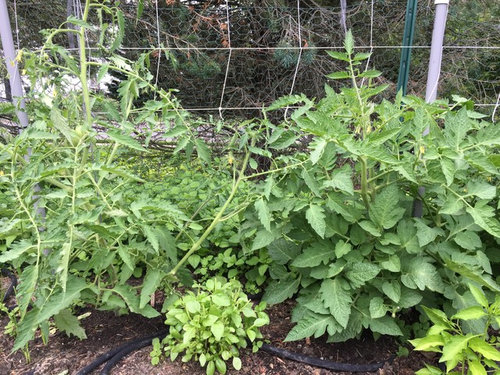
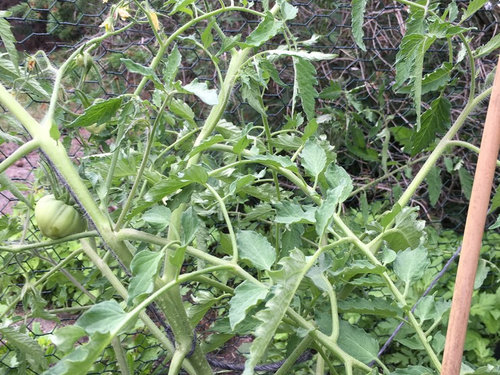
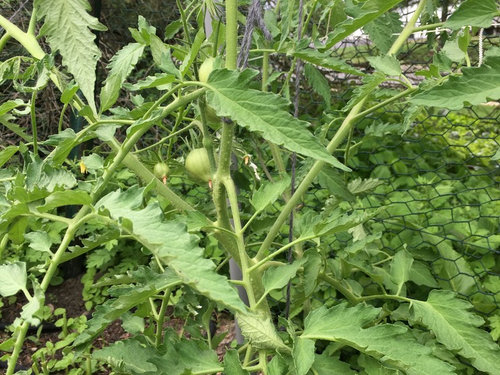
I've planted San Marzano and Cuor di Bue tomatoes and both seem to be doing OK, the oxhearts in particular got fruits before the Marzano inspite of looking a bit spindly. I am wondering if there is an issue with the oxheart plants or is it just not as leafy as the Marzano? (See pictures - the side by side really shows the difference). The leaves for the oxheart seem to curl almost all the time...
Oxheart on the left, Marzano on the right of the small basil...
A couple more pictures of the Oxheart plants:
Comments (19)
 10 years ago
Your plants look fine. I have grown Bull's Heart and San Marzano Redorta for a couple of years now and found both have weird leaves but produce great tomatoes. I read somewhere heart shaped tomatoes commonly have a "wilt" gene.
ss1114 thanked UserRelated Professionals
Madison Landscape Architects & Landscape Designers · Chambersburg Landscape Architects & Landscape Designers · Gloucester Landscape Architects & Landscape Designers · Eau Claire Landscape Architects & Landscape Designers · Platteville Landscape Architects & Landscape Designers · Odessa Landscape Architects & Landscape Designers · Logan Landscape Architects & Landscape Designers · Forrest City Landscape Contractors · Terre Haute Landscape Contractors · Toms River General Contractors · Beatrice General Contractors · Manhattan General Contractors · Altoona General Contractors · Grand Junction General Contractors · Cornwall General Contractorsss1114
Original Author10 years agoThanks. Any estimates on the timeline from fruitset to harvest for Oxhearts/Marzano? This is my first time ever trying to grow anything. And I grew these from seed starting April 2nd. I'm terrible at waiting :)
 10 years ago
The answer is always "longer than you want". ;)
Tomatoes are ready when they're ready. Best to think of them that way, or you'll drive yourself insane. There are just too many variables involved in real-world DTM, including the specific conditions in your garden, down to the specific locations in the garden where you've planted the tomatoes.
But comparatively speaking, most people report that hearts are mid-early, i.e., behind "early" varieties, and earlier than one would expect for tomatoes of their size. Of course, that doesn't help you with exact dates. It just means you'll most likely have them before things like Brandywine and other late varieties.
San Marzano is supposed to be "midseason".
Of course, things may not work out according to expectations in your garden. This is why tomatoes are an exercise in patience and acceptance.ss1114
Original Author10 years ago"This is why tomatoes are an exercise in patience and acceptance."
Very true. And this first time attempt at growing anything has been quite the lesson. But have to admit I have enjoyed the process, in spite of my impatience. Now that I can actually see the "fruits of my labor" ;), I just cant wait to taste them! But I guess I should wait until they ripen. And I need to put out some bird bath type things next to my raised bed. The birds seem to love perching the trellis I set up - would hate to see them peck away at my tomatoes before I get a chance to eat them!
- 10 years ago
The birds are probably earning any tomatoes they ruin by ridding the garden of pests. I'm using trellises this year, and the birds love to hang out on them, but not to eat any tomatoes; it's a great perch for spotting juicy bugs to eat. I haven't seen a single bug larger than an aphid on any of my tomato plants so far this year.
But, yes, leaving water out works. You might get a peck or two on red tomatoes in the beginning. They seem to be attracted to the color but I guess they discover that don't actually like the taste.ss1114 thanked gorbelly ss1114
Original Author10 years ago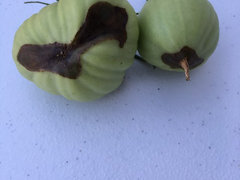
I guess this is what's called Blossom End Rot? I tried to be as consistent as possible with watering but was a day late this week, maybe that caused it. Or maybe its a calcium thing. I did fertilize a week ago with Tomatotone which supposedly has calcium. With the daily 90+ temperatures these days I'm thinking of switching to watering every 3 days instead of twice a week, where the occasional interval goes to 4.5 days. Not happy about the first tomato I took off a plant to be discarded. But I guess I have to be patient.
- 10 years ago
Yes, looks like BER. One missed watering won't cause it. Calcium deficiency is unlikely, as most soils have enough calcium, and the TomatoTone provides it anyway. It's an internal nutrient transport problem, sometimes caused by uneven watering (too much watering can be a problem, not enough, too frequently but too shallow, etc.). It can also just happen on early tomatoes and then stop as the plant "grows out of it", probably because the size of its root system increases.
I usually dig down into my beds to check moisture levels before watering. Be sure that you only water when you need to and that you water very deeply. This stimulates plants to send roots down deeper so that fluctuations in available water are minimized. If you water more frequently but shallowly, you encourage a shallower root system which is more affected by variations in available water.ss1114 thanked gorbelly - 10 years agolast modified: 10 years ago
Oh, one more thing: remember that "consistent available water" to your plants is not the same thing as "consistent watering schedule" to a human. Nature doesn't follow our schedules. You need to take into account rainfall, humidity, temp, and other conditions, in addition to what kind of soil you have, what species of plant you're talking about, etc. Sometimes, you may need to water more often. Other times, especially in our climate, plants may go for a long time without needing any supplemental water. Watering on a set schedule is a great way to produce uneven available moisture for the plant, especially on the too-much-water side. Aside from when they were young and establishing roots after being transplanted out, I've only watered my tomatoes about 3 times this year (not including applications of liquid fertilizer, which I do after rain so I don't really think of it as watering). And to be honest, I probably didn't need to water at least 2 of those times--like everyone else, I have an irrational nervousness about not giving my plants enough water, and I give in to that sometimes. I'm in the Philly area, so while I haven't had exactly the same rainfall as you, it's probably similar.
Most gardeners eventually develop a sense for when their plants need water. Some even go by wilting and don't water until their plants are wilted in the mornings (afternoon wilting in hot weather can be normal). I tend to second-guess myself, so I dig down into the beds to check moisture levels under the surface. I have a loamy clay soil, so it holds moisture well, and this year, I have never needed to dig down more than 2 inches to find moist soil. Conditions may be different in your beds.
ss1114 thanked gorbelly ss1114
Original Author10 years agoI try to check for dampness in the soil before watering, and usually find it dry 2 inches below. Soil definitely a lot of clay - my backyard was leveled out with a retaining wall by the previous owner and seems to be very clay heavy. I believe that's one of the reasons why I have to turn off my soaker hose after about 30 minutes - I start getting puddles on the surface. The puddles drain in a few minutes though, so not that bad...
But I will keep your advice in mind going forward as well, and try not to water unless I'm sure its required.- 10 years ago
I get puddling, sometimes, too, especially if the surface of the soil has been dry. I poke tiny holes in the bottom half of a large plastic bottle (milk bottle, large soda bottle) and sink it into the ground near my tomato plants when I plant out. Once the plants get large enough that their roots are deep and wide enough, I water into the bottle in addition to/instead of watering the ground. This helps delivers water more quickly and efficiently down under the surface. I don't have tons of plants, so this works well for me (I don't have a big enough garden to merit an irrigation system), although I actually may try clay ollas (or at least the cheaper DIY versions) next year. Ollas are generally thought of as solutions for drought areas, but I think they could be useful in many places and to address issues like soils that are slow to let water permeate down.
ss1114
Original Author10 years agoYep I like the bottle or milk gallon idea but did not learn of it until well after planting. I would do a lot of things differently now but there's always next year!
- 10 years ago
It won't make or break your plants. Just makes it easier and faster if you're watering by hand. In the past, I'd have to water very slowly to make sure it was sinking in instead of running off, which is annoying and time-consuming if you're doing it by hand.
ss1114
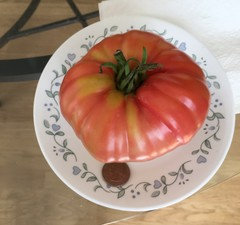
Original Author10 years agoFirst ripening tomato ever! I took it off the plant yesterday and its still got a bit to go before I can eat it I think. But I couldn't wait any longer. Are Cuor di Bue Tomatoes supposed to be tender? Even though its not fully ripe it doesn't feel very hard, a bit soft. The green ones are rock hard though...
- 10 years ago
Nice tomato, congratulations! Most of the heirloom and open pollinated tomatoes I grow are on the squishy side... You could let that one ripen on the counter for a few days but keep an eye on it.
ss1114 thanked User ss1114
Original Author10 years agoThanks for the input Rhoder551. I was starting to think whether I had done something wrong. It was delicious, but a bit squishy for sure. Very thin-skin that almost peels off on its own when slicing. You can see why they are called Oxheart when you slice them!
The biggest one has now started to turn red - bigger than a softball, wish I had a scale to weigh it!
- 10 years agolast modified: 10 years ago
You can see why most of the tomatoes sold in the grocery store have been selected to have thick skin and hard flesh. Any of the squishy tomatoes I grow would not survive all the handling and transporting involved in getting a tomato to the store for sale.
- 10 years agolast modified: 10 years ago
I would eat the first few at different stages of ripeness when trying an unfamiliar variety. Different varieties have different points when their flavor is best. Personal preference has a lot to do with it as well.

hoosier40 6a Southern IN