Software
Houzz Logo Print
lone_elm_z6

Pagoda Dogwood in full sun

10 years ago
last modified: 10 years ago

I put a Dogwood in full sun last spring. Apparently it is understory naturally. Seems to be content so far. If I keep a permanent wide mulch circle to insulate the shallow roots will that give me insurance for all the sun it will get? How sensitive are these to drying roots? I always forget -- clay, Leamington, ON

Comments (24)

  • 10 years ago

    I've seen them growing wild here in open low-ish grassy areas. You should be fine with the mulch.

    tj

  • PRO
    10 years ago

    yes, I wouldn't worry about it unless it starts showing some sign of stress.

  • 10 years ago

    Agree with ^....a shade-tolerant species that can still handle full sun......but not dry, baked soil.

  • 10 years ago

    Almost drowned my Pagoda Dogwood (which is in full sun) yesterday. Placed the sprinkler facedown on low under the tree, turned it on at ten, remembered at one that it was still on. Mulch was practically floating.

  • 10 years ago

    "I've seen them growing wild here in open low-ish grassy areas. "

    Learn something everyday. They grow wild here, but I've never seen an open grown PD. Are they more bushy, or do they show the classic sympodial habit I see in moist woodlands?

  • 10 years ago

    That is too technical for me, lol. I can post a picture tomorrow.

  • 10 years ago

    Technical? Me? Now that's something I've never heard before.

    It simply refers to the branching habit that gives it the "pagoda" look. Trees I see in open settings are usually more...full (i.e. bushy).

  • 10 years ago


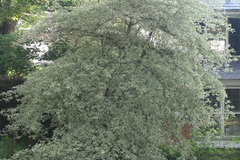
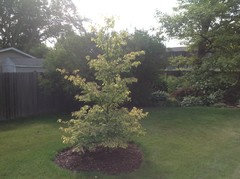
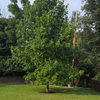
    Not the easiest tree to photograph. This is the variegated form in a sunny spot. Never any damage to the foliage from the sun. The habit is bushy and dense. We've all seen pagoda dogwood with the layers of branches which make it so interesting. That's not the case here, maybe because its the variegated clone.

  • 10 years ago

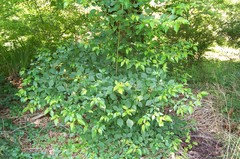
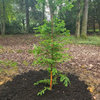
    A volunteer PD in shade (gets a few hrs of early morning sun). Already starting to show the layering effect -- first layer lies on the ground:

  • 10 years ago

    Maackia, the definition I looked up was far more technical than branching habit. lol My pagoda has the horizontal branching.

  • 10 years ago

    @maackia- The open grown ones I've seen still kept the pagoda look, but they were somewhat denser. Certainly a factor of ample moisture with abundant sun.

    tj

  • 10 years ago
    last modified: 10 years ago

    Sam, that's quite a variegated specimen. I've seen precious few and none even close to that in size. I agree, it doesn't have the classic form, but I'd take it. How much direct daily sun do you think it gets?

    TJ, I suspect the open grown trees you see grow in heavier, moisture retentive soils. I guess you said that in so many words. It would be a very short lived tree in our sand.

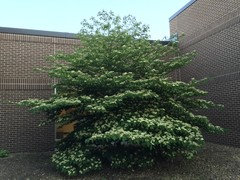
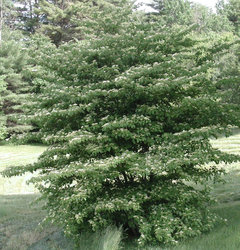
    Here's a PD on the campus of St Cloud State U. Ugly building; nice tree.

  • 10 years ago

    maackia -- nice specimen. The berry display later on should be just as nice.

  • 10 years ago
    last modified: 10 years ago

    Golden canker is pictured here This kills interior and lower branches of PD. It is a serious threat and can kill the whole tree. The branch should be removed and burned when found.

    Maackia, the variegated tree in my pic is somewhat sheltered by the house. The owner cut the top out of the tree several years ago and it thickened up as a result. It is normal for the white to turn pink.

  • 10 years ago

    Indeed, most dogwoods can canker up when stuck in a too-hot or too-dry situation for too long. Nevertheless, right outside my office is at least one very nice pagoda in full, blazing sunlight. So I know it can work.

  • 10 years ago

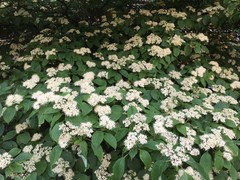
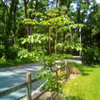
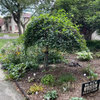
    This is my pagpda.

  • 10 years ago

    Sam, thanks for the reference to Golden Canker -- my smaller PD (not shown above) has had that on a few stems. Didn't know what it was, but instinctively cut off those infected, dead stems. Fortunately it hasn't been serious so far.


    Deb, your PD looks like it's variegated -- is it? Might just be the sun....

  • 10 years ago
    last modified: 10 years ago

    Sam, I also appreciate the info on golden canker since I see it on some of the wild growing trees.

    Here's an open grown one, multistemmed, that was already growing here when we bought the place. The voles seem to particularly enjoy dogwood roots, and have so far killed this pagoda and another pagoda, a variegated shrub, and are trying with at least one Kousa and another two pagodas. I have given up trying to grow dogwoods until I find a way to reduce the vole population.

    Although the photo shows it in shade, that was only for a couple hours very early morning before it spent the rest of the day in full sun. In winter, the tiered branches showed more than when it was fully leafed out due to the multiple stems.

  • 10 years ago

    beng12, I think it is variegated. What concerns me is the ends of the leaves turn black. I wonder if it is caused by too much sun?

  • 10 years ago

    Dang, Golden Canker. It sometimes seems as if every native has a designer disease. If ignorance is bliss, I wished I hadn't learned this.

  • 10 years ago

    terrene, who I haven't seen post here recently, has an effective vole deterrent: castor oil and urine. Seriously. She's on the New England Forum and I believe she just posted the "formula" recently, again. She's no blowhard, and if she says it wo rked I believe her.

  • 10 years ago

    I've opted out of the native, and instead grow giant dogwood, C.controversa, which is not prone to canker. Larger in all parts and more tree-like than pagoda, and will stand in full sun in TN. Just about impossible from seed though.

  • 10 years ago
    last modified: 10 years ago

    NHBabs, I've reduced mole/vole problems by continuously stamping down the soil around seedlings/saplings until it's rock hard & then they avoid those areas. Prb'ly not good for those trees initially, but better than roots being dug up by the critters.