Software
Houzz Logo Print
debby_1

Peach problems.

10 years ago
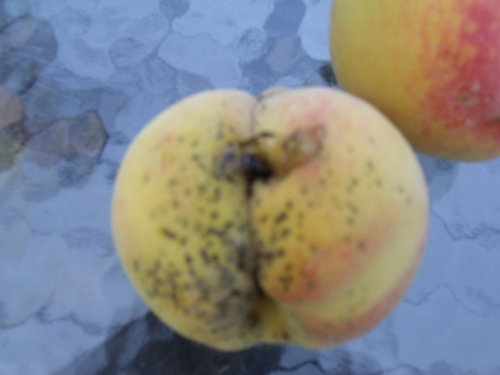
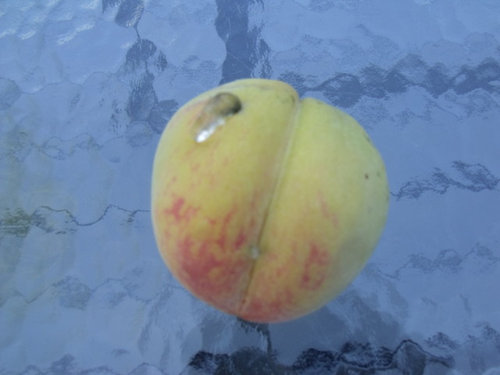
Can anyone tell me what is causing this? The tree has always had problems with oozing gel. What can I do to correct this?


Comments (5)

  • 10 years ago

    The gel is pectin. Something made a hole in the peach, possibly a bug burrowing in. You should look up peach pests in your area. I know the East Coast has to deal with plum curculio and oriental fruit moth

  • 10 years ago

    We have one tree that has peaches that look very similar. I notice the spots are mainly toward the top of the fruit.

    I found this info at Clemson university:

    Peach Scab

    Peach scab, also known as "freckles", is caused by the fungus Cladosporium carpophilum.
    Disease symptoms occur on the fruit as small (less than ¼ inch in
    diameter) velvety dark spots and cracks. In cases of severe infection,
    spots may join together to form large dark lesions. Leaf infection is
    usually not observed. Twig infections occur on the current year's growth
    and are light brown after 30 to 70 days, before later enlarging and
    becoming dark reddish brown the next season. Spots on the fruit only
    occur on the outer skin. Peel fruit to remove all traces of the disease.


    There's more info at http://www.clemson.edu/extension/hgic/pests/plant_pests/veg_fruit/hgic2209.html

    Clemson has a really good website for peaches.

    My peach problem looks more like yours, but perhaps it is a matter of being the early stage. But you might have two problems going on there.


  • 10 years ago

    I can't see the picture clearly, and you're not clear on where Gell is coming from, tree or fruit?

    Assuming you mean the tree shoots as well, I had lots of problems with this as well. The cause was from OFM, Moth worms digging into the tree and fruit. Lots of jelly and oozing, quite gross. Treatment is a pain in the ass, several applications of pesticide through the year.

    Can't see the picture, but the dark spots might be insects like stinkbugs punching holes in the fruit.

  • 10 years ago

    Here is a comment made on this website regarding your problem from May 2010. You may find it helpful:


    jellyman(6/7VA)

    Digdug:

    I believe your peaches have peach bacterial spot, although if you Google this term and "peach scab", you will find the two diseases difficult to distinguish. After years of wrestling with this distinction, I more or less concluded that bacterial spots are usually spread farther apart, as yours are, often beginning on the lower part of the peach, and are darker in color. I believe that peach scab usually begins at the top of the peach near the stem, then spreads outward, eventually forming a solid mass.

    I have had both of these diseases many times, and both are highly damaging to peaches. Yes, you can still eat them, but it's not much fun to do so, since you cannot even properly peel a peach with either of these diseases, which often affect the flesh to a depth of 1/4 inch or more. Many people peel peaches before eating, and peeling is standard procedure before freezing peaches, which is what happens to most of ours. While it is very important to try to prevent even minor damage to the fruits, in many cases the scab or spot spreads and stops growth of the peaches which of course is even worse.

    I wish you would not require us to guess where you live, but from the size of those peaches I have to guess somewhere in the coastal or interior Southeast. The rainy spring weather and early warming of the entire mid-Atlantic favors both of these diseases. Once these diseases are established on peaches, there is nothing to be done, since prevention is the key here, not cure. Application of bleach would be very unwise, and sulfur would not help at this point either. In fact, I believe sulfur to be useless against these diseases at any stage.

    Bacterial spot can also infect the leaves of peach trees, causing them to spot, turn yellow, and eventually fall off. The disease is also expressed by lesions on the limbs and twigs that exhibit sap leakage. Three or four years of unchecked bacterial disease can easily kill a peach tree. I have had pretty good luck with control of bacterial disease by applying two dormant sprays of a strong copper product called Kocide. Applications should be made in late fall, and again just before bud break.

    The most effective preventative that I have found against peach scab, which you will also no doubt see sooner or later, is a good spray of Daconil fungicide immediately after shuck split, and another around a week later while the peaches are still very small. I have tried other fungicides, including Captan and Topsin, and they do not seem to work for me. No spray will be effective once the peaches begin to size up, because the diseases are already there, though you cannot yet see them.

    You don't mention the variety of peach you have there, but most modern peach varieties are bred to color up red well before they are soft ripe, and can hang on the trees for over two weeks while bright red and still not be soft and sweet enough to pick. Commercial growers have discovered that consumers prefer bright red peaches, but still need a hard peach to ship. Truth be told, many yellow peach varieties taste much better than the highly colored reds. Color is not a good indicator of flavor.

    Finally, if keeping the "organic" faith is more important to you than growing good peaches, I doubt that you will ever grow decent peaches. There are some places in the country, mostly those that see warm dry weather during the growing season, that could pull off an organic peach, but not many of them are east of the Mississippi river. And so far we have talked only about diseases, not insects like the plum curculio and oriental fruit moth, which are normally present in the same areas that suffer from disease. Nor have we discussed brown rot, which often strikes later in the season. For the backyard orchardist, growing peaches is quite difficult, requiring all the help available from timely use of fungicides and insecticides.

    Don Yellman, Great Falls, VA

  • 10 years ago

    Thanks everyone for the help. We live in the southeast Ohio area near the river. We planted this tree about 12 years ago and a couple of years after that, we had a small hatching of cicadas. They got it pretty good. It has always had this problem. While I like the idea of organic, I would just like to have something that won't kill the pollinators. Is there a timing schedule that would help with that. I think we may have to cut this one down and replace with another. Would it be a problem to place in the same area? The ooze seems to be on the peaches themselves, but the I've never noticed the trunk. The limbs don't seem to have the problem. Thanks again.