Software
Houzz Logo Print
bostedo

Two years before the grass

10 years ago
last modified: 10 years ago

We've wanted to give buffalo grass (Buchloe dactyloides) a try in place of the St Augustine (with a trace of Bermuda) in our small backyard lawn once the declining shade trees came down. It was highly recommended to spend a good portion of a year when feasible making sure the old turf really is dead and gone - especially where Bermuda is involved. So, we turned off the sprinklers and lightly solarized almost all of the turf by mid-summer 2014.... before realizing scheduled home repairs would have contractors rolling around much of the backyard into 2015.... oops. What we decided to do was just let any forbs not recognized as obnoxious "weeds" grow and continue to pull or spot treat (with glyphosate) the turf or weed grasses as they reappeared. The following photos are a walk through these adhoc transitions.

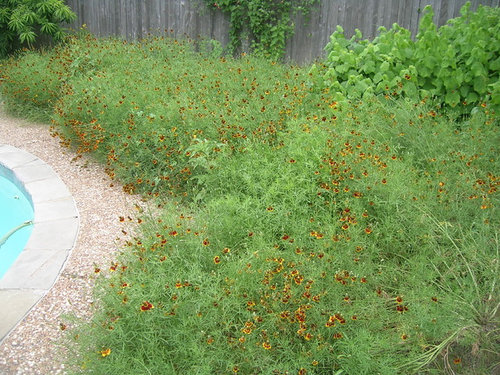
Forbs and vines established by September 2014 included various morning glory/bindweed, honeyvine (Cynanchum laeve), scarlet sage (salvia coccinea), and the blue wild petunia (Ruellia nudiflora). The Mexican hat (Ratibida columnifera) and Turkscap (Malvaviscus arboreus) were natives that escaped from the borders. American germander (Teucrium canadense), Whitemouth dayflower (commelina erecta), Texas dandelion (Pyrrhopappus pauciflorus), and clasping Venus's looking glass (Triodanis perfoliata) were some of the others that appeared at some point, but not clearly visible at the time of this photo. The pepper plant was a critter gift from the compost pile and yielded well:

By mid-May 2015, scions of our two Barton Springs Nursery Ratibidas had largely taken over the bare clay (they were not nearly as aggressive when there was turf) :

Right after this mid-June 2015 photo, we cut them down before the seeds could set:
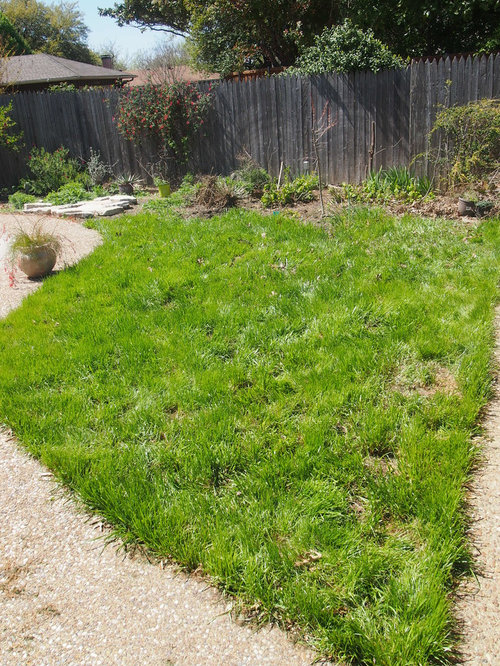
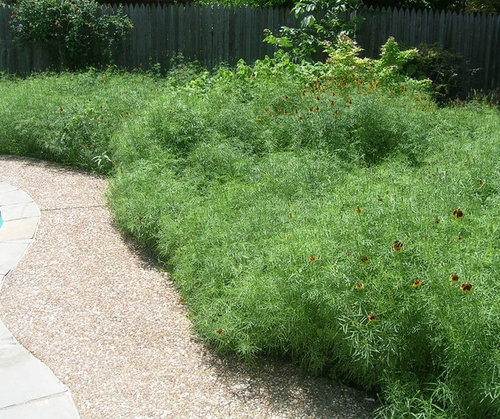
The Ratibidas are such hardy tap-root plants, they served as a sparse fern-like ground-cover after mowing until we tilled them under (or out) and seeded with annual ryegrass in the early fall 2015 for cover over the winter months. Ryegrass appearance was in decline by the time we tilled it under as (sort of) green manure right after this photo in late March 2016:
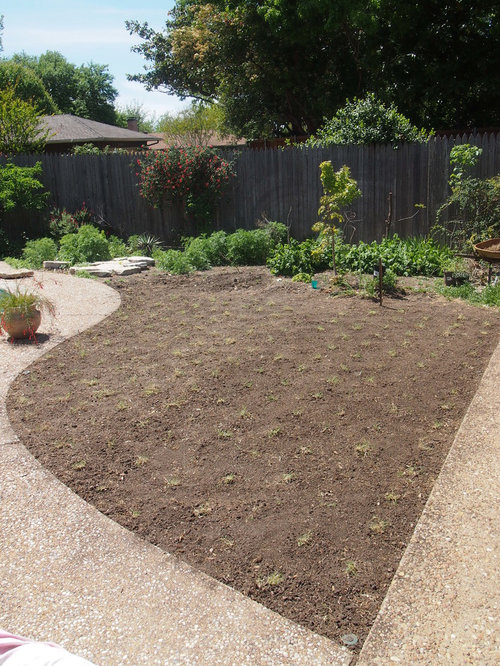
Would have wasted too much sod on this small area with a pallet as the minimum order size, so went with three trays of 'Prestige' plugs at 12" spacing. Would not want to do a larger space this way - or another small one without better weed prevention. This was just after being plugged on April 5th, 2016:
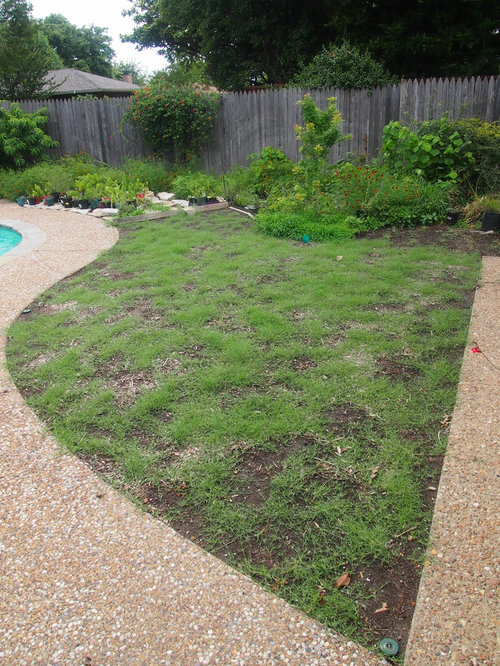
Several sources said to apply a pre-emergent, but the product instructions said not to use on fresh plugs. So made a wimpy compromise and applied a half-strength dose which didn't do anything for the dusting of crab/dallis/??? grass seeds our pots and bare soil had received. Would not make that mistake again. Not sure we would have had the time to keep ahead of the grassy weeds in a much larger area. The whole space was covered like this at about five weeks:
It was close to eight weeks (6/1) before the plugs broke dormancy and really started filling in:
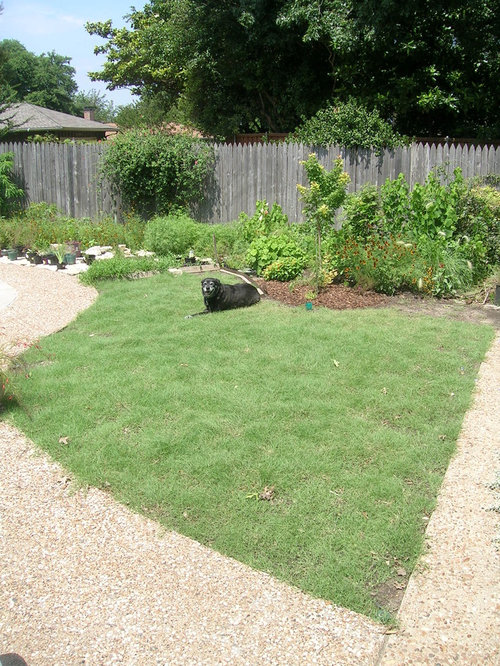
Was dog approved at week ten:
And well filled in by week twelve... which was the grower/nursery estimate:
Obviously too soon to tell how it will do year-round, but so far really like the texture and its natural sculpturing that moves with the wind. Probably still at least a couple weeks off from the first cut. Now on to the neglected borders.....

Comments (12)

  • 10 years ago

    I really enjoyed seeing the transformation! The buffalo looks so pretty and soft!

    bostedo: 8a tx-bp-dfw thanked PKponder TX Z7B
  • 10 years ago

    Nice! Thank you so much for sharing, I've always been interested in buffalo grass, but never saw this kind of step by step of switching over. Very cool!

    bostedo: 8a tx-bp-dfw thanked User
  • 10 years ago

    I love to see grass, hope this does extremely well for you. Thanks for taking us through the steps................very interesting.

    bostedo: 8a tx-bp-dfw thanked carrie751
  • 10 years ago

    It seems like wild Bermuda grass has always found its way into every buffalo grass yard I've seen. Has it been a problem for you?

    bostedo: 8a tx-bp-dfw thanked bjb817
  • 10 years ago

    Thanks for the comments. Our son's dog really does seem to find it much softer/nicer to lie on than the St Augustine, ryegrass, and especially the ratibida shoots that endured the contractor traffic.

    Forgot to include a link to the most helpful and realistic buffalo grass overview I found: The Benefits and Challenges of Using Buffalograss (OSU). It references these Instructions for Installing Buffalograss Plugs that address weed control... which I didn't exactly follow, but would on a repeat. We did go with a different root dip (Organic Plant Magic) that was suggested in the nursery's (HCG) instructions.

  • 10 years ago
    last modified: 10 years ago
    Bressler, Virtually all of the original Bermuda in our backyard had been killed off by years of dense shade and we had 18+ months to deal with any possible survivors in the brighter edges - we're as sure as we can be that it's Bermuda free. It's also surrounded by concrete and/or heavy shade, so not much chance of rhizome infiltration from outside. The similar appearance would make it hard to detect early, but am hopeful we can keep it out. Front yard would not be so easy since some Bermuda endures within both our and our neighbors' St Augustine.

    Seems cutting off the water and letting the buffalo go brown early could enable you to spot treat any greener Bermuda patches as long as it's caught soon enough. Should also be able to notice any with their earlier green-up in the spring. Hopefully pre-emergents will deal with any wild seed that manages to blow in.

  • 7 years ago

    Thank you so much for posting this bostedo!

    bostedo: 8a tx-bp-dfw thanked memetexas
  • 7 years ago

    I don't remember seeing this before. What a beautiful outcome! And it's very interesting to see the process you went through to get it going!

    For our more southern climate we plugged in Floratam St. Augustine for our small grass space several years ago. It is as sun and drought tolerant as Bermuda, but is somewhat cold tender. However, the last couple of winters were the first time in the eight or nine years we've had it when we had quite a bit of die back due to sudden cold snaps while it was still green. Bermuda filled in early, and thankfully enough of the very vigorous Floratam survived to smother most of it by mid summer.

    Brown spots from dog urine is a problem with any grass. I just sigh a little and try to look the other way ...

    bostedo: 8a tx-bp-dfw thanked roselee z8b S.W. Texas
  • 7 years ago
    last modified: 7 years ago

    Roselee, Our 'Raleigh'/'Palmetto' St Augustine front lawn has not responded well to my attempts to harden it to one deep watering per week max. I prepped a damaged section with herbicide that I was hoping to patch this spring with the new 'Tamstar' you've mentioned before, but it's still having supply problems. At this point, I'd plug the "dead zone" with 'Floratam' if it were sold this far north. Am confident we'll eventually have some sort of drought tolerant/low water use yard.... and still rooting for lawn over stone.

    Would like buffalo grass (BG) in the sunny sections of the front, but the remaining traces of the original Bermuda grass in our turf, need for an additional hard edge against our neighbor's St Augustine/Bermuda, and the considerably more prominent dog urine damage dissuade me from more than a little experimentation for now. The photo of BG urine damage I posted previously shows it at its least noticeable during active growth. As the BG starts to go dormant, the damaged spots don't recover and the lawn begins looking much worse - I never thought to take a photo...well, because it just looked so bad. St Augustine will occasionally show a bit of urine burn, but is significantly better than BG at tolerating those concentrated N blasts from our female K9s.

    One other confirmation of this relative pet "weakness" is that the source of our BG plugs now offers a hybrid Bermuda as their Dog Tuff product - though I'd still prefer the BG in our back yard.

  • 7 years ago

    Based on my experience (so I don’t make this a golden rule), Zoysia grass grows greener where the dogs pee.


    Omar

    bostedo: 8a tx-bp-dfw thanked Vulture61
  • 7 years ago
    last modified: 7 years ago

    Omar, Good to know.... the "dead zone" could be a great opportunity to give 'Palisades' a trial. Will look into it. Thanks.

Sponsored
Peabody Landscape Group
Average rating: 3.5 out of 5 stars8 Reviews
Columbus' Reliable Landscape Design & Contracting