Software
Houzz Logo Print
evd10

Thinning tomato clusters

10 years ago

I have a Goliath plant which has ten or more small fruits (marble size) in a cluster. I am thinking that some of these small fruits should be removed so the are only four or so fruits left in the cluster and am wondering if there is a best way to do this?

Comments (15)

  • 10 years ago

    What is your goal, your reason for doing so? Normally folks only do it if they are trying to grow especially big tomatoes for competition. In my experience with Goliath is commonly sets 6-8 fruit on a single cluster and they do fine. They don't all ripen at the same time anyway so you'll be removing some while the others are still green.

    That said if you don't care about the lost production then snipping them off just above the sepals with a sharp set of scissors should work.

    Dave

  • 10 years ago

    This is my first year with Goliath and I've never had so many fruits in a single cluster in any of the other varieties I've grown. I thought that they might not grow to normal size with so many fruits in a cluster. I think I'l take your advice and leave them alone an see what happens.

  • 10 years ago

    Like Dave said, why would one want fewer tomatoes ? I would want as many as possible.

    OTOH , the ones towards the end of cluster will smaller and will ripen later. But by not thinning you should get more tomatoes by the number and weight.


    Sey

  • 10 years ago
    last modified: 10 years ago

    Actually, thinning overly populated tomato trusses can be beneficial to total tomato yield if long term crop is your goal. Especially if you prune to one stem, keeping a good continuous vegetative growth of the plant while producing is key, and too many tomato on lower trusses will definitely slow a lot that growth, which will return only after harvesting some of the tomatoes. So this way you basically have a 'hole' in your production period, and the total yield per plant will be less. Which is why most hybrids have actually a low number of flowers per truss. Look at the popular Big Beef, about 5-7 flowers, compared to older beefsteakes that make 20+ on first trusses easily (of course, not all set, but sometimes in right conditions you can get 10+ fruit which will totally stunt the plant to about 2 trussses that actually produce). Goliath should be about the same as Big Beef, those huge trusses must be an anomaly.

  • 10 years ago

    Isn't pruning to one stem a particular case, though? I would personally not treat my largely unpruned plants according to the principles used by people growing tomatoes on single stems.

    And what do you mean by "long term crop"? In my in-ground, outdoor plants that I allow to develop vegetative growth largely unrestricted, I want as much fruit set as possible with few exceptions since the growing season is only a few months out of the year and some of that period will involve low fruit set due to high or low temps, etc. Maybe considerations are different for other climates or in greenhouses? But these are not the conditions of most hobbyist growers.

    I find that, when you don't engage in extreme pruning, tomatoes continue to pump out both fruit and vegetative growth as long as you feed them well and temps remain in a good range for fruit set. If they set too many fruits too early, the plant just stops developing some of those fruits. Doesn't stop fruits from setting higher up. Doesn't stop vegetative growth.

  • 10 years ago

    evd10, did you grow your plant from seed, or did you purchase the plant? I was wondering if maybe you got a "Cluster Goliath", which is bred specifically to produce large clusters of tomatoes in the 5 oz range. Goliath is a family of different F1 varieties, from what I understand, correct?

  • 10 years ago

    I was given the plant by a friend. I'm assuming he started it from seed as he usually does. I have other Goliath plants from him, but they are not acting like this one particular plant. I think I'll just let it be and see what happens. My other plants should produce more than enough tomatoes for my needs.

  • 10 years ago
    last modified: 10 years ago

    If it's just the one cluster and there are others behaving normally, I'd just chalk it up to a fluke on this plant. If all clusters are behaving this way or this is the first and only cluster that has set fruit, I would keep my mind open to the possibility that there was a seed mixup or mislabeled plant and you have a different variety that is supposed to behave this way. Perhaps a cluster tomato or even a cherry tomato. Mixups happen all the time, even to careful gardeners. They can happen through mislabeling plants during growing or seed mixups/stray seeds at the seed source.

  • 10 years ago
    last modified: 10 years ago

    " If they set too many fruits too early, the plant just stops developing some of those fruits. Doesn't stop fruits from setting higher up. Doesn't stop vegetative growth."

    Ripening tomatoes contain ethylene that maybe leaks into the rest of the plant. Too much ethylene causes leaf senescence. See

    http://jxb.oxfordjournals.org/content/53/377/2039.full

    https://en.wikipedia.org/wiki/Plant_senescence

    I once pinched off all of the flowers from an indeterminate tomato plant until August, after which, it produced many red tomatoes at the same time, stopped growing and died before the first frost. I suspect that too much ethylene from the ripe tomatoes killed the plant.

  • 10 years ago
    last modified: 10 years ago

    aruzinsky: Ripening tomatoes contain ethylene that maybe leaks into the rest of the plant. Too much ethylene causes leaf senescence.

    I don't think evd10 is having a problem with leaf senescence? And one large cluster early in the season is 1) probably not going to ripen all at once, although I suppose it's possible if the plant is bred for it, and 2) almost certainly not going to produce so much ethylene from one or two clusters that the plant would be overwhelmed. I guess maybe in the case of a crazy mutation. Or radical human intervention, as with your experiment. But established varieties seem to have no problem simply stopping fruit development if the effects or demands get too overwhelming for the plant.

    aruzinsky: I once pinched off all of the flowers from an indeterminate tomato plant until August, after which, it produced many red tomatoes at the same time, stopped growing and died before the first frost. I suspect that too much ethylene from the ripe tomatoes killed the plant.

    Not sure we can extrapolate from this very artificially produced special case to evd10's question. It's an interesting theory, though. However, it seems like any number of things could possibly have killed the plant, especially at that point in the season. Would be interesting if you could repeat the experiment in a controlled indoor environment. I would hesitate to call it "senescence", since tomatoes are technically perennials in their native habitats. I would think it was just massive stress.

  • 10 years ago
    last modified: 10 years ago

    "I would hesitate to call it "senescence""

    But, the leaves of tomato plants naturally die of old age and, it is well known that spraying Ethephon, an ethylene imitator, hastens the process. See

    https://kb.osu.edu/dspace/bitstream/handle/1811/56175/OARDC_HCS_0408.pdf?sequence=1

    and note

    "Ethephon not only promotes fruit ripening but initiates aging and senescence of leaves."

    "I don't think evd10 is having a problem with leaf senescence? "

    Neither do I, but an intermediate result of having a larger number of ripening tomatoes is slowed growth of the rest of the plant and ethylene probably has something to do with it.

  • 10 years ago

    Thanks for all the responses, but I think gorbelly got it right. I think that this is probably a cherry tomato plant that I'm dealing with most likely as a result of a mixup.

  • 10 years ago
    last modified: 10 years ago

    I really liked Fungus' comment and believe there are many good reasons to thin clusters.. I regret not having done more thinning myself this year since now I have an incredible harvest of tomatoes and I just wish I could spread out that yield. I noticed that many clusters are breaking from the excessive weight of developing fruits and when I used plastic cluster supports some of those even broke.

    What i will caution to the average gardener is that if you want to thin clusters you have opened yourself to a considerable amount of labor and the rewards may be marginal. I see no reason whatsoever to thin cherry/grape types even if you have 50 plus fruit on a cluster.

  • 10 years ago

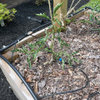
    I wanted to show an example of broken cluster.

    Not sure if thinning cluster could always prevent it but if possible I would readily sacrifice one tomato for the sake of four others.

  • 10 years ago
    last modified: 10 years ago

    That cluster can still be saved. As long as there is a decent attachment it will still grow pretty much normally. But if it will still grow, it will eventually detach.

    To save it, take a cloth strip or similar, 20-30cm long, run in under the middle of the cluster (not the base) and then tie it to the base of an upper leaf (2-3 leafs above, so it stays somewhat vertical) (lifting the cluster is not necessary and may in fact cause more trouble, but make sure it's really tense, and not loose at all, maybe lift it just a bit). I have attached like this a cluster of 10 Caspian Pinks (which are all growing above 200g) and it's been fine ever since. The base of the leaf is really strong, so don't worry about that.

Sponsored
High Point Cabinets
Average rating: 5 out of 5 stars21 Reviews
Columbus' Experienced Custom Cabinet Builder | 4x Best of Houzz Winner