

John Jeavons Garden Books
Well, I ordered and received two of John Jeavons' garden books: The Sustainable Vegetable Garden, and How to Grow More Vegetables, 8th Ed.
I've heard Dawn and others talk about his suggestions and methods, and I wanted to learn more about it. I've also ordered another book, by Duane Newcomb: Small Space, Big Harvest, which should be here tomorrow.
I'm sure many of you already have these books, but I'm excited to dig into them.
Comments (28)
 10 years agolast modified: 10 years ago
I've read Jeavon's books. I just can't do the double digging. I think they suggest 60% of your space for compostable materials? I keep looking at winter cover crops that will give me a big return on biomass, but I'll never be able to do the 60%. I read an ebook, and many of the charts were too small to read that way. I have wondered if I should get a hard copy.

Turbo Cat (7a)
Original Author10 years agoAmy, I haven't had a chance to sit down with these just yet. Yeah, I won't be double-digging. I did that one time (in a very small area), and I won't do it again. I couldn't if I wanted to. I can't do 60% of my area in compost, either, but there was someone on this forum ( I forget who) who has mentioned composting between rows. Was it George, maybe?? There are lots of folks, with good reasons, who don't like tilling because it disturbs the soil life, etc. I till, but my impact on the environment will be short-lived. If I can get a couple more years of gardens, I'll count myself lucky. You are more than welcome to borrow these books. We are only 15 miles from one another.
Mary
Related Professionals
Beatrice Landscape Architects & Landscape Designers · Victorville Landscape Architects & Landscape Designers · Albany Landscape Contractors · Meridian Landscape Contractors · McAllen Landscape Contractors · Fort Wayne Landscape Contractors · North Adams Landscape Contractors · Grand Rapids Landscape Contractors · Burlington Landscape Contractors · El Paso Landscape Contractors · Athens Accessory Dwelling Units · Joplin Accessory Dwelling Units · Fall River Accessory Dwelling Units · San Luis Obispo Accessory Dwelling Units · Eureka Accessory Dwelling UnitsTurbo Cat (7a)
Original Author10 years agoI forgot to ask: Does anyone grow brussel sprouts? I started some seeds inside this morning, but I've never grown them before. Any tips or tricks?
Turbo Cat (7a)
Original Author10 years agoDawn, when you overseed with winter rye, do you aerate first? I used to have an aerator that pulled behind my riding mower, but I let it go when I moved from the deep south back to Oklahoma. I don't want to buy another one...lol I am wanting an easy/cheap way to overseed...I need to do that anyway.
- 10 years ago
Nope. We cut the grass super short with the mower and then overseed the rye grass seed directly into the existing lawn. We water it daily for a while until it begins to sprout. We have horrible red clay but the rye grass seed sprouts and grows just fine. My biggest problem is that the deer think we planted the rye for them, so they yank and pull up entire plants while eating them. You know, deer are browsers and not grazers, so they are unkind to any plant they are eating since it seems like they yank and tug instead of gently nibbling away at the topgrowth. I have found that planting in September allows the grass to root in well and become established before frost comes. Usually the deer stay out of our yard until the surrounding fields have been frosted/frozen and don't have any green left in them, and our first killing freeze usually isn't until November.
- 10 years ago
I've mentioned Dawn's compost in the paths method to Mr OCD. It makes him twitch. He loves the square foot method, down to making little grids for the beds. That is way too fiddly for me, and limiting as to where a plant can go. He claims he's just the labor, but I know it goes against the grain for him when I plant. My biggest problem with grass clippings is fear of seeds. Heaven knows the bermuda and crabgrass find their way into the beds as it is. I have an AWFUL lot of crabgrass this year. I'm trying to get white Dutch clover established, but this time of year it is sad. Oh, well.
 10 years ago
Turbocat, I've heard of these books and sometimes urged to order them until i remember I've spent 5 years reading online (when i couldn't afford to buy a book), that I'm probably already covered.
Ya'll know I love compost and changing the soil. I've used some pretty strange stuff for the compost pile since our climate in mid summer and the height of winter are so deadly.
But I also have a large space. I tire of mowing and weed-eating. The funny thing is: I can't rake up all those grasses. It has something to do with the nature of the weakness in my back. I can double dig (if the temps aren't too hot), but I cannot rake too much.
In the last year I've begun taking advantage of the wild invasive species and adding it to the compost pile. Now, this isn't grown directly in the garden, but it gives me more biomass to fuel the compost.
I go out and snip off the seeds of johnson grass. I like these because I can't see well and it's hard not to miss any of the tall johnson grass seeds. I cut down that grass, shred it a bit with a machete and put in the compost piles. Johnson grass is great because it survives the heat longer than many other invasive species and is usually there in early hot summer when everything else is already dead.
Wild sweet pea vines are excellent, too, as well as honeysuckle vines. We have these growing along the fence line and they always appreciate a good clearing out. My daughter and I enjoy vases of their lovely blooms in the spring if we can beat the territorial ground bees to them. I'm careful not to mow or weed eat too close to their area so they can continue to thrive for us. When i started clearing parts of these vines to throw into the compost pile, they really took off. Here is where I truly began to learn the art of permaculture. I didn't set out a design, but stumbled upon it by way of natural need. In turn, I found I assisted the growth of the sweet pea vines by clearning the clutter. Hopefully, I won't be directly assisting the habitat of the territorial ground bees.
I should note that it is highly beneficial for your compost (or garden soil) to capture the natural liter on the ground right inside the fence lines. This area usually contains decades of natural decaying plants and leaves and is rich with microbes that will fuel your compost pile unless the land owner is OCD and rakes everything up clean. Every year I innoculate the garden soil with some of this. I'm only talking handfuls, here, and adding it to the garden soil like a spice in a dish.
I use the Jerusalem artichoke plants, too. Like comfrey, they spring back when you trim them (but don't do it too often if you're harvesting the roots or you can leave one or two stalks to mature while you take the others). If it weren't for the nutritional benefits in comfrey leaves over the 'chokes, I'd almost prefer Jerusalem artichoke plants over comfrey for harvesting into the compost pile. They seem to grow faster, but that may be because my comfrey is relatively new. Only this year did the comfrey snap back quickly after a harvest. I'll be one happy camper when I have a 100 foot wall of comfrey!
there really are no thugs in my yard with exception to field bind weed and english ivy. There's no use for these two.
I read an ebook by an excellent natural gardener who wrote in depth about the various cover crops. She did a controlled study in her garden to conclude which cover crop had the greatest biomass. She settled on oatmeal. I'm not sure, I think i concluded oatmeal wouldn't work well here. She might have been in Oregon where so many 'excellent' garden authors reside. I find that part offensive, sometimes. If i had their climate, I might be excellent, too. That'd be why I always ask questions here, in the Oklahoma forum, than all the other forums.
The next in line for her preference was buckwheat. Buckwheat works really well, as you know I've raved about it. I love how our local wasps and insect life really use the flowers, but it doesn't survive harsher temperatures and I found its mulching ability a little weak because it decays very quickly and is mostly stalk. The stocks are very moist and provide decaying matter, but the leaf spread is wanting. It works well if you plant densely, but I want something I can harvest seed. I'm still working into that part for any type of cover crop for sustainability.My preference for winter cover crop is giant mustard that I purchased from Stillwater Ag. That stuff can hold up to some very severe temperatures in the winter. It won't survive all winter, but is still alive by early spring. At that time many of the roots that took hold are still alive while on the surface of the soil is a gooey, icky nasty mess covering the soil very nicely. Gooey, icky, and nasty mess means a severe amount of organic material. That spot in my garden to which I did other things is STILL very rich soil.
The Giant white radishes (Daikon) for which I had placed much hope rooted out above the clay soil leaving only tiny strands of roots beneath. I planted them in areas that needed their effect the most. I guess they'll work well for partially amended soil? If I must ready the soil as if I were preparing it for carrots before planting a cover crop to add biomass, I'm really not gaining an edge time-wise and defeating the purpose. Keep in mind, I don't have really hard red clay, either. I have a good amount of dark rich clay loam mixed in with its harder clay. I was really disappointed in the Daikon radishes.
Stillwater Ag came to the rescue again by suggesting I buy Austrian peas. Mr. Coleman had posted about using Austrian peas to overwinter and I had that influence when the young man at Stillwater Ag suggested I try Austrian peas for overwintering. "You plant them in fall and they come up a bit, but in spring they really take off."
I'm settled on Austrian peas for overwintering all winter long. If a bunny munches on it, it grows right back. Yet, it's not stout enough to survive hot temperatures so it doesn't get out of control. It provides good ground cover, a bit more than a good stand of buckwheat and doesn't require any good soil to get started, but it does require innoculant! you won't get a decent stand without the innoculant, so I recommend you buy some on your first seeding if your Austrian peas are not already coated with some type of innoculant.
I have yet to try a combination of austrian peas and giant mustard. I think it would be a beautiful marriage.
I've yet to try hairy vetch. I have some and will be using them in places soon. I'm certain hairy vetch will go well as I've often seen the native vetch growing quite well in the back yard which explains why my soil, in part, is so healthy. It came up this spring I I just HAD to let it grow in. It was hard because I live in a city to leave it tall, but I did. I try as hard as I can to give the natural environment enough time to thrive in such a way.
The only soil cover that works for me over summer are heat-loving summer veggies and herbs and mulch of some type. Our quasi desert summer is just too harsh. I can say that letting some of the lambsquarters grow in helps shade the soil that would normally burn up throughout the hottest part of the day. I'm getting better about strategically placing lambsquarters throughout the garden to shade my tomato and pepper plants in the height of summer. Not too close, but close enough to shade something from about 2-3pm onward. Helps a ton.Turbo Cat (7a) thanked chickencoupe- 10 years ago
My daikons didn't do any thing either, Bon, I thought maybe it was because it was too wet there. For what it's worth, I saved this quote from a book I read on companion planting. "You can underplant hairy vetch which is a green manure that is resilient even during the winter season with late-season broccolis to provide protection to the soil after the broccolis have been harvested."
Companion Planting Joann Roberson Kindle Book - 10 years ago
Amy, If just hearing about it makes him twitch, he'd probably have a nervous breakdown if he had to live with it. There must be something about planting in those little SFG grids that appeals to people. My style is exactly the opposite, so John Jeavon's planting recommendations appeal more to me. There's still some precise plant placement involved, but since different kinds of plants are interplanted with one another, that appeals to my love of jungle craziness in the garden. I don't always get the spacing right either because I still like to cram too many things in too close to one another, but the close spacing really does cut down on weeds. JJ is absolutely correct on that point.
Bon, I use all the wild stuff too. It is the only reason I tolerate it. Any weed that is irritating is still biomass for compost. Well, not poison ivy, but just about anything else. I don't even worry and fret that much over seedheads as long as I remember to put them on the hot compost pile. Being in a sloping area where rain runoff carries every seed around down into our garden as the runoff runs through it means we're going to have the weeds anyway, so I just deal with them. Every weed I pull is more mulch/future compost. I try to keep that thought in mind as I'm yanking out the one million pigweed plants that sprout everywhere after it rains in summertime. Each little pigweed plant is just fodder for mulch/compost no matter how much I despise pigweed.
I agree that one person's most excellent plants are not necessarily ours because the soil and climate have such an impact on plant performance.
I agree about the daikons. I had turnips do the same thing. While they might be great for soil that has some looseness in it already, they cannot root in well in very dense clay. Mine mostly grew above ground with only the smallest roots in the ground----like onions popping up above ground as they ripen, only the turnips popped up above ground almost from day one. I suppose in both our cases the daikons and onions were informing us that they could not/would not grow in our crappy clay. Even loamy clay may not be to their liking as you've discovered. I am astonished by the difference in some plant performance in my amended clay versus the back garden's sandy/silty soil. Some grow better in one type of soil, some in the other. Some seem to do fine in either. Vetch has been used here as a cover crop for so long that it just randomly pops up everywhere, including in places in my garden where I don't want it. I just yank it out and feed it to the compost piles.
My only issue with winter cover crops is that they do not want to hurry up and leave and get out of my way when I am ready to plant cool-season crops. They argue with me that they are not done yet. Oh well, they have to get over that. In a more sane climate, they'd get to grow for more months yet, but I try to cut them down in January to get ready for planting in February and they aren't ready to go in January. It always is a power struggle between them and me. I am the gardener, so ultimately I win, one way or another. I'd rather deal with a happy cover crop that won't stop growing than with winter weeds that are the same way!
Dawn
Turbo Cat (7a)
Original Author10 years agoYou all have given me much to think about. I love learning new things, and if I can just hold onto some of it in this sieve I call a brain, my garden will be better for it. I do want to try a cover crop. I looked for clover at Stillwater Milling, but I didn't find any. What I've seen online is pretty expensive. I'd wondered if I grew a lot of mustard (which I have) and turnips (which I have), chard, etc...if the greens (mustard and chard and lettuce) could be considered a version of a cover crop, and just tilled in in later winter. I've got the texas cream peas, and those could be tilled in, right? Finding a cover crop that I won't have to battle next spring is pretty important.
I don't have a compost pile, and I don't have a good place for one, either. I thought about buying one of those $100 jobs at one of the big box stores, but they mostly had bad reviews, it seems. Having said that, I do some unconsciously: I have, right now, 12 lawn bags full of fall leaves that I paid a neighbor kid to rake up from his yard and sell to me (since they were bit by bit blowing into my yard). I have several 40 lb sacks of rabbit manure/bedding that I bought back in March, I think...that I was saving for this fall. Surely that has composted. I bagged and raked leaves and put them in the garden over the winter, along with the straw mulch that was still on the garden, and that all got tilled in...along with lettuce, and green beans that I'd mowed down, and some other green things that had over-wintered. I put coffee grounds in the garden all winter, and some molasses. I cropped the basil down hard today because it's so big, and that just went into the pathways, and will eventually get tilled in. Sometimes my neighbor scores a bag or two of grass clippings, and he'll bring them to me. My riding mower doesn't have a bagger, and it is $600 to buy one. My push mower has a bagger, and sometimes when I'm mowing a small area I'll put the bagger on and catch it, which goes in the pathways. I guess that's my minimal attempt at composting. I am sure I can do better.
My goal is to make the best use of my space, and to get the most out of it. I guess that's everyone's goal. lol
- 10 years ago
Turbocat, you can use any type of vegetable seed you have as a cover crop! if you have extra vegetable seeds that you know you'll never grow for harvest, you can use those. The soil does not care what roots. Some types of cover crops provide nutrients that are beneficial in ways others are, like nitrogen-fueled Austrians peas versus a tomato plant. Anything growing is better than nothing, according to the soil. To the soil it is all organic material.
Regular mustard, chard, chives.. anything.. will work just as well. Most legumes will help fuel nitrogen. I have a very large back yard as a host to vegetable patches and that allows me to really go out and guy a bunch of cover crop seed to plant, etc.
If I had a little garden, I'd use anything and everything as cover crops. I notice that many forum members here use cowpeas in summer. Cowpeas are easily accessible. In fact, Mr. Coleman provided about 5# of cowpeas for my own use last year. I could very easily use some of these as a cover crop and harvest when they're ready. I keep forgetting about having these and you just reminded me.
Clover! Did you know clover transplants very easily? It transplants almost as easy as bermuda grass. It's a cool season plant, so transplanting needs to occur in spring or fall. Just dig up a little bit making certain to grab plenty of roots and plop it down into the area that you want it. Keep moist until it settles in. Clover prefers partial or full shade. It won't thrive if exposed to our afternoon summer sun.
You can compost any way you like! There's no perfect way to compost, but nature's way. Nature is always perfect and if you don't feel like turning the compost, you can just be patient and let nature do it for you. I hot compost a lot because I'm always in a hurry, but many of them end up idle while I'm busy with other things. Oh. okay. I get out of discipline. Right. loz
If you want a garden where you're composting atop the garden bed, go for it. It's not unlike lasagna gardening. It may look trashy to other people who are more aesthetically inclined (i'm not one of them), but you and I know your plants will be very happy and healthy.
I'm a jungle gardener, too.Turbo Cat (7a) thanked chickencoupe Turbo Cat (7a)
Original Author10 years agoThat is perfect to hear! I culled a lot of old seeds a few weeks back; things that were really old and I'd picked up on sale, etc. I wish now I'd kept them, but I still have plenty left, and have tons and tons of greens of different types. I just never thought of that...just to keep something growing there. That's awesome. Thanks!!
- 10 years ago
Mary, there's a place just south of Collinsville called Holman Seed Farm. It is on Old 169/Garnett when going north from Owasso. It is S 5th from collinsville. They sell bulk seeds. I got my white dutch clover from them and Austrian winter peas and rye grass. I can't imagine Stillwater Milling NOT having any. They may not have seed packs, may be in bulk like Holmans.
- 10 years ago
I am a lazy composter I just pile what ever in a pile behind the barn. When it cooks down I put it on the gardens. Sometimes it's fast sometimes its slow. I am just trying to keep my plants alive, I'm not even thinking about adding new plants. I am tired of the heat and drought already. The summer solstice has occurred so summer is on the way out, right? Shorter days cooler temps, right? I think the sun has cooked my brain!!!
Turbo Cat (7a)
Original Author10 years agoThanks, Amy. I'll have to check them out. I have this week to myself, because the grandkids have gone on vacation till Friday. I may run over there. Stillwater may have had it in the big bags, like grass seed or something, and I just didn't see it. Course, I wouldn't need that much.
Stockergal, I need a gardening climate where the highs only reach the mid 80's. I also need a barn;) lol
Turbo Cat (7a)
Original Author10 years agoAmy, I found white clover at Stillwater Milling, but it is only sold in 25 lb bags...for $150. Yeah, I don't think so. lol I had planned to go over to Collinsville and check out Holman's, but I ended up in the vet ER with my 12 year old female cat. She's an indoor cat, who is allergic to fleas. The old neutered male, who keeps me company in the garden, has apparently dragged in a flea or two. I've been nursing/doctoring her myself for a few weeks, but things got serious this morning and I had to take her to the vet. She's gonna be fine, but I'm out $500. I spent another $100 getting flea-prophylactics for the back yard.
If it ain't one thing, it's anothern (sic).
Bon: I was able to grab a bunch of good seed for cover crops while I was at Stillwater Milling. I picked up every kind of field pea they sell, and they'd added a few varieties since I was last there. Among all the peas, I scored zipper cream peas (OMG cream peas or lady peas are my favorite things to eat), Mississippi silver cow peas, and several more varieties. Plus, I snatched and grabbed every leafy green or cruciferous seed I could find. Their seeds are SO CHEAP.
Dawn, I bought 5 lbs of annual rye, and I'm gonna overseed this fall. Thanks for reminding me.
Mary
- 10 years ago
Mary, I think I got 5 pounds of white Dutch clover at Holman's. Don't remember what I paid, but it wasn't much. They had big bags and the smaller ones, I think they packaged themselves.
- 10 years ago
Mary, I hope the cat comes through this crisis alright. Those furbabies can can expensive when they ahve a health crisis.
I love all southern peas except black eyes and green eyes. Zipper, cream, lady, pink eye purple hull, crowder....whatever! They're all fine eating. Especially with corn bread and any kind of cooked greens.
A bonus with the rye grass is that the cats love it. I grow cat grass for them too in water, but the like the plain and simple rye grass just as well.
It is too hot to do anything. I have set myself a strict time limit of 90 minutes outdoors in the morning, and that really only works out well if I am out the door into the great outdoors by 6:30 or 6:45 a.m. It is just too hot too early to stay out for very long. The nights aren't going to cool off much this week. so I may cut the 90 minutes to 60 minutes. If I can just get the harvesting done and turn on the water, I'm happy. In the evenings, I just water the containers if needed and close the garden gate and make sure it is latched. I suppose the deer are being careful to avoid coming out in the bright moonlight because today they came to the yard to try to scavenge bird seed that the doves/crows/other assorted wild birds hadn't eaten at around 2:30 p.m. It has been a long time since I've had deer in the yard at that time of the day in the dead of summer. I scolded them and warned them that eating the dove's cracked corn after it had been sitting in the hot sun all day might burn their mouths. They ate it anyway. So much for me offering advice to any of the wild critters!
Since it is too hot to focus on this year's garden, I might sit and make a list of what I want to grow next year, and then check it against the seeds in my seed box. It isn't exactly the same as being out in the garden, but on a day this warm, it will have to do.
Dawn
Turbo Cat (7a)
Original Author10 years agoI only ask that becuse I gotta do something else with mine. I'm thinking those big stackable storage things.
- 10 years ago
I'm getting cabin fever! I was out mowing this morning and wimped out quickly. What I really want to do is work in the garden, but what little time I have in the morn and eve is for mowing right now.
- 10 years ago
Mary, I went and looked. I still have white clover seed I picked up at Stillwater Ag about 2 years ago. You're welcome to some! They are white so I'm assuming they're coated in the appropriate innoculant. If we hook up, I'll even dig up some of my live clover for ya.
I ran out yesterday and planted cow peas and watered them in. - 10 years ago
It is one of those big stackable storage things. It is very, very full. It is embarassing how many seeds are in it, and it doesn't stop me from buying more. To be fair to me, I do have several small (1 lb. or less) bags of cover crop seeds in it. They take up more space than the average seed packet.
I'm hatching a plan inside my head to plant a blue/purple garden next year, an idea generated by all the blue lights on all the buildings in Dallas the last few days. It isn't that the whole garden would be blue and purple, just that I would use blue and purple as much as possible in flowers, herbs and veggie varieties. I do have lots of seeds on hand for blue and purple flowers and herbs, and for some vegetables. I'd have to buy more seeds for blue/purple veggies. There's nothing like a good reason to buy more seeds. I told Tim that my garden could be a "thin blue line" garden next year and he liked the idea. I'm pretty sure he also knew that it meant I'd be buying more seeds to make it happen.
For several years in the early to mid-2000s, I planted a rainbow garden, with each raised bed featuring one color of the rainbow, with the color of the beds in the same order as the colors of the rainbow. I wasn't canning much yet, so I had a lot more flowers in each bed than I do nowadays, and it was a lot of fun. The hardest bed at the time was green because there are not a lot of green-blooming flowers that flourish in our climate., although there's more green-flowered coneflowers now that there were then. I remember that for green flowers I had 'Envy' zinnia, 'Wizard' or 'Green Wizard' rudbeckia, green gladiolas, and Bells of Ireland. That rainbow garden era sort of got me started on the blue and purple beds too, and blue was harder than purple because there are not a ton of blue veggies. Even the tomato world has caught up with me now, producing all kinds of blue fruited tomato plants that actually have fruit that are blue at some stages. Back then I only had the variety 'Blue Fruit' to work with and it wasn't blue at all, it was more of a dark fruit like some of the heirloom purples or blacks.
In a lot of ways, the rainbow garden fueled my seed acquisition habit because I was actively searching for edible plants and flowers in all the colors of the rainbow. It wasn't easy to find corn in all the colors of the rainbow, but the search was half the fun. Trialing so many dozens of varieties of tomatoes back then also fed the seed habit, and worked well with the rainbow garden since I was planting tomatoes in all colors. Hmmm. If I plant a blue garden, I'd have to put my little blue bottle tree right in the middle of it. That would be more blue than I had back then too.
I bet I spend some time online this week searching for blue and purple seeds that I don't already have, but it is not likely to be today. I have a full day planned already and it does not (sadly) include any time for online seed shopping.
Dawn
Turbo Cat (7a) thanked Okiedawn OK Zone 7  10 years ago
Since little man went back to his mommas I have a lot of time now to do what y'all are doing. Checking seeds making lists during the heat of the day.
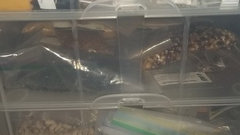
I am going to change my seed storage but i have been using a stackable ornament holder. It has 4 trays that latch together and each one holds a different category. Flowers,herbs...fruits...direct sow...indoor seeding.
It has worked well for me but I am outgrowing it. I may just buy another unit this Christmas.
 Turbo Cat (7a) thanked luvncannin




Okiedawn OK Zone 7