Software
Houzz Logo Print
miketropic

Irrigation input

10 years ago

I have come to the point that I must get some form of irrigation for the garden. Hose watering takes hours to hit them all, I think overhead sprinklers waste alot more than hits the plants so I am looking at some form of drip system or mini sprinklers. Does anyone run a decent sized irrigation system in there garden? Any tips, pros,cons, good system reviews? After looking over alot of sites drip depot seems to have decent prices and you can mix and match a system to your needs. Anyone else have systems there very happy with?

Comments (23)

  • 10 years ago

    I have a do it yourself system called Mr Landscaper drip irrigation. I have had this system for 20 years and it comes from Lowes. I do drain it and roll it up every fall and store in an outbuilding. It is around my house--foundation plants, hosta bed in front of the porch, numerous pots of flowers, around 4 tree shade beds and tops off a little pond that is in front of the porch. It has been a life saver. Due to no rain I have been using sprinklers in perennial beds, garden and under trees. We have gotten thunderstorms around us but not on us yet going on 4th week.

  • 10 years ago

    have you thought about a system of ollas? (OY Yahs). glue two clay pots together. stop up a hole. bury it stopped up hole side down next to your plant and fill with water through the unstopped hole. water seeps through the pours of the unglazed pot, watering the surrounding area slowly … i use 'em for tomatoes too

  • 10 years ago

    IDK if the pot idea would work. Im gardening on about an acre with beds up to 50 ft long packed with plants..need more of a drip system to handle it.

  • 10 years ago

    I've been using a drip irrigation system for three years now. Drip Depot is a great business to deal with. Reasonable prices and fast delivery. That said, drip irrigation is not all I need for my sandy soil. We can have an inch of rain on Monday and by Thursday the hostas are saying "That was nice, can we have more now?" This year I have run the system with a timer and have never turned it off no matter how much rain we've had. In an extended dry spell it will keep the hostas alive, but not thriving.

    I came back from a weeks vacation to find the stupid Orbit timer had malfunctioned. I have four zones and one was flooded and the other three bone dry. I still haven't caught up with the sprinkling.

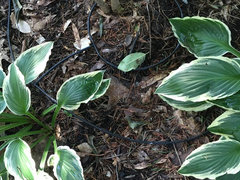
    if your soil is loamy or clay you'll do well with a drip system. It's insanely easy to set one up. I use the inline drippers, six inch spacing and make a little ring around each hosta. On the larger ones I need a double ring. I'll see if I can get some pictures tomorrow.

  • 10 years ago

    soil is heavy clay so was hoping this would do the trick. pics are always welcome

  • 10 years ago

    are the beds flat ...


    and the hosta lined out ...


    or will you be winding around, up and down???


    where are you .. will it need to be blown out for winter ...


    are you able to get machinery in there ... to bury supply pipe.. or could you go zen ... and ignore surface supply pipes???


    your of soil is irrelevant to the system.. its more of a how long to run a zone for.. to get water as deep as you need ...


    are you on a well .. or city water.. pressure is this issue ...


    ken

  • 10 years ago

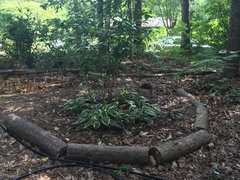
    Here's a pic of how I arranged the drip line for this bed that has a fringe tree with a ring of undulatas around it. I connected three concentric circles to try to even out the coverage.

  • 10 years ago

    had the bright idea to use the search engine in GW.. go figure.. lol ... ken

    http://www.gardenweb.com/gardenweb/query/hosta-irrigation/topic=hosta

  • 10 years ago

    are the beds flat ...

    Nope the entire garden is on a downward slope..which I guess helps the poor plants at the bottom get something from time to time

    and the hosta lined out ...

    not really there here there and everywhere with more being added every year

    or will you be winding around, up and down???

    Just winding around

    where are you .. will it need to be blown out for winter ...

    Northern KY ohio valley 6B/7A line. it will certainly have to be blown out in winter

    are you able to get machinery in there ... to bury supply pipe.. or could you go zen ... and ignore surface supply pipes???

    Hand dig is about the only option, wouldn't hurt me to just cover with mulch

    are you on a well .. or city water.. pressure is this issue ...

    City water, pressure is an issue. I tried to run 2 whiz heads 10 ft apart and it was a poor spray pattern. not sure of the exact PSI at the tap but the bottom bed ( 200ft or more away) is going to be the main problem.

    will look into the kit in the link you provided.


  • 10 years ago

    Is your tap at the bottom of the hill or the top? They sell pressure compensating drippers for use on slopes but I figure hostas don't need precise watering and the drip line is easy. I have good pressure but my lines run up and down the hill. I check some random drippers and the last dripper in the line to see if it's working. Plan on having multiple zones if you have a big garden. I'm still not sure what is the right amount of time to run each zone or how frequently, it's an ongoing experiment.

    If you're going to be running tubing on top of the ground make a drain at the lowest point that can be opened when the season is over. Make sure you put a washer with a mesh filter on it to keep the bugs out. You won't need to blow it out if you don't have pvc supply lines, just drain it.

  • 10 years ago

    you need an engineered product ...such as at the link .. watch the youtube.. then we can talk further ...


    i suspect .... no comparison to whiz heads ... its the engineering ...


    ken

    https://www.youtube.com/watch?v=RCSYeCyuM3c

  • 10 years ago

    BTW .. that stuff is self draining.. but that would still leave you the supply pipe ... which if thought out properly.. you could use the slop to drain ...


    dont forget.. the pipe need not be bone dry ... for winter.. just most of it.. so if the water freezes .. iit doesnt burst the pipe ...


    dont forget a back flow preventor ... which a plumber calls something else ... like pressure equalization or something ...


    ken


  • 10 years ago

    watched the video and the system seems very good. no spray headers or small tubes running off the main supply line. just weave it in the bed and cover with mulch. I am confused on how the "zones" work and I did not see anything about fittings and how to connect 2 lines together. if there is a blank area in between beds what kind of line do you run in between the 2 supply lines so as not to waste water?

  • 10 years ago

    how the "zones" work


    ===>>> its a pressure thing.. you need to start a relationship with a pro ...


    making up numbers ... if each emitter uses 1/4 gal ... you need to know your spigot output.. and that will limit the number of emitters you can have in a zone.. to water effectively ...'


    still with me ... very non-math ... lol ...


    so if you have one emitter every foot ... lets pretend your pressure limits you to 100 feet ... linear ...


    so if your area is larger.. you would need two.. or 3.. whatever zones ...


    so you have this one inch supply line .. up to the area .... and you tee off it.. and put in a ballcock .. or shutoff valve ... etc ...


    once its all in.. you have to figure out how long you have to run a zone.. to water effectively .. and that might be in hours .. since the drip is so slow ...but if you water deeply enough .. you wont be doing each zone each day ...


    trust me.. you will be using a lot less water.. once you figure it out ... when i used the click. click rainbirds.. i estimated more than half.. never hit the ground .. and was lost to evaporation .... nothing in this system will go directly to the sky ...


    you find out how it all works.. in your soil .. in your micro climate etc.. by digging small holes in between emitters and finding out how it spreads .... in clay its wide at the top... and hard to get deep ... in my sand.. its more of a teardrop.. wider at the bottom.. which is usually fine.. since that where the roots are ...


    pick one of the online suppliers.. and start talking to a pro ... they can figure out all the connectors.. etc ..


    thats my time for right now...

    ken


    ps: at the end of your supply line... you could also put a regular spigot.. i cant begin to explain how nice that is.. when you need water.. 100 feet from the house ... say.. to water in a new transplant .. etc ... that would be a 90 degree turn... a couple feet of supply line.. and a spigot.. it held upright by a stake ... i also put one.. a few feet from the house ... so when i needed water for other things.. i didnt have to unhook the system ....


  • 10 years ago

    I just ordered some PEX (cross linked polyethylene) piping to run a line about 125-130 feet back because I am sick of lugging long water filled hoses around.

    The cost is as follows:

    (2) 100 ft rolls of 1/2 inch PEX piping $60

    (1) Crimping tool and SS clamping rings $33

    (3) 90 degree elbows $8

    (1) Tee $3

    (1) Adapter for 3/4 fitting to faucet to 1/2 NPT 'SharkBite'

    fitting $5

    (1) 1/2 inch SharkBite ball valve (for drain) $7

    Total $116

    This will give me a hose connection set on a post (existing) about 120-130 feet away from a faucet that has a fitting for two hose connections with individual shut offs. When done with watering I would just crack open the drain line and shut it off at the house.

    Of course if any drip or soaker hoses are desired or need the cost of these extras would have to be added. I figure for $116 and maybe a day's work on installation. I will leave it on the surface covered in mulch in some areas and bury it in a shallow trench in other locations. I don't see any need for a deep trench, it is simply a hose substitute. An engineered irrigation system is another story, of course.

    The PEX is very inexpensive, once you have the crimping tool you have it forever. PEX is rated for potable water and freeze 'resistance'. The line will run all downhill in my case so it will be simply drained for the winter and drained after each use....if I remember. ;-]

    It is rated for more pressure, far superior freeze protection and is an easier installation (IMO) than flexible PVC and certainly standard PVC. 160 PSI rating at 74 degrees (tested to 480 PSI). Minimum bend radius for 1/2 inch tubing is 4 inches so it can be sent in a tortuous path where needed. 1/2 inch is fine for me and it will be easier to bury and more flexible. I would think it would be plenty for an average size drip irrigation system.

    It is available in various sizes up to 1 inch and for cold, hot water and for radiant heat systems with different tubing ratings.

    It sure as heck beats dragging around 150-200 feet of hoses up and down hills and all over the place. I my case it will not be near any utilities and extensions would be easy if I wanted them.

    FWIW Jon


  • 10 years ago

    jon.. do you know the trick or inserting fittings in hard black pipe??


    use a torch to WARM it ... lick or spit on the fitting [not the hot part.. lol] ... and slide it in ...


    if you melt the pipe.. well.. that means it got to hot ... lol ...


    the ENGINEERED part that i noted above.. regards using emitters that have a designated.. designed ... drip rate ... so that you can predict application across the whole distance .. etc ...

    cheap old recycled tire weep hose.. is not such a thing ... the further away from teh source.. the less water that weeps out ... and you find that out.. when things start dying at the far end ....


    JON??? .. dont forget the backflow preventer.. or you will be sucking hose water back into the hose.. since you pumped all the water uphill..


    ken


    ps: there is also a trick to uncoiling pipe or hose .... if you do it wrong... you are going to be rassling a snake all day long ... scaled up version of how to do it at link ... and if you leave it in the hot sun for a few hours.. it will get much more pliable ...

    https://www.youtube.com/watch?v=Qi1mQMM6_6I

  • 10 years ago
    last modified: 10 years ago

    Ken, I've used the SharkBite fittings for copper piping and they are pretty slick. Push them on (not hard at all) and it is sealed. The PEX is pretty flexible so I don't expect the fittings to be hard to push on. They utilize a clamp and compression tool to seal them. I'll find out when I get the 'stuff'. I will report back one way or the other. If the fittings are tough to affix (I really don't think they will be) I think I will try some hot water rather than my blowtorch to heat them up.

    I know a backflow preventer might be required by code; is one required for an elevated remote hose connection? The line is not going to end in a drainage pit, it will be hanging out over the edge of a hill in the air. It is far less likely to have any backflow than the 150 feet of hoses I utilize now. I leave just a fine mist flowing on the hose before I walk up and shut the water off at the house.

    Where the stand is for the hose connection I will tee off with one leg going up to the faucet for the hose and the other to the ball valve for the winter drain. The end of the PEX piping will hang out in the air and there is no chance of backflow. Some people place the drain into a drainage pit, which would have an opportunity for backflow. It is not like a buried irrigation system either where a negative pressure could draw in contaminants. I'm sure an inspector would disagree and demand a backflow preventer, but to me it has far less possibility for any backflow than using a garden hose.

    To me it is simply a permanent hose in a shallow trench.

    I'll know it was you if I get turned in. :-)

    Oh, I just noticed your comment about uphill. This is all downhill and will drain completely with the faucet shut off and the drain open. There will be no traps. When I drag the hose uphill I am headed back up toward the house and done watering or headed off to a different area.

    Jon

  • 10 years ago

    OP is uphill....


    you are downhill ...


    regardless.. is a 7 buck gizmo ... no reason to not use it .. uphill ... i mean.. after all ... he is building a very thin.. long.. water tank .. lol ... and it will be pressurizing due to the height ...


    also ... keep in mind.. i am on a well ... with a bladder tank ... and that works thru a range of pressures as it fills and empties .. so if its pressure falls.. it COULD suck water from outdoors.. inside ...


    its extremely important.. if you decide to add a fertilizer injector .. dont want that in the house ... [and i dont recommend such .. unless you spend a lot on it .. cheap ones are useless]


    ken

  • 10 years ago
    last modified: 10 years ago

    i see no reason for a filter in this set up ..... but in case some well peeps are reading in ....

    but with my well.. it would be something that be considered ...

    unnecessary with city water ...

    ken

    ps: its so important.. lol.. that i cleaned it when i put it on in spring .. and when i took it off in fall ... lol.. i suppose i could have utilized it better.. lol ... it was basically casino chips that fit together with micro level spaces in between ...

    this is the one i have

    https://www.nwgsupply.com/hydro-flow-netafim-disc-filter-3-4-in-mpt-x-mpt-140-mesh-17-gpm-maximum-flow.html?utm_source=google_shopping&gclid=COnhg-n8h84CFQ2HaQod4_YL2A

    this is what the inside looks like .. hit the operation link/button

    http://www.netafimusa.com/wastewater/products/manual-disc-filters

  • 10 years ago

    I agree Ken, in the event of an uphill run a backflow preventer is a good idea, especially or even always when a drip system is used.

    Jon

  • 10 years ago

    Must have gotten this confused..the water tap is at the top of the hill..everything runs down hill from it. every bed minus maybe 2 that are on the same plain as the water tap will be down hill so I shouldn't have to blow it out or get a back flow unit. after running the sprinkler 2 hours today with little effect I really need to get on this..or put it off till spring lol