Software
Houzz Logo Print
vlk20

butterfly bush issue, please help

10 years ago
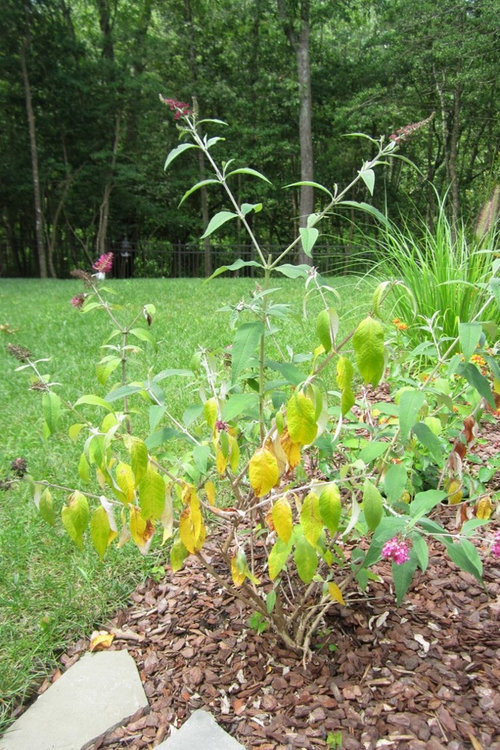
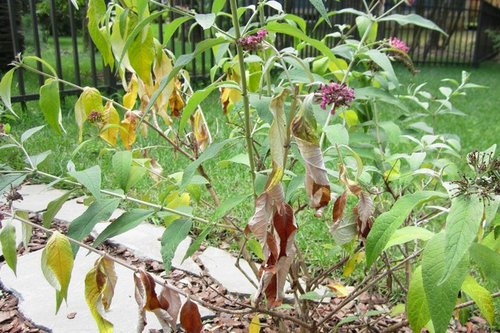
I planted 3 buddelia last fall, two are lovely but one is slowly going downhill. Here are 2 photos. All three are planted in the same bed, a few feet from each other.


I spray with neem oil every 10 days or so and so far it has worked to keep everything looking pretty nice except for this particular shrub. Also, we've had quite a few 90+ degree days lately, but the decline started before that. And the other 2 shrubs are close by and share the same soil, irrigation, etc. If there is any other info that you need to help, let me know.

Comments (12)

  • 10 years ago

    What is the Neem spray for? Have you identified a pest problem? If not there is no point to it.

    Have you looked below the soil surface around the roots? Is there any dryness, rot or other issue going on down there? The yellow leaves all appear to be on one part of the shrub. Examine the base of that section carefully.

  • 10 years ago

    The neem oil is to keep a lot of diseases in check (it works really well with both my flower beds and the veggie garden) and some insects as well. I will look at the soil underneath that part of the shrub. Weird, though, that the buddelia that is thriving 4 fet away shows no signs...

  • 10 years ago

    I spray everything with the neem oil, and it absolutely helps keep my flowers, veggies, etc. looking good and, in the case of the vegetables, producing. I'ts inexpensive and doesn't hurt the environment. I'm sticking with it. :) As for the butterfly bush, I dug it up today and the roots look healthy. The base of the plant looks fine as well. I'm stumped. So the next step is mailing some leaves to the local university's ag extension plant pathology dept. for analysis.

  • 10 years ago
    last modified: 10 years ago

    That's a good idea. But what is the soil like where you dug up the plant? Was it as wet/dry the same as the soil where the other bbs are growing.?

    You have made your position clear on Neem, so I'm not going to argue with you. However, since you're contacting the extension service anyway you could ask them about the disease prevention and "nutritional" qualities of Neem.If I'm not mistaken it is a dormant oil spray, isn't it? Does it add anything beneficial to the plant or soil? Just asking, because I don't know. What does it say on the label?

    Have you ever thought about compost or alfalfa tea? Although some in the scientific community (The Garden Professors / Linda Chalker ) don't agree, many home gardeners swear by it. "They" say it builds up the plants' vigor and disease resistance, and increases soil nutrients and micro organisms. At the risk of ticking you off, I'm thinking this could be, in the long run, better for plant health than an insecticide and is really cheap. I can tell you are proud of your garden so you really want to concentrate on building up the soil and vigorous plants. Then you'll have a healthy beautiful garden without using an insecticide for routine maintenance instead of for specific problems, which is Neem's intended use.

  • 10 years ago
    last modified: 10 years ago

    Hi Marie, yes, Neem Oil is a dormant oil spray but used in diluted formulations it is excellent for managing some softer-bodied insects (aphids, mealybugs particularly are recurring problems) and some diseases. No, it has no nutritional qualities. :) The lower leaves on my tomatoes always used to get spotty and yellow due to a couple of different (common) diseases, but the Neem oil keeps them looking good all season long. Same with garden phlox, roses, and echinacea to name a few. Less spotty plants, less disease to spread. It's very environmentally friendly, and cheap, so I just spray everything (except certain flowers as the label instructs).

    I did look at the soil when I dug up the buddelia yesterday. It was a tad moist and crumbly, and you could see traces of the compost that I had used when planting these last fall, and some of the alfalfa pellets that I used to fertilize a couple of months ago. We have horrible soil, so my husband and I killed our backs removing some of the yucky stuff, then mixing what was remaining with compost and bagged topsoil. It's just weird that the same bush 3' away is doing just fine, as are a half-dozen other types of shrubs planted in the same bed. I'll have another batch of compost ready in a few weeks, and will dig that into the beds to prep everything for winter. Compost tea may be another idea for startup next spring, I'll have to look into it. Thanks for the idea.

  • 10 years ago

    Are the affected leaves on one limb? If it's just one branch I would experiment by cutting out that branch. I have several of these plants (the yellow variety being my favorite) and it seems the more I ignore them, and cut them back, the better they do. I've never had them suffer from insects or disease......and in general consider them hard to kill. : )

    BTW, as for using the oil, the only negative I've read is this: Oil solutions should never be applied to plants during hot weather (85° F
    [29° C] or warmer) or in direct sunlight. To prevent burning of
    tissues, treated plants should be shaded until the application is dry.

  • 10 years ago

    I just learned a lot about Neem from you! Thanks. How do you apply it?

    My garden is too big and I'm getting too slow to be able to be (or even desire to) as methodical as you are. It is better to be proactive, certainly. Perhaps you'll post photos of your garden someday.

    This has been an interesting exchange.


  • 10 years ago

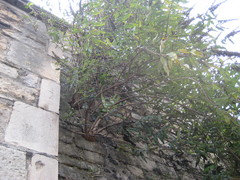
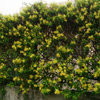
    I am wondering if the conscientious soil prep is causing the problem. Buddleja's natural habitat is stony hillsides and over here it is an invasive weed species which favours poor soils and fast draining ground. It can be seen for mile after mile along railway tracks growing in pure ballast. It sprouts from chimney pots and the masonry of derelict buildings.

    The picture illustrates the conditions it enjoys....


  • 10 years ago

    Sorry, we have had some busy weeks, but I did want to update. I sent samples to the plant path lab at UDel and they tested clear of any disease of insect damage. She suggested that they might still be in transplant shock, especially since we've had several 95+ degree days. All three now look bad, but I'm going to let them go for the time being and hope that they return in the spring. Also, I am considering moving the plants to a more appropriate area in the fall and NOT prepping the soil much other than replacing the rock-hard clay with regular ol' unfortified topsoil.

    Marie, I swear by neem oil. :) It's low impact, keeps the insect population down, and seems to do a good job on reducing the more serious diseases. However, it doesn't do much for downy mildew, which is ravaging my cukes now (I'm using a copper spray to keep that in check). But I did a stupid thing last week and bought 3-in-1 oil-based product that was sesame oil based and it actually damaged a couple of plants. So back to the neem oil for me, even if I had to drive a half hour to a store that had it!

  • 10 years ago

    Hello this is my first time here. I use neem oil untill my first batch of lady bugs get here. I put out ladybugs 3 times a year and don't have any problems with insects. I do like the neem oil but lady bugs work good too

  • 10 years ago

    floral_uk has captured it perfectly. Buddleja is coming up in the gravel just outside the metro tracks in suburban Baltimore. It never gets too tall, the crews come through and spray with herbicide.