Software
Houzz Logo Print
sunshine_1621

Tomato question....

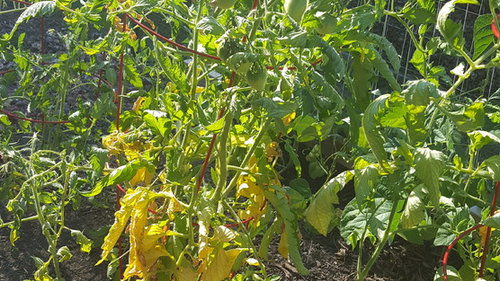
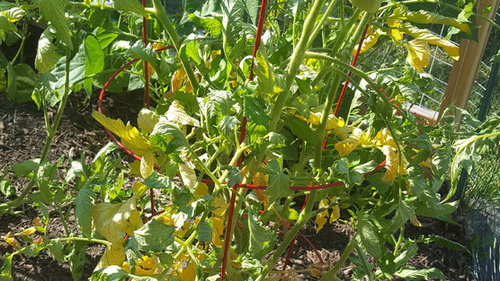
Does this look problematic? I'm seeing more and more yellowing as days go by. Does this indicate an issue or should I not worry?

Thanks!


Comments (41)

  • 10 years ago
    last modified: 10 years ago

    I am suspicious of your soil.

    What is your soil like underneath that mulch? You would be better off improving what you have - by adding homemade compost - rather than buying stuff in.

  • 10 years ago

    My soil is clay... I don't have mulch except on the perimeter or the garden bed. I add compost every year and try to mix it in with existing soil.

  • 10 years ago

    Do you apply fungicide? Yellow leaves at the bottom are often a sign of fungus infection.

  • 10 years ago

    No I don't use chemicals. Is there any way of knowing for sure if it's a fungus infestation? Maybe I will cut off the leaves and see if others keep yellowing? Looks like the fruit is still developing....

  • 10 years ago

    I am in upstate N.Y., also, (Herkimer County), and my tomatoes aren't doing that. It does indicate a problem, but I don't know what. Have you been watering? Fertilizing? If so, how often and with what?

  • 10 years ago

    Sorry, my eye was drawn immediately to the mulch down on the right of the photo and I panicked.

    It seems to me that your plants should look a little more robust. However, I don't know what the problem is.

    I wonder if it's worth heaping some of the soil up around the stem, to encourage rooting from there. It needs to be moist soil.

    Do the other tomato plants look like this? Or does the mulch on the side have something to do with it?

    Have a look at the whole crop and see what is different.

  • 10 years ago

    I would pinch off all the yellow stems, then watch and see...i regularly pinch off my lower stems anyway, so it won't hurt the plant, but then watch to see if the yellowing keeps "climbing up"....if it does, then that indicates a nutritional problem...it's not insects...you have a problem with your soil there. your local cooperative extension will test your soil...I think you need to do that. Mulching is fine within it's boundaries...but it can also cause a huge excess in nitrogen...your plants will have tons of leaves, and little or no fruit..you really need to get your soil tested to know what you're dealing with...

    in future years...start a compost pile...compost can never hurt...use the weeds you pull, and the leaves from your lawn...then top dress your grow beds with the compost.

  • 10 years ago

    Alright.... non-worry just evolved into devastation.

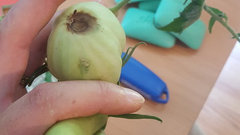
    looks like blossom end rot to me. I have opalkas and Hungarian hearts. Both have the yellowing leaves. Not all of the tomatoes have rotten ends tho. Will they all in time? Should I just pull the plants at this point? Contemplating my future gardening life at the moment.... ohh, the melancholy....

  • 10 years ago

    I read up on bes, I'm going to crush some tums into the soil and more fish emulsion today. We will see what happens. I'm not a big fertilizer person, I've only done it twice so far this year but we'll see what happens. I really need to do a soil test and reevaluate throughout the winter.

  • 10 years ago

    Do you grow tomatoes in the same place each year? It could also be verticillium wilt.

  • 10 years ago

    You have two separate problems. Blossom end rot isn't producing all those yellow leaves, which is the problem you originally came here with. That still looks fungal to me. BER is often attributed to a calcium deficiency, but even I get it a couple of times, and my soil is permeated with limestone (as in LOADS of calcium). One way to get it is by over nitrogenating your soil, as nitrogen ties up calcium. But it sounds like that's not your issue.

    If you don't want to apply fungicide, then I'd remove the yellow leaves and dispose of them carefully. DO NOT compost them.

  • 10 years ago

    Excess nitrogen is one of the problems you get when mulch breaks down...before you start adding calcium and fish emulsion...get your soil tested. Without a test, you are just taking guesses....

  • 10 years ago
    last modified: 10 years ago

    Fungus generally causes spots on the leaves... not entire leaves and branches to turn yellow without any dark spots, sporulation or necrosis. For some reason Houzz has started zooming OUT (?) when clicking on a picture, but I only see yellow leaves.

    Yellowing lower leaves is indicative of a nitrogen deficiency. IMHO that is your problem, plus the BER. Hopefully the plants will outgrow the BER.

    Those bottom yellow leaves are pretty far gone - I would just cut them all off.

  • 10 years ago

    All good comments. IMHO, I'd remove all yellowed or other stressed leaves/branches, dipping clippers in a weak bleach/water solution and rinsing hands between plants. Dispose of clippings carefully, as stated, don't compost. Then spray entire plant and soil with the same weak bleach solution. That's worked for me without going to the heavy duty fungicides. Here's a link I found that discusses it at length.

    http://tomatoville.com/showthread.php?t=28509

    Good luck,

  • 10 years ago

    Don't worry about the blossom end rot. And don't pull up your plants.

    Blossom end rot is caused by calcium deficiency and calcium deficiency can be caused by how you water. I suspect it is due to watering.

    When tomatoes are allowed to dry out between waterings, there is a lowering of calcium. A more even watering regime is required.

    In fact, I think watering every morning, nice and early, is a good way to water a vegetable garden. The water is then available to them during the day, when they need it. And everything is dry (leaves and such) at night, which will reduce fungal attack.

  • 10 years ago
    last modified: 10 years ago

    Watering every day is a great way to get root rot. You end up with a lot of moisture near the surface (day and night), which isn't where most of the roots should be. That will breed fungus. You also end up with shallow roots, which is a disadvantage when the weather gets warm.

    True that about pure yellow leaves indicating a nutrient deficiency - probably nitrogen. I didn't look closely at the picture. I just assumed there were brown spots mixed in with the yellow. Don't seem to be. I'd remove the leaves, but I still would dispose of them.

  • 10 years ago

    I agree with dan about the watering...don't know what climate tete is in...but here, in upstate N.Y. (where OP is)...it is inviting all kinds of problems. Better to water when they need it, and deeply...so roots grow way down...if I watered every morning, I'm sure I would have a ton of fungal diseases and probably no crop! Advice is best given and taken, especially about watering, from those with climates closest to your own.

  • 10 years ago
    last modified: 10 years ago

    Lauren, you never answered when asked about your watering habits or I missed it.

    So I am gonna go out on a limb and say both of Laurens problems are caused by stress - stress caused by insufficient watering during this dry spell (and high temps) going on right now. Or watering in the wrong place for the plant to find it.

    With this weather I don't think watering daily (or even twice daily) will cause root rot or fungus.

    I do know there are many people here who believe (rather strongly) that plants can live w/o water but in this heat wave I think it is prudent to "just add water".

    And given that Lauren does not want to add chemicals (and shouldn't have to for these two problem) I think she has nothing to loose by "just adding water".

    It is not uncommon for the lower leaves on a tomato plant to yellow as the plant ages but it is common knowledge that BER is caused by uneven watering. So to fix two problems with one thing "just add water twice daily" (morning and evening) until the problem subsides.

    Do let us know how you make out Lauren.

  • 10 years ago
    last modified: 10 years ago

    I strongly agree with other posters against blindly adding daily water. Adding water twice daily is going to make the problem worse, if it is the nitrogen deficiency it appears to be, and invite fungal problems. The OP also indicated the soil is clay and is showing a picture with heavy mulch, two things that decrease watering needs substantially. Watering mulched plants in clay soil twice a day in zone 5 is a sure fire way to kill your plants.

    Obviously, plants need water, and if the soil is dry deep under the surface a good deep watering to even out soil moisture is a good thing, which the plants may very well need right now.

    Even in this heat wave I gave my plants a single deep watering, going back weeks. I did underwater a little, and there are some signs of stress in the lower leaves, but they look better than the OP's for sure, and no BER and the septoria is kept under control.

  • 10 years ago

    FWIW, fixed nitrogen is water soluble, and overwatering will just tend leach it out. So if the problem is nitrogen deficiency, overwatering will make it worse.

  • 10 years ago

    Ya know it is just amazing (to me anyway) how, when troubleshooting things (in life, in general) people will leap right over the things that are needed to sustain life to suggest things that aren't needed.

    These plants are obviously stressed. The first thing Lauren should do is review how these plants are cared for.

    Maybe instead of staying hydrated just skip the xrays and CAT scan and go right for the MRI?

    You don't even know how or if she is watering and have not even asked. All this extreme talk prob has her afraid to "just add water".

    Let me suggest something - just "add water" each day for 2 or 3 days - IF that is the problem you will certainly notice the plant coming back to life. Do let us know if water makes this problem worse or better.

    Said another way if you do not "add water" and have not for some time the plants will no doubt just die and the kind folks here will say "see I told you it was martians".

    IF those plants are deficient in nitrogen it is only because it is water that moves nutrients to and thru the plant. However, BER is not from lack of nitrogen but calcium. NOT lack of calcium in the soil but in the plant.

    So I will say it again one more time - it is water that moves the calcium to and thru the plant.

    Both people and plants need nutrition to stay healthy and sustain life. Without water all things die. It is said that people can live longer without food than water.

  • 10 years ago
    last modified: 10 years ago

    Gumby, you are again missing the basic point that too much water kills plants. This is a scientifically proven fact! There can absolutely be too much of a good thing. If you don't think you can overwater a tomato plant, I honestly don't know what to say... you should go visit the tomato forum sometime.

    If lack of water isn't the problem, which I see no reason to believe it is (you only simply need to google tomato drought stress to see that is not what the plant has), you can possibly kill the plant by blindly adding water - twice a day! - completely unlike what would happen naturally for that matter - based on nothing other than "plants need it".

    You only need to look at your soil, stick a finger in, to see what the situation is, and whether the plant needs water. If it does, water away! But water deeply, and infrequently, and take into account the conditions of your soil, mulch, weather etc., and keep an even and correct soil moisture level deep under the surface. It is called being smart.

  • 10 years ago

    Looking at the leaves towards the ends of the branches made me wonder if you either water too much, or not enough. My guess would be not enough. I do have the same questions about your watering habits. And I've always heard blossom end rot comes from inconsistent watering.........too much, and then not enough over a period of time. Don't give up, and don't pull your plants yet! Gardening is a lot of trial and error. Hang in there!

  • 10 years ago

    Yes, I was laying in bed last night thinking that I forgot that you guys have a completely different climate to mine.

    We cheer if we get rain in the growing season. It is certainly not a given.

  • 10 years ago

    However, I disagree about the method of watering for tomato plants. I think an even moisture is better. However that is achieved in your particular part of the world.

    Calcium becomes Unavailable when the soil is dry. And therefore, blossom end rot happens.

  • 10 years ago

    Good on you, gumby. I totally agree with what you've said.

  • 10 years ago
    last modified: 10 years ago

    'But water deeply, and infrequently, ...'

    This is not a good way to water vegetable gardens. And particularly not tomato plants.

  • 10 years ago

    False. Watering deeply and infrequently is a good way to water vegetable gardens. Frequent watering produces shallow roots, which is not in the better interest of the plant. As I said, shallow roots basically NEED more frequent watering. So if you start doing it that way, you'll end up being locked in. Frequent watering doesn't just moisten the soil. It makes it soggy, and that's a recipe for root rot. Now, what is meant by "infrequently" depends on where you are. In my climate, in midsummer with high temps above 100F and low temps around 80F, you pretty much have to water deeply every three days.

    Tomato plants don't need to be watered any differently than just about anything else.

    I will say, that if you have crappy soil, that doesn't hold moisture well, frequent watering may be your only way out.

    "Even moisture" is indeed best for plants, and if your soil is decent, it will hold an even moisture for many days. I can stick my finger in after two days and it is JUST AS MOIST as it was after one day. But if you're trying to achieve an even soggy mess, then daily watering is a good idea.

    If you have a problem with that, just Google "water deeply and infrequently". You'll be surprised at what you get, from nurseries, extension services, etc. Frequent shallow watering is NOT recommended by anyone.

  • 10 years ago
    last modified: 10 years ago

    Shallow watering is not even watering. The water barely penetrates the surface and the root ball has very uneven and inadequate moisture. It is constantly wet on top and dry deep down, where the best roots should be.

  • 10 years ago
    last modified: 10 years ago

    Lauren, if you got any of the rain storm that is hitting here right now you should see some improvement in your plants which will solve the mystery.

    Click here to see some pics that look just like yours ...
    <If lack of water isn't the problem, which I see no reason to believe it is (you only simply need to google tomato drought stress to see that is not what the plant has), >

  • 10 years ago

    'False. Watering deeply and infrequently is a good way to water vegetable gardens. Frequent watering produces shallow roots, which is not in the better interest of the plant.'

    Gardens (of trees, shrubs, ground covers, bulbs blah blah) should be watered infrequently. Deeply. Slowly. Encourage the water to go down and that encourages the roots to do the same.

    Vegetable gardens on the other hand, are different. We don't want the plants stressed, ever. We want them to grow in leaps and bounds, and produce to the best of their ability.

    The same is true of anyone growing plants for selling. Nurseries (if they have a clue) water their plants when necessary and do not allow them to dry out between waterings. Of course, it's all open to interpretation. What is 'drying out'? If plants are wilting, you have caused them stress. And stressed plants do not grow as well.

    So, the way we water something depends on what it is.

  • 10 years ago

    Right or wrong I believe there are people who think there is only on way to garden, one way to grow something.

    I believe gardening is one of the wonderful things we do in life where there are so many variables we can mess things up (like I do) and still have fun (like I do) and still get excellent results (like I do), ha.

    So when I say water something people ass-U-me that I water they way they do when I don't. I water completely different and I bet that watering techniques are like fingerprints and everyone has a different style, a different technique, resulting in a different outcome.

    I guess we all need to be more specific when we say to "water" something then again maybe even that won't help?

    It would certainly help to ask questions when is comes to gardening advise and would be even more helpful if people would answer those questions so they could get better and more specific advise.

    HTH

  • 10 years ago

    Yes, gumby.

    For example, because I say that vegetable gardens should be kept moist, it is assumed by some that I mean sodden, or that I water too shallowly. Not so.

  • 10 years ago

    "Vegetable gardens on the other hand, are different. We don't want the
    plants stressed, ever. We want them to grow in leaps and bounds, and
    produce to the best of their ability."

    Yes, but daily watering has nothing to do with that. The moisture level, at depth in the soil, can be pretty stable without that kind of watering. I have no idea why "daily" watering is needed to keep plants from being stressed. Why not every four hours? Why not every ten minutes? Where does your 24 hours come from? I have to be a little skeptical about recipes for watering that don't seem to have a lot to do with soil moisture.

    If you want to keep plants from being stressed, water when the soil needs moisture.


  • 10 years ago

    Does anyone know about Hydroponics? How often do they water? How do they check for moisture "at depth"?

    Where do they stick their finger?

    Anyone?


  • 10 years ago

    Ok... I am back. I appreciate everyone's advice. So 1 week later my tomatoes look better. I took all the yellowing leaves off and I don't have any new ones coming back. Last weekend I added tums powder to the soil and fish emulsion. My 3 opalkas are still producing tomatoes with bes and the plants are pretty small. My 3 Hungarian hearts are producing tomatoes with no bes now. So I can only pray they stay like that. I did not water anything since sunday... then I just watered today. And we had a good rain mid-week. I am a little crazy about watering I must admit and it's something that I believe has hurt my garden in the past. My soil is clay, I really do not think water requirements are that great. My dad has never watered his veggie garden ever. Whole summer... no manual watering. If I had to guess, I would say maybe too much water is the culprit here. This all has made me want to invest in a moisture meter. Anyway, the plants are better but I do still have the bes on half and bad leaf curl on all. They still don't look healthy but they look better than before. I'll have to see what is to come.

    Do you think I should fertilize again this weekend?

  • 10 years ago

    Why don't the roots rot in hydroponic plants?

    Linda

  • 10 years ago

    I think that they do an on/off cycle ...water, then it drains, then water...the other way is to oxygenate the water with pumps and air stones. Either way...they must constantly add nutrients...there is a lot of picky testing, I believe!

    But..to just blindly water every day in soil, without even checking for your plants water requirements is just asking for problems.

    Lauren...glad your plants are looking better. Best moisture meter is your finger! You will never misplace it..just stick your fingers in the soil, if dry..water!

  • 10 years ago
    last modified: 10 years ago

    Root rot is a HUGE problem in hydroponic gardens. It's a problem in wet anaerobic media. That's why the water has to be well aerated. Also, the hydroponic bath is kept well disinfected. UV sterilizers, etc. Also, sometimes chillers are used to keep the bath temperature from getting too high. There are supplements (like beneficial bacteria) that can be added to prevent rot.

    As noted, best "moisture meter" is a finger. Just needs a bit of calibration. I've seen a few commercial electronic soil moisture meters, and they usually don't work very well.

  • 10 years ago

    I should add that it used to be thought that BER was simply caused by calcium deficiency in the soil. New research says it's a bit more complicated than that. It really involves the transfer of calcium in the plant tissues, and unavailability of that calcium to the developing fruit. That may or may not depend on calcium content in the soil. It can, on the other hand, be caused by large variations in soil moisture (as in, after a heavy rain), where fruit are expanding quickly, but the plant can't pull calcium fast enough even if the soil is loaded with calcium.

Sponsored
Peabody Landscape Group
Average rating: 3.5 out of 5 stars8 Reviews
Columbus' Reliable Landscape Design & Contracting