

Frigging RRD?
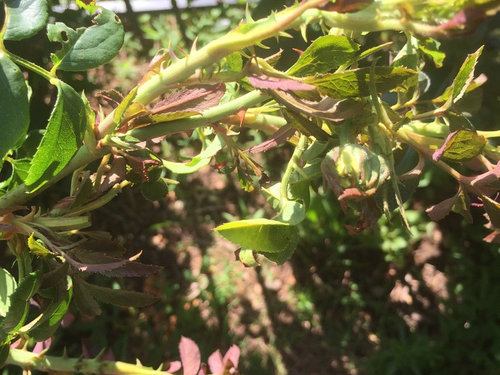
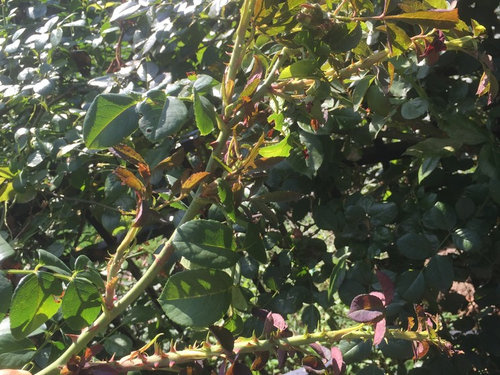
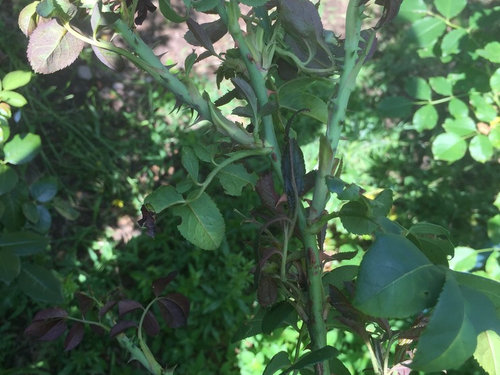
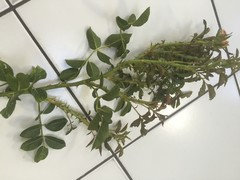
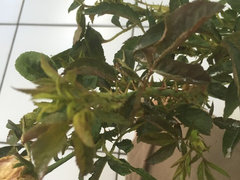
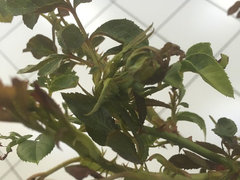
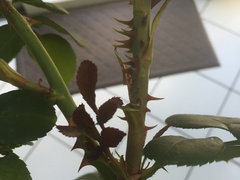
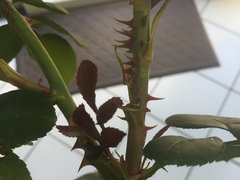
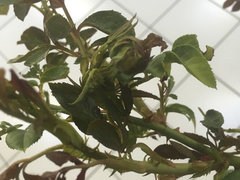
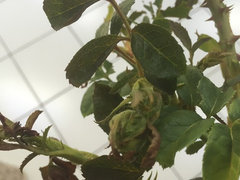
Strange growth on my Cinderella Fairy Tale. Is it RRD? Thanks!
Comments (25)
Related Professionals
Montgomery Landscape Architects & Landscape Designers · Pine Bluff Landscape Architects & Landscape Designers · Anderson Landscape Architects & Landscape Designers · Lincoln Landscape Architects & Landscape Designers · Manhattan Landscape Architects & Landscape Designers · Hilo Landscape Architects & Landscape Designers · London Landscape Architects & Landscape Designers · Elizabethtown Landscape Contractors · Aberdeen Landscape Contractors · Oneonta Landscape Contractors · Wilmington Home Builders · Zanesville Home Builders · Waco Home Builders · Murrieta Home Builders · Reno Home Builders 10 years agolast modified: 10 years ago
Sorry, but yes, it looks like friggin' RRD. Misshapen red leaves, hyper-thorniness, growth thicker than the cane it springs from, clustered witch's broom...if you caught it early, take that whole cane down to the graft (or as low as you can if it's own root), then watch all new growth. I've saved a few, especially more mature specimens, by catching it early. If it's a young plant, your chances are slimmer, but it's still worth trying to save. But at THE FIRST sign of more abnormal growth, get ruthless and dig it up and get rid of it.
John
 10 years ago
Yes to RRD.
Interesting the contortions that the few blooms have. Are those blooms hollow???
Are we seeing multiple views of several canes?
I wonder if the Kordes roses are so healthy that they push massive RRD faster than less healthy roses....your thoughts?
Ann
- 10 years agolast modified: 10 years ago
I only grow one Kordes rose, and it's still healthy, thank goodness.
I'd not really thought about that facet of the disease, Ann, and mine is a completely amateur opinion, but based on my experience, once a rose catches RRD, it seems like the robust growers DO push more of the nasty growth, faster, than the average growers. I'm not sure if that's a good thing for early detection, or if it's a bad thing that would allow the virus to spread through the plant faster. I'm watching a slow growing tea right now, with one new sprout that seems suspicious, but it's growing so slowly I can't make up my mind, lol. In contrast, when my Golden Celebration showed signs, it was almost overnight that a 4" witches' broom showed up. Likewise, recently my Night Owl ( another fast grower) showed LOTS of abnormal growth, in several places, suddenly and severely.
John
User thanked fig_insanity Z7b E TN - 10 years ago
The second half of the 'robust growth' is /might be/maybe, just maybe be a case of nutrients going out but a lot fewer coming back. This may be what happened on my Fortuniana. Huge witches broom, way out on a ten foot cane, we cut the cane off, and the bush seems to be healthy four years later. This witches broom is the size of a beach umbrella (it's dried and hanging in our basement).
User thanked stillanntn6b User
Original Author10 years agolast modified: 10 years agoThank you, everyone!!!
Ann -- I cut off a couple branches, but the shots are mostly one of the two.
John -- It is 6-year old plant, and a solid small climber. I will cut off the canes with abnormal growth. I caught one in early spring, but thought it might just be overly exuberant growth.
Richard -- I love climbers as well. Truly heartbreaking. I have a Laguna, an Awakening and a climber wanna-be Golden Fairy Tale growing right by it. I favor rampant, wild plants....
Where I live, I know it is a matter of time my roses get hit, but it is still plain sad....
 10 years ago
Braverichard that is exactly why I don't do climbers anymore. Too many years invested in waiting for it to mature. Only to see rrd come a long and get it.
Farmerduck, I'm very sorry about your rose.
Too others reading Ann is NOT saying that Kordes roses are more likely to get rrd. She simply meant that robust roses of all types seem to break into extra fast rrd symptoms. That actually makes it easier to see it early.
- 10 years ago
Farmer Duck - my condolences. At first I wanted to say no- not RRD, but yes it is very abnormal growth. Did you notice that the thorns are not only excessive but the shape is also distorted. Normally the thorns are concave changed to an exaggerated upward concave shape.
Nothing that we know now indicates own root roses to be more susceptible than budded roses. I don't know if vigorous roses are more likely to get it. You might be right more vigorous roses will show more symptoms earlier, but that might be a good thing as perhaps a fast cutback could save the rose. So much to learn about this horrible disease. I am in love with climbers and I do not think I will stop growing climbers even with this risk.
- 10 years agolast modified: 10 years ago
Ann, I just has a thought...or six. You made the comment about "a case of nutrients going out but a lot fewer coming back". I wonder if there IS a more one-way flow of nutrients and sap, with the witches' brooms literally starving the rest of the plant by hogging resources? It must take a lot to support that much crazy growth. Does the plant die of root starvation? And if the flow of sap is toward the abnormal growth, is that what gives us the chance of saving the whole rose by cutting off the visibly infected cane? Is the infection carried in the sap? Passed cell to cell? Has anyone tested normal-seeming wood from an infected rose at different times to test the rate of spread of the virus through the entire plant? Does it have to reach the roots or just the crown before it can become a systemic infection? Sheesh...too many questions, I know, but I'd never thought of them until you made that comment. TIA!
John
- 10 years ago
,Does it have to reach the roots or just the crown before it can become a systemic infection?
A rose growing friend in Kentucky had a show rose that he loved (he had won his first Queen of Show with it). When he and I talked about RRD (D back then) he had had RRD on that rose for five years, Each year he'd see RRD on it and he'd cut the bad part off. FIVE YEARS. RRD apparently hadn't gotten past the huge crown and into the roots and then through the plant. RRD just stayed in part of the grafted crown.
I have a plant propagation book from the thirties (think Dixie Rose Growers...nobody has ever even heard of them), but many photos of their growing practices. Anyway, there''s a section through a graft on a two year old plant, and the contortions of the xylem/phloem are really curved in part and nearly straight in the rest.
My own holy grail of rose 'innerds' would be a study to see the variability of phloem sieve cells. Some classes of rose may use smaller/different sieve cells to pump more up from the roots than goes down from the leaves....totally unproven.
Right now, my oldest 'saved by cutting off a cane' is a Rouletti that's going on 15 years old. But I never was able to save a HT. My HTs were never huge. So many variables, such a tired rose grower that I've become.
 10 years ago
Well the good news is that if its caught in time it can be prevented from spreading to other roses. Mine are clean this season and I am watching like a hawk.
Susan
 10 years ago
farmerduck - So sorry about your rose! Such an ugly disease - I hope solutions are found in the near future to combat this.
Ann, if you don't mind me asking, to what extent has your garden been affected by RRD? How often? I know it is not if but when it will affect my garden as I have found even more cases lately even closer to my garden. It sounds stupid but it is like an alien invasion - you know they're nearby but there is not a lot you can do but watch and wait.
Is it true that climbers are more likely to get RRD? I have never read this before but I hear it mentioned often.
User
Original Author10 years agoI dug CFT out this morning out of caution. It was hard, but had to be done. RIP. It is a beautiful rose.
Ann -- meant to answer one of your questions above. The buds were firm. Bud being hollow is another RRD symptom?
Dave -- Doubt that there is any scientific data on climbers being more AT risk. However, intuitively, they ought to as are bigger, taller and far more sprawling than, say, a Floribunda, and thus the more risk of exposure. Climbers take years to show their stride, and the return on investment gets lowered a lot more if you factor into RRD. I have two CFTs, and this particular one only came into its own last season after perhaps 4 or 5(?) years.
- 10 years ago
Assorted answers.
Re empty buds: in Missouri we were at the Botanical Garden talking RRD and someone brought in a rose cane that he thought had crossed with a raspberry (and might have commercial appeal). The buds had three layers of asymmetric sepals and nothing inside. The buds looked a lot like brussels sprouts. Since then, whenever I see big buds with badly distorted sepals, I ask about what's inside.
Susceptibility of climbers: in many, many yards, New Dawns were the first roses to get RRD. At that time New Dawns were the most popular rose in my part of the country. Probably because of the density of the bush and their acting as wind breaks and so many of them. So far my Dr. Van Fleet hasn't, but that may be because I am not letting the canes make a dense mass. There may also be a 'when is the growth spurt' and does it overlap with mite population surges factor.
My gardens: worst year I lost 3%, and that was of about 500 roses. That year was very dry, and we were irrigating heavily...so our target plants were perfect for mite dispersal to land on and stay. Talking sub rosa with some professionals I think there is agreement that the mite dispersal may be more of a problem in drought years, and definitely that there is a minor spring dispersal in the south east, and then the big fall dispersal that's in the literature.
Most years I now lose two or three. I lose more to vole damage. We made a conscious decision to redesign the beds (and there were many on the side of our hill, in our back yard and the species garden down in the field) to enhance air flow. The air flow is, I think, a major thing.
We've gotten older and my love of HTs has fallen as I made the decision not to spray fungicides (esp when DH stopped being fastidious with the breathing masks in the heat of summer). We're down to about 200 roses now
We haven't irrigated for the past five years. Two years were so dry that our well just wasn't suitable for irrigation and after two years of not 'working', the drip irrigation system needed major work. A lot of roses can live drier lives once they are established; bloom production drops, but rain in fall makes great fall flushes.
I'm really pleased with the health of the Kordes' Roses' leaves, canes and the overall speed of growth. Unlike Dr. Huey, Kordes' own roots do really well in my soils (and I have at least three different soils.) I had RRD on one cane of one this spring....so far where I took the cane off, there's not been a recurrence.
- 10 years ago
Thank you, Ann, for the answers and sharing your experience! I'm sorry you have lost so many over the years. I, and others on the forum, appreciate and value the information you share.
I know I need to work on increasing airflow in my garden. I love the full English style garden appearance but this could be detrimental to my garden in the end.
Thank you, farmerduck. I agree - climbers are a great investment.
- 10 years ago
Dave
I've come to think that english style (at least in my mind) may be the way to go, with the right companion plants and workng to keep all the plants along a wind path at the same height.
"right companion plants" would include mints and lots of compositae. Mints because of a paper i read about growing commercial mint organically...the beneficials took over fastest when allowed to overwinter in patches of mint left in the fields. I would never suggest that anyone grow creeping charlie, but I have it in one bed (and can't seem to get rid of it no matter how much I pull , and since it invaded that bed, the multiflora descendent polys (Orleans rose and descendents) that were getting at least one RRD infection each year.....haven't. And it was planted to maximize air flow, but I really should have lost one or two now, given how many I was losing (one a year) before the creeping charlie moved in.Compositae...especially for fall companion plants. 'Cause that's what I've read.
I do have microscopes and I've checked many of my RRD sick roses looking for the eriophyids, and I see their carcasses but no live ones. So far.
- 10 years ago
Great to know, Ann! I had some spearmint I potted and sunk in the garden hoping that would keep it under control but it did not and I am still ripping it out of the garden. I do have catmint and hummingbird mint. I have a lot of lavender, allium, basil, chives etc. I do need to plant more compositae. In a previous garden I had a large section was dedicated to compositae - I have yet to see such a "happy" garden since - it was so active w/ beneficial insects. I need to try and create that environment again.
- 10 years ago
RRD is terribly painful, dug out a 4 year old double KO bush. It had shown symptoms, cut the cane off all the way at the bottom, brand new cane came up with symptoms as well...

- 10 years ago
Farmer Duck - not a scientific answer but climbers may seem to get RRD more often because with all other types of roses we tend to prune the top growth off every year and this may be cutting infected areas before they show symptoms where we tend not to prune climbers very much at all so RRD symptoms may become visible and also spread through the plant.
- 10 years ago
Chris,
Fairly often the initial infection is at a bud axil along the cane, rather than apically. It's harder to see along a cane, but the apical aberrant growth is easier to spot.
Again, air flow....reduce it enough and the mites drop. When they drop in a mass of leaves the resulting aberrant growth at one bud axil is hard to see, if the rose is a mass of healthy canes.
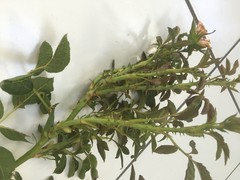
Take a look at FarmerDuck's photos in the followup post ...followup to the original post. That's what growth from an apical infection often looks like (depending on the genetics of the rose.) If it had bent over a bit more, it would have made what I call a candelabra
- 10 years ago
stillant6n,
My reference was to several posts that seem to think that climbers are more genetically susceptible to RRD which I think is unlikely. We do know that the expression of RRD can sometimes be stopped after initial symptoms by pruning below the infection site. Yes, it is at the bud axial where the mite feeds which means it can be at quite a few points along any given rose cane where the infection can first appear.
My point was simply that we tend to prune shrubs, HTs and floribundas fairly low every year so if there was an infection site higher on the bush we remove the infected site before the infection can continue down the cane and infect the entire plant. With climbers we do not typically prune very much of the shrub meaning that the infection can be more easily affect the entire rose. I don't know about the theory that climbers act as wind breaks, I would think the same could be said about big shrubs - after all it only takes one mite blowing on the wind to land on a rose. So much to learn about this disease glad to see all the research being done.
If a raspberry actually crossed with a rose that would be very interesting to the breeding community and exceedingly rare.
User
Original Author10 years agoThis is purely anecdotal. I did find a small wild multiflora seedling at the foot of CTF in early spring. It looks like it was infected with RRD, and I pulled it out as soon as I saw it. That was the thing that put me on my RRD alert, and the "early" detection of this infection. That seedling is probably several weeks old, and must have been there by way of bird dropping. (Not herbicide damage as I do my own yardwork, well the bulk of it anyway, and do not use herbicide). Do we know if RRD can also spread by bird droppings? Seems intuitive, but I have only heard about it spreading by mites.
- 10 years ago
A small test by Amrine didn't show transmission by seed, but it was a small study.
A much larger study of the corn virus showed only a few questionable seed produced infections. Out of thousands of seeds. It was a 'field test' so that left some uncontrollable variables.
The bad thing (for us) about multiflora seeds is that when spread by birds, they arrive with their own nutrients, ready to go.
I wouldn't say that climbers are more genetically susceptible, because the genes of climbers are so variable.Multiflora gets RRD; Dorothy Perkins (which to me seems to have some multiflora in it) is one that's common but I've never seen with RRD.
R. bracteata doesn't get it (the mites don't like it); Mermaid does.
R. wichurana (the low growing form) hasn't gotten it in my species bed even though R. laevigata growing through it and above it does.
I think (excepting R. bracteata) that location and windflow and size of target plant are more important.
Too often I've thought from one situation that there was a rose with resistance. Only every frickin' time I've found the hoped for resistant cultivar with RRD symptoms in another growing situation.


braverichard (6a, North MO)