Software
Houzz Logo Print
lynn2112

Please Share Your Experiences Regarding Maggie

Ingrid recently posted a comment about Maggie failing to perform so great thus far in her garden. I too have had questions about Maggie, more specifically, is this a rose that thrives in the Hot and Moist, but struggles in the Hot and Dry? Please share your observations/experiences.


TIA

Comments (30)

  • 10 years ago

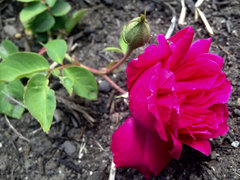
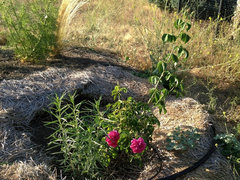
    Mine is 6 months old from ARE and seems very happy here. Dry, sunny, 105 F here yesterday. Has bloomed nicely already. Sorry picture inadequate. Very healthy and vigorous.

    Sheila's garden. · More Info

    Lynn-in-TX-Z8b- Austin Area/Hill Country thanked Sheila z8a Rogue Valley OR
  • 10 years ago
    last modified: 10 years ago

    Thank you for providing input, Sheilah. 105F is very hot. Looking forward to seeing your Autumn pics:)

  • 10 years ago

    Maggie mine was from a neighbor in New Orleans who grew it from cuttings in his backyard. It came with the victorian he bought. It had been neglected for decades.
    His yard had a rich dark soil, being a block from the levee. You cannot imagine the heat and humidity there unless you have sweated for 24 hours straight when electricity went out.

    I've grown her here in Tennessee, until voles took out the roots one hungry winter. I miss her because she did so well here.

    Lynn-in-TX-Z8b- Austin Area/Hill Country thanked stillanntn6b
  • 10 years ago

    Today 104 F and baby Maggie happy.

    Sheila's garden. · More Info


    Sheila's garden. · More Info

    Lynn-in-TX-Z8b- Austin Area/Hill Country thanked Sheila z8a Rogue Valley OR
  • 10 years ago

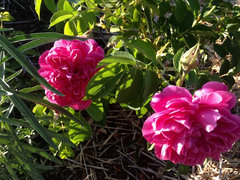
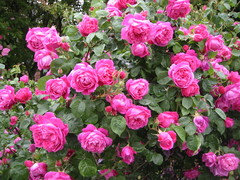
    Wow! Erasmus, gorgeous.

  • 10 years ago

    I think we all need this rose now. That is just crazy wack!

  • 10 years ago

    ..that's a stunning rose. I'll have to check if it's called something else...

  • 10 years ago

    My Maggie band I just got this spring is doing awesome and has been throwing up new canes! :)

    Lynn-in-TX-Z8b- Austin Area/Hill Country thanked Alana8aSC
  • 10 years ago

    I tried Maggie twice, once between Lyda Rose and the Fairy with 4 to 5 hours direct sun and then in the arboretum's antique garden next to a thriving Monsieur Tillier, again with less than 6 hours direct sun. I thought with her "old rose" genes that she would be fine in these conditions, but ended up with spindly five foot plants and sparse bloom.

    Admittedly there was some tree root competition too.

    I'd like to grow her again but this time I'll treat her like a Bourbon, with the best soil and a generous space and feed her like a hybrid tea not like a shrub.

    I still think she's a good rose for our climate, long hot and humid summers. I'm in coastal SE Virginia which has an 8A climate a lot like Charleston but with colder winters. I remember seeing her at ARE, lots of blooms on a lovely five foot bush.

    Lynn-in-TX-Z8b- Austin Area/Hill Country thanked barbarag_happy
  • 10 years ago

    Maggie is a great rose for me. My big Maggie blooms tirelessly for me all summer. I took a cutting from her, and baby Maggie is thriving and starting to show herself as a good bloomer too. However, I suspect that unfortunately my experience isn't too helpful for you, Desertgarden, because my climate is SO different (hot humid summers that can be very dry or very wet; long winters that can be very cold, rather warm, wet, dry, you name it).

    Lynn-in-TX-Z8b- Austin Area/Hill Country thanked User
  • 10 years ago

    Thank you. I have a second plant of it in an area I would think it would do well in but that plant has been there a long time and never has grown much. So it varies.

    Seems to me I've heard it called Eugene Marlitt. I'll look it up. It has a strong fragrance with some peppery notes. I do think the blooms might fry if it was too hot and dry.

    Lynn-in-TX-Z8b- Austin Area/Hill Country thanked erasmus_gw
  • 10 years ago

    Erasmus, stunning rose!

  • 10 years ago
    last modified: 10 years ago

    Could you tell me about Maggie's leaves and petals please, Erasmus? In images, it appears that both have some substance or thickness, however, I have yet to see Maggie in person. I have been eyeing and reading about this rose for years. This is the closest I have ever come to having a Maggie. I just do not want to throw away another rose (Natchitoches Noisette will enter the compost heap soon). My family is about maxed out from my donations in terms of gifts, mis-labeled roses I did not like etc., so now what doesn't work in my garden goes into the compost bin. I have been very lucky thus far, but try to be more and more cognizant to avoid wastefulness .

  • 10 years ago
    last modified: 10 years ago

    Marlorena, many folks think "Maggie" might be 'Eugene E. Marlitt', a Geschwind rose, although I recently encountered an article by Professor Wang in which he seems to speculate that "Maggie" might be a very old rose from China (Baoxiang) that has also been in India for a long time as "Kakinada Red".

    I've enjoyed reading this thread, although my own "Maggie" is quite young and quite petite, so I have nothing much to say about her yet.

    Virginia

  • 10 years ago

    I had mine long enough ago (15 or so years) that I don't remember clearly what was wrong with it. Spotty in some fashion. I've tried some of the roses I discarded from that period a second time, thinking that now that I am a more experienced rose grower I might have better luck. So far I end up removing them again, so I think I'll stop wasting perfectly good roses with my experiments.

    Rosefolly

    Lynn-in-TX-Z8b- Austin Area/Hill Country thanked Rosefolly z5
  • 10 years ago

    As I look at my baby "Maggie", I think of something along the lines of a tetraploid China/Bourbon, as if one of the old triploid red Chinas got together with 'Rose Edouard', which also is claimed to be an older-than-thought cultivar from India.

    :-)

    ~Christopher

  • 10 years ago
    last modified: 10 years ago

    Sorry, but Christopher... I am not even close to there yet with the first half ( can look up Rose Edouard)...what does that mean..in non-botanical terms or examples :).

    Btw... glad to see you posting:)

  • 10 years ago
    last modified: 10 years ago

    It's been a very busy Summer for me.......

    OK, so tetraploid means the rose has four of each chromosome, triploids have three of each, and diploids have two of each. Most of the Chinas and Teas are diploid, while most of the Europeans are tetraploid (except for Albas and a few others of that family that have five or six copies of each). One of the things that often happens when a plant has extra chromosomes is that it looks more robust in its parts -- thicker leaves, petals, stems, etc. You'll see this in other plants as well, such as Daylilies. Basically, I think it's because even that extra bit in every cell adds up when multiplied by the total number of cells.

    When the first crosses between European and Chinese roses happened, usually the results were triploids, because 'Old Blush' and the Tea-Scented Chinas were very fertile diploids, and the Europeans mostly tetraploids. Many of these triploids were sterile to some degree, but a few were fertile enough to continue their lines. When triploids successfully self-seed, sometimes they give diploid offspring, sometimes more triploids, and sometimes tetraploids. I think that the diploid offspring expanded the China and Tea classes, while the tetraploids became Bourbons.

    The wrinkle here is that some of the original red Chinas are actually triploid, and according to what I read in various books and articles, they seem to lean more toward putting two sets of chromosomes in their ovules and one set in their pollen. This means that if they were successfully fertilized with pollen containing two sets of chromosomes -- such as may happen from a tetraploid or triploid Bourbon -- the result could be a tetraploid reddish China-leaning Bourbon. And the offspring would likely be more fertile than most triploids. Incidentally, this is likely why many of the few Hybrid Chinas known to be fertile were red -- they probably arose from red China seed fertilized by tetraploid European OGRs.

    As to 'Rose Edouard', that is possibly the oldest Bourbon -- or a seedling of it. The story went that on the Isle of Bourbon, people grew 'Old Blush' and some repeat-blooming Damask in alternating hedges or something, and a seedling emerged that was like something between the two. But another story goes that this rose was long-known in India, often used as rootstock, and perhaps the "seedling" was just a sucker emerging from below the ground. So if 'Rose Edouard' is actually older than the Bourbon legend tells, and if "Maggie" matches another with the same story, perhaps "Maggie" arose in Asia as a seedling from some red China fertilized by 'Rose Edouard'.

    Anyway, as I watch my "Maggie" slowly grow -- I think it's just a bad spot -- she reminds me of my red Chinas, except larger in all her parts. Even the scent is rather similar.

    :-)

    ~Christopher

    Lynn-in-TX-Z8b- Austin Area/Hill Country thanked AquaEyes 7a NJ
  • 10 years ago

    I can believe Maggie might have a greater number of chromosomes if that results in thicker stems and leaves. I'll try to get a picture today and compare it to SDLM, which looks similar to me. Maggie never sets hips...I don't know if it has fertile pollen. I don't think SDLM sets hips either. I have long wondered if Maggie has some China in it. The winter damage it finally got in 2013 and 14 might indicate some China ?

    Lynn-in-TX-Z8b- Austin Area/Hill Country thanked erasmus_gw
  • 10 years ago

    Hi Christopher,

    Can
    you tell me how your Maggie has done in your garden? Is it disease resistant? I
    am also in New Jersey and your experience would be very helpful.

    I
    have a spot that is a bit shady in the afternoon, and I was wondering whether it
    would be a good place for Maggie.

    Many
    thanks!

  • 10 years ago
    last modified: 10 years ago

    Thank you so much, Christopher!! I really appreciate you taking time to write that post. It is very helpful not just because I have questions regarding Maggie, but moving forward with OGR rose purchases etc. If I lived in N.J., I would bring a Venti something to you, and a trash can full of coffee grounds:)

  • 10 years ago
    last modified: 10 years ago

    Virginia,

    ..thanks for your reply earlier, all very interesting...

    I have since read that Dr Manners did DNA testing and found 'Maggie'/'Eugene E Marlitt' to be the same rose as you alluded to. Still, it's one I won't have to fret over as I don't think it would be suitable here, and it's not available as far as I can tell, but it sounds like a treasure for those that have it...

    Lynn-in-TX-Z8b- Austin Area/Hill Country thanked User
  • 10 years ago
    last modified: 10 years ago

    Hi Marlorena-

    I have doubts about whether Geschwind ever released a rose named Eugene E. Marlitt. The earliest reference to the rose I can find is in French (Nomenclature de tous les noms de roses connus... by Simon and Cochet-Cochet, 2nd ed. 1906), and references 'Eugénie John Marlitt' as a 1902 HT raised by Geschwind. In the 19th C. there was a German novelist who wote romances under the pen-name E. Marlitt; her real name was Eugenie John.

    I can find no other early 20th C. references until 1912 when the rose (now called 'Mme Eugene Marlitt') is hailed in an American catalog as one of the finest red HT's known.

    Sometime in the 1920's, she apparently switched genders, as rose names sometimes do (and a sex-change via typo sounds much less painful than surgery). It's easy to see how Eugenie can sound like Eugene E., but was the rose still going by Eugenie even in the 1920's?

    There are no early references that I can find (and I've looked, but probably my method was lacking) in German. Not in Rosen-zeitung or any other publication. It's true that I don't speak or read German, although I do know enough "rose German" to usually be able to translate rose descriptions I find when adding references to HMF.

    So I wonder what Geschwind called this rose, if it really was his rose. There doesn't seem to be anything at all that's straightforward about the Marlitt rose, and I'm surprised that anyone could find a specimen with a reliable provenance to test against "Maggie".

    As for whether "Maggie" would be a good rose for you, the question is moot if you can't find one, but it does seem to be fairly adaptable. And sometimes roses that are heat-loving also do well in cooler climes (Geschwind's 'Gruss an Teplitz' is apparently grown throughout much of SE Asia, but I seem to recall that you grow it too). So if you did happen across a "Maggie" one day, it might be fun to try it out.

    Virginia

    ETA: Since writing the above, I did locate a 1907 reference to Mme Eugene in a U.S. catalog.


  • 10 years ago

    ...Yes it would be fun Virginia, and thanks so much for this fascinating information, it's always so interesting. I wish I had figured that out... Eugenie to Eugene E., that's a great deduction. I've just been reading about her on Wikipedia...

    I read about the DNA testing on the Heritage Roses Group newsletter, the American one, but I don't think it went into any further details... I wonder if Mr Manners might see this and comment..?

    Yes I do have 'Gruss an Teplitz'.. blackspot ridden, but the blooms I cannot resist.

  • 10 years ago
    last modified: 10 years ago

    Hi Marlorena-

    I am also giving 'Gruss an Teplitz' a go, and I have a very young "Maggie" as well. Fingers crossed that they like it here, but it's likely that we have the kind of hot humid climate that suits them. And I really don't even notice blackspot unless it's pretty bad. I find that I enjoy things more if I choose not to notice the defects...

    I found this earlier post that suggests that as of 2009, Dr. Manners had not tested "Maggie" with the Marlitt rose, and seemed skeptical (as am I) that there even was a known plant of the Geschwind rose to use for testing.

    Of course, what you read may have been later and better info.

    I think Christopher posted something here or at HMF about 'Hermosa' being a sport that has been found on several different roses; seemingly a reversion to an ancestral form of those roses. I wonder if something similar could explain how "Maggie" keeps popping up hither and yon?

    Cheers,

    Virginia

  • 10 years ago

    Virginia, thanks for that link, this is all getting quite fascinating... I've also been reading on HMF where I should have looked before but often forget to do so. Apparently someone states that the research was done at the University of Montreal in 2009 and established they are all the same rose, i.e. Pacific, Kakinada Red and the other two... perhaps Dr Manners got the information from them.

    This is a link to the Heritage Roses Group, it's right down on page 26 about a conference at Mottisfont, in 2014 I think.. which quotes Dr Manners..
    HRG

    I also note from a post on your link that this 'Maggie' rose is considered the same as a 1902 Geschwind called 'Julius Fabianics de Misefa', and it is suggested that the rose became Eugene E. Marlitt when arriving in the States, so I wonder if not only did it have a kind of sex change, but a change of Nationality as well, presumably to make it sound more American, which EEM certainly does to my ears...

    Incidentally, I have found JFdeM on the Hooks site in France. Of course I don't know if they still have it, or would still send to me here with the Brexit business, and their pending upheavals, but I might ask out of curiosity. Apparently the rose is cold hardy and does well in Sweden.

    Here is a photo of the rose on the Hooks site. I wonder if this reminds anyone of 'Maggie'...
    JFdeM

  • 10 years ago

    Thanks, Marlorena, for the link to the HRG newsletter. Yes, it is carefully stated that the rose in commerce as Eugene E. Marlitt may not be the Geschwind rose of the early 20th C., and I doubt anyone is willing to go to bat for the premise that the original rose has survived. Maybe so, but it's doubtful.

    'Eugene E. Marliit' could certainly be an American invention, but the similarity of the name to that of Eugenie [John] Marlitt, a German writer would be a strange coincidence. And the first reference that I can locate is French, not American. Nomenclature mix-ups of all types are all-too-common. I think it's odd that so many modern English-language references (and HMF) give Eugene a French accent as though the rose were of French origin or named for a Frenchman.

    The rose in commerce as 'JFdeM' certainly could be "Maggie". I seem to recall that Sangerhausen gave us 'Barcelona' as 'Francis Dubreuil', so I had to smile when I read a commenter's post which seemed to imply that a Sangerhausen provenance should be unquestionable. I think it was Jeri who pointed out that the rosarium was a battlefield in at least one of the World Wars.

    But, yes, I think it's quite possible/likely that if you order 'JFdeM' from the Hooks, you could get "Maggie". Or maybe you'll get the long-lost 'Francis Dubreuil'?

    Here's a link to a pdf of the 2015 Indian Rose Annual with an article by Professor Wang on p. 46 that might be of interest...

    Virginia

  • 10 years ago
    last modified: 10 years ago

    aah. thanks again Virginia.... gosh you're a mine of information. I got down to pages 52/53 and from all this I now understand that both in Montreal and Florida they did genetic testing, to confirm that Pacific, Kakinada Red, and Maggie, are all the same rose, and the writer feels that a rose found in China called 'Baoxiang', although not genetically tested with the others, is strongly thought to be the same rose again, and that Eugene E. Marlitt is a Baoxiang-like rose.

    How this rose seems to have travelled the world. Anyone who has it should feel somewhat honoured I think...

    As for 'Julius Fabianics de Misefa', with a name like that I could quite understand if it morphed into various others along the way...

    I should add, thanks for your time in helping me reach a kind of muddled understanding. I think I'm getting there...

  • 10 years ago

    Marlorena, if you have even a "muddled" understanding of what's going on with these roses, you are way ahead of me!