Software
Houzz Logo Print
rick7072

Annuals to plant now?

10 years ago
last modified: 10 years ago

Following up and supplementing my similar post in the Perennials forum, can folks here recommend annuals that I can plant now that will keep
their bloom for the rest of the season? I know there are a few that can even keep
blooming after a light frost. Considering that I have my immediate sights set on this August-September-October, it seems I may have better luck in that task with annuals than with perennials.

I wonder though if there's an issue that early August may be too hot for planting.

Thanks for any thoughts.

Comments (17)

  • 10 years ago

    in my MI ... where its been in the 90s for weeks ... it would be a very hard time to try to start seedlings .. in the ground ...


    it might work in flats .. where they wouldnt bake to death ... but counting germination time.. then time to maturity ... flowering ... in my MI .. they might be flowering in 60 to 80 days ... lets call it 90.. 3 months ... which would mean in the best of worlds.. they would be blooming near 11/1 .... maybe a month before first frost ...


    sure.. if we knew where you were.. if more southern ... you would have a longer season .. so maybe it will all work out ....


    not to mention.. vigor would be reduced with the declination of the sun.. in fall ... the sun gets weaker... so plants start growing slower ...


    regardless ... doing some experiments.. will get you some useful info for the future.. so give it a try ...


    is there some party or something you are shooting for ..... ken


  • 10 years ago

    Your best bet would be to go to a garden center and buy already started plants. Petunias will go through a frost. If you have to start from seed, a quick growing annual is zinnia. Beware of those late season grasshoppers that will eat a row of seedlings in a day. Plus, you'll have to water the seeds 3 times a day outdoors till they sprout and put down a root.

    Rick (zone 6b, MA) thanked susanzone5 (NY)
  • 10 years ago

    which would mean in the best of worlds.. they would be blooming near 11/1 .... maybe a month before first frost ...


    ==>> correction ... 11/1 would be a month AFTER first frost.. and near the first predicted FREEZE ...


    ken

  • 10 years ago

    Ken,

    " which would mean in the best of worlds.. they would be blooming near 11/1 .... maybe a month before first frost ...==>> correction ... 11/1 would be a month AFTER first frost.. and near the first predicted FREEZE ..."

    You might want to re-check your arithmetic.

    ZM

  • 10 years ago
    last modified: 10 years ago

    And I'm a bit confused about my plant hardiness zone here in the Boston suburbs. Some charts list me as 6b and others as 5b. I don't think we ever get below -5 degrees in the winter so that would have to put us at 6b. And for what it's worth, our first frost is between Oct. 11-20.

  • 10 years ago
    last modified: 10 years ago

    Hi Rick,

    My first frost experiences here in 5b are close to the Oct 11-20 bracket you mentioned. There has been a revised Zone Map published which accounts somewhat for climate change, and takes note that frosts and freezes in, say the century 1700, don't have as much bearing on the probabilities as the weather data in the century 1900. I think the present data is based on measurements made from 1981 through 2010.

    A frost, as distinguished from a killing freeze, does do serious cosmetic damage to zinnias. Leaf tips are "burned" and so are petal tips. 32 degrees on a clear night leaves zinnias looking pretty sad, though still alive. Since climate data is now a moving target, predicting frost/freeze events is subject to more uncertainty than it used to be. Last year we had a killing freeze on October 30th. But on the 28th of October my zinnias were severely damaged and, in my notes, they were described as "half dead". Incidentally, a killing freeze does not necessarily kill the zinnia seeds in the seedheads.

    Your data in the suburbs of Boston will differ considerably from Boston itself. You could do a search for Boston suburbs and use the suburb nearest you, or if you are lucky, data for your suburb. My nearest data is 8 miles away as the crow flies. I live in a rural area, so I sort of interpolate between nearby points for which data is available. All you can hope for is probabilities. Weather is always a gamble, and the best you can hope for is to get good numbers for the odds.

    ZM

    Rick (zone 6b, MA) thanked zen_man
  • 10 years ago

    Thanks for the Zinnia ideas, zen_man. I am going to get some seed tomorrow and plant in the next few days. I've always liked Zinnia and have not experimented enough with the different varieties.
    btw, I've always been confused about the USDA zones. My understanding is that they relate only to the average lowest winter temperature and technically have nothing to do with first or last frost dates, is that right? I'm about 10 miles west of Boston. Most charts say I'm in 6b which I understand to mean that the average single lowest temperature in the winter is between -5 and 0. But then somewhere I saw that we're 5b but in 20 years I have never seen it get below -10.

  • 10 years ago

    Hi Rick,

    I have also been a bit confused by the USDA zones. I think they relate to winter hardiness: to say that plant is good to Zone 5b means that the plant will usually survive the Winter. I believe that the USDA zones have been changed a bit to account for the trend toward a warmer climate, responding to climate change. I don't grow perennials, so Winter survivability isn't an issue for me. I do get some "volunteer" zinnias, so apparently some zinnia seeds do make it through our Winter.

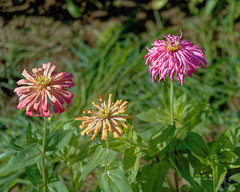
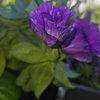
    I'll toss in a semi-recent picture of some of my blooming zinnias.

    I have been making succession plantings of zinnias since early in May. I will stop doing that in the next few days, and start taking better care of the zinnias that I already have. Zinnias are a hobby of mine, and I have been dabbling at breeding them.

    ZM

  • 10 years ago

    Thanks, ZM. Nice photo. We got a good rain yesterday and the ground is moist and we're back down into the 80s for the next ten days. So I think I'm going to plant some Zinna seed and then buy plants of petunia and marigold and plant them (and probably see what else they have at my local nursery). I also have packets of Viola and Pansy which after someone's suggestion have been sitting in the freezer for a week (slapdash workaround for real stratification) and I'll plant some of those seed also. If at the nursery they have Lobelia? Geranium? Montauk Daisy? I might include them in this fall floral experiment.

  • 10 years ago

    Pansies, Dianthus, and snapdragons can take a light frost. Stores should start selling them as it cools off along with ornamental cabbage/kale.

    Rick (zone 6b, MA) thanked Tiffany, purpleinopp Z8b Opp, AL
  • 10 years ago
    last modified: 10 years ago

    Though I think I'm going to be mostly planting seedlings now rather than seeds, I'm curious just for my own education: are there some flower seeds where the soil is too warm now for them to germinate?

  • 10 years ago
    last modified: 10 years ago

    Our local greenhouse is giving away their annuals, I "saved" some herbs, coleus and papyrus annuals from the dump. Planted them in containers so I can bring them in for the winter: herbs for the kitchen and the rest to use as hose plants

  • 10 years ago

    Perennial Sweet Peas (really fragrant!) do not like warm soil at all when seeded out. I tried waiting until April this year here in VA, and the few that did germinate only grew about 6"----not tall enough to avoid being trampled by my dog. Sow them in very early Spring (My Mother used to plant them on Good Friday).

    If you like decorative Kale, you could plant them now, and by October they would look great with some pumpkins for a beautiful display. Just thin them out, keep them watered and watch out for Cabbage worms/moths on them. Plus if you don't use anything harmful to keep the pests away they make beautiful platter decorations for Thanksgiving!

  • 10 years ago
    last modified: 10 years ago

    Um, I am starting off hardy annuals such as cornflowers, poppies, gillia, lavatera, legousia, flax, calendula...and next month, I will be in full sowing mode for corncockles, silene, agrostemma, ammi, orlaya, corn marigold, nigella...obviously for an early flowering next May/June. Not too late to sow biennials such as myosotis, stocks, verbascum, wallflower, campanulas and foxgloves

    Rick (zone 6b, MA) thanked User
  • 10 years ago

    Thanks, Campanula, Those hardy annuals you're planting -- I see you're in Zone 8 in the UK, so aren't they going to germinate now and then be killed by the winter cold?

  • 10 years ago

    rick - Campanula's seeds are all hardy annuals so will not be killed by our winters. They'll over winter as young plants 'for an early flowering next May/June' as Campanula mentioned. Possibly they would behave differently in your climate. But many of them should survive under snow I would have thought.

    At the moment our garden centres are starting to fill up with Winter 'annuals' like pansies, violas and polyanthus.