Software
Houzz Logo Print
marigold33_gw

Carparthian Bellflower

10 years ago

Carparthian Bellfower (Rapido white and Rapido blue) Does anyone know if these are biennials? Thanks.

Comments (10)

  • 10 years ago

    It may be for you, Flora, but I find the maddening C.carpatica to behave as mere annuals in my garden...unlike just about any other campanula apart from c.medium and C.pyramidalis.

  • 10 years ago

    I don't grow it Campanula - I was just reporting its official botanical status. You've grown hundreds of Campanulas so I'd take your word for it any day regarding its performance in our climate.

    But however it behaves in practice it isn't a biennial botanically speaking so it does have the potential to live longer than two years. We don't have any idea where the OP is gardening so who knows - maybe it would survive better for him or her?

  • 10 years ago

    might help to know.. where OP is ... ken

  • 10 years ago

    It's stated to be hardy from zones 3-9. I'm in NY zone 6.

  • 10 years ago

    Just guessing here but with many of these Alpine plants it is our winter wet which finishes them off, not winter cold. RHS also says snails and slugs like them. If grown in a very free draining soil in a gastropod free area they may well be perennial in NY z6.

  • 10 years ago
    last modified: 10 years ago

    The Rapido series is said to be an improvement (including more vigorous than) the Clips series.

    Had Clips in one local garden for years. Probably a fortuitous location: reached by the lawn sprinkler and very good drainage. It never lasted more than a few years, in an edging location, in several other gardens. Moved on to things moss phlox and aubrieta.

    Personally, I particularly like the large campanulas (giant, milky). Their bloom is quite striking towards the back of a mixed perennial border.

  • 10 years ago

    Sunnyborders, I'm new to campanulas but I recently bought blue and white clips, a Platycodon Balloon flower and Summer Cloud Delphinium in the hopes these plants will return. I plant a lot of annuals each year and it's becoming taxing but even biennials are appreciated. I'm going to check into some other Campanulas like giant, milky thanks!

  • 10 years ago
    last modified: 10 years ago

    Marigold33,

    Campanula (Camp) and many others on this forum certainly know more about more Campanula than I do, but I do know which commonly available ones have worked in my gardens here. It would also be informative to know what campanulas have worked well for other gardeners and why they might recommend them to others.

    Some may find the giant and the milky bellflowers too large, requiring staking, etc.. Various members here have mentioned small and medium sized Campanula as doing well for them. For instance, I also find the hybrid Campanula 'Sarastro' attractive and very well behaved, though not that vigorous. Several other medium-sized Campanula are quite showy, but terrible runners (namely Korean but especially spotted bellflower). In that size-range, I've found nettle-leaved campanula (C. trachelium) very dependable, quite nice and find that any seeding around it does is easy to control.

    There is, of course, a large number of different herbaceous and alpine garden perennials that can do very well (given appropriate growing conditions). You mention balloon flowers. I don't use the dwarf ones, but commonly available normal-sized cultivars can be very long-lived here (taprooted (deep-rooted) perennials like that do tend to live a longer time). For me, the double-flowered (Hakone) series is particularly pretty. Like others, I've found the blue and white Sentimentals live longer than the pink ones.

    I haven't found delphinium very long-lived in my gardens (2 or 3 years), but they're extremely showy.

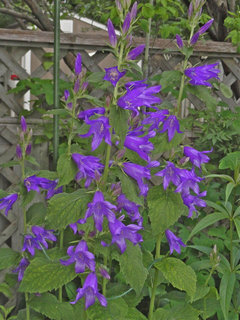
    Below Campanula latifolia 'Brantwood', a giant bellflower (June 12, 2015). I've had one 'Brantwood' for up to 10 years.

    For what it's worth, I'd say gardening with mixed perennials is more challenging that gardening with annuals. With annuals, it seems to me that you can clear it all away at the end of the growing season (and if you have avoided bad seeders) you can then start with a clean slate next year.

    Maybe have some carefully chosen perennials and some annuals. Or rather, you can avoid the tribulations of both by using shrubs!

    Marigold33 NY-Z7 thanked sunnyborders
  • 10 years ago

    Thanks so much Sunnyborders, I'm taking down the information and will be looking into these. I truly appreciate the insight it helps a lot!

0
Sponsored
Daniel Home
Average rating: 4.8 out of 5 stars20 Reviews
Premier Interior Design Team Transforming Spaces in Franklin Co, Ohio